
 Worksheets
MEE Final STUDY GUIDE
Total questions: 50
Worksheet time: 25mins
Name
Class
Date
1.
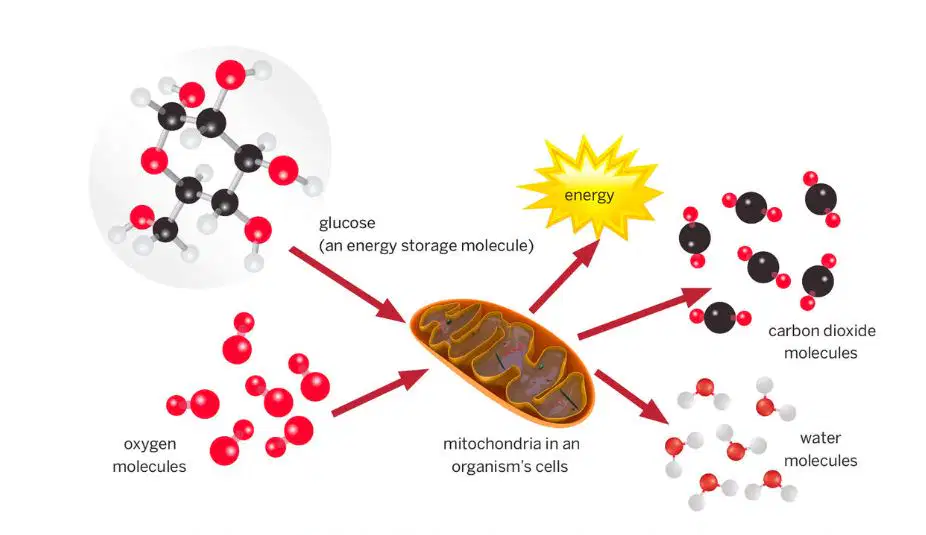
What is this called?
a)
Photosynthesis
b)
Cellular respiration
c)
System
d)
Decomposer
2.
What are two ways to increases the amount of energy storage molecules producers can make?
a)
increase sunlight.
b)
decrease sunlight.
c)
burn dead matter.
d)
bury dead matter.
e)
trap carbon dioxide.
3.
What are two ways to decrease the amount of energy storage molecules producers can make?
a)
increase sunlight.
b)
decrease sunlight.
c)
burn dead matter.
d)
bury dead matter.
e)
trap carbon dioxide.
4.
Photosynthesis is done by _________________________.
a)
Oxygen
b)
Consumers
c)
Carbon
d)
Producers
5.
Photosynthesis requires 1.__________________ from sunlight and 2.______________________ from abiotic matter.
a)
1. Energy 2. Oxygen
b)
1. Energy 2. Carbon dioxide
c)
1. Carbon dioxide 2. Energy
d)
1. Oxygen 2. Energy storage molecules
6.
Photosynthesis makes _______________________________ for an ecosystem
a)
Energy storage molecules and oxygen
b)
Energy storage molecules and carbon dioxide
c)
Oxygen and carbon
d)
Producers and consumers
7.
What is the name of the process that allows carbon to move from abiotic matter to biotic matter?
a)
Abiotic to biotic transformation
b)
Photosynthesis
c)
Vaporization
d)
Sublimation
8.
What is abiotic matter?
a)
The process by which plants use sunlight to produce food.
b)
Matter that makes up the nonliving parts of an ecosystem, such as air, water, and rocks.
c)
A molecule that organisms can use to release the energy they need to survive.
d)
An organism that can make its own energy storage molecules.
9.
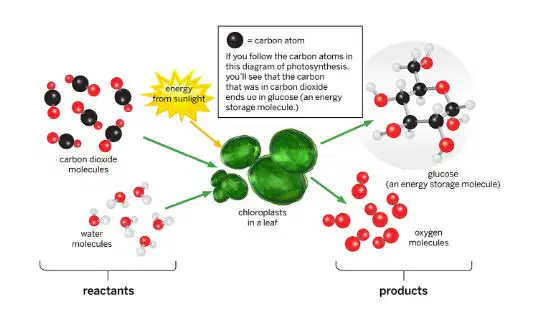
What is this called?
a)
Photosynthesis
b)
Cellular respiration
c)
System
d)
Decomposer
10.
What is biotic matter?
a)
A set of interacting parts forming a complex whole.
b)
A molecule made of carbon and oxygen atoms.
c)
Matter that makes up the living and dead organisms in an ecosystem.
d)
To link two or more things.
11.
Carbon is best described as which of the following?
a)
The chemical reaction that releases energy into cells.
b)
A type of atom that makes up molecules such as carbon dioxide and energy storage molecules.
c)
All the living and nonliving things interacting in a particular area.
d)
An organism that needs to eat in order to get energy storage molecules.
12.
What is carbon dioxide?
a)
A set of interacting parts forming a complex whole.
b)
Matter that makes up the nonliving parts of an ecosystem.
c)
A molecule made of carbon and oxygen atoms.
d)
An organism that can make its own energy storage molecules.
13.
A consumer is defined as:
a)
An organism that can make its own energy storage molecules.
b)
A type of atom that makes up molecules such as carbon dioxide.
c)
An organism that needs to eat in order to get energy storage molecules (such as starch and fat).
d)
All the living and nonliving things interacting in a particular area.
14.
What are energy storage molecules?
a)
Matter that makes up the nonliving parts of an ecosystem.
b)
A molecule that organisms can use to release the energy they need to survive.
c)
To link two or more things.
d)
The process by which plants use sunlight to produce food.
15.
An ecosystem is:
a)
A type of atom that makes up molecules such as carbon dioxide.
b)
All the living and nonliving things interacting in a particular area.
c)
An organism that needs to eat in order to get energy storage molecules.
d)
A molecule made of carbon and oxygen atoms.
16.
Photosynthesis can be described as:
a)
A molecule that organisms can use to release the energy they need to survive.
b)
The process by which plants and other producers use energy from sunlight to change carbon dioxide and water into oxygen and glucose.
c)
To link two or more things.
d)
Matter that makes up the living and dead organisms in an ecosystem.
17.
A producer is:
a)
An organism that can make its own energy storage molecules (such as glucose).
b)
A molecule made of carbon and oxygen atoms.
c)
Matter that makes up the nonliving parts of an ecosystem.
d)
All the living and nonliving things interacting in a particular area.
18.
What do connect mean?
a)
To link two or more things
b)
A molecule made of carbon and oxygen atoms.
c)
Matter that makes up the nonliving parts of an ecosystem.
d)
All the living and nonliving things interacting in a particular area.
19.
What is a system?
a)
An organism that needs to eat in order to get energy storage molecules.
b)
A set of interacting parts forming a complex whole.
c)
The process by which plants use sunlight to produce food.
d)
A molecule that organisms can use to release the energy they need to survive.
20.
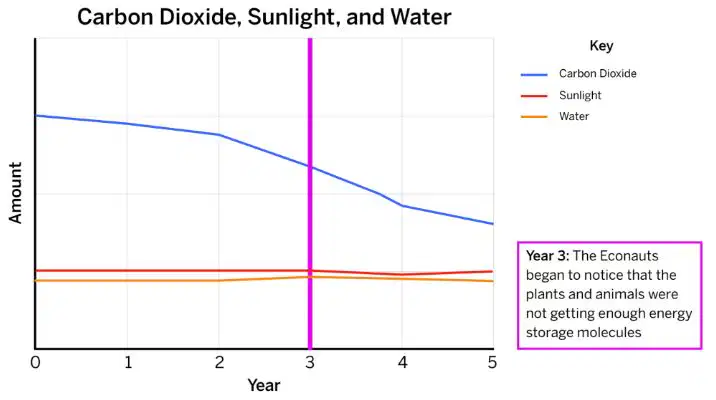
What does this chart tell you?
a)
Producers were dying quickly
b)
The biodome was losing carbon dioxide quickly
c)
Everything was great in the biodome
d)
There was not enough sunshine
21.
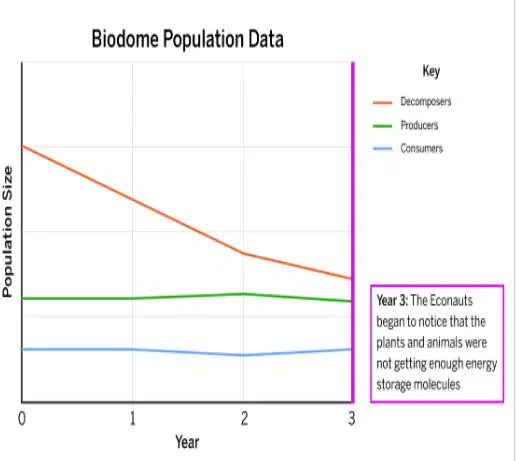
What does this chart tell you?
a)
Carbon dioxide was disappearing
b)
There was not enough sunlight in the biodome
c)
Decomposers were dying quickly
d)
Producers were dying quickly
22.
What is a decomposer ?
a)
An organism that needs to eat in order to get energy storage molecules.
b)
An organism that gets energy storage molecules (such as glucose) by breaking down dead matter
c)
The process by which plants use sunlight to produce food.
d)
A molecule that organisms can use to release the energy they need to survive.
23.
What is cellular respiration ?
a)
An organism that needs to eat in order to get energy storage molecules.
b)
The chemical reaction between oxygen and glucose that releases energy into cells
c)
The process by which plants use sunlight to produce food.
d)
A molecule that organisms can use to release the energy they need to survive.
24.
When you breathe out, you release which form of carbon?
a)
Methane
b)
Carbon monoxide
c)
Carbon dioxide
d)
Carbon fiber
25.
How does photosynthesis work?
a)
Plants convert sunlight into carbon dioxide and water.
b)
Sunlight is absorbed by animals to create energy.
c)
Plants take in sunlight, carbon dioxide, and water to produce glucose and oxygen.
d)
Chloroplasts in animals use sunlight to make food.
26.
Article Question: What are the Econauts trying to prove by living inside the biodome?
a)
That animals can talk in space
b)
That ecosystems are easy to build
c)
That humans can survive in a closed ecosystem
d)
That glass domes are fun to live in
27.
Article Question: Why do you think decomposers like worms and fungus are important in an ecosystem?
a)
They help recycle dead things into nutrients
b)
They eat all the healthy plants
c)
They scare away predators
d)
They make the dirt cleaner by eating bugs
28.
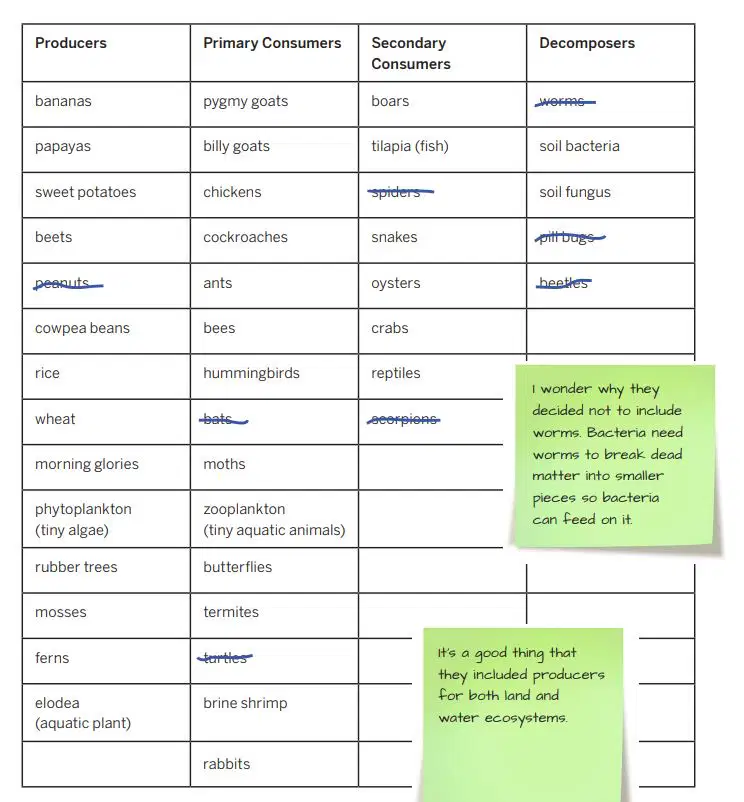
Article Question: Look at the organisms listed do you notice anything that might be missing or that could cause a problem later?
a)
Too many rabbits
b)
No plants for land animals
c)
Missing worms and other decomposers
d)
Too many animals and no humans
29.
Article Question: What changes do you notice about the goats from Year 1 to Year 5?
a)
The goats had fewer babies and got thinner
b)
The goats started singing
c)
The goats got stronger and healthier
d)
The goats turned into cows
30.
Article Question: Are they disposing of their trash properly? Was there any evidence in the article that suggests they were doing it wrong?
a)
Yes, because they’re keeping it tidy
b)
No, because they burned the trash
c)
Yes, because the trash turns into new plants
d)
No, because burying everything in sealed bags stops decomposition
31.
Article Question: Even though the goats weren’t sick, they were getting thinner what do you think that means?
a)
They were getting more exercise
b)
They were bored and wanted to leave
c)
They weren’t getting enough food or nutrients
d)
They were just cold from the winter
32.
Article Question: What are some living things that contain carbon?
a)
Only animals
b)
Only plants
c)
All living things like people, plants, animals, and bacteria
d)
Just humans and animals
33.
Article Question: Why is carbon so important for life on Earth?
a)
It makes food taste better
b)
It helps make up important molecules in all living things
c)
It keeps living things warm
d)
It glows in the dark
34.
Article Question: How does carbon become part of the air around us?
a)
When the sun turns water into water vapor
b)
From rain
c)
When people breathe out, they release carbon dioxide
d)
When the wind blows
35.
Article Question: Why do more living things live near the shallow parts of a lake than in the deep parts?
a)
More sunlight reaches the shallow water, allowing more plants to grow.
b)
The shallow water is warmer than the deep water.
c)
Fish prefer to stay near the surface.
d)
There is more salt in the deep water.
36.
Article Question: What do producers need to do photosynthesis?
a)
Sunlight, carbon dioxide, and water
b)
Oxygen and sugar
c)
Soil and roots
d)
Rain and wind
37.
Article Question: What makes plant cells different from your cells?
a)
Plant cells have chloroplasts, which your cells do not.
b)
Plant cells are smaller than your cells.
c)
Your cells have more DNA than plant cells.
d)
Your cells are able to do photosynthesis.
38.
Article Question: What is the job of a chloroplast in a plant cell?
a)
To help the plant breathe underwater
b)
To make food for the plant using sunlight
c)
To carry messages between cells
d)
To store water for the plant
39.
Article Question: What do chloroplasts use to make glucose and oxygen?
a)
Sunlight and soil
b)
Oxygen and nitrogen
c)
Protein and sugar
d)
Water and carbon dioxide
40.
Article Question: How do we know that chloroplasts used to be independent organisms?
a)
They can talk to other cells.
b)
They are found in animal cells too.
c)
They are not green like plants.
d)
They still have their own DNA.
41.
Article Question: What do decomposers eat?
a)
Fresh fruit and vegetables
b)
Living animals
c)
Dead plants and animals
d)
Rocks and minerals
42.
Article Question: Why are decomposers important to ecosystems?
a)
They eat live plants
b)
They trap carbon in dead matter
c)
They release nutrients back into the soil
d)
They scare away pests
43.
Article Question: Which decomposers usually start breaking things down first?
a)
Worms
b)
Bacteria
c)
Insects
d)
Fungus
44.
Article Question: Why are soil bacteria important?
a)
They clean the air
b)
They help roots grow longer
c)
They break down tiny pieces of dead matter
d)
They dig big holes in the ground
45.
Article Question: What kind of decomposer is mold?
a)
A type of worm
b)
A type of fungus
c)
A type of insect
d)
A type of bacteria
46.
Article Question: What happens during cellular respiration?
a)
Food turns into oxygen
b)
Energy is stored for later
c)
Oxygen and glucose form carbon dioxide and water, releasing energy
d)
Cells stop working
47.
Article Question: Where in the cell does cellular respiration happen?
a)
Nucleus
b)
Cell wall
c)
Mitochondria
d)
Cytoplasm
48.
Article Question: What are mitochondria often compared to?
a)
Power plants
b)
Batteries
c)
Engines
d)
Solar panels
49.
Article Question: What makes mitochondrial DNA special?
a)
It’s exactly like the DNA in the nucleus
b)
It’s only found in animals
c)
It’s the same as tree DNA
d)
It’s more like bacterial DNA than nuclear DNA
50.
Article Question: What were mitochondria a long time ago?
a)
Tiny pieces of sugar
b)
Drops of water
c)
Independent bacteria
d)
Parts of plant roots
100 %

