
 Worksheets
Physics Concepts Quiz
Total questions: 37
Worksheet time: 19mins
Which concept explains that the laws of physics are the same for all non-accelerating observers?
Motion Is Relative
Postulates of the Special Theory of Relativity
Simultaneity
Spacetime
What phenomenon describes the difference in elapsed time as measured by two observers, due to a relative velocity between them?
Length Contraction
Time Dilation
Relativistic Momentum
The Twin Trip
Which equation represents the relationship between mass and energy?
F = ma
E=mc2
p = mv
V = IR
What is the term for the concept that combines space and time into a single interwoven continuum?
Simultaneity
Spacetime
Length Contraction
The Correspondence Principle
What is a frame of reference?
A fixed point in space
A perspective from which position and motion are observed and measured
A stationary object
A moving vehicle
Why does the speed of an object only make sense relative to a frame of reference?
Because objects are always stationary
Because objects have different velocities relative to frames that are moving relative to each other
Because speed is an absolute measure
Because frames of reference are always fixed
What is an example of different frames moving relative to each other?
A frame fixed on a road and another frame fixed on a moving car
Two stationary frames
A frame fixed on a building and another on a tree
Two frames fixed on the same object
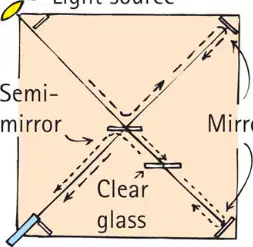
What is the primary purpose of the Michelson interferometer as described in the text?
To measure the speed of light in a vacuum.
To separate a beam of light into two beams and recombine them to detect speed differences.
To amplify light signals for better visibility.
To change the color of monochromatic light.
In the Michelson interferometer, how are the two beams of light oriented relative to each other?
Parallel
At right angles
Opposite directions
At 45 degrees
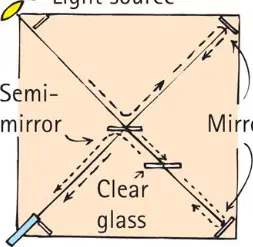
What was the purpose of setting one path of the Michelson interferometer parallel to the motion of Earth in its orbit?
To measure the speed of light in different directions.
To detect changes in Earth's gravitational field.
To observe changes in average speed due to Earth's motion.
To calculate the distance between Earth and the Sun.
What was the outcome of the Michelson-Morley experiment when the apparatus was rotated?
Significant changes in speed were observed.
No changes were observed.
The speed of light was found to vary.
The apparatus malfunctioned.
What does the first postulate of the Special Theory of Relativity state?
The speed of light is variable.
All laws of nature are the same in all uniformly moving frames of reference.
The speed of light depends on the observer's motion.
Gravity affects the speed of light.

According to the second postulate of the Special Theory of Relativity, what is true about the speed of light?
It varies with the observer's speed.
It is constant for all observers, regardless of motion.
It changes with the source's motion.
It is faster in a vacuum.
What does it mean for two events to be simultaneous?
They occur at different times.
They occur at the same time.
They occur in different locations.
They occur in the same location.
In the context of relativity, what is true about two events that are simultaneous in one frame of reference?
They are always simultaneous in all frames of reference.
They are never simultaneous in any other frame of reference.
They may not be simultaneous in a frame moving relative to the first frame.
They are simultaneous only if observed from a stationary frame.
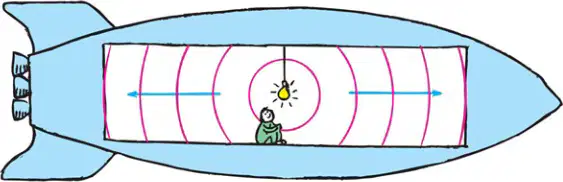
From the point of view of the observer traveling with the compartment, how does light from the source behave?
It travels different distances to each end of the compartment.
It travels equal distances to both ends of the compartment.
It travels only to the front of the compartment.
It travels only to the back of the compartment.
Why are the events of light striking the front and back of the compartment not simultaneous for an observer in a different frame of reference?
Because the light travels at different speeds.
Because the observer is moving faster than light.
Because of the ship’s motion, light strikes the back sooner.
Because the light source is stationary.
Is the nonsimultaneity of hearing thunder after seeing lightning similar to relativistic nonsimultaneity?
Yes, it is exactly the same phenomenon.
No, it is a completely different phenomenon.
It depends upon how loud the thunder is.
It depends upon how far the thunder is.
Is the nonsimultaneity of hearing thunder after seeing lightning similar to relativistic nonsimultaneity?
Yes, they are the same phenomenon.
No, it is a completely different phenomenon.
Yes, both involve moving observers.
No, both are related to sound speed.
Suppose that an observer standing on a planet sees a pair of lightning bolts simultaneously strike the front and rear ends of the compartment in a high-speed rocket ship. Will the lightning strikes be simultaneous to an observer in the middle of the compartment in the rocket ship?
Yes, they will be simultaneous.
No, they will be nonsimultaneous.
It depends upon how fast the ship is moving.
It depends upon how long the ship is.
Suppose an observer on a planet sees lightning bolts strike the front and rear ends of a rocket ship simultaneously. Will the strikes be simultaneous to an observer in the middle of the rocket ship?
Yes, they will be simultaneous.
No, they will be nonsimultaneous.
It depends on the speed of the rocket ship.
Only if the rocket ship is stationary.
What do physicists call the concept where each object, person, planet, star, and galaxy exists?
The space continuum
The time continuum
The spacetime continuum
The universe continuum
How do different observers measure the ratio of distance to time for events linked by a light beam?
They measure different ratios
They measure the same ratio
They measure no ratio
They measure inverse ratios
What is the relationship between space and time according to the concept of spacetime?
They are separate entities
They are loosely connected
They are intimately linked
They are unrelated
What is the arrangement called when a flash of light bounces between two fixed parallel mirrors?
Light clock
Light mirror
Time mirror
Flash clock
What happens to the time intervals of the flash of light in a light clock?
They vary randomly
They take equal time intervals
They increase over time
They decrease over time
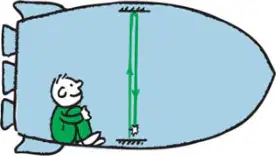
What does an observer moving with the spaceship observe about the light flash in the light clock?
The light flash moves horizontally.
The light flash moves diagonally.
The light flash moves vertically.
The light flash moves in a circular path.
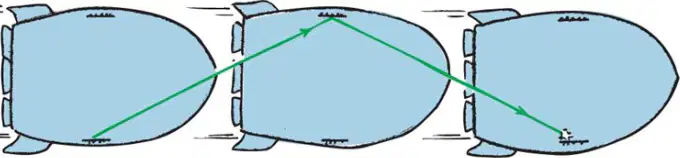
How does an observer who sees the moving ship pass by perceive the light flash?
The flash moves in a straight vertical line.
The flash moves along a diagonal path.
The flash moves in a circular path.
The flash moves horizontally.
What path does light follow when observed from the ground as a spaceship passes overhead?
Straight up and down
Circular path
Diagonal path
Zigzag path
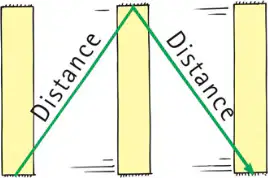
Why must light travel for a longer time between mirrors in our frame compared to the frame fixed on the spaceship?
Because the speed of light is faster in our frame
Because the speed of light is slower in our frame
Because the speed of light is the same in all reference frames
Because the mirrors are further apart in our frame
What is the term used for the time measured in the frame of reference moving with the clock?
Relative time
Proper time
Universal time
Absolute time
What is the relationship between proper time $ t_0 $ and relative time $ t $ in terms of the Lorentz factor?
t=γt0
$ t = \gamma t_0 $
$ t = t_0 + \gamma $
$ t = \gamma + t_0 $
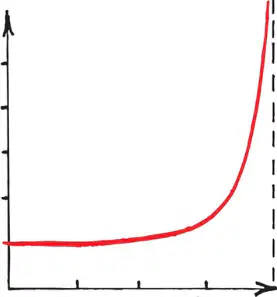
What happens to the Lorentz factor as the speed of a spaceship increases?
It decreases.
It remains constant.
It increases.
It fluctuates randomly.
How do clocks behave as a spaceship approaches the speed of light?
Clocks tick faster.
Clocks tick slower.
Clocks stop ticking.
Clocks tick at the same rate.
What do we observe about time when a rocket travels close to the speed of light?
Time speeds up.
Time remains unchanged.
Time appears to stand still.
Time moves backward.
If you were moving in a spaceship at a high speed relative to Earth, would you notice a difference in your pulse rate or the pulse rate of people on Earth?
Yes, you would notice a difference in both pulse rates.
You would notice a difference in your pulse rate, but not the pulse rate of people on Earth.
You would notice a difference in the pulse rate of people on Earth, but not in your own pulse rate.
You would not notice a difference in either pulse rate.
If you were moving in a spaceship at a high speed relative to Earth, what would you notice about the pulse rate of people on Earth?
You would notice no difference in the pulse rate of people on Earth.
You would notice a difference in your own pulse rate.
You would notice a difference in the pulse rate of people on Earth, but not in your own pulse rate.
You would notice a difference in both your pulse rate and the pulse rate of people on Earth.

