
 Worksheets
Unit #6 Waves Review
Total questions: 62
Worksheet time: 54mins
Waves transfer (a)
Which waves require a medium (matter) to travel?
x-ray
microwave
sound
water

Which letter represents amplitude? (a)

2. What property of a wave is represented by letter B? (a)
8. The lowest part of a transverse wave is known as a (a) .
9. The frequency of a wave is measured in (a) .

What does point C represent? (a)
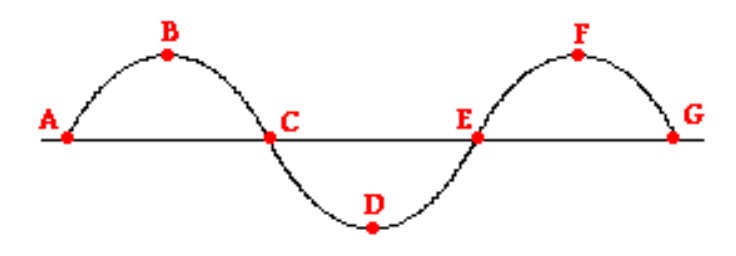
Which letter(s) represent the trough of the wave? (a)
What types of waves carry energy at a right angle or perpendicular to the direction of the energy flow? (a)
What are the parts of a longitudinal wave? (a)

Which wave is pictured? (a)
What types of waves can travel through empty space AND mediums? (a)
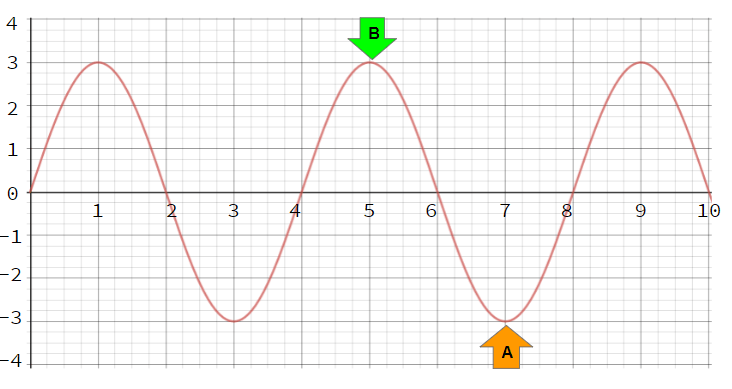
What is the amplitude of this wave?
2
3
6
10
What is the wavelength of this wave?
1
2
3
4
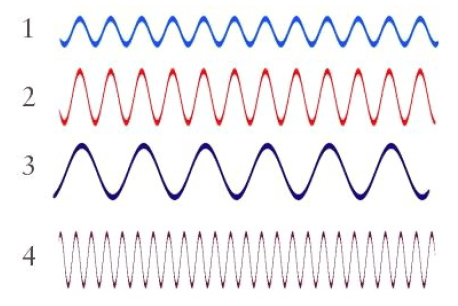
Which of the following images shows a change in frequency?


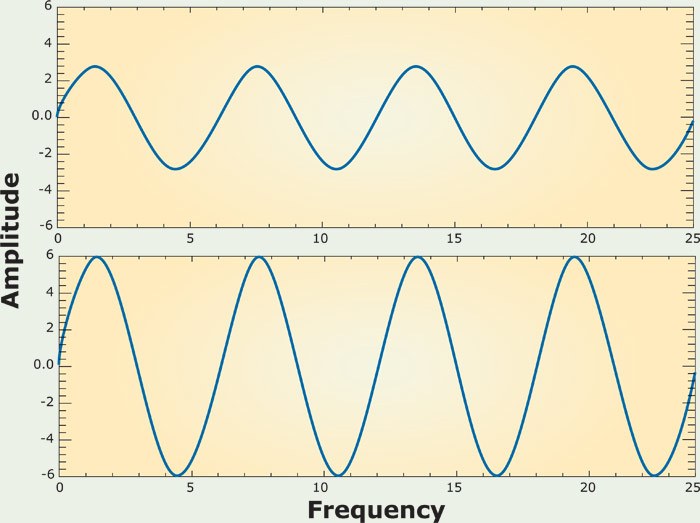
Which of the following images shows a change in amplitude?
What is NOT a suggestion you would give to someone to decrease their risk of noise-induced hearing loss?
Wear ear protection such as ear plugs or noise-cancelling headphones
Stand closer to sources of loud noises -- the sounds are less intense there!
Avoid unnecessary exposure to loud noises

How are sound waves like ripples in a pond?
They are both types of electromagnetic radiation.
They travel faster in water than they do in the air.
They radiate outward from a central point.
They have the same wavelengths.
How are we able to hear?
When the sound waves enter our ears we process this information in the brain as signals. Which the brain then processes as sound.
Our ears process waves which echo in our ears making it able for us to hear.
When our brains hear a sound our ear transmit sound into our brains to hear.

Radio waves
Has the longest wavelengths and the lowest frequency
Microwaves
Used in cell phone communication and police radar systems
Infrared rays
It is used in thermal imaging
UV rays
Overexposure to this can result in sunburns and skin cancer
Gamma Rays
Has the highest energy of all electromagnetic radiation and is the most damaging to human tissue
Reorder the following according to the spectrum
red
orange
yellow
green
blue
Reorder the following from shortest wavelength to the longest wavelength.
gamma waves
x-rays
ultraviolet waves
visible light
infrared rays
What is the difference between frequency and wavelength?
The shorter wavelength, the less frequency.
The longer the wavelength, the frequency is greater.
The longer the wavelength, the frequency is less.
Which best defines reflection?
The bouncing of a wave off a boundary or object
The bending of a wave as it enters a new medium
The spreading of a wave around boundaries or objects
The overlapping of waves
What best defines refraction?
The bouncing of a wave off a boundary or object
The bending of a wave as it enters a new medium
The spreading of a wave around an obstacle
The overlapping of waves
What best defines diffraction?
The bouncing of a wave off an object or boundary
The spreading of a wave around an obstacle
The bending of a wave as it enters a new medium
The overlapping of waves

What are echos an example of?
Reflection
Refraction
Diffraction
Absorption

What is the picture an example of?
Reflection
Refraction
Diffraction
Transmission

What is the picture an example of?
Reflection
Refraction
Diffraction
Scattering

The picture shows a prism. What property of waves causes the light to look like a rainbow as it exits the prism?
Reflection
Refraction
Diffraction
Transmission
What is the best description of an opaque material?
no light passes through the material
some light passes through the material
all light passes through the material
What is the best description of a transparent material?
no light passes through the material
some light passes through the material
all light passes through the material
What is the best description of a translucent material?
no light passes through the material
some light passes through the material
all light passes through the material
Which pictures shows a translucent image?
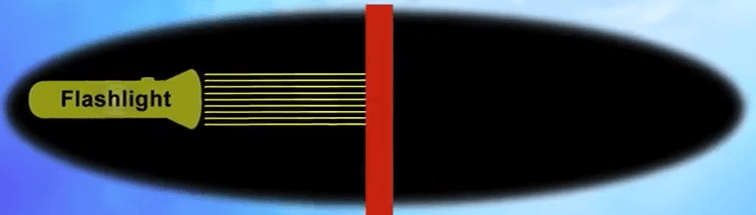
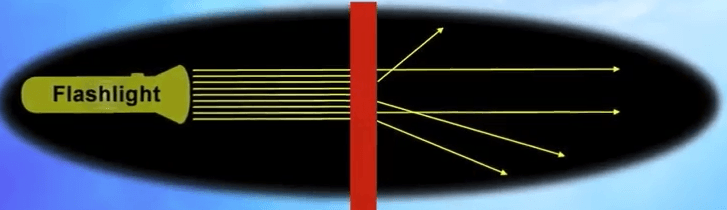
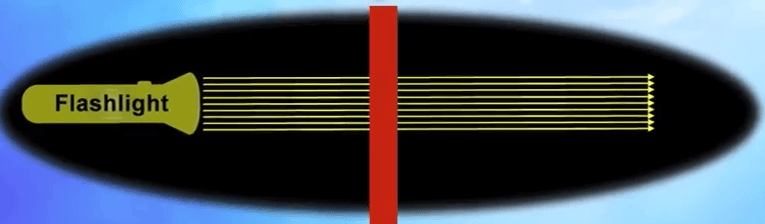
Which pictures shows a transparent image?

What type of object is shown in the picture?
opaque
transparent
translucent
Refraction occurs when waves enter a new (a) and change (b) .
Wave changes direction when moving from one medium to another
Refraction
Wave stays in the same medium but bends around an obstacle.
Diffraction
Wave encounters a barrier that causes the wave to return.
Reflection
Wave completely passes through a medium.
Transmission
Waves combine together to form a larger wave.
Interference

Why won't the red filter allow the other colors to transmit?
Because they reflect off of the filter.
Because only red can transmit through a red filter.
Because red has the longest wavelength.
Which colors make up white light?
Red, Orange, and Yellow
All colors
Reds and Violets
Cell phones (also have microwaves) and televisions use this type of EM wave. It has the longest wavelength with the lowest frequency.
Radio Wave
TV Wave
Gamma wave
Ultraviolet Wave

How does light behave when hitting this shirt?
Yellow is absorbed; all other colors are reflected.
Yellow is reflected; all other colors are absorbed.
All colors are absorbed, but yellow is refracted.
Yellow is scattered and all other colors are absorbed.
The material through which a wave travels
Mechanical Wave
Medium
Crest
Trough
Which property of a sound wave is related to the pitch of the sound?
Period
Frequency
Amplitude
Wavelength

Oliver is learning about signals in his electronics class. He learned that a digital signal is best described as a signal that (a) .
A signal that varies continuously
A signal that represents data using discrete values
A signal that is always analog
A signal that cannot be transmitted
Why are digital signals considered more reliable than analog signals?
They are less affected by noise and interference
They are easier to generate
They require more bandwidth
They are always faster
(a) is a key advantage of digital signals over analog signals in terms of data transmission.
Digital signals can be easily compressed
Digital signals are always cheaper
Digital signals require no power
Digital signals are always slower
Match the following scenarios with the suitable type of signal for minimal loss of quality over long distances.
Analog, because it is continuous
Continuous signal transmission over short distances
Digital, because it can be easily corrected for errors
Long-distance transmission with error correction
Analog, because it is more natural
Natural sound reproduction in a local area
Digital, because it is cheaper
Cost-effective digital communication
In what way does the use of digital signals impact the quality of audio and video transmissions compared to analog signals?
Digital signals degrade more over distance
Digital signals maintain quality better due to error correction
Analog signals are always clearer
Analog signals are more reliable
What is one way in which sending information by digital signals is better than sending it by analog signals?
The range of analog signals is only a few meters.
Analog signals suffer more interference.
The equipment for analog signals costs more.
Analog signals can't transmit sound information.

Digital codes can only have certain values: 0's and 1's. True or False?
True
False

This blocky signal is:
digital
analog

This smooth signal is:
digital
analog

