
Font size
 Worksheets
Unit 4 Study Guide
Total questions: 58
Worksheet time: 32mins
A substance that tastes sour, reacts with metals, and turns blue litmus paper red is called _______.
acid
base
salt
water
A substance that tastes bitter, feels slippery, and turns red litmus paper blue is called _______.
base
acid
salt
metal
A property of some substances to 'eat away' at other materials is called _______.
corrosive
flammable
magnetic
elastic
A compound that changes color when in contact with an acid or a base is called an _______.
indicator
solvent
catalyst
reactant
An atom which has gained or lost electrons, resulting in an overall charge, is called an _______.
ion
isotope
molecule
proton
Acids produce _______ in water.
Hydrogen Ions (H+)
Oxygen Molecules (O2)
Sodium Ions (Na+)
Chloride Ions (Cl-)
Bases produce _______ in water.
Hydroxide Ions (OH-)
Hydrogen Ions (H+)
Sodium Ions (Na+)
Chloride Ions (Cl-)
What is the pH range for acids, neutral substances, and bases?
0-6 Acids, 7 neutral, 8-14 bases
0-7 Acids, 8 neutral, 9-14 bases
1-5 Acids, 6-8 neutral, 9-14 bases
0-4 Acids, 5-9 neutral, 10-14 bases
List the pH values of strong acids.
0-3.5
4-7
7-10
10-14
List the pH values of weak acids.
3.5-6.9
0-1.9
7.0-8.5
12.0-14.0
List the pH value of neutral substances. Neutral: ___
7
5
9
2
List the pH values of weak bases.
7.1-10.5
1-3
4-6.9
11-14
List the pH values of strong bases.
(a)
Which of the following indicates a neutralization reaction?
Acid + Acid → Salt + Water
Base + Acid → Base + Water
Acid + Base → Acid + Salt
Base + Acid → Water + Salt
Soap feels slippery. What effect will it have on red litmus paper? Blue litmus paper?
How can antacids calm the symptoms of a stomachache?
They will neutralize the acid because they are bases
They increase the production of stomach acid
They cause the stomach to produce more enzymes
They make the stomach more acidic
Give an example of a solution.
Kool-Aid
Sand and iron filings
Oil and water
Marbles in a jar
If you add sugar to lemonade and stir, you form a solution. Is the sugar a solute or a solvent?
Solute
Solvent
Liquid
Base
If you add sugar to lemonade and stir, you form a solution. Is the lemonade a solute or a solvent?
Solvent
Solute
Precipitate
Suspension
What type of mixture is a solution?
Homogeneous Mixture
Heterogeneous Mixture
Colloidal Mixture
Suspension
A(n) ________ solution is a solution that has less than the maximum amount of solute that can be dissolved.
Unsaturated
Saturated
Supersaturated
Dilute
A(n) ________ solution is a solution that contains more solute than it can normally hold.
Supersaturated
Dilute
Unsaturated
Saturated
A(n) ________ solution is a solution that contains as much solute as it can hold.
Saturated
Dilute
Unsaturated
Concentrated
Name some factors that affect the solubility of a solute.
1) Temperature 2) Pressure 3) Agitation 4) Concentration 5) Surface Area 6) Catalyst
1) Color 2) Shape 3) Odor 4) Density 5) Taste 6) Texture
1) Volume 2) Mass 3) Hardness 4) Elasticity 5) Magnetism 6) Transparency
1) Boiling point 2) Melting point 3) Freezing point 4) Conductivity 5) Luster 6) Malleability
Polar molecules will form solutions with other ______ molecules.
polar
nonpolar
ionic
metallic
Nonpolar molecules will form solutions with other ______ molecules.
nonpolar
polar
ionic
metallic
The solubility of solids ______ as the solvent temperature increases.
increases
decreases
remains the same
becomes zero
If the pressure in a solution increases, then its solubility (a) .
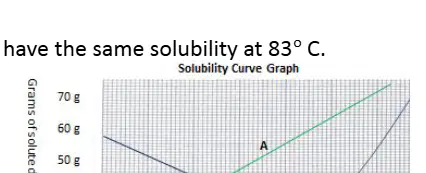
Using the solubility chart below, list the two substances which have the same solubility at 83° C.
C & D
A & B
B & D
A & C
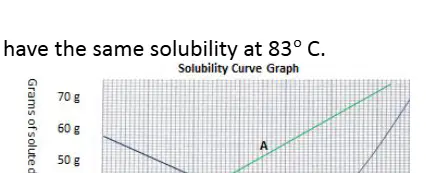
Using the solubility chart below, list the temperature at which 55 g of Substance A dissolves in 100 g of water. (Refer to the Solubility Curve Graph)
50 °C
20 °C
70 °C
90 °C
If a solution A has 50 gram of solute per 100 g of water at 60 degrees C, the solution is said to be.
SUPERSATURATED
UNSATURATED
SATURATED
DILUTE
What is solubility?
the maximum amount of a substance that will dissolve in a given amount of solvent at a specified temperature
the temperature at which a substance melts
the process of a solid turning into a gas
the ability of a substance to conduct electricity
23. A(n) ________ is a substance that ionizes when it dissolves in water, resulting in a solution that can conduct electricity.
electrolyte
solvent
colloid
precipitate
The ________ of a solution is the amount of solute dissolved in a specified amount of solution.
concentration
temperature
pressure
volume
25. Acids are proton _________?
donors
acceptors
neutralizers
buffers
26. Bases are proton _________.
acceptors
donors
neutralizers
reducers
27. Which of the following are ways to quickly dissolve a solid substance in water?
Increase the temperature, stir the solution, and crush the solid
Decrease the temperature, leave the solution still, and use large solid pieces
Add more solid, use cold water, and avoid stirring
Cover the container, use less water, and keep the solid whole
The following are common acids and bases. Label each of them with an A for Acid or B for Base. KOH: _______
Base
Acid
Salt
Water
The following are common acids and bases. Label each of them with an A for Acid or B for Base. H2SO4: _______
Acid
Base
Salt
Water
The following are common acids and bases. Label each of them with an A for Acid or B for Base. NH4OH: _______
Base
Acid
Salt
Neutral
The following are common acids and bases. Label each of them with an A for Acid or B for Base. Ca(OH)2: _______
Base
Acid
Salt
Water
The following are common acids and bases. Label each of them with an A for Acid or B for Base. HClO4: _______
Acid
Base
Salt
Water
The following are common acids and bases. Label each of them with an A for Acid or B for Base. HClO2: _______
Acid
Base
Salt
Neutral
The following are common acids and bases. Label each of them with an A for Acid or B for Base. Mg(OH)2: _______
Base
Acid
Salt
Water
Which of the following is a way to distinguish between acids and bases?
By their color
By their taste
By their pH value
By their boiling point
Would the following household items be considered Acids (A), Bases (B), or Neutral (N)? Lemons: _______
A
B
N
None of the above
Would the following household items be considered Acids (A), Bases (B), or Neutral (N)? Ammonia: _______
B
A
N
C
Would the following household items be considered Acids (A), Bases (B), or Neutral (N)? Drinking Water: _______
N
A
B
C
Would the following household items be considered Acids (A), Bases (B), or Neutral (N)? Alka Seltzers: _______
B
A
N
C
Would the following household items be considered Acids (A), Bases (B), or Neutral (N)? Tomato: _______
A
B
N
None of the above
Would the following household items be considered Acids (A), Bases (B), or Neutral (N)? Soap: _______
B
A
N
C
Would the following household items be considered Acids (A), Bases (B), or Neutral (N)? Milk: _______
A
B
N
None of the above
Would the following household items be considered Acids (A), Bases (B), or Neutral (N)? Vinegar: _______
A
B
N
C
Would the following household items be considered Acids (A), Bases (B), or Neutral (N)? Bleach: _______
B
A
N
C
Would the following household items be considered Acids (A), Bases (B), or Neutral (N)? Drain Cleaner: _______
B
A
N
C
Would the following household items be considered Acids (A), Bases (B), or Neutral (N)? Gastric Juices: _______
A
B
N
None of the above
Would the following household items be considered Acids (A), Bases (B), or Neutral (N)? Distilled Water: _______
N
A
B
C
Would the following household items be considered Acids (A), Bases (B), or Neutral (N)? Rain Water: _______
A
B
N
None of the above

