wayground logo

Free Printable Worksheets

Font size

S
M
L
XL
Worksheets

Changes Over Time

Total questions: 74

Worksheet time: 48mins

Name
Class
Date
1.

What did Charles Darwin observe in finch populations of the Galapagos Islands?

a)

different species were found on different islands

b)

all species were found on one of the islands

c)

identical species were found on all the islands

d)

the same species were found as ones found in North America

2.

The disappearance of a species is called

a)

Evolution

b)

Extinction

c)

Migration

d)

Mutation

3.
Which statement best describes the process of evolution?
a)
Populations can survive in different locations on earth
b)
Environmental conditions limit the number of species on Earth
c)
Populations grow when resources are abundant
d)
The traits of a species can change over time
4.
Charles Darwin’s observation that finches of different species on the Galápagos Islands have many similar physical characteristics supports the hypothesis that these finches 
 
a)
have the ability to interbreed.
b)
acquired traits through use and disuse.
c)
all eat the same type of food.
d)
descended from a common ancestor.
5.

What is a trait that helps an organism survive and reproduce?

a)

variation

b)

adaptation

c)

species

d)

evolution

6.

Who developed the theory of evolution by natural selection (survival of the fittest)?

a)

Galapagos Islands

b)

Charles Dickens

c)

Charles Darwin

d)

Jay Wright

7.

Adaptation is the same thing as growing.

a)

True

b)

False

8.

Evolution happens with just one individual.

a)

True

b)

False

9.

Evolution of adaptations is something that happens to populations over many generations.

a)

True

b)

False

10.

Adaptations that enable organisms to adjust to changing condition can evolve, but only if...

a)

their DNA changes

b)

they grow larger

c)

those abilities are passed on to future generations

d)

it changes their hair color

11.

All humans are the same species with many populations.

a)

True

b)

False

12.

The process in which populations gradually change over time is called

a)

Immigration

b)

Evolution

c)

Whales

d)

Species

13.

How do fossils form?

a)

Playdoh

b)

When 2 dinosaurs get into a fight

c)

Movie magic

d)

Very specific geological processes

14.

How does the fossil record organize fossils?

a)

In separate folders

b)

By size

c)

By estimated ages and physical similarities

d)

By species

15.

Why do scientists examine the fossil record?

a)

To figure out relationships between extinct and living organisms

b)

They've already watched everything on Netflix

c)

Gotta do something with all these rocks

d)

For museums

16.

What are 2 ways to compare organisms to find evidence of common ancestry?

a)

Comparing skeletal structures

b)

Comparing favorite music

c)

Comparing DNA

d)

Comparing sizes

17.

Species that have a common ancestor will have traits and DNA that are more similar to each other than to other species.

a)

True

b)

False

18.

Which animal would expect a dog's genes and proteins to be the most like?

a)

Wolf

b)

Bear

c)

Alligator

d)

Lion

19.

Although Darwin did not know about genes, he could see that animals of the same species who had slight variations that helped them to survive longer could produce more offspring than animals who were not as well equipped. Which of the following could be an example of a variation that would help a group of animals survive?

a)

black bears in a region that was always covered with snow

b)

turtles with long necks on an island where the food source was elevated

c)

choosing a cat to take home from an animal shelter

d)

planting a certain kind of flower to attract butterflies

20.

Which of the following is NOT a fossil?

a)

outline of a fern

b)

petrified wood in the desert

c)

baby mammoth found in a glacier

d)

old stone tools found in a cave

21.

 ____ are remains of life from an earlier time.

a)

Sedimentary Rocks

b)

Fossils

c)

Variations

d)

Limestones

22.

 Survival of the fittest.

a)

Variation

b)

Camouflage

c)

Vestigial Structures

d)

Natural Selection

23.

A trait that makes an individual different from other members of its species.

a)

Embryology

b)

Variation

c)

Natural Selection

d)

Homologous Structures

24.

In a litter of feral kittens, the bright yellow ones were easy for predators to spot. Two generations later, each kitten in the litter was grey.

a)

Analogous Structures

b)

Artificial Selection

c)

Natural Selection

d)

Homologous Structures

25.

Sometimes sedimentary rocks are disturbed by road construction, volcanic eruptions, or earthquakes. How might scientists determine the age of fossils found under these conditions?

a)

Relative Dating

b)

Carbon Dating

c)

Radiometric Dating

d)

Absolute-Age Dating

26.

What type of dating scale is shown on each side of the figure?  The left side represents ___________ dating, while the right side represents ___________ dating.

a)

Relative Dating/Absolute Dating

b)

Absolute Dating/Relative Dating

c)

Radiometric Dating/Carbon Dating

d)

Carbon Dating/Radiometric Dating

27.

. Suppose there is a large population of ptarmigan in Alaska. These birds have mostly white feathers in winter, and mostly brown feathers in summer. Now, because of a mutation, a few birds stay white all year. What would happen if the climate changed permanently, and the ground was snow-covered all year?

a)

White birds would be more likely to die

b)

Brown birds would be more likely to survive.

c)

White birds would be more likely to survive.

d)

There would be no change.

28.

One of the Galapagos tortoises. What can you infer about its diet? Explain.

a)

Because of its long legs and neck it could reach tall plants

b)

Because of its long legs and neck it would eat short plants

c)

Because of its long legs and neck it could catch prey quickly

d)

It has no advantageous appendages.

29.
The fossil record help scientists
a)
better understand the kind of organism that lived in the past
b)
better understand how the environment has changed over time
c)
better understand how organisms have evolved over time 
d)
all of the above
30.
 The best definition for biological evolution is?
a)
A.  When Earth’s processes cause change overtime.
b)
B.  When rock’s change over time.
c)
C.  When a species changes      overtime.
31.
Which of the following word pairs are connected to the theory of natural selection?
a)
a) variation and adaptation
b)
b) adaptation and absolute age
c)
c) absolute age and radioactive dating
d)
  d) radioactive dating and variation
32.
Survival of the Fittest and Evolution were proposed by what scientist?
a)
Charles Darwin
b)
Albert Einstein
c)
Steven Hawking
d)
Isaac Newton
33.
Where the better adapted organisms survive to pass traits along to offspring.
a)
Evolution
b)
Natural Selection
c)
Extinction
d)
Artifical Selection
34.
What is the advantage of having different shaped beaks?
a)
To look different from other species.
b)
To be able to eat the food readily available in the environment.
c)
To protect itself against predators.
d)
To protect itself against prey.
35.
What are the most studied animals in the galapagos?
a)
Finches
b)
Tortoises
c)
Turtles
d)
Lizards
36.
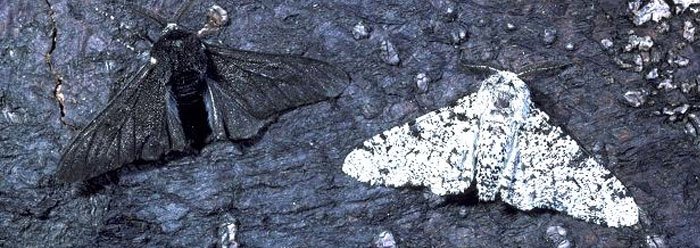
The trees these moths used to live on were white, but have been covered in soot from coal factories. Which moth will be more successful in this environment?
a)
Dark moth
b)
Light moth
c)
Both will be equally successful
d)
Neither will be successful
37.
Since the 1800s humans have stopped burning coal, and the trees have returned to their original color. Which moth will be more successful in this environment?
a)
Dark moth
b)
Light moth
c)
Both will be equally successful
d)
Neither will be successful
38.
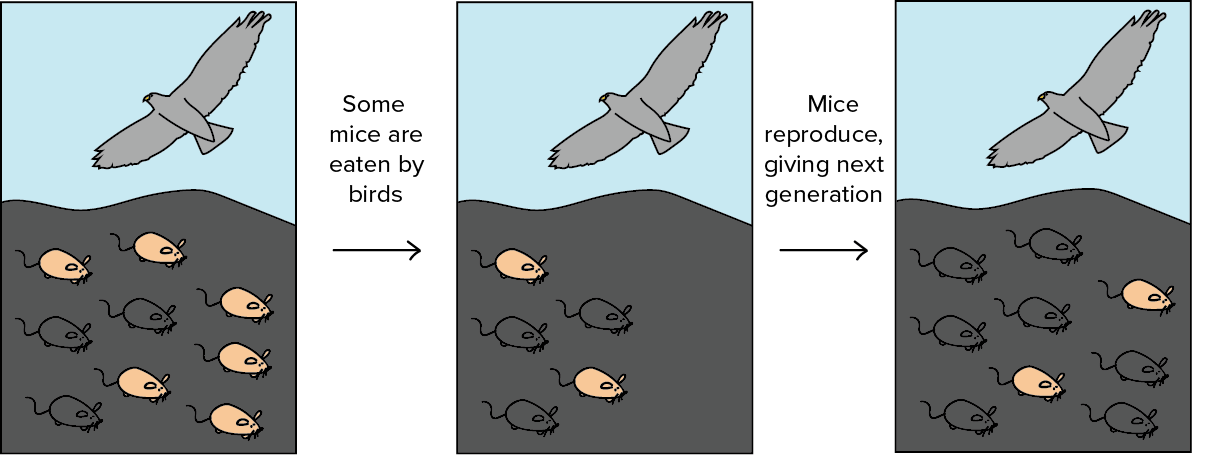
Why is the mouse population changing over time?
a)
The light mice can reproduce more successfully than the dark mice
b)
The hawks eat more dark mice than light mice because the dark mice taste better
c)
The hawks eat more light mice than dark mice because they can see the light mice more easily
d)
The hawks eat more dark mice than light mice because they can see the dark mice more easily
39.
Which best describes the role of mutations in natural selection?
a)
Mutations help an organism to better survive in their environment
b)
An organism may acquire a helpful mutation by interacting with the environment
c)
A mutation may result in an adaptive trait that makes an organism more likely to survive and reproduce
d)
Organisms with certain traits are more likely to win competitions for mutations
40.
Darwin conducted much of his research on
a)
the Samoan Islands
b)
the Hawaiian Islands
c)
Catalina Island
d)
the Galapagos Islands
41.
What was the name of the ship Darwin traveled the world on?
a)
HMS Beagle
b)
SS Beagle
c)
HMS Bugle
d)
SS Bugle
42.
Survival of the Fittest and Evolution were proposed by what scientist?
a)
Charles Darwin
b)
Albert Einstein
c)
Steven Hawking
d)
Isaac Newton
43.
Behavioral changes of individuals of a species that allow for better survival. (Acquired traits)
a)
Variation
b)
Adaptation
c)
Behavior
d)
Environment
44.
The theory of evolution by natural selection means that what is changing over time?
a)
The inherited traits of a population.
b)
The acquired traits of a population.
c)
Hair color and eye color
d)
Attractive features.
45.
Mutations are a change in what?
a)
DNA
b)
tRNA
c)
genotype
d)
phenotype
46.

What word describes a trait that helps an organism survive in its environment?

a)

natural selection

b)

mutation

c)

camouflage

d)

adaptation

47.
Which organisms are most likely to survive?
a)
the best adapted
b)
the fastest
c)
the strongest
d)
the most domesticated (tamed)
48.
Any inherited trait that gives an organism an advantage in its environment is called ___.
a)
a mutation
b)
an adaptation
c)
evolution
d)
natural selection
49.
Do organisms "decide" to evolve and change?
a)
Yes, they know they need to change to survive 
b)
No, they change because of natural selection
50.
The differences among a species, like different bird beaks, are called
a)
genes.
b)
variations.
c)
traits.
d)
theories.
51.
Where the better adapted organisms survive to pass traits along to offspring.
a)
Evolution
b)
Natural Selection
c)
Extinction
d)
Artifical Selection
52.
The theory of evolution by natural selection means that what is changing over time?
a)
The inherited traits of a population.
b)
The acquired traits of a population.
c)
Hair color and eye color
d)
Attractive features.
53.
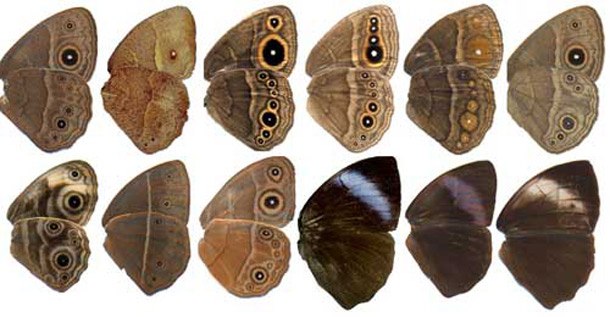
These moths are all the same species. The differences between their wings is an example of ________________
a)
Natural Selection
b)
Variation
c)
Homeostasis
d)
Extinction
54.
Which best describes the role of mutations in natural selection?
a)
Mutations help an organism to better survive in their environment
b)
An organism may acquire a helpful mutation by interacting with the environment
c)
A mutation may result in an adaptive trait that makes an organism more likely to survive and reproduce
d)
Organisms with certain traits are more likely to win competitions for mutations
55.

The more genetic variation a population has,

the more likely it is for some individuals to

a)

evolve

b)

migrate

c)

survive

d)

mutate

56.
The white feathers of a snowy owl allow it to blend in with its environment during the winter months (snow). This is an example of ________________
a)
Species
b)
Environmental Change
c)
Adaptation
d)
Variation
57.
Darwin referred to this as survival of the fittest. Over time, it results in changes in the inherited characteristics of a population because organisms with adaptations that make them fit for their environment will survive and reproduce better than those without favorable traits.
a)
Natural Selection
b)
Genetic Variation
c)
Survival of the Fittest
58.
Remains of ancient organisms are called
a)
Extinctions
b)
Fossils
c)
Mutations
d)
Variations
59.
Which of the following is a fossil?
a)
a plant that has recently died
b)
a group of organisms that can reproduce
c)
a structure or organ that no longer functions
d)
a trace of an organisms that existed in the past
60.
what did Charles Darwin observe in finch populations of the Galapagos Islands off the coast of South America?
a)
different species on different islands
b)
all species on one of the islands
c)
identical species on all the islands
d)
the same species as North America
61.
Charles Darwin concluded that the 13 species of finches on the Galápagos Islands:
a)
were identical to 13 finch species in northwestern South America 600 miles to the east
b)
probably evolved from one ancestral South American species
c)
had all adapted to the same food sources
d)
B and C
62.

Which rock layer most likely contains fossils of the oldest organisms?

a)

1

b)

2

c)

3

d)

4

63.
What type of fossil is an imprint in a rock?
a)
cast 
b)
trace 
c)
mold
d)
whole/part 
64.
Fossilized rock in the shape of dinosaur bones are which type of fossil?
a)
real bone
b)
mold fossil
c)
cast fossil
d)
trace fossil
65.
This type of fossil forms when sediments bury an organism and then sediments change into rock; the organism decays leaving a cavity in the shape of the organism.
a)
mold
b)
cast
c)
petrified
d)
trace
66.
This type of fossil forms when a mold is filled with sand or mud that hardens into the shape of the organism.
a)
mold
b)
cast
c)
trace
d)
preserved
67.
This type of fossil forms when minerals soak into the buried remains, replacing the remains, and changing them into rock.
a)
mold
b)
cast
c)
petrified
d)
preserved
68.
Remains of animals can be preserved by preventing them from decaying. What substances might help preserve parts or a whole animal
a)
tar, amber, ice
b)
ice, carbonization, trace
c)
rock, amber, ice
d)
tar, carbonization, rock
69.
Hardened tree sap is called
a)
diamonds
b)
amber
c)
tar
d)
syrup
70.
What type of fossil is pictured? 
a)
mold
b)
cast
c)
trace fossil
d)
petrified fossil
71.
This is produced when sediments fill in a cavity made when an object decayed
a)
mold
b)
cast
c)
 index fossil
72.
4. What is the name of this kind of fossil?
a)
Amber Fossil 
b)
Exoskeleton fossil
c)
Trace Fossil
d)
Petrification Fossil
73.
Which layer of rock is the oldest?
a)
A
b)
B
c)
C
d)
D
74.
Petrified fossils means?
a)
afraid
b)
scared
c)
spooky
d)
turning into stone