
 Worksheets
EOC Prep: 2.9, 2.7, 2.6, 3.14, 3.3, 3.4, 3.2 3.5
Total questions: 150
Worksheet time: 2hrs 43mins
What does bias refer to in the context of media and political communications?
The use of symbols to convey messages
A type of propaganda technique
The inclination or prejudice in favor of or against a particular person, group, or idea
A fair and balanced perspective on news stories
How can bias manifest in media?
Through the unbiased presentation of news stories
Using symbols that have universal meanings
By providing multiple viewpoints on an issue
The selection and presentation of news stories
What is symbolism in the realm of politics and media?
A technique used to present news in a balanced way
The use of symbols or images that represent ideas or concepts
The dissemination of unbiased information
The practice of providing evidence-based information
What can political symbols include?
Balanced and unbiased news reports
Flags, logos, colors, gestures, and slogans
Critical analysis of all political viewpoints
Facts and statistics only
What is propaganda?
A method of presenting news in an unbiased manner
A form of entertainment in media
The dissemination of biased or misleading information to shape public opinion
The use of symbols to convey neutral messages
How can one identify bias in media?
Looking for diverse perspectives and sources that provide multiple viewpoints
By accepting the first news article read as fact
Ignoring the use of language in news articles
Focusing on news that aligns with personal beliefs only
What technique is used in propaganda to manipulate public perception?
Presenting facts in a straightforward manner
Using persuasive techniques such as emotional appeals and exaggeration
Encouraging critical thinking among viewers
Providing a balanced view on all topics
Why is understanding bias, symbolism, and propaganda crucial?
To follow the news without questioning it
For being critical consumers of media and political communications
To ensure one only consumes media from a single source
To support one's existing opinions without challenge
What does critically analyzing symbols in media involve?
Accepting the intended message without question
Considering the intended message and the potential impact on public opinion
Ignoring the context and audience interpretation
Focusing solely on the aesthetic appeal of the symbols
What role do social media platforms play in the spread of propaganda?
They strictly limit the spread of all forms of propaganda
They serve as neutral platforms without influencing the spread
They can amplify propaganda due to their wide reach and algorithms
They completely prevent any biased information from being shared
Why is media literacy important in identifying propaganda?
It is not important; media literacy has no impact on understanding propaganda
It enables individuals to critically evaluate sources and messages
It helps in promoting the consumption of propaganda
It ensures complete trust in all media messages without questioning
How do fact-checkers contribute to combating misinformation in media?
By providing unbiased news stories only
By verifying the accuracy of information and clarifying falsehoods
By promoting the most popular news stories
By focusing on sensational news to attract more viewers
Why is it important to have media literacy in the digital age?
To be able to create digital media content
To ensure all digital content consumed is entertaining
To critically evaluate the reliability and credibility of online information
To increase one's participation in digital media consumption only
How do personal biases of journalists potentially affect their reporting?
They ensure reporting is always factual and unbiased
They have no effect on reporting as journalists are trained to be objective
They may influence the selection of stories and how they are presented
They increase the diversity of perspectives in the media
Why is it crucial to check multiple sources when researching a news story?
To confirm the story is popular across different platforms
To ensure the story aligns with one's pre-existing beliefs
To compare different viewpoints and assess the reliability of the information
To find the version of the story that is most entertaining
What are the specific requirements that individuals must meet to be eligible to hold public office?
Age, citizenship, and residency requirements
Only citizenship requirements
Only age requirements
No specific requirements
What is a common age requirement for individuals seeking local office?
18 years
21 years
25 years
30 years
What is one common qualification that applies in many states for state offices?
Being a resident of the state
Having a law degree
Owning property in the state
Being a member of a political party
Residency is an important qualification for candidates seeking state office because:
it ensures candidates have a connection to the community they wish to represent.
it allows candidates to have a better understanding of national issues.
it guarantees candidates have prior political experience.
it ensures candidates have financial stability.
What role do constitutional qualifications play in our democratic system?
They ensure that only eligible candidates can hold office, maintaining the integrity of the democratic process.
They limit the power of the government by imposing checks and balances.
They provide a framework for the separation of powers within the government.
They allow for the direct election of government officials by the people.
Individuals must meet certain criteria to be eligible for public office. Which of the following is NOT a common criterion?
Minimum age requirement
Citizenship
Residency
Owning property
Which office is mentioned as an example of a state office?
Mayor
President
Governor
Supreme Court justice
Which of the following are in the Executive Branch?
President
Senate
Supreme Court
Cabinet
Which of the following are in the Legislative Branch?
Supreme Court
Cabinet
Senate
House of Representatives
Which of the following are in the Judicial Branch?
President
Supreme Court
Cabinet
Congress
Which of the following are the Constitutional Requirements to be President?
Must have a college education
At least 35 years old
Natural born citizen
U.S. resident for at least 14 years
Which of the following are the Constitutional Requirements to be a member of the House of Representatives?
At least 25 years old
U.S. citizen for 7 years
At least 35 years old
Natural born citizen
Which of the following Constitutional Requirements is the same for a member of the House of Representatives and a member of the Senate?
Natural born citizen
US citizen for 8 years
At least 30 years old
Inhabitant of the state they are representing
Who is the face of the Executive Branch for individual states?
Supreme Court
Governor
Vice President
Lieutenant General
Which of the following Constitutional Requirements is the same for the Florida House of Representatives and the Florida Senate?
At least 21 years old
Natural born citizen
Resident of the District they represent
At least 25 years old
What is the minimum residency requirement for a person to become a United States Senator?
5 years
7 years
9 years
11 years
What is the minimum number of years a person must have been a U.S. citizen to be eligible for the House of Representatives?
5 years
7 years
10 years
15 years
What is the minimum age requirement to become a United States Senator?
25 years
30 years
35 years
40 years
Analyze why the U.S. Constitution requires the President to be a natural-born citizen rather than a naturalized citizen.
To prevent foreign influence
To ensure loyalty to the country
To maintain a tradition of citizenship
To limit the number of candidates
Which amendment to the United States Constitution limits the President to two terms?
20th Amendment
22nd Amendment
24th Amendment
26th Amendment
Why is it important for a President of the United States to have lived in the United States for at least 14 years?
To ensure familiarity with national issues
To have a diverse cultural background
To meet international diplomatic standards
To understand foreign policies better
Evaluate the impact of having no term limits for members of the U.S. Congress on the legislative process.
Allows for more experienced legislators
Increases the likelihood of corruption
Reduces accountability to constituents
Limits diversity in representation
What is the minimum age required to become the President of the United States?
30 years
32 years
35 years
40 years
What is the minimum age required to become the Governor of Florida?
25 years
30 years
35 years
40 years
According to the U.S. Constitution, if the Vice President becomes President, what is the maximum number of years they can serve?
6 years
8 years
10 years
12 years
How many consecutive terms can a governor of Florida serve?
1 term
2 terms
3 terms
4 terms

Led by Thomas Jefferson
Democratic Republicans
Federalists

Led by Alexander Hamilton
Democratic Republicans
Federalists
Supported by small farmers, artisans, and southerners/westerners
Democratic Republicans
Federalists

Believed in a loose interpretation of the Constitution; read between the lines
Democratic Republicans
Federalists

Believed in a strict interpretation of the constitution; exact wording
Democratic Republicans
Federalists

There is nothing in the Constitution about political parties.
True
False

George Washington suggested that political parties would lead to which of the following in America?
An end to democracy
A stronger democracy
Monarchies
Division among Americans

A political party is a group of people _______________________________________________.
who share the similar beliefs about government.
who share the similar beliefs about the president.
who share the similar beliefs about congress.
who share the similar beliefs about the judicial branch

How a political party feels on certain issues is stated in their...
radio addresses
mailings
pamphlets
platforms

Which political party has a donkey as their logo?
Democratic Party
Republican Party
Green Party
Libertarian Party

No party affiliation; vote based on issues/ideas, not along party lines
Democrats
Independent (NPA)
Republican
Green

In order to win an election, a major party is most likely to...
propose cuts to popular programs
appeal to the political center
divide campaign funds between candidates equally
orgnaize leaders of special interest groups

What is a moderate?
Someone who favors liberalism
Someone who doesn't follow politics
Someone who has some liberal and some conservative beliefs
Someone who favors conservatism

Which party was created in opposition to the spread of slavery?
Republicans
Democrats
Progressive
Prohibition

Which group believes that government should be more involved in the lives of citizens?
Moderates
Conservatives
Democrats
Republicans
A person running for office is a _____.
candidate
delegate
write-in candidate
speaker
Political parties try to influence the government by...
lobbying members of Congress
donating money to the opposing party's elected officials
getting their members elected
proposing amendments to the Constitution
The United States has a _____.
two-party system.
multi-party system.
one-party system.
In order to win the presidency...
the candidate must earn 1/2 of the states nomination
the candidate must win the popular vote
the candidate must win 270 electoral college votes
the candidate must be selected by the house or represenatives
The conversation below is part of a political discussion.
---------------------------
Lou: I am going to vote for the candidate who will support cutting government spending.
Bob: Yes, we spend too much on some programs.
---------------------------
Which party’s candidates are these voters most likely to support?
Democrat
Republican
What are the names of the two major political parties in the United States today?
Democratic and Republican
Democratic and Libertarian
Socialist and Republican
Socialist and Libertarian
In the modern political system, which issue represents a basic disagreement between Republicans and Democrats?
The responsibilities of government
The frequency of national elections
The legality of the U.S. Constitution
The support for the U.S. military soldier
Which government office has these requirements?
----------
Be at least 25 years old
Be a U.S. citizen at least 7 years
Reside in the state to be represented
U.S. Senator
Governor of Florida
President of the United States
Member of the U.S. House of Representatives
Which government office has these requirements?
----------
Be at least 30
Citizen at least 9 years
Reside in the state to be represented
U.S. Senator
Florida Governor
President of the United States
Member of the U.S. House of Representatives
Which government office has these requirements?
----------
Be at least 35
A natural born citizen
Reside in the US for 14 years
Governor of Florida
U.S. Senator
President of the United States
Member of the U.S. House of Representatives

This man was the first leader of the modern Democratic Party
Alexander Hamilton
Thomas Jefferson
Andrew Jackson
Abraham Lincoln

According to this map, who won the electoral college in 2008?
John McCain
Barack Obama
One important feature of US elections is that they are ________ meaning everyone can vote and the results are counted
Free and Fair
biased
limited
once every 2 years
What is the first step in the voting process?
Voting
Registration
Debates
Primary Election
The formal ceremony when the new president is sworn in.
inauguration
debate
party
convention
What can you infer about the campaign slogan, "Four More Years?"
It's for a Democratic candidate.
It’s relevant only during state primaries.
It's supporting the incumbent.
It can be used by any nominee.
9) Place these events in chronological order: A) general election; B) primaries and caucuses; C) national convention; D) Inauguration Day.
A B C D
C, D, B, A
C, B, A, D
B, A, C, D
B, C, A, D
Winning which state would give the biggest electoral boost to a presidential candidate?


How many electors does each state have in the Electoral College?
A fixed number of 10 for every state
Equal to the number of its counties
Equal to the number of its cities
Equal to the number of Senators and Representatives for that state
What did the 12th Amendment change about the Electoral College?
It established separate electoral votes for President and Vice President
It abolished the Electoral College
It made the popular vote the method for electing the president
It increased the number of electors for each state
What happens if a candidate wins the popular vote in a state?
They become the governor of that state
They receive all of that state's electoral votes
They must win the popular vote in all states
They automatically win the presidency
What is the minimum number of electors a state can have?
One
Two
Three
Four
Who are citizens actually voting for in a presidential election?
The vice president
The president directly
A slate of electors pledged to support their candidate
Members of Congress
What is the purpose of the Electoral College?
To provide opportunities for kids in college
To elect school board members
To elect the President of the United States
To elect the Representatives to the House of Representatives
What is the total number of electoral votes in the Electoral College?
538
100
250
270
Even though Washington, D.C is not a state, it has three electoral votes. True or False.
True
False
"Winner take all" means that all of a state's electoral votes go to the candidate who had the majority of votes in that state. True or False?
True
False
What month do the people vote for President of the United States?
December
January
March
November
In order to win the presidency, the candidate must win both the popular vote and the electoral vote. TRUE or FALSE?
True
False
This branch is made up of two houses (Bi-cameral).
Legislative
Executive
Judicial
This branch includes a cabinet of expert advisors (e.g., the Secretary of Agriculture)
Legislative
Executive
Judicial
This branch is made up of a Supreme Court and lower courts.
Legislative
Executive
Judicial
This branch is responsible for making the laws of the country.
Legislative
Executive
Judicial
This branch is responsible for interpreting laws.
Legislative
Executive
Judicial
Who is responsible for the execution and enforcement of federal laws?
The President
Congress
The Supreme Court
State Governors
What mechanism allows the executive branch to check the legislative branch?
Appointing judges
Declaring laws unconstitutional
Vetoing bills
Issuing executive orders
Which body has the power to declare war?
The President
The Supreme Court
The Senate
Congress
Which branch has the power to establish post offices?
Legislative
Executive
Judicial
Which branch has the power to resolve disputes between two states?
Legislative
Executive
Judicial
Which branch has the power to appoint judges?
Legislative
Executive
Judicial
Which branch has the power to appoint ambassadors? (ambassadors = a person who is chosen to represent his or her nation overseas or in an international organization)
Legislative
Executive
Judicial
Which branch has the power to print/coin money
Legislative
Executive
Judicial
Which branch has the power to create and collect taxes?
Legislative
Executive
Judicial
Which branch contains the Commander in Chief of our armed forces?
Legislative
Executive
Judicial
Which BRANCHES can make and approve/ratify international treates? (SELECT ALL)
Legislative
Executive
Judicial
Which branch has the power to raise and support an army or navy?
Legislative
Executive
Judicial
Which branch has the power to impeach (charge government leaders with a crime)?
(a)
Which is a responsibility of the state government?
Printing money
Declaring war
Conducting elections
Regulating interstate commerce
What court is known as the highest court in the U.S.?
Supreme Court
Ultimate Court
Tennis Court
Food Court
When the Supreme Court declares laws unconstitutional, this is known as
judicial opinion
judicial review
legislative power
executive order
How many U.S. Supreme Court justices are there?
10
5
7
9

The newspaper headline below describes an event in U.S. history.
Which parts of the national government participated in the process described in the newspaper headline?
Senate and President
Supreme Court and President
House of Representatives and Senate
Supreme Court and House of Representatives
Who are the President's advisors?
The Cabinet
Congress
The Supreme Court
The Governors
The newspaper headline below describes an event in U.S. history.
" Richard Nixon Receives Pardon for any Crimes in Office"
Which part of government was responsible for the event in this headline?
President
Congress
Supreme Court
The Constitution has 3 parts. The Preamble, (a) , and Amendments.
Congress' power to coin money is:
an elastic power
an enumerated power
an implied power
a nonlegislative power
The elastic clause allows Congress to:
make temporary treaties with foreign countries.
regulate trade between states.
stretch its powers to meet new needs.
tax U.S. citizens in times of economic crisis.
Which of the following is a reserved power?
Declare war
Issue marriage licenses
Coin money
Collect taxes
In a federal system of government, power is:
shared between federal and state governments.
held only by the federal government.
held only by the state government.
kept from the people.
The supremacy clause states that:
the constitution is the supreme law of the land
state laws are stronger than federal laws
federal and state laws have equal power
local governments have no power
Which provision (part) of the Constitution resolves conflicts between the laws of a state and laws passed by the U.S. Constitution?
Bill of Rights
Concurrent powers clause
Necessary and Proper Clause
Supremacy Clause
Powers held by both the state and federal governments, such as the powers to tax and set up courts, are called:
Concurrent powers
Reserved powers
Implied powers
Preexisting powers
Which of the following best explains the 10th amendment?
To declare war is a
confederal system
a system of government where power is located with the independent states and there is little power in the central government
a system of government in which power is divided and shared between national, state, and local government
powers that are not granted to the federal government that belong to (are reserved to) the states and the people; see Tenth Amendment
the powers specifically named and assigned to the federal government or prohibited to be exercised by the states under the U.S. Constitution
enumerated or delegated powers
the powers specifically named and assigned to the federal government or prohibited to be exercised by the states under the U.S. Constitution
powers shared by the national, state, and/or local government
powers that are not granted to the federal government that belong to (are reserved to) the states and the people; see Tenth Amendment
a system of government in which power is divided and shared between national, state, and local government
necessary and proper clause
the power of Congress to make laws that they need to carry out their enumerated powers
powers that are not granted to the federal government that belong to (are reserved to) the states and the people, see Tenth Amendment
he powers specifically named and assigned to the federal government or prohibited to be exercised by the states under the U.S. Constitution
the final amendment in the Bill of Rights, it states: ”The powers not delegated to the United States by the Constitution, nor prohibited by it to the States, are reserved to the States respectively, or to the people.”
What are reserved powers?
Powers that are used in emergencies
Powers that are given to the president only
Powers that are not granted to the national government and are reserved for the states
Powers that are specifically granted to the national government
What are concurrent powers?
Powers that involve foreign countries
Powers shared by both the national government and the states
Powers that are forbidden
Powers that only the states have
What is a federal system of government?
A system where all government power is held at the center.
A system where independent states join together to provide specific services.
A system where power is 'layered' or shared among different levels.
A system where the central government is the weakest of all government systems.
In a unitary system of government, who performs all the governmental functions?
Local governments
The president
The central government
Independent local governments
How does a federal system differ from a unitary system?
In a federal system, power is divided between a central authority and constituent political units, while in a unitary system, a single central government holds all the power.
In a federal system, there is no central authority, whereas a unitary system has a strong central government.
A federal system is governed by a single individual, while a unitary system is governed by a collective body.
There is no difference; both systems are fundamentally the same.
Argentina’s government has an elected president, National Congress, and Supreme Court. Argentina also has provinces, or states, that have their own constitutions and executive, legislative, and judicial branches. The central government and provinces share power in Argentina. What type of system is being described?
Federal
Confederal
Unitary
Japan’s government is organized with a strong, central government, comprised of a legislative branch called the Diet and an executive branch led by a prime minister and ministers of state. In Japan, there are 47 prefectures or states; however, the prefectures are not independent and rely on the central government for funding. What type of system is being described?
Federal
Confederal
Unitary
This excerpt is from Article V of the U.S. Constitution.
The Congress, whenever two thirds of both houses shall deem it necessary, shall propose amendments to this Constitution, … when ratified by the legislatures of three fourths of the several states.
Based on this excerpt, which of the following is a part of the constitutional amendment process?
the signature of the chief executive
passage by the legislative branch
agreement of the judicial branch
a national vote
Which is the last step in amending the U.S. Constitution?
The voters approve the amendment in a national election.
The president signs the amendment in a public ceremony.
Three-fourths of the state legislatures ratify the
amendment.
Two-thirds of both houses of Congress ratify the
amendment.
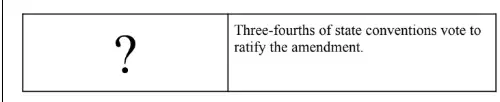
This diagram shows the two ways that an amendment to the U.S. Constitution is ratified.
Which statement completes this diagram?
Three-fourths of state
legislatures vote to ratify the amendment.
The president issues an executive order and ratifies the amendment.
Two-thirds of both houses of Congress vote to ratify the amendment.
The Supreme Court rules the amendment is
constitutional and ratifies the amendment.
Thousands of amendments have been introduced but how many have been ratified?
Ten amendments
Twenty-three amendments
Twenty-seven amendments
No amendments have been changed
Which of the following statements is true?
Amendments are added to the Constitution every single year.
The founding fathers made it very easy to amend the Constitution.
An amendment must be replaced every 25 years.
Amendments cannot be removed from the Constitution, but instead a new amendment is needed to repeal it.
Why did the framers feel it was necessary to amend the Constitution?
Amending the Constitution would allow for tyranny
Amending the Constitution can reflect changing times, beliefs, and social condidtions
Amending the Constitution shows other governments how strong the U.S. government is
Amending the Constitution allows for a smooth transition between political parties
What type of vote is required for Congress to approve an amendment?
Supermajority
Unanimous
Minority
Majority
It is difficult to amend the constitution because the framers wanted to make sure _____.
changes were only made when absolutely necessary
no one ever changed the Constitution
hardly anyone got a say
the President got all the say

