
 Worksheets
KS3 Y8 Topic 1 Forces
Total questions: 170
Worksheet time: 5hrs 31mins

What is a Force?
The distance
A Jedi mindtrick
A push or pull
The scientist who is most famous his work on forces
Albert Einstein
Stephen Hawking
Sir Isaac Newton
Galileo Galilei


A pull moves things _______ .
Close to you
Away from you

A push moves things _______ .
Close to you
Away from you

Which of the forces in this image is the smallest?
A
B
C
D
E

What type of force is needed to unlock a door?
Pull
Push
Twist
Jump
What is an object doing when it is decelerating?
Speeding up
Slowing down
Traveling at a constant speed
The force that pulls objects towards Earth.
Gravity
Friction
Force
A force that results from two objects rubbing past each other.
Gravity
Friction
Air Resistance

The kicker applies a__________to the other karate master.
Pull
Pomegranate
Pizza
Push
What tool is used to measure weight or force?
Newton meter
Ruler
Stopclock
Tape Measure

What is this?
Stop Watch
Meter Stick
Newton meter
Test Tube
An apple has a mass of 0.2 kg. Calculate the weight of the apple on Earth (g = 10 N/kg).
(a)
Mass is measured in kg (which means kilograms)
Force is measured in N
What does N stand for?
nothings
newtons
newts
nells
True or false:
A force can change the speed of an object, but it can’t change its direction of movement
False
True
True or false:
Friction will always try to slow down a moving object
False
True
A ball is falling through the air because gravity is pulling it down. As the speed increases, does the force of air resistance on the ball increase or decrease?
decrease
increase
What does it mean when two forces are said to be “balanced”?
It means that the object is not moving.
It means that the two forces are both equally pushing down, so nothing can change.
It means that the two forces are both equally pushing down, so nothing can move.
It means that the two forces are the same size and act on the object in opposite directions. (So the overall effect is no change in speed.)
True or false:
If all the forces acting on a moving object are balanced, the object will slow down and stop?
False
True
What force keeps the Moon in orbit around the Earth?
Art
Friction
Gravity
Magnetism
The strong nuclear force
Select the correct statement:
Mass is the amount of matter ("stuff")
in something.
Weight is the amount of matter ("stuff")
in something.
Select the correct statement:
The mass of something is the force you get when the force of gravity acts on the mass.
The mass of something is the force you get when the force of gravity acts on the weight.
The weight of something is the force you get when the force of gravity acts on the mass.
The weight of something is the force you get when the force of gravity acts on the weight.
True or false:
An object will have the same mass on Earth as it has on the Moon.
False
True
True or false:
An object will have the same weight on Earth as it has on the Moon.
False
True

Is this correct?
Yes
No
What units are forces measured in?
Newtons (N)
Kilograms (kg)
Joules (J)
Meters (m)
What type of force acts when two objects are physically touching each other?
Non-contact force
Contact force
Magnetic force
Gravitational force
How are forces represented in diagrams?
With arrows
With numbers
With dots
With letters
What does a resultant force of zero indicate about an object's motion?
The object will change direction
The object will accelerate
The object will slow down
The object will either remain stationary or keep moving at the same speed
Which force acts against an object as it travels through air?
Friction
Tension
Gravitational
Air resistance
What type of force is friction?
A non-contact force
A magnetic force
A contact force
An upthrust force
Which force pulls an object towards other objects with mass?
Magnetic
Tension
Gravitational
Thrust
What is the force called that is produced by magnets?
Frictional force
Reaction force
Gravitational force
Magnetic force
What type of force allows objects to float?
Friction
Magnetic
Gravitational
Upthrust
Which force is responsible for keeping planets in orbit around the sun?
Magnetic force
Gravitational force
Electrostatic force
Frictional force

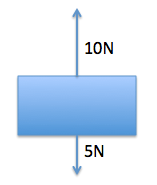
What is the net force on the block? (The overall force)
5 Newtons up
5 Newtons down
15 Newtons up
15 Newtons down
The unit of measurement for forces is
Joules
Meters
Kilograms
Newtons
If there were no forces acting on a moving object it would
stay in motion
come to a stop
lose speed
gain speed

Which example would be a balanced force?
Train moving at a constant speed in the same direction.
A skier going down a hill.
A basketball being passed to a teammate.
An apple falling to the floor.
What is terminal velocity?
Constant speed in a certain direction
Changing speed in a certain direction
Changing direction
Slowing down in one direction
What force acts on a skydivers parachute?
Gravity
Weight
Air resistance
Thrust
To calculate weight...
Weight = gravity ÷ mass
Weight = distance x time
Weight = volume x distance
Weight = mass x gravity
What is the gravitational strength of Earth?
100 N
10 N
9.8 N/kg
7.6 N/kg

If the net force is equal to zero, the forces acting on the object are
balanced
unbalanced

Which one of these arrows best corresponds to the force of
drag?
Green arrow
Purple arrow
Yellow arrow
Red arrows

Which place has more gravity?
Moon
Earth
What is friction?
Friction is a force that is against motion
Friction is the force of attraction that any mass produces.
Friction is a force that increases motion.

What force is acting upwards on the book?
Gravity
Friction
Thrust
Reaction force
The units of force are
Newtons
Kilograms
N/m2
Pressure is equal to force divided by what
area
mass
time
Army tank tracks are useful for travelling through the mud because..
they decrease the force the vehicle exerts on the ground
they increase the force the vehicle exerts on the ground
they decrease the pressure the vehicle exerts on the ground
Where would you find the largest pressure?
Under a snowshoe
At the tip of a pin
The units of pressure are
N
N/m2
m2
Why does a knife exert a large pressure on a tomato?
Because it has a large area
Because it has a small area
Would you rather stand on one nail or 100 nails?
1
100
Pressure =
me, now I am in Y8
force x area
force / area
How do you increase pressure?
Make the area bigger
Make the area smaller
Make the force smaller
How do you decrease pressure?
Make the area bigger
Make the area smaller
What happens to the pressure in a liquid as you go deeper?
The pressure decreases
The pressure increases
The pressure becomes zero
The pressure remains the same
What is the pressure in a solid?
Force applied on a unit area of the solid's surface
Temperature of the solid
Color of the solid
Volume of the solid
Which of the following is a non-contact force?
Gravity
Friction
drag
Magnetic
Which of the following is an example of contact force?
Friction
Gravity
Magnetism
Tension
What is the pressure exerted by a 500 N force on an area of 2 m^2?
750 Pa
1000 Pa
250 Pa
1500 Pa
Where is the pressure greatest?
At the surface of the ocean
In the middle of the ocean
At the bottom of the ocean
Water pressure decreases as depth increases
false
true
Which of these animals would probably cause the greatest pressure on the ground?
A large cow with big feet
A large cow with small feet
A baby cow with big feet
A baby cow with small feet

Forces are measured in....
Kilograms
Newtons
Centimetres
kg/N
Forces are measured using a ….
calculator
Balance
Ruler
Newton meter
Forces can make objects....
Speed up or start
Slow down or stop
Change direction, turn and change shape.
All of the above

The tennis ball will move in which direction?
Up
Right
Down
Left

Which forces are correct?
up is weight, down is air resistance
up is weight, down is friction
up is air resistance, down is friction
up is air resistance, down is weight
Pressure can be calculated using the equation:
Pressure = Force ÷ Area
Pressure = Area ÷ Force
Pressure = Force x Area
Pressure = Force + Area
Pressure is measured in ….
newtons
m/N2
N/m2
N/cm2
Where is atmospheric pressure the lowest?
seaside
hill
mountain
cave
A parachute slows down a sky diver because it increases...
Air resistance
Friction
Drag
All of the above
Pressure is higher when the force is concentrated on a small area.
True
False
As the area increases the pressure increases
True
False
As the area decreases the force gets smaller.
True
False
Flip flops would leave a deeper dent in sand than stiletto heels.
True
False
Pressure is measured in N/m2.
True
False
The can collapsed because....
The pressure on the inside was equal to the pressure on the outside.
The pressure on the inside was greater than the pressure on the outside
The pressure on the inside was less than the pressure on the outside
The balloon did not pop because.....
The bed of nails had a higher pressure than the single nail
The bed of nails had a lower pressure than the single nail
The bed of nails had an equal pressure than the single nail
Polar bears have wide feet because...
Wide feet have a large surface area so less likely to sink in the snow
Wide feet have a small surface area so less likely to sink in the snow
Wide feet have an equal surface area so less likely to sink in the snow
Pressure = Force x area
True
False
What is the correct equation for pressure?
P = FxA
P= A/F
P=F/A


A force is applied to a ball and the ball squashes. When the force is removed, the ball returns to its original shape. The ball is...
an elastic object
an equilibrium object
an unelastic object
an inelastic object
A force is applied to a lump of modelling clay, compressing it. When the force is removed, the clay does not return to it's original shape because it is...
an elastic object
an inelastic object
an equilibrium object
an unelastic object
Pressure inside an inflated balloon is due to...
The air particles being compressed together inside the balloon
Particle colliding with the inside surface of the balloon
A higher number of air particles outside the balloon
The pressure inside and outside the balloon being in a state of equilibrium
When a force is applied to an object it can change its...
(a)
When we apply a force to an object to change its shape, what is this called?
Extension
Deformation
Squashing
Stretching
Which materials will return back to their original shape when they have been stretched?
Plastic
Elastic
Inelastic
Metals
What is extension?
The original length of the spring.
The amount of length the spring has increased by.
More time to complete the question.
The new length of the spring.
The original length of a spring is 10cm, its extended length is 30cm. What is the extension?
10
20
30
40
What happens when a spring reaches its elastic limit?
The force applied to the spring is equal to its elongation.
Hooke's law ceases to be valid.
The spring constant increases.
The spring can be stretched out but will revert back to its original shape.
Who created Hooke's law?
Robert Hooke
Isaac Newton
Albert Einstein
Dmitri Mendeleev
What is Hooke's Law?
The force applied to the spring is proportional to its extension.
The fore applied to the spring is equal to its extension.
The force applied is equal to the spring constant.
The spring constant is equal to the extension.
If F is force, k is spring constant and x is extension, Hooke's Law tells us that:
F=k/x
x=Fk
k=Fx
F=kx
A graph of extension against force for an elastic material is:
A downward curve
An upward curve
A straight line from the origin
A straight line from any point on the x and y axis


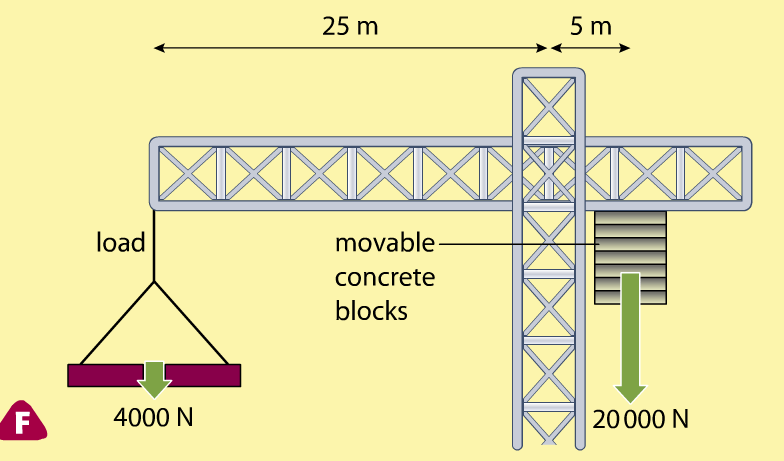

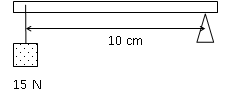
True or false:
The weight of a person sitting on a see-saw is known as the load.
true
false
Complete:
Moment = ___ x distance from ___.
pivot, force
load, pivot
force, pivot
force, middle
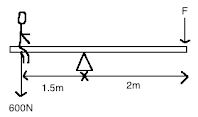
A boy of weight 600N sits on the see-saw as shown at a distance of 1.5m from the pivot. What is the force F required at the other end to balance the see-saw?
450 N
350 N
4.5 N
200 N
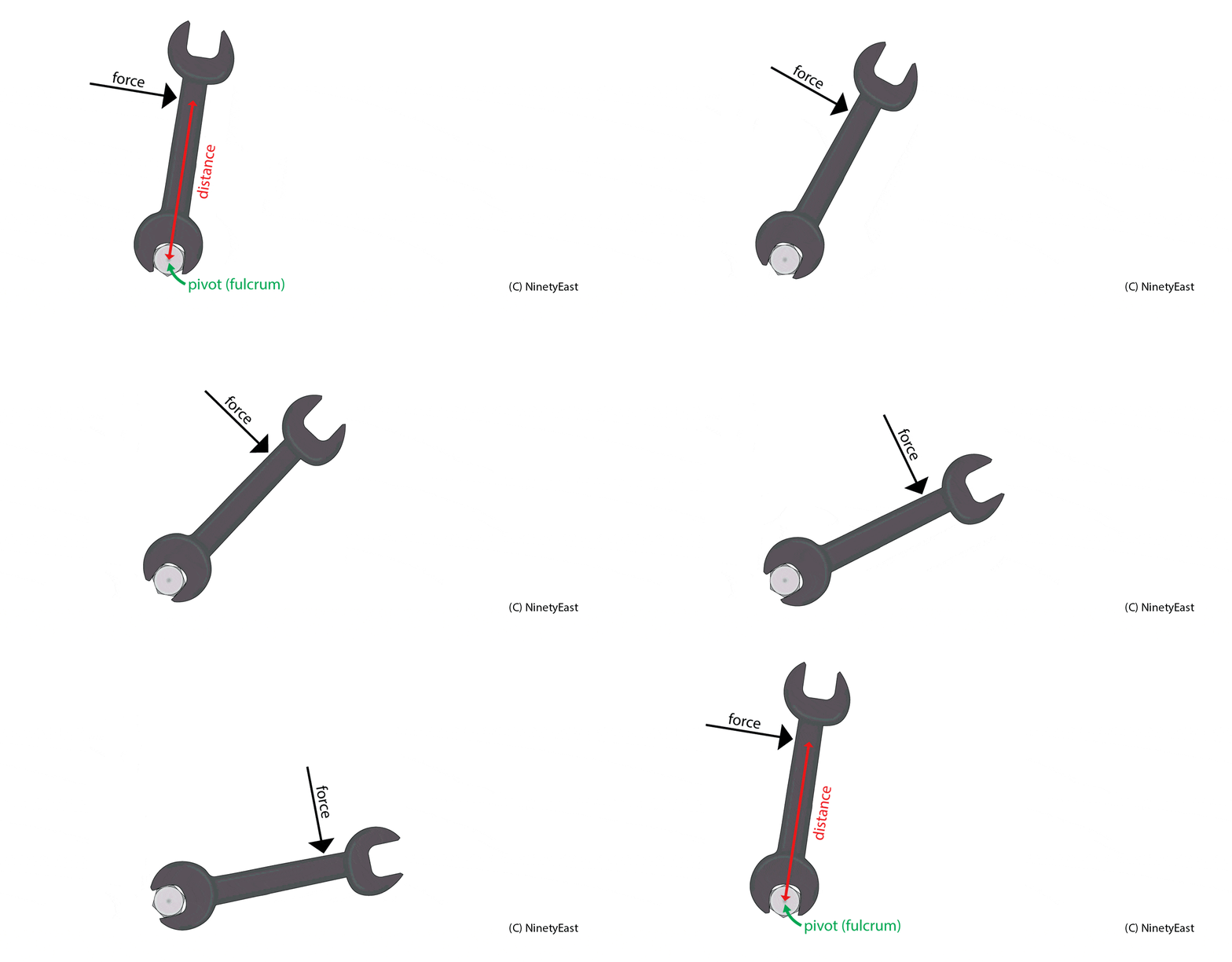
What do we call forces applied to anything that turns?
Minute
Moment
Minimum
Monument

What do we use to calculate the size of a turning force (moment)?
Work x Force
distance from pivot / Force
Force / distance from pivot
Force x distance from pivot
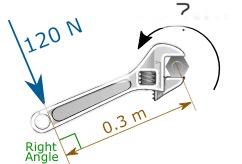
What is the size of the moment shown by the black arrow?
30 Nm
36 Nm
40 Nm
60 Nm
The word ‘fulcrum’ is another name for what?
load
effort
pivot
middle
True or false:
The weight of a person sitting on a see-saw is known as the load.
true
false
Complete:
Moment = ___ x distance from ___.
pivot, force
load, pivot
force, pivot
force, middle
True or false:
A small force moved over a large distance results in a large force moved over a small distance.
true
false
What are the units of (turning) moments?
nm
mn
Mn
Nm
True or false:
A person lifting the handles of a wheelbarrow is applying effort.
true
false
True or false:
The bigger the force the lower the turning effect.
true
false
Where is the pivot on a wheelbarrow
the handles
where the contents of the wheelbarrow
where the wheel is
True or false:
A force is generated when a molecule of a gas or liquid hits an object.
true
false
Complete:
The ___ is the force someone is applying to a lever.
load
effort
force
A boy of weight 600N sits on the see-saw as shown at a distance of 1.5m from the pivot. What is the force F required at the other end to balance the see-saw?
450 N
350 N
4.5 N
200 N
What to we call forces applied to anything that turns?
Minute
Moment
Minimum
Monument
What do we use to calculate the size of a turning force (moment)?
Work x Force
distance from pivot / Force
Force / distance from pivot
Force x distance from pivot
What is the size of the moment shown by the black arrow?
30 Nm
36 Nm
40 Nm
60 Nm

How would you calculate this moment?
40 cm / 50 N
50 N / 40 cm
50 N x 40 cm
What is the size of this moment?
2000 Ncm
150 Ncm
30 Ncm

