wayground logo

Free Printable Worksheets

Font size

S
M
L
XL
Worksheets

7th Grade Final Exam Review 2023

Total questions: 175

Worksheet time: 2hrs 17mins

Name
Class
Date
1.

The variable that is deliberately changed in an experiment is called the ______ variable.

a)

dependent

b)

independent

2.

What is the DEPENDENT variable in this experiment?


"Does eating breakfast improve test scores?"

a)

eating breakfast or not

b)

the grade you got on the test

c)

what time you get up in the morning

d)

how tasty the breakfast is

3.

You are testing how the amount of water affects plant growth. What would be the INDEPENDENT VARIABLE in this experiment?

a)

They type of pot you put the plants in.

b)

The amount of water each plant receives.

c)

The amount of sunlight the plants get.

d)

The amount the plant grows.

4.

Mr. Pransky wants to see how different surfaces affect how high a tennis ball can bounce. What is the independent variable?

a)

the type of surface

b)

using the same ball

c)

how high the balls bounce

5.

A student wants to test the hypothesis of "If salt is added to water then the boiling point of water will decrease (go down)." What is the independent variable?

a)

presence of salt

b)

boiling point of water

c)

amount of water

6.

Sadie is testing how the age of a seed affects how fast plants grow. Look at the picture to see if you can figure out what makes her experiment unfair. Mark all that apply. (Hint: Select 2 answers)

a)

She used different types of seeds/plants.

b)

The plants are in different pots.

c)

There is more than one plant per pot

7.

What is the independent variable (also known as the manipulated variable)?

a)

what we are deliberately changing or testing

b)

what we are observing or measuring

c)

what we keep the same to make the experiment fair

8.

What is the dependent variable (also known as the responding variable)?

a)

what we are deliberately changing or testing

b)

what we are observing or measuring

c)

what we are keeping the same to make the experiment fair

9.

What are the constant variables?

a)

what we are changing or testing

b)

what we are observing or measuring

c)

what we keep the same to make the experiment fair

10.

Scientific Question: Will a person fall asleep faster if they listen to music?

What is the IV or manipulated variable?

a)

music

b)

time to fall asleep

c)

person

11.

Scientific Question: Does being tardy impact test scores?

What is one of the constant variables?

a)

test scores

b)

the time a student arrives to class

c)

amount of time to complete test

12.

Scientific Question: Does being tardy impact test scores?

What is the DV or responding variable?

a)

test scores

b)

the time a student arrives to class

c)

amount of time to complete test

13.

Scientific Question: Does being tardy impact test scores?

What is the IV or manipulated variable?

a)

test scores

b)

the time a student arrives to class

c)

amount of time to complete test

14.

All matter is made of _________.

a)
energy 
b)
atoms 
c)
electrons 
d)
compounds 
15.
What is at the center of every atom?
a)
An electron
b)
A compound
c)
A molecule
d)
A nucleus
16.
The positively charged particles of an atom are the ________.
a)
electrons
b)
protons
c)
neutrons
d)
protons & neutrons
17.
What does the nucleus of an atom contain?
a)

Electrons and neutrons

b)

Protons and neutrons

c)

Neutrinos and positrons

d)

DNA and RNA

18.

Atoms are made up of ________________

a)

energy

b)

electrons

c)

subatomic particles

d)

gasses

19.

Name the subatomic particles that make up an atom.

a)

solid, liquid, gas

b)

electrons, protons, nucleus

c)

energy, protons, nucleus

d)

electrons, protons, neutrons

20.

__________ are negatively charged particles that are in the orbitals around the nucleus.

a)

Protons

b)

Nucleus

c)

Neutrons

d)

Electrons

21.

A neutron has _________ charge or is ________.

a)

negative ... neutral

b)

positive .... neutral

c)

no .... negative

d)

no ... neutral

22.
Which is an electron?
a)
A
b)
B
c)
C
23.

Most of the mass in an atom is concentrated in the...

a)

electrons

b)

nucleus

c)

protons

d)

empty space

24.

What particle uniquely identifies an element?

a)

Number of Valence Electrons

b)

Number of Protons

c)

Number of Electrons

d)

Atomic Mass

25.

True/False: Compounds are made of two or more different elements.

a)

True

b)

False

26.

What is the atomic number for an element with 3 protons?

a)

2

b)

1

c)

3

d)

6

27.

Protons and electrons balance the charge of an atom.

a)

True

b)

False

28.

Electrons are___________

a)

Extremely small even in comparison to protons.

b)

part of the nuclues.

c)

Super Positive, like cheerleaders!

d)

very large

29.

An atoms overall charge is

a)

positive

b)

depends on its mood

c)

neutral

d)

negative

30.
Contains only one kind of atom.
a)
Element
b)
Compund
c)
Mixture
31.
The air is a _________. 
a)
element 
b)
mixture 
c)
compound 
d)
energy 
32.
Elements can be broken down into simpler substances. 
a)
false 
b)
true 
c)
sometimes 
33.
Examples are milk and gasoline.
a)
elements
b)
mixtures
c)
compounds
34.

Examples are carbon (C) and uranium (U)

a)

elements

b)

mixtures

c)

compounds

35.
Is sugar (C12H22O11) an element or a compound?
a)
Element
b)
Compound
36.
What is salad?
a)
element
b)
compound
c)
mixture
37.
Classify the picture with the correct label.
a)
Element
b)
Compound
c)
Mixture of Elements
d)
Mixture of Compounds
38.
Classify the picture with the correct label.
a)
Element
b)
Compound
c)
Mixture of Elements and Compounds
d)
Mixture of Elements
39.
Classify the picture with the correct label.
a)
Element
b)
Compound
c)
Mixture of Elements & Compounds
d)
Mixture of Compounds
40.
As particles are exposed to warmer temperatures they __________
a)
speed up
b)
slow down
c)
stay the same
d)
vibrate
41.
This can be separated physically. 
a)
mixture 
b)
element 
c)
compound 
42.

The things that make up a mixture ________ their individual properties.

a)

lose

b)

share

c)

keep

d)

alter

43.
These must be separated chemically. 
a)
elements 
b)
compounds 
c)
mixtures 
d)
homogeneous mixtures 
44.
Compounds contain a _____ set of elements.
a)
fixed
b)
random 
c)
sweet 
d)
inaccurate 
45.
The things in a mixture always retain their........
a)
smell properties 
b)
physical and chemical properties 
c)
shape 
d)
color 
46.
These contain only one kind of atom. 
a)
element 
b)
compound 
c)
mixture 
d)
water 
47.

All alloys are mixtures.

a)

True

b)

False

48.
A mixture made of parts that separate upon standing is what type of mixture?
a)
suspension
b)
solution
c)
alloy
d)
colloid
49.

A mixture consisting of one substance dissolved or evenly spread throughout another.

a)

suspension

b)

colloid

c)

compound

d)

solution

50.
Combination of two or more pure substances that are not chemically combined
a)
compound          
b)
atom
c)
mixture 
d)
element
51.

What is an alloy?

a)

It is an element

b)

It is a compound

c)

It is a mixture called a suspension

d)

It is a type of mixtue called a solution

52.

Which one of the following would you use to separate sand from iron filings? *Select the BEST choice*

a)

a bar magnet

b)

filter paper

c)

evaporation

d)

a tweezer

53.

To separate a mixture of soil and water, what separation method should be used?

a)

Filtration

b)

magnetism

54.

To separate a mixture of salt and water what separation method should be used?

a)

Filtration

b)

Magnetism

c)

Evaporation

55.

What mixture is best separate by the tool in the image provided?

a)

Sugar and Salt

b)

Sand and rocks

c)

Apples and grapes

56.

How many elements are in C6H12O6?

a)

1

b)

2

c)

3

d)

4

57.

How many atoms of carbon (C) are in C6H12O6?

a)

3

b)

6

c)

12

d)

24

58.

Element or Compound?

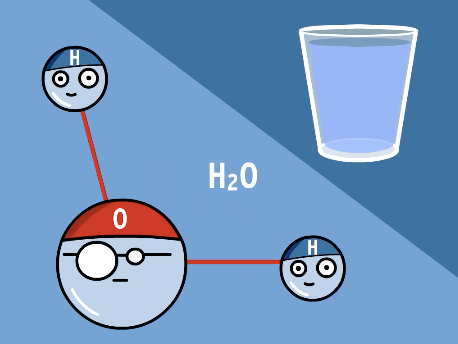
H2O

a)

Element

b)

Compound

59.

Which is the correct formula for:

3 Hydrogen (H)

1 Sulfur (S)

4 Oxygen (O)

a)

H3SO4

b)

HSO4

c)

H4S3O

d)

H2O

60.

The substances at the beginning of a chemical equation are called the ______

a)

product

b)

yield

c)

chemical symbol

d)

reactants

61.

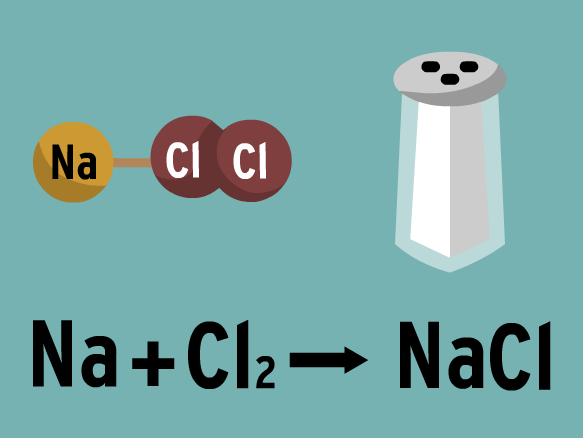
In this image, the symbol to the right of the arrow (in black) are called _______.

a)

Products

b)

Reactants

c)

Subscripts

d)

Coefficients

62.

All of the following are chemical changes except:

a)

Iron rusting

b)

Water evaporating

c)

Wood burning

d)

Food rotting

63.

How many hydrogen atoms are there?

a)

1

b)

4

c)

5

d)

6

64.

CH4 is an example of a--

a)

chemical equation

b)

chemical formula

c)

chemical reaction

d)

chemical symbol

65.
Covalent compounds
a)

share electrons

b)

transfer electrons

c)

contain a sea of electrons

d)

are always gases

66.
What two types of atoms make a covalent bond?
a)
2 Nonmetals
b)
1 Nonmetal and 1 Metal
c)
2 Metals
d)
2 Noble Gases
67.
What charges attract?
a)
Opposite
b)
Same
68.
What elements generally make an ionic bond?
a)
metal and nonmetal
b)
2 or more nonmetals
c)
metal
d)
none of the above
69.
What is a valence electron?
a)
an electron that is found in the outermost shell of an atom. 
b)
an electron found in the innermost shell of an atom.
c)
an electron found in the middle shell.
70.
Electrons are lost, gained, or shared to create chemical bonds.
a)
True
b)
False
71.

Which type of bond involves a transfer of an electron from one atom to another?

a)

Polar Covalent 

b)

Non Polar Covalent

c)

Ionic

d)

Metallic

72.
Blue Color: Chemical or Physical Property
a)
Chemical Property
b)
Physical Property
73.
Density: Chemical or Physical Property
a)
Chemical Property
b)
Physical Property
74.
Flammability (burns): Chemical or Physical Property
a)
Chemical Property
b)
Physical Property
75.
Solubility (dissolves): Chemical or Physical Property
a)
Chemical Property
b)
Physical Property
76.
Reacts with Acid: Chemical or Physical Property
a)
Chemical Property
b)
Physical Property
77.
Brittleness: Chemical or Physical Property
a)
Chemical Property
b)
Physical Property
78.
Sour Taste: Chemical or Physical Property
a)
Chemical Property
b)
Physical Property
79.
Melting Point: Chemical or Physical Property
a)
Chemical Property
b)
Physical Property
80.
Reacts with Water: Chemical or Physical Property
a)
Chemical Property
b)
Physical Property
81.
Boiling Point: Chemical or Physical Property
a)
Chemical Property
b)
Physical Property
82.
Luster: Chemical or Physical Property
a)
Chemical Property
b)
Physical Property
83.
Is burning wood a chemical or physical change?
a)
chemical
b)
physical
84.

Is glass breaking a chemical or physical change?

a)
chemical
b)
physical
85.
Is a a rusting bicycle a chemical or physical change?
a)
chemcial
b)
physical
86.
Is frying an egg a physical or chemical change?
a)
chemical
b)
physical
87.

Which is an example of a chemical change?

a)
b)
c)
d)
88.
The phase change from water vapor to liquid water is known as...
a)
evaporation
b)
precipitation
c)
condensation
d)
sublimation
89.
2. A change of state from a liquid to a solid is called....
a)
Melting
b)
Freezing
c)
Evaporation
90.
5. What is it called when a solid turns directly into a gas?
a)
Sublimation
b)
Condensation
c)
Liquid
91.
7. All phase changes (changing states) requires energy to be added or taken away.
a)
True
b)
False
92.
What happens to particles when they are heated?
a)
They speed up and spread out
b)
They slow down and compress
c)
They stop moving
d)
They move closer together and speed up
93.
Melting is ...
a)
liquid to solid
b)
solid to liquid
c)
solid to gas
d)
gas to liquid
94.
No definite shape, but has a definite volume
a)
Gas
b)
Liquid
c)
Solid
95.
Definite shape and a definite volume.
a)
Gas
b)
Liquid
c)
Solid
96.
No Definite Shape and No Definite Volume
a)
Gas
b)
Liquid
c)
Solid
97.
When the temperature of matter increases the particles...
a)
speed up and move closer
b)
speed up and move farther apart
c)
slow down and move closer together
d)
slow down and move farther apart
98.
Gas particles have the ________ kinetic energy because they move the fastest.
a)
least
b)
most
99.
All phase changes are
a)
chemical changes
b)
chemical reactions
c)
physical changes
d)
irreversable
100.
What kind of energy is added to or removed from matter to cause a phase change?
a)
Radiation
b)
Heat
c)
Solar
d)
Wind
101.
Which state of matter take up ALL the space inside a container? 
a)
solid
b)
liquid
c)
gas
d)
all of the above
102.
Bonds are the strongest within this phase.
a)
solid
b)
liquid
c)
gas
d)
polimers
103.
Energy always travels from high to low.
a)
True
b)
False
104.
When a substance changes from a liquid to a gas, energy is lost.
a)
True
b)
False
105.
Evidence of a chemical reactions is anything that shows - 
a)
a new substance has formed
b)
a solid dissolved in a liquid
c)
interaction between 2 gases
d)
a change in the state of matter
106.
One of the signs of a chemical reaction taking place is:
a)
Bubbles are produced 
b)
Reactants are not combining
c)
Products are not forming
d)
Color is not changing
107.
Which of the following describes a precipitate?
a)
a liquid forms when a block of metal is heated
b)
a solid forms when one liquid is poured into another
c)
a gas forms when a solid is placed in a liquid
d)
bubbles form when an acid is poured on a rock
108.
Which is NOT an indication of a chemical change?
a)
temperature change
b)
formation of a precipitate
c)
shape change
d)
production of light
109.
You know you a chemical reaction has occurred if 
a)
there is a precipitate.
b)
there is a color change.
c)
there is a temperature change.
d)
All of these answers are evidence.
110.
Which of the following is an example that includes evidence of a chemical reaction?
a)
A sample of zinc is placed in water and it settles to the bottom
b)
A solid block of ice is heated and it completely melts into a liquid. 
c)
Sugar that is burned gives off an odor and turns brown and then black.
d)
A tomato is placed into a blender and chopped up into smaller pieces.
111.
Four students performed four different investigations by combining different substances. Which of the observations is most indicative of a chemical reaction?
a)
investigation 1
b)
investigation 2
c)
investigation 3
d)
investigation 4
112.

The law of conservation of mass says substances can neither be _______ nor ___________.

a)

Built; torn down

b)

Blended together; separated

c)

Created; destroyed

d)

Condensed; extracted

113.

Sodium and chlorine combine to form sodium chloride, or table salt. Sodium and chlorine are:

a)

Producers

b)

Products

c)

Reactionaries

d)

Reactants

114.

4 grams of hydrogen and 32 grams of oxygen will combine to form:

a)

36 grams of water

b)

28 grams of hydroxide

c)

32 grams of oxygen

d)

36 grams of deuterium

115.

In a chemical reaction, 4 grams of sodium must combine with how many grams of chlorine to produce 10 grams of table salt?

a)

4 grams

b)

6 grams

c)

8 grams

d)

10 grams

116.

What is net force on an object sitting still?

a)

0 N

b)

20 N

c)

There are no forces applied to an object sitting still

d)

Cannot be calculated

117.

You try to push your laptop across a table but it is not moving. What force might prevent the laptop from sliding?

a)

friction

b)

gravity

c)

magnetism

d)

normal

118.
What force holds the planets in motion around the sun?
a)
Magnetic
b)
Electrical
c)
Gravitational
d)
Air Resistance
119.
What is a Force?
a)
The distance
b)
Mass
c)
A push or pull
d)
Give me a  failing grade 
120.
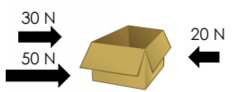
Calculate the Net Force. 
a)
60N, Left 
b)
40N, Right 
c)
0N
d)
60N, Right
121.
What will cause an object to move?
a)
Applied forces
b)
Balanced forces
c)
Unbalanced forces
122.
The sum of all forces acting on an object.
a)
Contact Force
b)
Balanced Force
c)
Unbalanced Force
d)
Net Force
123.

Forces that have a net force of zero Newtons

a)

Balanced force

b)

Unbalanced force

124.
Balanced or unbalanced?
a)
balanced
b)
unbalanced
125.
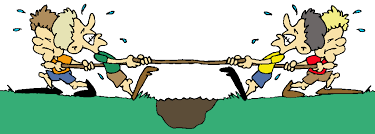
If these teams are pulling with the same amount of force what will happen?
a)
The boy in blue will win.
b)
They will not move at all.
c)
The boy in red will win.
d)
Both will fall down.
126.

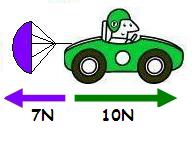
What is the net force?

a)

3 N

b)

3 N, right

c)

17 N, right

d)

3 N, left

127.

A ____________ is a push or a pull on an object.

a)

friction

b)

force

c)

magnet

d)

gravity

128.
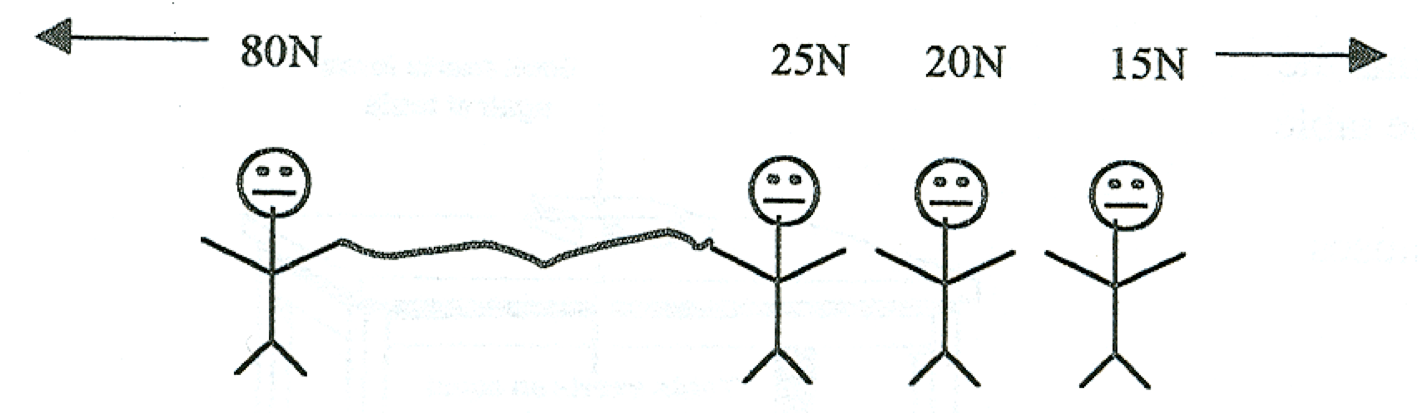
Who wins the tug of war with what net force?
a)
The person on the left with 20 N
b)
The person on the left with 80 N
c)
The people on the right with 20 N
d)
The people on the right with 100 N
129.
What does the strength of gravity between two objects depend upon?
a)
Mass & distance
b)
Mass & weight
c)
Gravity & inertia
d)
Inertia & mass
130.
All objects in the universe have a gravitational attraction to each other. 
a)
True
b)
False
131.
This type of force resist motion between two surfaces that are pressed together
a)
contact
b)
gravity
c)
friction
132.

Motion is any change in ___________.

a)

acceleration

b)

distance

c)

position

d)

velocity

133.

This graph shows that as an object’s mass increases its

a)

inertia increases

b)

inertia decreases

c)

acceleration increases

d)

acceleration decreases

134.
What does friction produce?
a)
light
b)
sound
c)
heat
d)
gravity
135.
What direction does friction act relative to motion?
a)
in the same direction
b)
in the opposite direction 
c)
need more information
d)
depends on the force
136.
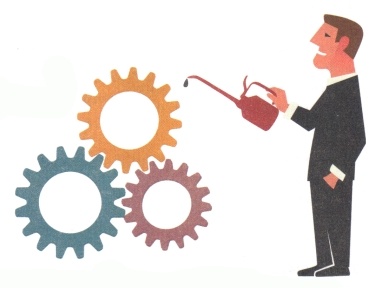
How does friction affect speed?
a)
more friction decreases speed
b)
more friction increases speed
c)
less friction decreases speed
d)
less friction doesn't affect speed
137.
Which of the following is an example of friction that is helpful?
a)
Brakes used on a bike
b)
Tires from a car on the road
c)
Tread on the bottom of your shoes
d)
All are examples that are helpful
138.
What type of friction is not moving?
a)
static
b)
sliding
c)
fluid
d)
rolling
139.
Which of the following is an example of friction that is harmful?
a)
Pencil marking on paper
b)
Engine parts wearing out
c)
sand placed on ice in the winter
d)
Using an eraser to erase marks
140.
Which would NOT be a way of reducing friction?
a)
making the surfaces smoother
b)
using lubricants such as waxes, oils, or grease
c)
changing from sliding friction to rolling friction using ball bearings
d)
Using kitty litter on snow and ice to help your car gain traction
141.
How can friction be reduced?
a)
reduce the force acting between the 2 surfaces
b)
reduce the roughness of the 2 surfaces coming in contact
c)
use wax, grease or oil
d)
all of the above are ways of reducing friction
142.

Which law of motion states that,for every action, there is an equal and opposite reaction?

a)

Newton’s First Law of Motion

b)

Newton’s Second Law of Motion.

c)

Newton’s Third Law of Motion

d)

The law of reaction.

143.

If you kick a bowling ball and a tennis ball with the same amount of force,according to Newton’s Second Law of Motion,what will happen?

a)

The tennis ball will travel farther than the bowling ball

b)

The bowling ball will travel farther than the tennis ball

c)

The bowling ball will travel faster,but cover a shorter distance

d)

The balls will travel the same distance.

144.

According to Newton’s First Law of Motion…

a)

An object in motion will slow down when moving down a hill

b)

An object in motion will stay in motion unless acted upon by an unbalanced force.

c)

An object in motion will always move sideways when acted upon by an outside force.

145.

Inertia is...

a)

An object's movement

b)

An object's resistance to a change in its motion

c)

An object's acceleration

d)

An objects velocity

146.

If you increase the force on an object, its acceleration increases

a)

true

b)

false

147.

If you increase the mass of an object, its acceleration decreases

a)

true

b)

false

148.
The greater the mass of an object
a)
the more space it takes up
b)
the greater its inertia
c)
the more balanced it is
d)
the easier the object is to move
149.

Forces that do not cancel

a)

Balanced forces

b)

Unbalanced forces

c)

Net force

d)

Newtons

150.

Both an object's speed and its direction

a)

Motion

b)

Velocity

c)

Force

d)

Gravity

151.

A force that pulls all objects toward one another

a)

Force

b)

Gravity

c)

Distance

d)

Acceleration

152.

Newton's First Law describes motion when forces are ______

a)

balanced

b)

unbalanced

c)

both balanced and unbalanced

153.

Newton's Second Law describes motion when forces are ______

a)

balanced

b)

unbalanced

c)

both balanced and unbalanced

154.

What is an example of kinetic energy?

a)

A bird sitting in a tree

b)

A bouncy ball on the table

c)

A car driving on the highway

d)

A book on shelf

155.

Energy cannot be created or destroyed.

a)

True

b)

False

156.
The Ability to do work
a)
Soil 
b)
Energy 
c)
Matter
d)
Math
157.
The faster an object moves, the ________ kinetic energy it has. 
a)
more
b)
less
c)
none of the above
d)
all of the above 
158.
Gravitational potential energy depends on the ________ and ________ of the object. 
a)
Height and mass
b)
Friction and movement
c)
Mass and Movement
d)
Height and Friction 
159.
What kind of energy is in a rock at the edge of a cliff?
a)
Potential
b)
Kinetic
c)
both
d)
neither
160.
Which point has the most potential energy?
a)
D
b)
F
c)
B
d)
A
161.
At which point is potential energy greatest?
a)
W
b)
X
c)
Y
d)
Z
162.
Which point has the greatest kinetic energy?
a)
W
b)
X
c)
Y
d)
Z
163.
The law of conservation of energy means ________________________
a)
Energy CAN be created and destroyed or transformed
b)
Energy can be used up or transformed
c)
Energy CANNOT be created or destroyed, only transformed
d)
Energy cannot be transformed
164.
Which bowling ball has LESS kinetic energy
a)
8 m/s
b)
10 m/s
c)
they have the same amount of enery
d)
none of these
165.
Which has the greatest gravitational potential energy?
a)
a minicooper
b)
a semi truck
c)
a human
d)
a baby
166.
Heat transfers from an area of ____temperature to an area of ___ temperature.
a)
high to low
b)
low to high
c)
high to high
167.
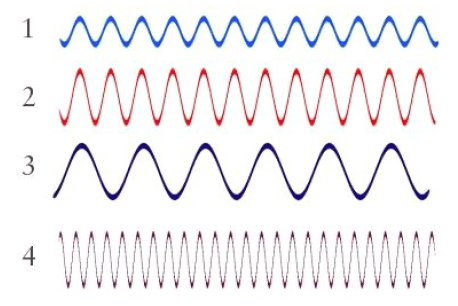
Which wave in the diagram has the greatest wavelength?
a)
1
b)
2
c)
3
d)
4
168.
Refraction causes waves to bounce back off of an object.
a)
True
b)
False
169.
Which of the following is the bending of a wave, which changes its speed.
a)
Reflection
b)
Diffraction
c)
Refraction
d)
Frequency
170.
When waves meet, and form either a larger or smaller amplitude
a)
Radiation
b)
Interference
c)
Diffraction
d)
Microwaves
171.
Waves can meet and form a smaller amplitude.  If this occurs, it is called
a)
Constructive
b)
Destructive
c)
Diffractive
d)
Refractive
172.
The combination of two waves to form a larger amplitude is what type of interference?
a)
Constructive
b)
Destructive
c)
Diffractive
d)
Refractive
173.

This is when sound waves reflect or bounce off an an object.

a)

Echo

b)

Transmission

c)

Refraction

d)

Absorption

174.

When you place things into water they sometimes look bent (see the image below). What is this an example of?

a)

Refraction

b)

Diffraction

c)

Transmission

d)

Absorption

175.

Which type of interaction is this?

a)

reflection

b)

refraction

c)

diffraction