
 Worksheets
Protein Structure and Characteristics Worksheet
Total questions: 39
Worksheet time: 20mins
The variations in the physical characteristics between different proteins are influenced by the overall amino acid compositions, but even more important is the unique amino acid
number.
sequence.
bond.
orientation.
Some proteins have alpha helices, some have beta sheets, and still others have a combination of both. What makes it possible for proteins to have these common structural elements?
specific amino acid sequences
side-chain interactions
the hydrophobic-core interactions
hydrogen bonds along the protein backbone
Which of the following is NOT a feature of α helices?
anti-parallel
1 helical turn every 3.6 amino acids
part of protein secondary structure
amino acid side chains that point outward
Which of the following statements is TRUE?
Disulfide bonds are formed by the cross-linking of methionine residues.
Disulfide bonds are formed mainly in proteins that are retained within the cytosol.
Disulfide bonds stabilize but do not change a protein’s final conformation.
Disulfide bonds are more common for intracellular proteins, compared to extracellular proteins.
Chemical reactions carried out by living systems depend on the ability of some organisms to capture and use atoms from nonliving sources in the environment. The specific subset of these reactions that break down nutrients in food can be described as
metabolic.
catabolic.
anabolic.
biosynthetic.
The best way to know if an organic molecule has been reduced is to see if there was an increase in the number of _________ bonds.
C-H
C-O
H-H
C-N
ΔG° indicates the change in the standard free energy as a reactant is converted to product. Given what you know about these values, which reaction below is the most favorable?
ADP + Pi → ATP ΔG° = +7.3 kcal/mole
glucose 1-phosphate → glucose 6-phosphate ΔG° = -1.7 kcal/mole
glucose + fructose → sucrose ΔG° = +5.5 kcal/mole
glucose → CO2 + H2O ΔG° = -686 kcal/mole
ΔG measures the change of free energy in a system as it converts reactant (Y) into product (X). When [Y] = [X], ΔG is equal to
ΔG° + RT.
RT.
ln [X]/[Y].
ΔG°.
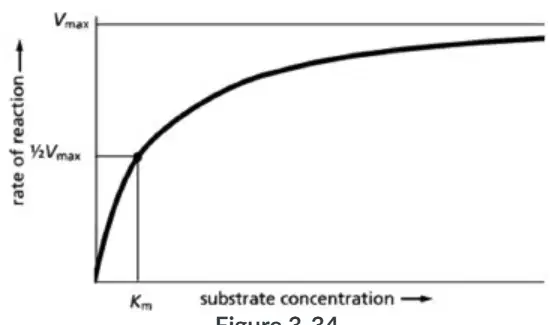
What does the K_m value indicate with respect to enzyme–substrate interactions?
the maximum rate of catalysis
the number of enzyme active sites
the enzyme–substrate binding affinity
the equilibrium rate of catalysis
The study of enzymes also includes an examination of how the activity is regulated. Molecules that can act as competitive inhibitors for a specific reaction are often similar in shape and size to the enzyme’s substrate. Which variable or variables used to describe enzyme activity will remain the same in the presence and absence of a competitive inhibitor?
V_max
V
V_max and K_m
K_m
Energy cannot be created or destroyed, but it can be converted into other types of energy. Cells harvest some of the potential energy in the chemical bonds of foodstuffs to generate stored chemical energy in the form of activated carrier molecules, which are often employed to join two molecules together in ________ reactions.
oxidation
hydrolysis
condensation
dehydrogenation
You have a concentrated stock solution of 10 M NaOH and want to use it to produce a 150 mL solution of 3 M NaOH. What volume of water and stock solutions will you measure out to make this new solution?
135 mL of water; 15 mL of NaOH stock
115 mL of water; 35 mL of NaOH stock
100 mL of water; 50 mL of NaOH stock
105 mL of water; 45 mL of NaOH stock
An ionic bond between two atoms is formed as a result of the
sharing of electrons.
loss of electrons from both atoms.
loss of a proton from one atom.
transfer of electrons from one atom to the other.
Although covalent bonds are 10–100 times stronger than noncovalent interactions, many biological processes depend upon the number and type of noncovalent interactions between molecules. Which of the noncovalent interactions below will contribute most to the strong and specific binding of two molecules, such as a pair of proteins?
electrostatic attractions
hydrogen bonds
hydrophobic interactions
van der Waals attractions
Which of the following monomer building blocks is necessary to assemble selectively permeable boundaries around and inside cells?
sugars
fatty acids
amino acids
nucleotides
What is the pH of 100mM solution of HCl (strong acid)? pH=-log[H]
ph=10
ph=107
ph=2
ph=0.2
ph=1
Which chemical group is present in the N terminus of proteins?
there are infinite number of options, it could be any group
amide
methyl
amino
carboxyl
Which of the following is NOT TRUE about amino acids (find all that are false):
all amino acids have the same ability to interact with water
there are 20 amino acids from which all proteins are made
all amino acids have a NH2 and COOH groups
amino acids are linked together to form branched carbohydrate polymers
amino acids can have charged or non-charged side chains
In the case of a simple conversion reaction such as X→Y, which value of ΔG° is associated with a larger concentration of X than Y at equilibrium?
ΔG° = -5
ΔG° = -1
ΔG° = 0
ΔG° = 1
Which of the following IS NOT a tenet of cell theory:
the cell is a basic unit of life
cells have complex diverse morphologies
all organisms are composed of one or more cells
cells can only arise from pre-existing cells
all of the above are tenets of cell theory
What type of regulation is it when a product inhibits its own synthesis?
allosteric modulation
non-competitive inhibition
GTP mediated activation
feedback inhibition
phosphorylation
The formation of CO2 from CH4 occurs by which type of reaction?
oxidation
hydrolysis
condensation
reduction
absorbance
What defines the atomic number of an atom?
the number of protons in its nucleus
the number of protons + the number of neutrons in its nucleus
the number of protons + the number of electrons
the number of protons + the number of electrons + the number of neutrons
The terms “prokaryote” and “bacterium” are synonyms.
True
False
How do you like this 213 class so far? (no matter which answer you choose, you get the points!)
Too easy
Too hard
The knowledge is interesting. I expect to learn more and expect the instructor to make it more challenging.
It is perfect amount of information. I don't expect the instructor to make it more challenging.
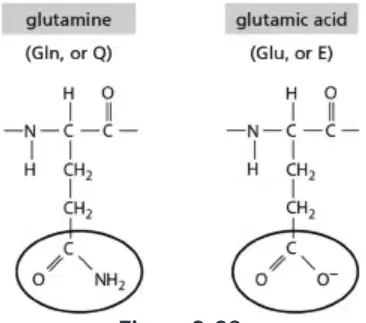
The amino acids glutamine and glutamic acid differ only in the structure of part of their side chains. At pH7, what type of interactions are possible for glutamic acid but not for glutamine?
ionic bonds
hydrogen bonds
van der Waals interactions
covalent bonds
Which of the following is FALSE about molecular chaperones?
They assist polypeptide folding by helping the folding process follow the most energetically favorable pathway.
They can isolate proteins from other components of the cells until folding is complete.
They can interact with unfolded polypeptides in a way that changes the final fold of the protein.
They help streamline the protein-folding process by making it a more efficient and reliable process inside the cell.
The Ras protein is a GTPase that functions in many growth factor–signaling pathways. In its active form, with GTP bound, it transmits a downstream signal that leads to cell proliferation; in its inactive form, with GDP bound, the signal is not transmitted. Mutations in the gene for Ras are found in many cancers. Of the choices below, which alteration of Ras activity is most likely to contribute to the uncontrolled growth of cancer cells?
a change that prevents Ras from being made
a change that increases the affinity of Ras for GDP
a change that decreases the affinity of Ras for GTP
a change that decreases the rate of hydrolysis of GTP by Ras
Cholesterol is an essential component of biological membranes. Although it is much smaller than the typical phospholipids and glycolipids in the membrane, it is a/an _________ molecule, having both hydrophilic and hydrophobic regions.
polar
oxygen-containing
hydrophobic
amphipathic
Cells require one particular monosaccharide as a starting material to synthesize nucleotide building blocks. Which of the monosaccharides below fills this important role?
glucose
fructose
ribulose
ribose
Both DNA and RNA are synthesized by covalently linking a nucleoside triphosphate to the previous nucleotide, constantly adding to a growing chain. In the case of DNA, the new strand becomes part of a stable helix. The two strands are complementary in sequence and antiparallel in directionality. What is the principal force that holds these two strands together?
ionic interactions
hydrogen bonds
covalent bonds
van der Waals interactions
Because there are four different monomer building blocks that can be used to assemble RNA polymers, the number of possible sequence combinations that can be created for an RNA molecule made of 100 nucleotides is
1004
4100
4 ? 100
100/4
Macromolecules in the cell can often interact transiently as a result of noncovalent interactions. These weak interactions also produce stable, highly specific interactions between molecules. Which of the factors below is the most significant in determining whether the interaction will be transient or stable?
the size of each molecule
the concentration of each molecule
the rate of synthesis
surface complementarity between molecules
Polypeptides are synthesized from amino acid building blocks. The condensation reaction between the growing polypeptide chain and the next amino acid to be added involves the loss of
a water molecule.
an amino group.
a carbon atom.
a carboxylic acid group.
Which of the following is NOT a feature commonly observed in β sheets?
antiparallel regions
coiled-coil patterns
extended polypeptide backbone
parallel regions
Two or three α helices can sometimes wrap around each other to form coiled-coils. The stable wrapping of one helix around another is typically driven by ________ interactions.
hydrophilic
hydrophobic
van der Waals
ionic
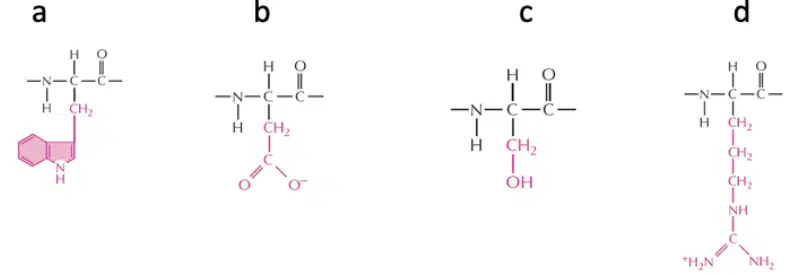
Which of these amino acids is not charged but polar.
a
b
c
d
Enzymes cannot change the equilibrium of biochemical reactions
True
False
__________ play an important role in organizing lipid molecules with long hydrocarbon tails into biological membranes.
Hydrogen bonds
Ionic bonds
Hydrophobic forces
Van der Waals aracons

