
 Worksheets
Civics Final
Total questions: 45
Worksheet time: 23mins
Name
Class
Date
1.
Federalism is defined as the sharing of power between
a)
legislative, executive and judicial levels of government.
b)
judges, Congress, and the President.
c)
national, state, and local governments.
d)
Marshall, Calhoun, and Jackson.
2.
The 1803 Supreme Court decision in the case of ______________ v. _______________ established the precedent of judicial review.
a)
Marbury v. Madison
b)
Gibbons v. Ogden
c)
Brown v. Board of Education
d)
McCulloch v. Maryland
3.
Based on the inquiry assignment, what reasoning best explains this evidence from Ghosts of Gold Mountain: Despite their critical role in American history, the Railroad Chinese remain silent spikes to this day. Tens of thousands of letters went back and forth across the Pacific... Yet not a single message from or to a Railroad Chinese in this vigorous traffic has been located despite the most strenuous research efforts.
a)
The contributions of Chinese rail workers in the Gilded Age have been preserved in many of their letters.
b)
Americans workers wanted to remember the Chinese who build the transcontinental railroad.
c)
No Chinese rail workers wrote down anything about their experiences.
d)
All first hand writings of Chinese rail workers have been lost.
4.
Based on the following quote, what does the term "Gilded Age" imply about the late 19th century?
"Mark Twain referred to the late 19th century as the "Gilded Age." He meant that while this time seemed shiny and attractive on the outside, it was actually corrupt and dishonest underneath.
a)
It was a period of unchallenged prosperity and happiness.
b)
It was characterized by superficial wealth masking deeper corruption.
c)
It was a time of complete social equality and harmony.
d)
It was a period of technological stagnation and decline.
5.
John C. Calhoun proposed that ________________ nullify the Tariff of 1828 because it was helping northerners at the expense of southerners.
a)
North Carolina
b)
South Carolina
c)
Virginia
d)
Massachusetts
6.
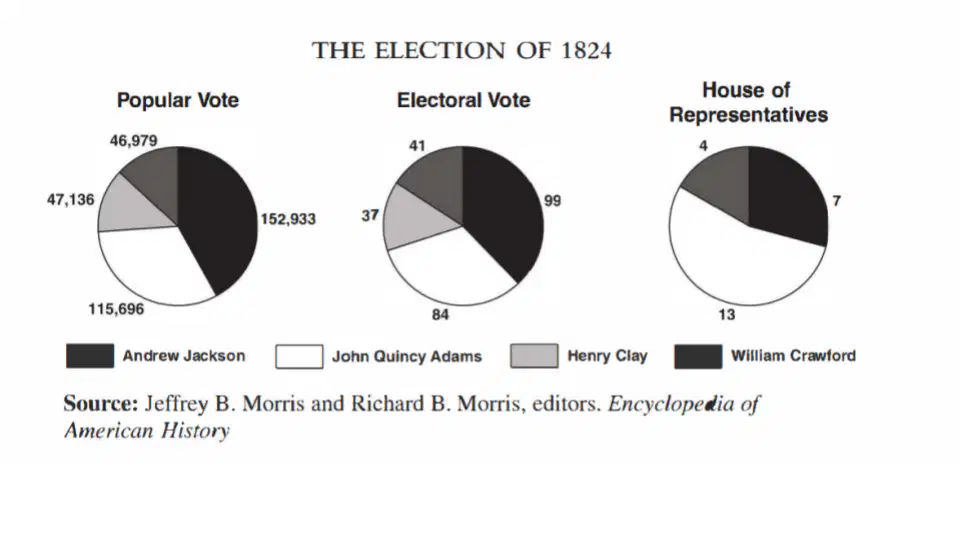
According to the chart, John Quincy Adams won the election of 1824 by a 13 to 7 to 4 margin in the ____________________ .
a)
Senate
b)
House of Representatives
c)
Popular Vote
d)
Electoral Vote
7.
What phrase from the Declaration of Independence did many enslaved people use to support the argument to abolish slavery?
a)
the pursuit of happiness
b)
all men are created equal
c)
consent of the governed
d)
the right of the people to alter it
8.
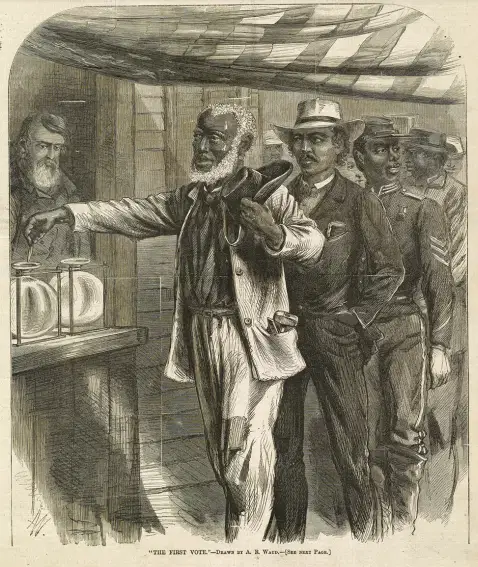
Based on the action and the caption at the bottom of the image below, it was probably published soon after which of these changes went into effect?
a)
Signing of the Declaration of Independence
b)
Ratification of the 1st amendment
c)
Ratification of the 11th amendment
d)
Ratification of the 15th amendment
9.
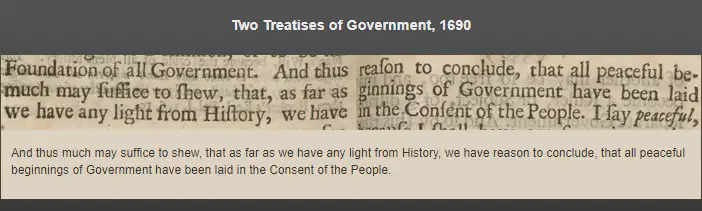
The Declaration of Independence was influenced by John Locke's 1690 Two Treatises of Government. According to the image below, where does Locke say that peaceful governments get their power?
a)
from the light of History
b)
from firm Foundations
c)
from the Consent of the People
d)
from the British monarchy
10.
The 1620 Mayflower Compact was one of the earliest examples in America of people signing and agreeing to govern themselves. In the text of the Mayflower Compact, this idea of government is defined as ________________ .
a)
the "necessary and proper" clause
b)
the "civil body politic"
c)
"rule of law"
d)
"freedom of speech"
11.
The Magna Carta’s most famous clause gave all free men the right to justice and a fair trial. What part of the Constitution guarantees those same rights to U.S. citizens?
a)
The Preamble
b)
Article 1
c)
Article 2
d)
The Bill of Rights
12.
What evidence from the History.com article best supports this claim:
The English Bill of Rights (1689) had the greatest influence on the Constitution.
a)
"it outlined 13 rights and liberties of individuals"
b)
"it listed King James's misdeeds"
c)
"it confirmed rightful successors to the throne"
d)
"it created a constitutional monarchy"
13.
What does the Constitution do?
a)
declares our independence from Great Britain
b)
sets up the government and protects basic rights
c)
gives states more rights and power
d)
outlines punishments for breaking the law
14.
What did the Declaration of Independence do?
a)
declared our independence from Great Britain
b)
declared our independence from France
c)
declared our independence from Native Americans
d)
declared independence of the slaves
15.
From what continent were people taken to the U.S. and sold as slaves?
a)
Africa
b)
Asia
c)
Europe
d)
South America
16.
Which of these was NOT a reason colonists came to America?
a)
for religious freedom
b)
for economic opportunity
c)
to practice charity with other cultures
d)
to escape persecution
17.
Who lived in America before the Europeans arrived?
a)
Scandinavians
b)
Spaniards
c)
the French
d)
Native Americans
18.
What is the supreme law of the land?
a)
Declaration of Independence
b)
Articles of Confederation
c)
Constitution
d)
Bill of Rights
19.
Which of these did NOT cause the colonists to fight the British?
a)
taxation without representation
b)
because the British soldiers stayed in their houses
c)
because they wanted more land
d)
because they didn't have self-government
20.
What is an amendment?
a)
a new wing on the White House
b)
a change or addition to the Constitution
c)
a ruling in favor of the government by the Supreme Court
d)
a new traffic law
21.
Which of these is NOT one of the three branches of the federal government?
a)
the military branch
b)
the legislative branch
c)
the executive branch
d)
the judicial branch
22.
What stops one branch of government from becoming too powerful?
a)
the CIA
b)
the Pentagon
c)
the people
d)
checks and balances
23.
What part of government makes federal laws?
a)
Attorney General
b)
Congress
c)
Supreme Court
d)
President
24.
Who is in charge of the executive branch?
a)
President
b)
Chief Justice
c)
Speaker of the House
d)
Majority Leader
25.
Which of these does the JUDICIAL branch NOT do?
a)
reviews laws
b)
executes laws
c)
resolves disputes
d)
decides if laws are Constitutional
26.
What are the two parts of Congress?
a)
Senate and Supreme Court
b)
Senate and House of Representatives
c)
President and Senate
d)
President and House of Representatives
27.
What does the President's Cabinet do?
a)
advises the President
b)
leads federal prosecutions
c)
writes laws
d)
keeps the White House clean
28.
Who signs bills into law and also has the power to veto bills?
a)
Speaker of the House
b)
Chief Justice
c)
President
d)
Vice President
29.
Which one of these is a power only for the federal government?
a)
provide schooling and education
b)
maintain local roads
c)
give drivers licenses
d)
print money
30.
Which one of these is a power of the states?
a)
provide schooling and education
b)
review the Constitution
c)
appoint Cabinet members
d)
print money
31.
Who does a U.S. Senator represent?
a)
all the people of their political party
b)
just the people who voted for them
c)
all the people in the United States
d)
all the people in the state in which they ran for office
32.
Why do some states have more Representatives in Congress than other states?
a)
because some states pay more taxes
b)
because some states have more people
c)
because some states have been part of the country longer
d)
because some states only want a certain number of them
33.
What is the political party of the current U.S. President?
a)
Republican
b)
Libertarian
c)
Democrat
d)
Green
34.
Which of these is NOT a promise you make when you become a naturalized citizen of the United States?
a)
to stay out of jail
b)
to obey the laws of the United States
c)
to be loyal to the United States
d)
to defend the Constitution and laws of the United States
35.
Which one of these was NOT an issue that led to the Civil War?
a)
economic reasons
b)
slavery
c)
states' rights
d)
Native American rights
36.
Name one right reserved for U.S. citizens.
a)
the right to drive
b)
the right to run for federal office
c)
the right to go to school
d)
the right to medical care
37.
Which of these is NOT a right granted in the Constitution?
a)
freedom of expression
b)
freedom of religion
c)
the right to bear arms
d)
the right to clean drinking water
38.
Which of these groups of people were the last to receive the right to vote by the federal government?
a)
Black men
b)
Citizens between the ages of 18 and 21 years of age
c)
Native Americans
d)
Women
39.
How many electoral college votes does a candidate need to win the Presidency?
a)
100
b)
268
c)
270
d)
535
40.
Which of the following does NOT represent a strategy used by women in their quest for the right to vote?
a)
threats of violence
b)
marches
c)
published materials
d)
sermons
41.
It took 130 years after the Constitution was ratified for it to get amended to include the right for women to vote. Which of the following was NOT a societal diversion that slowed down their progress?
a)
The Civil War
b)
World War I
c)
The 15th amendment
d)
The Women's Suffrage Conventions
42.
“The great rule of conduct for us in regard to foreign nations is in extending our commercial relations, to have with them as little political connection as possible.”
According to this quote from George Washington's Farewell Address, what should be the sole focus of U.S. foreign policy?
a)
political involvement with Europe
b)
securing Mexico's freedom
c)
building the U.S. economy
d)
protecting Caribbean nations
43.
What part of the world did the 1823 Monroe Doctrine pledge to protect from European recolonization?
a)
The American continents and the northern hemisphere
b)
The Asian continents and the eastern hemisphere
c)
The American continents and the southern hemisphere
d)
The American continents and the western hemisphere
44.
The two ends of the spectrum of foreign policy are
a)
isolationist and imperialist
b)
democratic and republican
c)
liberal and conservative
d)
inclusive and exclusive
45.
Which of these statements from his "A World Safe for Democracy" speech best supports Woodrow Wilson's idea that "peace can never be maintained except by a partnership of democratic nations."
a)
We have no quarrel with the German people.
b)
We have seen the last of neutrality in certain circumstances.
c)
We are but one of the champions of the rights of mankind.
d)
We seek no indemnities for ourselves.
100 %

