
 Worksheets
16 Hire a Financial Advisor and 17 Build Wealth
Total questions: 65
Worksheet time: 33mins
What is the main difference between a financial planner and a financial advisor as described in the passage?
Financial planners only give investment advice, while advisors create holistic plans.
Financial planners help you come up with a comprehensive plan for your entire financial life, while financial advisors might be more limited to giving advice on investments.
Financial advisors are not licensed, while planners are.
Financial advisors only work with budgeting.
Fill in the blank: Financial planners are generally trained to help you come up with a comprehensive plan to help navigate your entire _________
financial life
work schedule
diet plan
travel itinerary

According to the diagram, both financial planners and financial advisors give you ________ advice.
investment
medical
legal
culinary
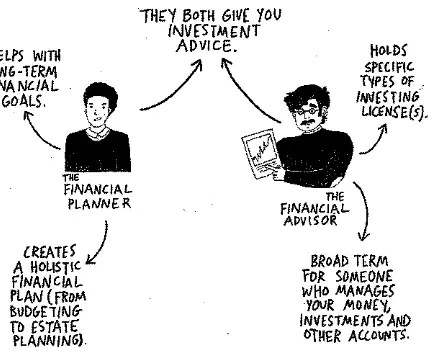
Which of the following is a responsibility of a financial planner according to the diagram?
Holds specific types of investing licenses
Helps with financial goals outside investing
Only manages investments
None of the above

A financial advisor is a broad term for someone who manages your money, investments, and other accounts.
True
False
Fill in the blank: A ______ is a person or organization that acts on behalf of another person to manage assets and is legally and ethically required to put their client’s best interests before their own.
fiduciary
beneficiary
auditor
shareholder
Fill in the blank: The ______ standard is a regulation that says a broker must make 'reasonable efforts to obtain information' on a client before making investment recommendations.
suitability
fiduciary
disclosure
prudence
What does it mean when advisors are independent?
They can only recommend products from one company.
They are free to recommend financial products from different companies.
They are required to sell only Wells Fargo products.
They are not allowed to recommend any products.
A brokerage firm only needs to abide by the ______ standard. (Fill in the blank)
suitability
fiduciary
ethical
prudent
A registered investment advisor (RIA) is legally required to act as a ______.
fiduciary
broker
principal
agent
Which of the following statements is true about a hybrid firm?
It is only a brokerage firm.
It is only a registered investment advisor.
It is registered as both a brokerage firm and a registered investment advisor.
It cannot sell certain products.

According to the cartoon, if your potential financial advisor answers 'YES' to 'ARE YOU A FIDUCIARY OR DO YOU RECOMMEND PRODUCTS THAT YOU RECEIVE COMMISSIONS ON?', what does this indicate?
The advisor is not a fiduciary.
The advisor has passed the first obstacle to becoming your financial advisor.
The advisor is independent.
The advisor only sells Wells Fargo products.

According to the Venn diagram, which type of financial advisory firm is legally required to act as a fiduciary?
Registered Investment Advisor
Hybrid
Brokerage Firm
None of the above
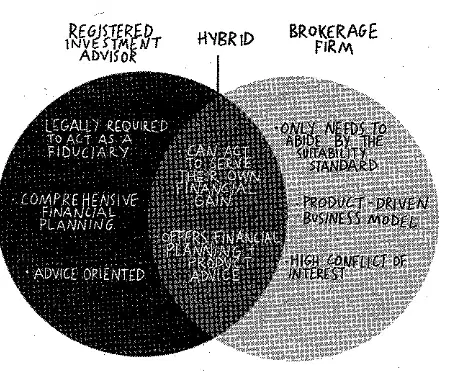
Which type of financial advisory firm is described as 'product-driven business model' in the Venn diagram?
Registered Investment Advisor
Hybrid
Brokerage Firm
All of the above
Fill in the blank: Fee-only planners and advisors are almost always ________ that act in the best interests of their clients.
fiduciaries
brokers
salespeople
consultants
Fee-only advisors receive compensation from mutual funds or insurance companies.
True
False
According to the passage, a potential benefit of working with a fee-only advisor is:
They receive commissions from product sales.
They provide less biased financial advice.
They have higher fees than other advisors.
They only work with wealthy clients.

According to the diagram 'UNDERSTANDING THE LONG-TERM COST OF ASSET MANAGEMENT FEES', if you invest $100,000 with no fees, what does your investment earn?
$170,000
$330,000
$160,000
$100,000
Fill in the blank: An asset under management (AUM) fee can be fee-only, but it can also be a part of fee-based compensation if the advisor also gets paid ________.
commissions
bonuses
dividends
interest
What is the most commonly cited annual asset management fee percentage mentioned for a client's investment account balance?
0.5%
1%
2%
5%
Paying a 1 percent asset management fee could cost investors 25 percent of their returns over forty years.
True
False
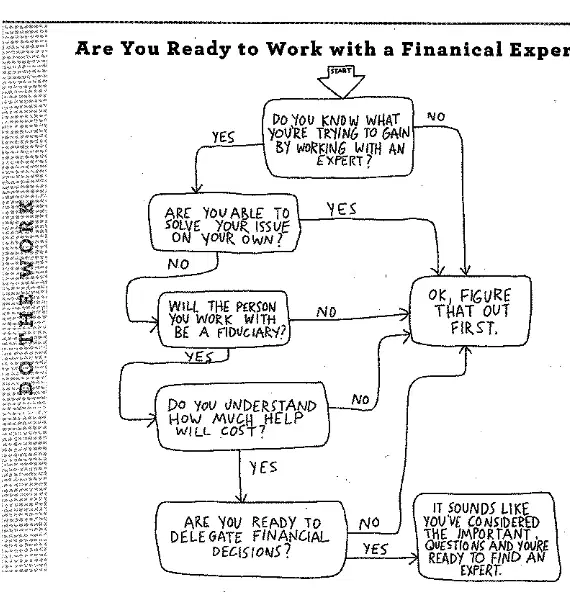
Bottom line, how should a you assess the effectiveness of a financial advisor?
Do the financial advisor make you feel good about your finances?
Does the financial advisor enable you to forget about your finances and take care of you?
Does your financial advisor save you time or effort and make more money than you would make on your own?
Does your financial advisor work for people who you admire and impress you?
Should the financial advisor with whom you work be a fiduciary?
Yes
No
Should you make sure that you understand how much financial advice will cost and get that cost in writing?
Yes
No
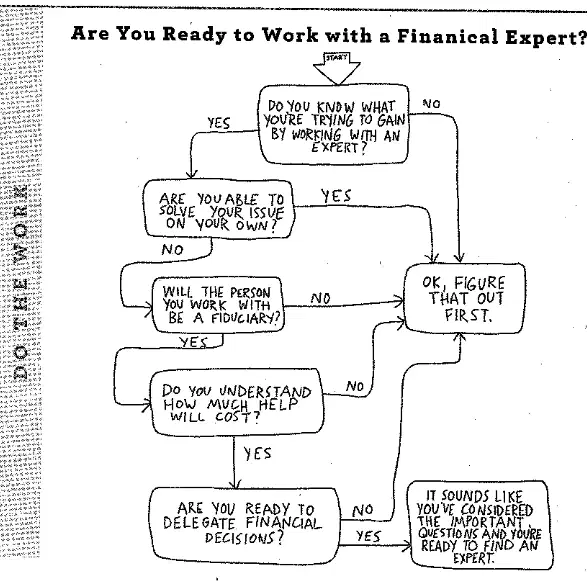
According to the flowchart 'Are You Ready to Work with a Financial Expert?', should you know what you're trying to gain by working with an expert?
This is the first decision point in the flowchart. The answer depends on the individual's self-assessment, but the flowchart suggests you should know this before proceeding.
No, the flowchart recommends skipping this step.
The flowchart suggests you should not know this before proceeding.
The flowchart indicates this is not important before working with an expert.
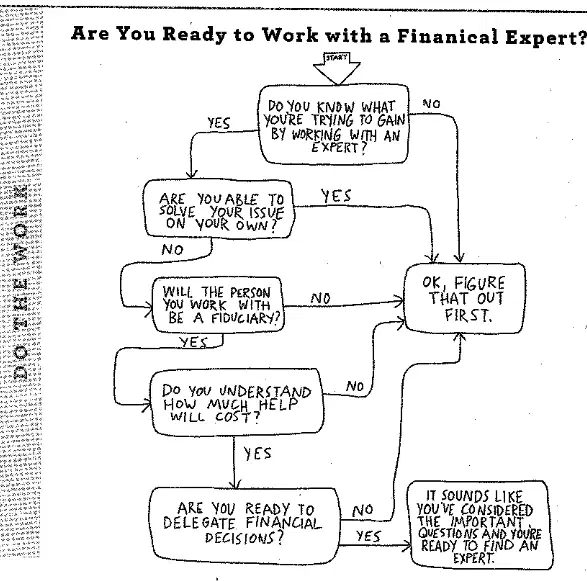
According to the flowchart 'Are You Ready to Work with a Financial Expert?', should you understand how much financial advice will cost?
The flowchart suggests you should understand the cost before proceeding.
The flowchart says cost is not important.
The flowchart recommends ignoring the cost.
The flowchart does not mention cost at all.
According to Scott Galloway, what is wealth?
An impressive house, car, and lifestyle that other people envy
Having enough income to live the life that you want to life, without worrying.
Having enough credit to buy whatever you want, then paying for what you bought later.
Having more than you need.
Fill in the blank: Wealth is a megaphone for our values, ideas, and ________.
voice
money
power
actions
According to Finance for the People, what is the purpose of life insurance as explained by the Paco de Leon boss?
To provide a lump sum for vacations
To replace someone's income if they died while covered by the policy
To pay off all debts immediately
To buy luxury items
Fill in the blank: For every $50,000 of income that would need to be replaced, a person would need a ________ dollars' worth of term life insurance, assuming one can buy an investment that pays 5% a year.
million
hundred thousand
ten thousand
billion
According to the passage, what does 'financially independent' mean?
Relying on a paycheck from a job
Financial security is independent of a paycheck from a job
Spending all your wealth
Winning the lottery
According to Finance for the People, what is the main difference between income and wealth?
A) Income is how much you earn over a period of time and wealth is how much you have at a particular time.
B) Income and wealth are the same thing.
C) Wealth is how much money you earn, and income is what you own.
D) Income is only for athletes, and wealth is for everyone else.
People with high incomes are always wealthy.
True
False
Fill in the blank: According to a 2009 Sports Illustrated article, _____ percent of former NBA players are broke within five years of retirement.
60
25
40
75
Fill in the blank: Finance for the People states that 78 percent of former NFL players have gone bankrupt or are under financial stress within _____ years of retirement.
two
five
ten
eight
According to the passage, what does creating wealth often require?
Spending all your income
Earning an income only
A shift in perspective
Becoming a professional athlete
According to the passage, what is a common and traditional way to multiply your money?
Investing in the stock market
Buying luxury goods
Keeping money in a savings account
Spending on entertainment
What is a brokerage account?
An account where you can only buy stocks
An account where an investor can buy and sell investments like different kinds of funds or even individual stocks
A savings account with high interest
An account only for retirement savings
Fill in the blank: The government tries to encourage us to save for our own retirement by creating _______.
tax incentives
retirement penalties
mandatory spending
extra fees
A home is always a better investment than stocks, according to the passage.
True
False
It is important to know whether home-buying is the right thing for you because:
It helps you make informed financial decisions.
It guarantees you will make a profit.
It is required by law.
It is the only way to have a place to live.
According to the passage, what is the measure of your wealth?
(a)
Which of the following is NOT generally included in your personal asset category?
Real estate
Monthly utility bills
All your cash in your various checking accounts
All your cash in your various savings accounts
Investments, including 401(k) plans and other retirement plan balances
Fill in the blank: To calculate your net worth, you add up all your cash and the value of your assets, then you subtract the total balance of all your ________.
debts
incomes
investments
salaries
Diversifying your investments can help reduce the risk of losing all your wealth in a single downturn.
True
False
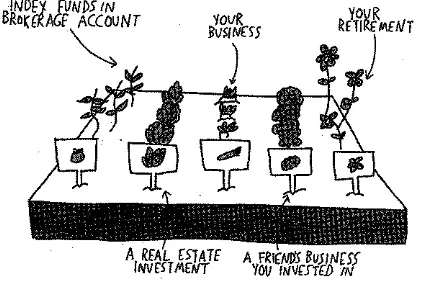
Which of the following is an example of an asset you might invest in, as shown in the diagram 'Some Garden Variety Assets'?
Your business
Index funds in a brokerage account
Your retirement
All of the above
Real estate investment
Which of the following is considered an asset?
Jewelry
Car loan
Student loan balance
Personal loans
Which of the following is NOT a liability?
A) Student loan balance
B) Art
C) Car loan
D) Personal loans
Fill in the blank: The value of your stake in a business is considered a(n) (a) .
Fill in the blank: A mortgage or home equity line of credit is an example of a ________.
liability
asset
income
expense
Which of the following is an example of a debt?
Jewelry
The balance you owe on your credit cards
Art
The value of your stake in a business
Your net worth is a data point that should inform what actions you take.
True
False
Folks with a positive net worth have the space to breathe and options for their finances.
True
False
Fill in the blank: In the long term, net worth is one underlying factor that enables people to ________.
retire
travel daily
cook faster
read more books
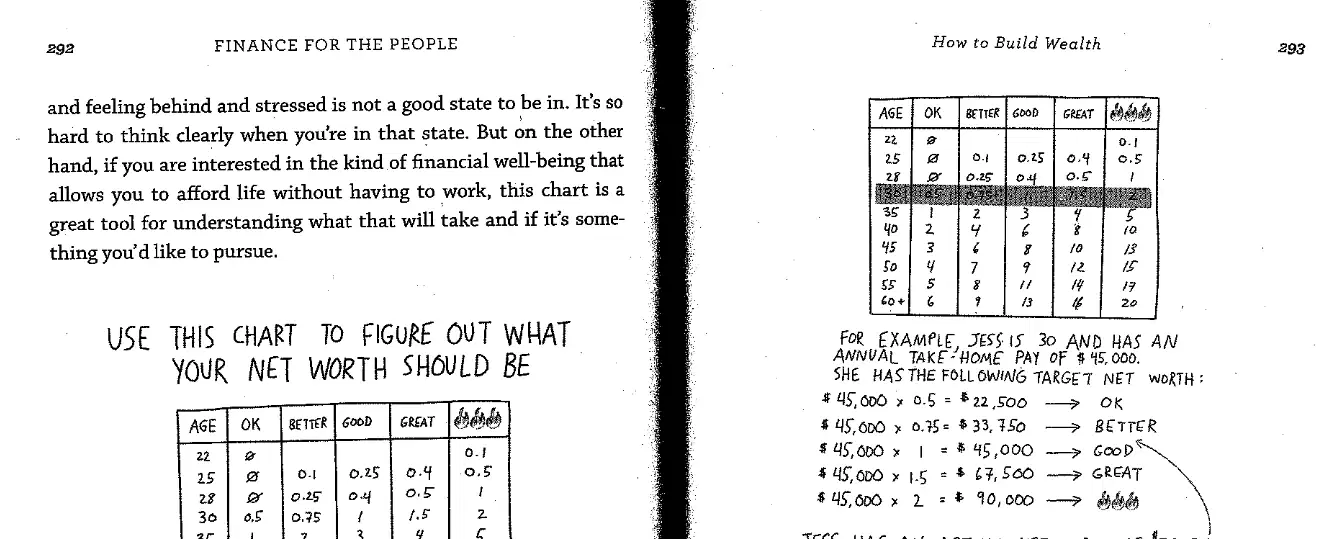
What is the target net worth multiplier for someone who is 25 years old and wants to be in the 'Fire' category?
0
.5
1.
1.5

If your annual take-home pay is $50,000 and you are 40 years old, what is your target net worth for the 'Good' category?
$50,000
$100,000
$200,000
$400,00

If 30 year old Jess makes $45,000 a year and has an actual net worth of $38,450, which category does she fall into?
OK, but could be better
Better, almost good
Good, but not great
Great, but not on fire with bags of money
💰💰💰
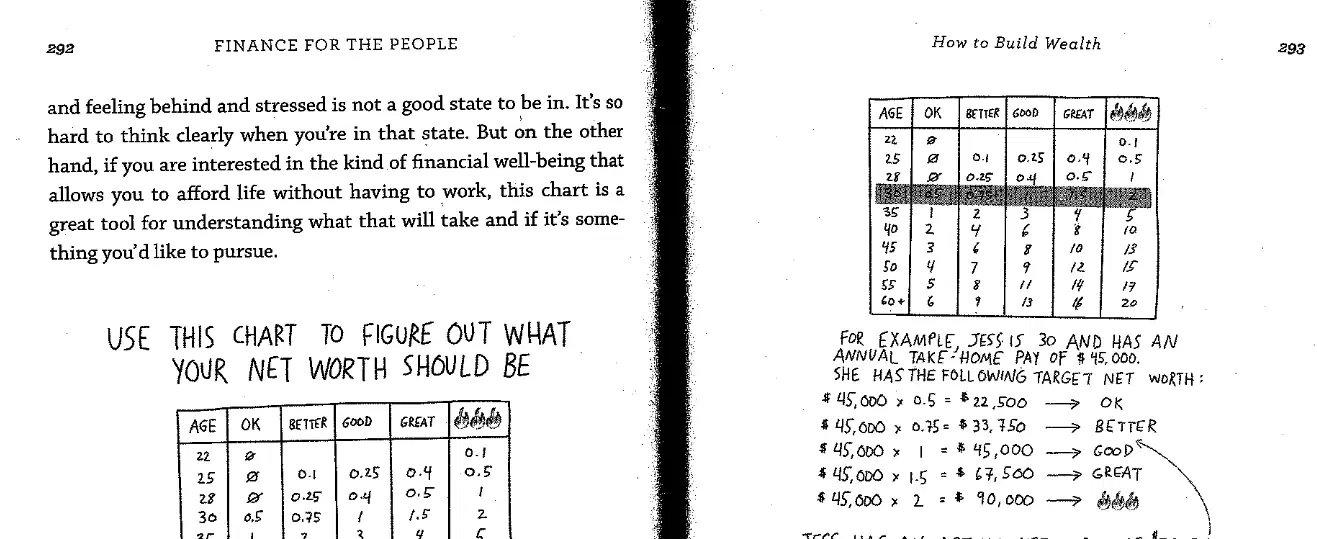
According to the chart, what is the net worth multiplier for someone aged 50 in the 'OK' category?
(a)
What are some reasons why people might want to create wealth that lasts after their death, beyond supporting their own children?
To support charitable causes and leave a legacy
To travel the world
To avoid paying taxes
To buy luxury cars
According to Finance for the People, what is the value of having clear goals and a strategy for building wealth?
It helps to focus efforts and make informed decisions.
It guarantees instant wealth.
It eliminates all financial risks.
It is not important for financial success.
What are some habits or behaviors mentioned in Finance for the People that can help you reach your financial goals?
Saving regularly and budgeting
Spending impulsively
Ignoring financial planning
Relying on luck

What is the chart in the accompany graphic called?
An expense report
A cash flow statement
A balance sheet
An abridged prospectus
How can you use your target net worth to assess your strategy for achieving financial success?
Set a specific net worth goal and create a detailed financial plan to reach that net worth.
Ignore your net worth targets and spend freely.
Rely solely on luck to achieve your financial goals. Forget about your net worth.
Track net worth to assess financial progress. Increases in net worth are good. Decreases are problematic.
Why are goals useful?
Because they provides direction and motivation.
Because they are easy to achieve.
Because they are unrelated to our needs.
Because they are not important.
What attitudes and beliefs do people who achieve financial independence usually embody and exhibit?
They have a growth mindset and believe in financial discipline.
They avoid setting financial goals.
They believe money is unimportant and irrelevant.
They hate self responsibility.

