
 Worksheets
Final Exam Practice (Units 1 & 2)
Total questions: 27
Worksheet time: 20mins
Which of the following is/are true?
According to Dalton’s Atomic Theory, two atoms of nickel could have different masses
According to Dalton’s Atomic Theory, a chemical reaction cannot change an atom of zinc into an atom of copper
Robert Millikan’s oil drop experiment determined the charge-to-mass ratio of an electron
Rutherford's gold foil experiment showed that atoms must have a very dense nucleus which contains most of the mass, but occupies little of the volume of the atom, most of the atom is empty space
Which of the following is/are true?
If two identical waves are in phase when they interact, the result is destructive interference
As the energy of a photon decreases, the frequency decreases and wavelength increase
Green light has a longer wavelength than microwaves
Diffraction demonstrates the wave of nature of light
Which of the following is/are true?
According to Hund's rule, no two electrons in an atom can have the same four quantum numbers
In a multi-electron atom, all orbitals within a given subshell are degenerate
The ground-state electron configuration for Sn is [Kr] 5s^24d^105p^2
For the ground-state orbital diagram of Se, there are 4 unpaired electrons
Which of the following is/are true?
CaCl2 dissolved in water is considered a homogenous mixture
Dimethyl ether, CH3OCH3, is considered a pure substance, molecule, and a compound
Chlorine gas, Cl2, is considered a pure substance, molecule, and compound
Sweet tea with ice cubes is considered a homogenous mixture
Which of the following is/are true?
A valence electron in its ground state in In (Indium) could have the quantum numbers n=4, l=2, ml=1, ms= 1/2
F has 7 valence electrons, 1 of which is unpaired
Ca and Cd have the same number of valence electrons
Co has 2 valence electrons and 25 core electrons
Which of the following is/are true?
A theory is a tentative explanation of observations; a law is model for the way nature works
A law describes why or how something happens; a theory describes what happens in nature
A law is a brief statement that summarizes past observations and predicts future ones
When iron rusts in a closed container, the mass of the container and its contents do not change” is an example of an observation
Which of the following classification is true for Br?
Alkali metal
Main-group metal
Nonmetal
Halogen
Which of the following is/are true?
The law of multiple proportions applies when comparing two samples of CH2O obtained from different sources
The law of definite proportions applies when comparing a sample of CH20 to a sample of C2H4O
According to the law of conservation of mass, if 7.7 grams sodium reacts completely with 11.9 grams chlorine gas to produce sodium chloride, then 19.6 grams sodium chloride should be produced
According to the law of definite proportions, all samples of a given compound, regardless of their source or how they were produced, have the same proportions of their constituent elements
Which of the following is/are true?
According to the Bohr model of the atom, electrons orbit the nucleus at a particular distance, which corresponds to the energy of the electron
The energy of an electron in an atom is quantized, which means only certain values of energy are possible for an electron in an atom
In the Bohr model of the atom, when an electron absorbs energy it jumps to a lower energy level; when it jumps back to a higher energy level, it emits a photon with an energy equal to the difference
As the energy of a photon decreases, the wavelength decreases and the frequency increases
Which of the following is/are true?
N=5, l=0, ml= -1, ms=1/2, is a valid set of quantum numbers
An electron with the quantum numbers n=3, l=2, ml=1, ms=1/2, and an electron with the quantum numbers n=3, l=1, ml=1, ms=-1/2atre in the same subshell
There are exactly 5 orbitals in an atom that can have the quantum numbers n=4, l=2
The principal quantum number corresponds to the size and energy of an orbital; the angular momentum quantum number corresponds to the shape of the orbital
Which of the following is/are true?
Two atoms of the same element must have the same mass number
A cation is formed when a neutral atom of an element loses one or more electrons
A neutral atom of Se-80 has 34 protons, 34 electrons, and 46 neutrons
Two isotopes of an element have the same number of neutrons, but a different number of protons
Which of the following is/are true?
Ice melting to form water is an endothermic process
Density is an intensive property; mass and volume are extensive properties
If a salt is dissolved in water and the sodium gets colder, the dissolving process is endothermic
If energy transferred from the system to the surroundings, it is a negative change in energy for the surroundings and a positive change in energy for the system
Which of the following is/are paramagnetic?
Sn4+
Zn2+
V3+
Si
Which of the following is/are true?
In CH3CHO, the O atom is bonded to the C and there is one double bond in the Lewis structure
There is one triple bond in C2H2
There is at least one double bond in hypochlorite
There is a triple bond in N2H2
Which of the following is/are true?
The effective nuclear charge of Cl is larger than the effective nuclear charger of Ca
A neutral Cl atom is larger than a neutral Ca atom
Ca2+ is larger than a neutral Ca atom
Cl- is larger than a Ca2+
Which of the following is/are true?
I has a more exothermic electron affinity than Rb
Xe has a more exothermic electron affinity than I
K has a more exothermic electron affinity than Rb
Cu has more metallic character than Rb
Draw the resonance structure for perbromate. Which of the following is/are true?
There are 3 equally good resonance structures
Looking at the best resonance structure (if there is more than one equally good "best" resonance structure, choose one), there is one single bond and three double bonds
Looking at the best resonance structure (if there is more than one equally good "best" resonance structure, choose one), all oxygen atoms have a 0 formal charge
Looking at the best resonance structure (if there is more than one equally good "best" resonance structure, choose one), there is a 0 charge on the bromine atom
Which of the following is/are true?
A theory is a tentative explanation of observation; a law is a model for the way nature works
A law describes why of how something happens; a theory describes what happens in nature
A law is a brief statement that summarizes past observations and predicts future ones
"When iron rusts in a closed container, the mass of the container and its contents do not change" is an example of an observation
Which of the following is/are true?
In CH3CHO, the O atom is bonded to the C and there is one double bond in the Lewis structure
There is one triple bond in C2H2
There is at least one double bond in hypochlorite
There is a triple bond in N2H2
Which of the following is/are true?
The effective nuclear charge of Cl is larger than the effective nuclear charge of Ca
A neutral Cl atom is larger than a neutral Ca atom
Ca2+ is larger than a neutral Ca atom
Cl- is larger than Ca2+
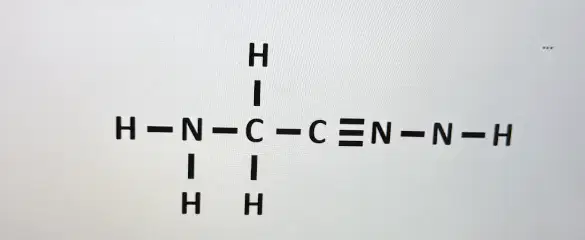
Complete the Lewis Structure for NH2CH2CNNH by adding lone pairs. Which of the following is /are true?
The molecular geometry around the bolded atom is trigonal planar: NHCH2CNNH
The molecular geometry around the bolded atom is trigonal pyramidal: NH2CH2CNNH
The molecular geometry around the bolded atom is trigonal pyramidal: NH2CH2CNNH
The molecular geometry around the bolded atom is bent: NH2CH2CNNH
Which of the following is/are true?
To transition from liquid to gas, you can decrease temperature or decrease pressure
Intermolecular forces between particles in a gas are very weak relative to thermal energy
Solids can be categorized as crystalline or amorphous; crystalline solids have no long-range order
In a solid, the particles cannot move with respect to one another (only vibrate in one place), so solids have a definite shape and definite volume
Which of the following is/are true?
Nitrogen is more electronegative than boron
Sulfur is more electronegative than O
A Si-F bond would be more polar than a N-F bond
Electronegativity is the energy released when an electron is added to a gaseous atom or ion
Which of the following is/are true?
The empirical and molecular formulas can be the same for a compound
The formula for the compound formed between Zn and Br is ZnBr
In PbS2, lead has a 2+ charge
In ionic bonding, electrons are transferred; in covalent bonding, electrons are shared
Draw the Lewis structure for CH3NH2, and CH2NH. Which of the following is/are true?
The bond between the carbon and nitrogen in CH3NH2 is longer and weaker than the bond between the carbon and nitrogen in CH2NH
There is a double bond between the carbon and nitrogen atoms in CH3NH2
There is a total of two lone pairs of electrons in CH2NH
There is a 0 formal charge on the nitrogen atom in CH2NH
Which of the following is/are true?
Ba2I IS barium iodide
AgBrO4 is silver perbromate
CrPO4 is chromium (III) phosphate
Na2SO4 (10 H2O) is sodium sulfate decahydrate
Which of the following is/are true?
The second ionization energy is the energy required to remove an electron from a 1+ gaseous atom
The first ionization energy of Cs is larger than the first ionization energy of Ba
The second ionization energy of Ba is smaller than the second ionization energy of Cs
The first ionization energy of Na is smaller than the first ionization energy of Cs

