
 Worksheets
Fluid Mechanic conceptual
Total questions: 91
Worksheet time: 56mins
What is the formal definition of a fluid?
Substance that deforms continuously under any shearing stress
Substance that cannot be compressed
Substance that will deform only when a massive shearing stress is applied
What is the formal definition of a fluid?
Substance that deforms continuously under any shearing stress
Substance that cannot be compressed
Substance that will deform only when a massive shearing stress is applied
Use unit analysis to solve the following problem:
A community of 75 people desires a tank to store a 3-day supply of water. If the average daily water usage per person is 1.7 gallons, determine the required size of the tank in cubic feet. Answer with one decimal place.
Note: unit conversions are listed in Appendix K of the Mott Textbook
(a)
What is one correct definition of specific gravity?
the ratio of the density of any fluid at any temperature to the density of water at 4 degrees C
the weight of a fluid per unit volume
the ratio of the density of any fluid at 4 degrees C to the density of water at 4 degrees C
the ratio of the density of water to the density of any fluid
Carbon dioxide has a density of 1.964 kg/m3 at 0 degrees Celsius. Calculate its specific weight (in N/m3) at the same temperature. Answer with one decimal place.
(a)
The rise (or fall) of a liquid in a capillary tube is a common phenomena associated with what?
Surface tension
Viscosity
Compressibility
Pressure Differences
As the temperature of a fluid decreases, its surface tension ____________.
Decreases then increases
Decreases
Stays the same (not temp dependent)
Increases
"Wetting" and "non-wetting" behavior is dependent on:
Surface type only
Liquid type only
Both liquid type and surface type
When water is placed on glass, it behaves as a wetting liquid where adhesion forces are _________________ cohesion forces.
Equal to
Greater than
Less than
Dynamic viscosity and kinematic viscosity both describe the 'thickness' of a fluid and are related by the fluid's:
Specific weight
Specific gravity
Gravity
Density
The flow of viscous fluid between two surfaces of varying velocities is known as (a) flow.
What is the no-slip condition that all fluids satisfy?
the experimental observation that the fluid doesn't "stick" to solid boundaries
the experimental observation that the fluid "slips" by solid boundaries
the experimental observation that the fluid "sticks" to solid boundaries
Fluids for which the shearing stress is not linearly related to the rate of shearing strain are designated as what?
non-Newtonian fluids
Newtonian fluids
Inviscid fluids
Viscous fluids

May the fluids to their curve
1 (Oil), 2 (Ketchup), 3 (Ooblek)
1 (Ooblek), 2 (Oil), 3 (Ketchup)
1 (Oobleck), 2 (Ketchup), 3 (Oil)
Which forces act upon a fluid if no shearing stresses are present?
Only weight
Only pressure
Only pressure and weight
The pressure at any point in a static fluid depends only on the:
depth of the fluid and specific weight of the fluid
depth of the fluid and container shape
depth of the fluid
Which is the correct conversion between 'pounds per square inch' (psi) and 'pounds per square foot' (psf)?
12psi = 1psf
1 psi = 144 psf
144 psi = 1 psf
The hydraulic lift for an automobile service garage has a cylinder with a diameter of 8.0 inches. What pressure must the oil in the cylinder have to be able to lift 6000 lb? Answer in psi with 3 significant figures.
(a)
How can the absolute pressure be found by using the gage pressure?
by subtracting the atmospheric pressure from the gage pressure
by adding the gage pressure and the atmospheric pressure
by using the ideal gas equation
Absolute pressure is always positive. True or False?
True
False
When an engineer says that the pressure of a liquid surface is "zero," what pressure are they referring to?
atmospheric pressure in gage units
static pressure in absolute units
atmospheric pressure in absolute units
static pressure in gage units
What does a negative gage pressure mean?
The gage pressure is equal to zero pressure
Negative gage pressures are not possible
A vacuum pressure exists in the measured fluid
A monometer is a:
pressure measuring device
velocity measuring device
temperature measuring device
A major advantage of the U-tube manometer is:
The pressure measurement calculations are simplified
The ability to measure higher pressures with the use of a denser gage fluid
It is more accurate than other types
When is an inclined tube manometer used?
It can be used at any time
When the measured pressure changes are small
When the fluid to be measured has a very low density
For an incompressible fluid at rest, the pressure increases (a) with depth. As a consequence, large forces can be developed on plane or curved surfaces in contact with the fluid.
When a surface is submerged in a fluid, the resultant pressure force on the body acts in what manner? Assume no shear forces are present.
Perpendicular to the surface of the body
In the same direction as the force of gravity
Parallel to the surface of the body
The magnitude of the resultant force of a static fluid on any submerged surface is equal to the (a) of the pressure prism.
Does the resultant static force acting on a submerged plane surface act through the centroid of the submerged body?
Yes
No, it acts above the centroid
No, it acts below the centroid
The point through which the resultant force acts on a submerged plane surface is called the (a) , which is the centroid of the pressure prism itself.
Even though the side profile of the pressure prisms for a rectangular and non-rectangular surface are identical, the pressure prisms themselves are different volumes. This impacts the calculations of:
neither - it does not impact resultant force calculations
the resultant force location only
both the resultant force magnitude and location
the resultant force magnitude only
When calculating the force due to a static fluid on an inclined plane surface, you should use _____________ distances for the y centroid or h_c
Vertical
Horizontal
Inclined
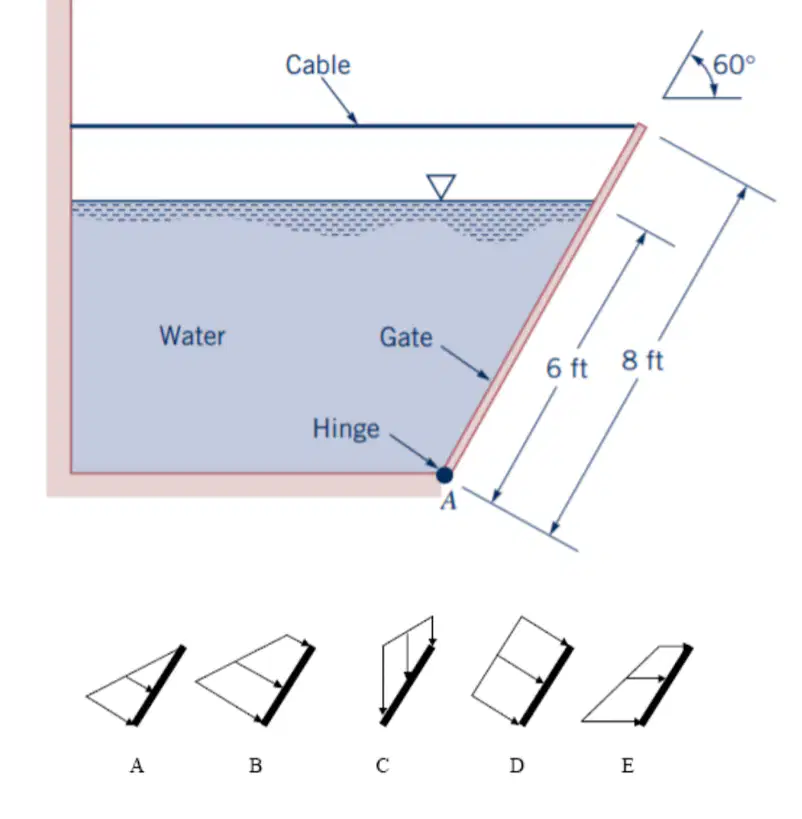
What does the pressure prism look like for the submerged inclined, rectangular gate shown in the figure below?
A
B
C
D
E
The projected area of a curved surface is used in the calculation of which force?
Horizontal force
Both horizontal and vertical forces
Vertical force
The projected area of of cylindrical curved surface is a:
(a)
The magnitude of the vertical force component on a curved surface is equal to the _______________ of the fluid _________________ the curved surface.
Volume; above
Weight; above
Volume; below
Weight; below
The buoyant force is caused by a difference in (a) on an object submerged in a fluid.
Archimedes' principle states that the buoyant force has a magnitude equal to the _____________ of the fluid displaced by the body and is directed vertically upward.
Mass
Volume
Weight
Does the shape of the body matter when applying Archimedes' Principle?
Yes
No
The buoyant force is always present, whether the object floats, sinks, or is suspended in a fluid.
True
False
If a flow is unsteady, its _____________________ may change with time at a given location.
Temperature
Density
Velocity
Velocity, Temperature, and/or Density
If the flow is steady, there can be differences in velocities at different locations in the flow field, True or False?
True
False
If the volume flow rate of water is 0.075 m3s, what is the weight flow rate in N/s?
(a)
Streamlines are ____________________ to the velocity vector of fluid flow at every point.
Tangent
Parallel
Equal
Perpendicular
The velocity at a stagnation point will always be equal to:
(a)
The amount of mass in a system is constant, True or False?
True
False
The (a) equation is the control volume expression for the conservation of mass.
When flow is _____________, you can assume that the mass flow rate in is equal to the mass flow rate out (of a control volume).
unsteady
steady
non-uniform
uniform
What assumptions are made for the following form of the continuity equation?
∑Aoutvout−∑Ainvin=0
Steady, compressible
Steady, incompressible
steady, incompressible, single fluid stream
What is the physical principle behind the momentum equation developed for Fluid Dynamics?
Conservation of mass
First law of thermodynamics
Newtons 1st law of motion
Newtons 2nd law of motion
You must always choose the same direction for your coordinate axis system when solving the momentum equation, True or False?
True
False
If you are analyzing a closed pipe system with the momentum equation, you must consider reaction forces AND forces due to (a) .
Pressure forces always act __________________ a control volume.
perpendicularly towards
parallel to
tangentially to
perpendicularly away from
In order to ignore forces due to gravity (weight) in momentum equations, your system must be oriented ________________.
horizontally
vertically
at an incline
When defining velocity vectors to use in the momentum equation, v1 must ____ the control volume and v2 must ___ the control volume for sign conventions to work properly.
enter;exit
exit;enter
In the derivation of the Bernoulli equation, what is assumed to be negligible?
Streamlines
Pressure effects
Velocity effects
Viscous effects
The Bernoulli equation can be written in terms of heights called what?
Heads
Levels
Elevations
Datums
The velocity at a stagnation point will be greater than the velocity at surrounding areas, True or False?
True
False
In general, the Bernoulli equation states that if the velocity increases, the pressure _______________.
decreases
increases
remains constant
The three components of total head are:
weight, pressure, energy
velocity, pressure, elevation
kinetic, potential, flow
potential, pressure, velocity
The hydraulic grade line (HGL) is a graphical representation of the Bernoulli Equation that excludes which form of energy/head?
Flow/Pressure
Potential/Elevation
Kinetic/Velocity
All of the same simplifications that we applied to the Bernoulli Equation (e.g., 'open atmosphere,' 'stagnant surface,' 'equal elevation,' etc.) can be applied to the General Energy Equation, True or False?
True
False
What is the typical efficiency of pumps and motors?
30-50%
50-70%
70-90%
>90%
If the weight flowrate of a fluid is 0.38 kN/s and a pump adds 50 m of energy to the fluid, what is the power added to the fluid in kilowatts?
(a)
Which pipe diameter should you use in calculations?
Nominal
Inside
Outside
Schedule
Laminar flow is
Re<2000
2000-4000
>4000
Major/friction losses in pipe flow increase as ___________ increases.
Velocity
Pipe diameter
Friction factor
Pipe length
The Moody diagram relates the following variables:
Minor loss coefficient
Darcy friction factor
Pressure
Velocity
Relative roughness and Reynolds’s number
The wholly turbulent friction factor _________________ with increasing Reynolds number.
Is unchanged
Decreases
Increases then decreases
Increases
What are the units of the loss/resistance coefficient (K)?
N or lb
Unitless
Ft or m
N*m or lb*ft
In a sudden enlargement, velocity abruptly increases.
True
False
The resistance coefficient (K) for an exit loss problem is always (a) .
True or False? 90 degree standard elbows cause less energy loss than 90 degree long radius elbows.
True
False
Class 1 series solves for
Pressure at a point
Volume flow rate
Pipe size
Class II Series solves for
Pressure at a point
Volume flow rate
Pipe size
Class III Series solves for
Pressure at a point
Volume flow rate
Pipe size
Friction losses must be calculated for each type of pipe that is in a system
True
False
Pressure drops are proportional to ________.
Volumetric flow rate
Velocity head
Elevation head
Which viscosity is used in the Method III-A equation? (Note: pay attention to this as using the wrong viscosity is a common mistake in these problems!)
Kinematic
Dynamic
Your goal with Method III-A is to solve for the pipe diameter, then choose a pipe or tube with an inner diameter just larger than the diameter you found.
True
False
For parallel pipe systems, flow rates are equal and losses are additive.
True
False
Method A is used when (a) is known
Method B is used when (a) is known
NPSH Available for a pump must be higher than the NPSH required by a certain safety margin in order to prevent cavitation. Different situations/companies/standards may call for different safety margins (for example, the safety margin for pumps involved in flood control is very large). The Mott textbook follows the American National Standards Institute (ANSI) standard, which states an NPSH safety margin of _________ percent.
20
5
3
10
Pressure values in the formula used to calculate NPSH_A are always in absolute pressure units.
True
False
When the pump is located above the reservoir from which it is drawing fluid, the h_s term in the NPSH formula will be ____________ (because the datum is always placed at the level of the pump).
Negative
Positive
What is the nominal size of the suction line in the following pump designation?
3 X 4 - 10
3
4
10
What is the driving force of fluid movement in open channel flow?
(a)
True or false? Weirs and flumes are used to measure flow in open channels because they create conditions where Q can be calculated as a function of the dimensions of the weir or flume and a single depth measurement upstream.
True
False
What are the benefits of using a long-throated flume? (select all that apply)
Less expensive
Simpler than critical flumes
Better for low flows
More adaptable

What is the throat width of the smallest Parshall flume that can measure flows in an open channel that range between 20 and 800 cfs? (Answer in ft)
(a)

