
 Worksheets
anh 11
Total questions: 60
Worksheet time: 43mins
Sinh vật duy trì nòi giống nhờ quá trình nào sau đây?
Hô hấp.
Tiêu hoá.
Sinh sản.
Quang hợp.
As technology develops, some traditional jobs may _______ while new ones appear in digital industries.
improve
increase
disappear
survive
THE GROWING CHALLENGE OF URBANISATION
Every year, millions of people leave the countryside and move to cities in search of better jobs, education, and healthcare. This process, called urbanisation, has been happening rapidly in many parts of the world, especially in Asia and Africa. Cities like Ho Chi Minh City, Jakarta, and Nairobi are expanding quickly as more people arrive to find new opportunities. For many, city life seems full of promise — modern buildings, public transport, and access to services that rural areas may lack. Urbanisation has helped many people escape poverty and build a more comfortable future for their families.
However, the fast growth of cities also creates serious challenges. When too many people move to urban areas too quickly, housing and infrastructure cannot keep up. As a result, some residents must live in small, crowded areas with poor sanitation. Traffic congestion, air pollution, and waste disposal are common problems in large cities. In addition, the high cost of living makes it difficult for low-income families to afford basic needs such as rent, food, or transportation. Some migrants also struggle to find stable jobs or adapt to the fast pace of city life. Without careful planning, the benefits of urbanisation can quickly disappear under these pressures.
To make cities more livable, governments and communities must work together toward sustainable urban development. This means creating more affordable housing, improving public transport, and protecting green spaces. Encouraging people to recycle and use energy efficiently also helps reduce pollution. Education programs can raise awareness about environmental protection and responsible consumption. If cities grow in a balanced and thoughtful way, urbanisation can become a positive force for development and a better quality of life for everyone.
Question 28. Which of the following is NOT mentioned as a result of rapid urban growth?
A. Traffic congestion
.
B. Falling birth rates
C. Poor sanitation
D. High living costs
New urban areas aim to provide residents with modern __________ such as schools, hospitals, and parks
expenses
high-rises
comforts
facilities
Many people move to cities because they hope to find better _______ and living conditions.
vacations
subjects
jobs
hobbies
Local _______ are worried that the new factory may cause air and noise pollution in their neighbourhood.
managers
residents
visitors
tourists
Our company offers __________ working hours and rewards employees based on their performance.
flexible
fixed
limited
stric
Your work experience is __________ to this job position, so you have a high chance of getting hired.
relevant
unnecessary
confusing
unrelated
Cơ sở tế bào học của hình thức sinh sản vô tính đó là:We need to put_______ the meeting until next week because the director is away.
off
out
away
on
THE CHANGING WORKPLACE
The modern workplace looks very different from what it was twenty years ago. Many companies now allow flexible working hours; (31)______, some even let employees choose where they work from. This change has been made possible by advances in technology such as video meetings, online collaboration tools, and cloud storage. As a result, people can share information and complete projects without being in the same office.
Employees are expected to take care(32)______their own performance and results. Instead of waiting for instructions, they need to plan their daily tasks and manage their time carefully. Managers often set clear goals but allow workers to decide how to achieve them. People (33)______ can stay organised and motivated tend to perform better in this kind of environment.
Teamwork remains important, but it often happens online rather than face-to-face. Good communication and digital literacy are essential for success. Employers are encourage to (34)______, because happy and engaged employees usually produce higher-quality work and stay with the company longer.
As the global economy continues to change, new jobs will appear while others may disappear. The key to success is lifelong learning. Employees who keep their skills updated will have a great advantage. In short, flexibility and curiosity will become the most valuable (35)______ in the workplace of the future.
Question 31.
A. instead
B. however
C. therefore
D. for example
A. instead
B. however
C. therefore
D. for example
Mark the letter A, B, C, or D on your answer sheet to indicate the best arrangement of utterances or sentences to make a meaningful exchange or text in each of the following questions.
a. Soft skills such as communication, teamwork, and problem-solving are just as important as academic knowledge.
b. These skills help students work well with others and deal with challenges in real-life situations.
c. Many employers today look for people who not only have good qualifications but also strong soft skills.
d. Developing soft skills at school can make students more successful in their future studies and careers.
e. Therefore, teachers and schools should create more activities that allow students to practice these skills.
b – a – c – d – e
a – b – c – d – e
d – b – c – a – e
c – b – a – d – e
A customer complains their coffee is cold and asks for a hot one.
Customer: Excuse me, this coffee is cold. Could I get a hot one, please?
Waiter: _____. I’ll bring you a new cup right away.
I’m really sorry, sir.
I hope it’s fine.
I’m not quite sure.
I don’t think so
THE GROWING CHALLENGE OF URBANISATION
Every year, millions of people leave the countryside and move to cities in search of better jobs, education, and healthcare. This process, called urbanisation, has been happening rapidly in many parts of the world, especially in Asia and Africa. Cities like Ho Chi Minh City, Jakarta, and Nairobi are expanding quickly as more people arrive to find new opportunities. For many, city life seems full of promise — modern buildings, public transport, and access to services that rural areas may lack. Urbanisation has helped many people escape poverty and build a more comfortable future for their families.
However, the fast growth of cities also creates serious challenges. When too many people move to urban areas too quickly, housing and infrastructure cannot keep up. As a result, some residents must live in small, crowded areas with poor sanitation. Traffic congestion, air pollution, and waste disposal are common problems in large cities. In addition, the high cost of living makes it difficult for low-income families to afford basic needs such as rent, food, or transportation. Some migrants also struggle to find stable jobs or adapt to the fast pace of city life. Without careful planning, the benefits of urbanisation can quickly disappear under these pressures.
To make cities more livable, governments and communities must work together toward sustainable urban development. This means creating more affordable housing, improving public transport, and protecting green spaces. Encouraging people to recycle and use energy efficiently also helps reduce pollution. Education programs can raise awareness about environmental protection and responsible consumption. If cities grow in a balanced and thoughtful way, urbanisation can become a positive force for development and a better quality of life for everyone.
Question 24. Which of the following can be the best title for the passage?
A. Life in the Countryside
B. The Growing Challenge of Urbanisation
C. Modern Buildings and Services
D. Escaping Poverty in Rural Areas
SMART CITIES OF THE FUTURE
As technology continues to advance, many countries are turning their attention to creating smart cities. A smart city uses modern technology and data to make urban life more convenient, safe, and sustainable. Sensors, cameras, and digital systems help manage traffic, energy use, and waste more efficiently. For example, in Singapore, traffic lights adjust automatically to reduce traffic jams, while in Seoul, smart recycling bins send alerts to the city when they are full. These innovations allow cities to operate more smoothly and improve the quality of life for everyone who lives there.
Smart cities also aim to protect the environment and make daily life easier for citizens. By using renewable energy such as solar and wind power, they reduce pollution and save natural resources. In addition, public transport systems powered by clean electricity help lower carbon emissions and make traveling faster and cheaper. Many cities also provide mobile apps that allow residents to track buses, pay bills, or report local problems such as broken streetlights. This level of connection between people and city services encourages community participation and helps local governments respond more quickly to citizens’ needs.
Still, building and maintaining a smart city is not easy. It requires large investments, skilled workers, and strong data protection systems to keep personal information safe. Smaller or developing cities may struggle to afford such advanced technology. Moreover, technology alone cannot solve all urban problems. Issues such as housing shortages, inequality, or unemployment also need social and economic solutions. Nevertheless, experts believe that smart technologies will play a key role in making urbanisation more sustainable in the future. With careful planning, cooperation, and responsible leadership, smart cities can provide both modern comfort and environmental care, showing how innovation can make city life better for all.
Question 26. The word they in paragraph 2 refers to _______.
A. public transport systems
B. smart cities
C. citizens
D. natural resources
THE CHANGING WORKPLACE
The modern workplace looks very different from what it was twenty years ago. Many companies now allow flexible working hours; (31)______, some even let employees choose where they work from. This change has been made possible by advances in technology such as video meetings, online collaboration tools, and cloud storage. As a result, people can share information and complete projects without being in the same office.
Employees are expected to take care(32)______their own performance and results. Instead of waiting for instructions, they need to plan their daily tasks and manage their time carefully. Managers often set clear goals but allow workers to decide how to achieve them. People (33)______ can stay organised and motivated tend to perform better in this kind of environment.
Teamwork remains important, but it often happens online rather than face-to-face. Good communication and digital literacy are essential for success. Employers are encourage to (34)______, because happy and engaged employees usually produce higher-quality work and stay with the company longer.
As the global economy continues to change, new jobs will appear while others may disappear. The key to success is lifelong learning. Employees who keep their skills updated will have a great advantage. In short, flexibility and curiosity will become the most valuable (35)______ in the workplace of the future.
Question 34.
A. motivate
B. motivationally
C. motivational
D. motivation
THE GROWING CHALLENGE OF URBANISATION
Every year, millions of people leave the countryside and move to cities in search of better jobs, education, and healthcare. This process, called urbanisation, has been happening rapidly in many parts of the world, especially in Asia and Africa. Cities like Ho Chi Minh City, Jakarta, and Nairobi are expanding quickly as more people arrive to find new opportunities. For many, city life seems full of promise — modern buildings, public transport, and access to services that rural areas may lack. Urbanisation has helped many people escape poverty and build a more comfortable future for their families.
However, the fast growth of cities also creates serious challenges. When too many people move to urban areas too quickly, housing and infrastructure cannot keep up. As a result, some residents must live in small, crowded areas with poor sanitation. Traffic congestion, air pollution, and waste disposal are common problems in large cities. In addition, the high cost of living makes it difficult for low-income families to afford basic needs such as rent, food, or transportation. Some migrants also struggle to find stable jobs or adapt to the fast pace of city life. Without careful planning, the benefits of urbanisation can quickly disappear under these pressures.
To make cities more livable, governments and communities must work together toward sustainable urban development. This means creating more affordable housing, improving public transport, and protecting green spaces. Encouraging people to recycle and use energy efficiently also helps reduce pollution. Education programs can raise awareness about environmental protection and responsible consumption. If cities grow in a balanced and thoughtful way, urbanisation can become a positive force for development and a better quality of life for everyone.
Question 26. The word crowded in paragraph 2 is closest in meaning to _______.
A. expensive
B. dirty
C. narrow
D. spacious
THE WORLD OF WORK
The world of work is constantly changing, influenced by technology, globalisation, and social trends. In the past, people usually stayed in the same job for many years; (31)_____, many workers now change jobs several times during their careers. This is often because technology develops so quickly that new skills are required all the time, and companies need employees who can keep up with these changes.
Employers today look for people who can apply (32) ______ new situations and learn new things quickly. They also value teamwork, creativity, and problem-solving skills. Workers (33) _____can communicate well are more likely to be successful, especially in international companies where employees often work with colleagues from different cultures and backgrounds.
Another big change is the rise of remote work. Thanks to the internet and digital tools, many people can now work from home or from anywhere in the world. This flexibility helps workers have a better work-life balance and saves time on travelling. However, it also requires strong organisation and self-discipline, because managing your own time can (34) ______ your life.
In the future, experts predict that some traditional jobs will disappear, but many new ones will appear. The most important thing is to keep learning and stay positive about change. Those who are open-minded and motivated will always find opportunities, no matter how the world of work (35)______.
Question 34.
A. effect
B. affect
C. effective
D. effectively
Trường hợp nào sau đây không phải là sinh sản vô tính ở thực vật?
Cây cỏ gấu non phát triển từ rễ củ.
Cây dương xỉ non phát triển từ bào tử.
Cây sắn dây phát triển từ một đoạn thân.
Cây táo non phát triển từ hạt.
Chúng ta có thể nhân giống cây khoai tây bằng bộ phận nào của cây?
Lá.
Thân củ.
Hoa.
Rễ.
Trong thiên nhiên cây tre có thể sinh sản bằng
rễ phụ.
lóng.
thân rễ.
thân bò.
Sinh sản vô tính ở thực vật là cây non được sinh ra mang đặc tính
giống cây mẹ, có sự kết hợp giữa giao tử đực và giao tử cái.
giống cây mẹ, không có sự kết hợp giữa giao tử đực và giao tử cái.
giống bố mẹ, có sự kết hợp giữa giao tử đực và giao tử cái.
giống và khác cây mẹ, không có sự kết hợp giữa giao tử đực và giao tử cái.
Thể giao tử cái ở cây có hoa là
phôi nhũ.
túi phôi.
noãn.
bầu noãn.
Sau khi thụ tinh, noãn biến đổi thành
Thể giao tử cái ở cây có hoa là
phôi nhũ
túi phôi
noãn
bầu noãn
Sau khi thụ tinh, noãn biến đổi thành
quả
hạt
phôi
đài
Hạt phấn chưa phân hoá có hai tế bào trong đó tế bào bé gọi là
tế bào ống phấn
tế bào sinh dưỡng
tế bào sinh sản
giao tử đực
Thụ phấn là quá trình
vận chuyển hạt từ nhị đến đầu nhụy
hợp nhất nhân giao tử đực và nhân tế bào trứng
vận chuyển hạt phấn từ nhụy đến đầu nhụy
hợp nhất giữa nhị và nhụy
Hình thức sinh sản của cây rêu là sinh sản
bào tử
phân đôi
sinh dưỡng
hữu tính
Hình bên mô tả một quá trình (quá trình X) xẩy ra trong sinh sản hữu tính ở thực vật có hoa. Quá trình X là
sự thụ tinh
sự kéo dài của ống phấn
sự thụ phấn
sự phát tán của hạt
Hình bên mô tả sơ đồ cấu trúc của một hoa lưỡng tính. Các bộ phận của hoa được đánh số thứ tự từ 1 đến 4. Quá trình thụ phấn xảy ra ở vị trí nào của hình bên?
Vị trí số 3
Vị trí số 4
Vị trí số 2
Vị trí số 1
Hình bên mô tả cấu trúc của một hoa lưỡng tính. Các bộ phận của hoa được đánh số thứ tự từ 1 đến 4. Sau quá trình thụ tinh, bộ phận phát triển thành quả và hạt lần lượt là
1 và 2
1 và 4
2 và 3
3 và 4
Sơ đồ dưới đây mô tả một phần của cây mẹ. Từ phần cấu trúc nào sẽ phát triển thành cây mới?
Vị trí số 3
Vị trí số 4
Vị trí số 2
Vị trí số 1
Loài thực vật sinh sản bằng bào tử là
xương rồng
vạn tuế
dương xỉ
xấu hổ
Hoa đực không có bộ phận nào
bộ nhuỵ
bộ nhị
đế hoa
đài hoa
Phát biểu nào sau đây là đúng về khái niệm "cảm ứng ở thực vật"?
Phát biểu nào sau đây là đúng về khái niệm "cảm ứng ở thực vật"?
Khả năng phản ứng của thực vật đối với kích thích của môi trường đảm bảo thực vật thích ứng với điều kiện sống thường xuyên thay đổi.
Hình thức phản ứng của một bộ phận của cây trước một tác nhân kích thích theo một hướng xác định đảm bảo thực vật thích ứng với điều kiện sống thường xuyên thay đổi.
Hình thức phản ứng của cây trước một tác nhân kích thích không định hướng đảm bảo thực vật thích ứng với điều kiện sống thường xuyên thay đổi.
Khả năng tiếp nhận và trả lời kích thích của thực vật đối với các kích thích từ môi trường đảm bảo thực vật thích ứng với điều kiện sống thường xuyên thay đổi.
Tập tính động vật là
một số phản ứng trả lời các kích thích của môi trường (bên trong hoặc bên ngoài cơ thể), nhờ đó mà động vật thích nghi với môi trường sống và tồn tại.
chuỗi những phản ứng trả lời các kích thích của môi trường bên ngoài cơ thể, nhờ đó mà động vật thích nghi với môi trường sống và tồn tại.
những phản ứng trả lời các kích thích của môi trường (bên trong hoặc bên ngoài cơ thể), nhờ đó mà động vật thích nghi với môi trường sống và tồn tại.
chuỗi phản ứng trả lời các kích thích của môi trường (bên trong hoặc bên ngoài cơ thể), nhờ đó mà động vật thích nghi với môi trường sống và tồn tại.
Sinh trưởng ở thực vật là quá trình:
chỉ tăng chiều dài cơ thể.
chỉ tăng về chiều ngang cơ thể.
chỉ tăng về khối lượng cơ thể.
tăng về khối lượng và kích thước cơ thể.
Phát triển là:
toàn bộ những biến đổi diễn ra bên ngoài của cá thể, gồm thay đổi chiều cao và cân nặng.
toàn bộ những biến đổi diễn ra trong chu kỳ sống của cá thể, gồm thay đổi về số lượng tế bào, cấu trúc, hình thái, trạng thái sinh lý.
toà
Phát biểu nào sau đây không đúng về đặc điểm sinh trưởng và phát triển ở động vật?
Các phần khác nhau của cơ thể động vật có tốc độ sinh trưởng không giống nhau.
Các loài khác nhau có tốc độ và giới hạn sinh trưởng khác nhau,
Sự phát triển của các cơ quan, hệ cơ ở giai đoạn phôi thai trên một cơ thể là giống nhau.
Cơ thể động vật sinh trưởng với tốc độ không đều có giai đoạn diễn ra nhanh, có giai đoạn diễn ra chậm.
Điều gì sau đây quyết định tuổi thọ của một người?
Yếu tố di truyền và yếu tố môi trường sống.
Chế độ ăn uống và tập luyện hằng ngày.
Chế độ làm việc và nghỉ ngơi.
Lối sống, trạng thái tâm lí và bệnh tật.
Phát biểu nào sau đây đúng về cảm ứng ở sinh vật?
Cảm ứng là sự tiếp nhận và phản ứng của sinh vật đối với những thay đổi của môi trường.
Đảm bảo trước điều kiện với môi trường sống.
Cảm ứng là sự tiếp nhận kích thích của sinh vật đối với những thay đổi của môi trường.
Cảm ứng là phản ứng của sinh vật đối với những thay đổi của môi trường.
Ở động vật, phản xạ là gì?
Phản ứng của cơ thể trả lời lại các kích thích bên ngoài hoặc bên trong cơ thể
Phản ứng của cơ thể thông qua hệ thần kinh chỉ trả lời các kích thích bên trong của cơ thể.
Phản ứng của cơ thể thông qua hệ thần kinh chỉ trả lời các kích thích bên ngoài cơ thể
Phản ứng của cơ thể thông qua hệ thần kinh trả lời các kích thíc
Khi nói về sinh trưởng thứ cấp, phát biểu nào sau đây là đúng?
Sinh trưởng thứ cấp là sự gia tăng về chiều dài của cơ thể thực vật
Sinh trưởng thứ cấp là do hoạt động của mô phân sinh bên
Sinh trưởng thứ cấp có ở tất cả các loài thực vật hạt kín
Sinh trưởng thứ cấp chỉ có ở thực vật một lá mầm
Khi nói về vai trò điều tiết quá trình sinh trưởng và phát triển của hormone thực vật, phát biểu nào sau đây là sai?
Sự phân hóa giới tính của hoa liên quan đến hàm lượng hormone trong cây.
Ở cây non nhiều rễ phụ thì đa phần sẽ phát triển thành cây đực.
Cây có ít rễ và nhiều lá, có sự cân bằng hormone thì tỷ lệ hoa đực và hoa cái bằng nhau, giới tính đực cái cũng ở trạng thái cân bằng.
Cây có nhiều rễ và ít lá, có sự cân bằng hormone thì tỷ lệ hoa đực bằng hoa cái, giới tính đực cái cũng ở trạng thái cân bằng.
Nhận xét nào dưới đây là sai về sinh trưởng và phát triển ở động vật?
Sự phát triển của động vật bao gồm ba quá trình liên quan mật thiết với nhau là sinh trưởng, biệt hóa tế bào và phát sinh hình thái.
Cơ thể động vật được hình thành do kết quả của quá trình phân hóa của hợp tử.
Đặc điểm của quá trình sinh trưởng và phát triển của động vật thay đổi tùy theo điều kiện sống của chúng.
Sự sinh trưởng là sự gia tăng kích thước cũng như khối lượng cơ thể động vật theo thời gian.
Nhân tố bên trong nào quan trọng điều khiển sinh trưởng và phát triển của động vật?
Nhân tố di truyền.
Tuổi thọ.
Thức ăn.
Nhiệt độ và ánh sáng.
Ở thực vật có hoa, quá trình hình thành hạt p
Trong điều khiển sinh trưởng và phát triển của động vật?
Nhân tố di truyền.
Tuổi thọ.
Thức ăn.
Nhiệt độ và ánh sáng.
Ở thực vật có hoa, quá trình hình thành hạt phấn trải qua:
1 lần giảm phân, 3 lần nguyên phân
1 lần giảm phân, 4 lần nguyên phân
1 lần giảm phân, 1 lần nguyên phân
1 lần giảm phân, 2 lần nguyên phân
Thụ thể nào tiếp nhận kích thích đau?
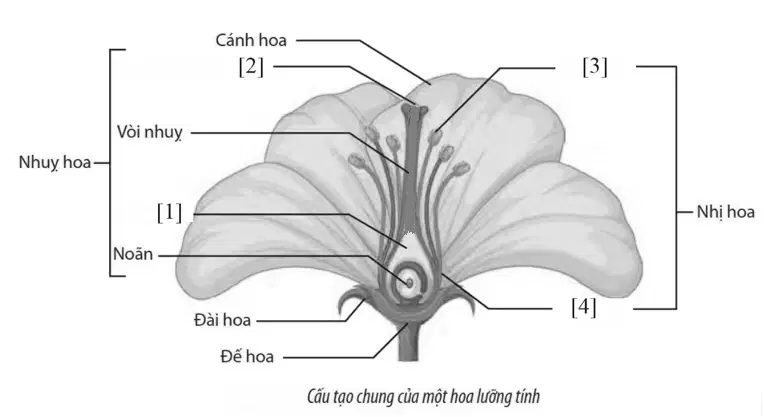
Dựa trên cấu tạo hoa (hình dưới) và vai trò các bộ phận, các phát biểu sau là đúng hay sai?
[1] là nơi chứa một hay nhiều noãn phụ thuộc vào loài, noãn qua quá trình biến đổi hình thành túi phôi chứa tế bào trứng.
[2] là đầu nhụy.
[3] là bao phấn, chứa các túi tiểu bào tử là cấu trúc sinh ra hạt phấn.
[4] là chỉ nhị, nơi chứa các giao tử cái.
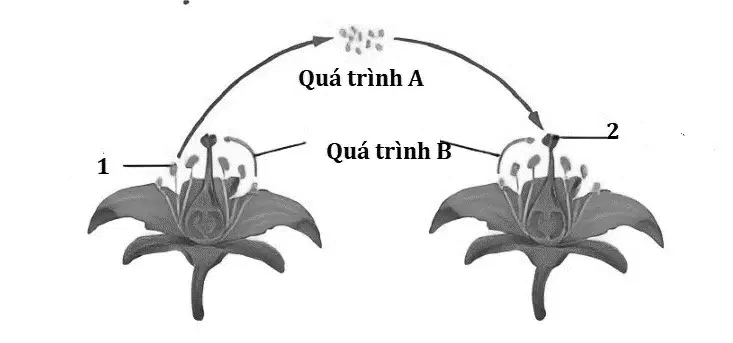
Hình bên mô tả quá trình sinh sản hữu tính ở thực vật, mỗi nhận định sau đây là Đúng hay Sai khi nói về quá trình này?
Quá trình B là quá trình thụ phấn chéo, quá trình A là tự thụ phấn
Quá trình B có thể làm giống thoái hóa qua nhiều thế hệ.
Quá trình A được thực hiện nhờ sự hỗ trợ của các loài như ong, bướm hoặc tác động của gió.
Quá trình A có thể tạo ra các giống mới có các phẩm chất tốt hơn so với giống ban đầu.
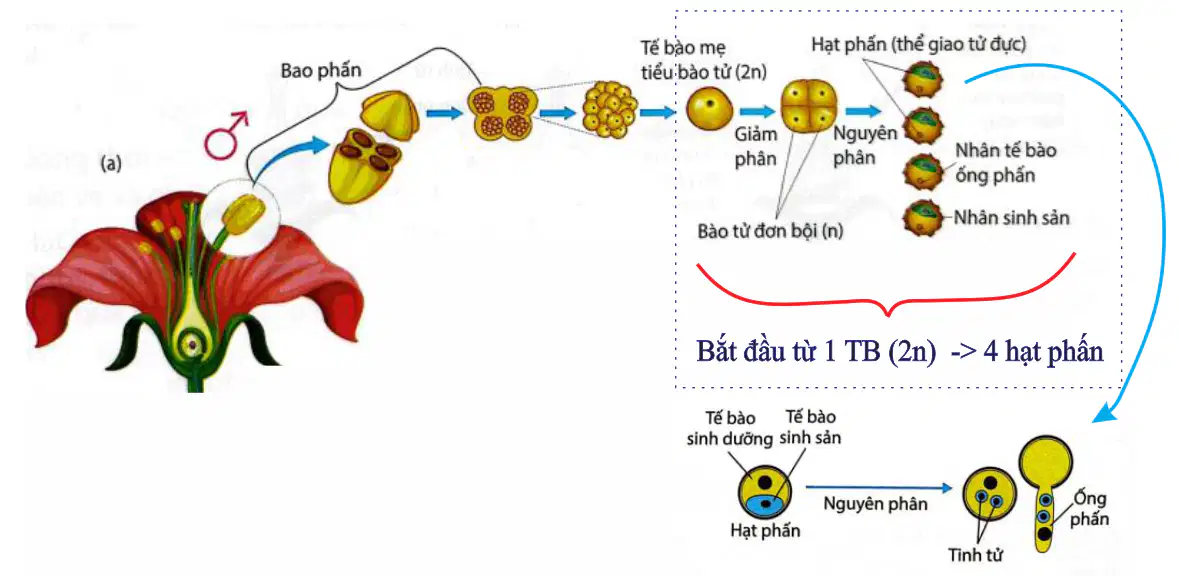
Khi nói đến quá trình hình hạt phấn (hình) ở thực vật có hoa. Mỗi nhận định sau đây là Đúng hay Sai về quá trình này.
Trong bao phấn, mỗi tế bào mẹ (2n) giảm phân → 4 tế bào con (n), mỗi tế bào con (n) nguyên phân 1 lần → 1 hạt phấn (thể giao tử đực).
Mỗi hạt phấn có 4 tinh tử (giao tử đực n).
Hạt phấn chính là giao tử đực của cây
Trong mỗi hạt phấn tạo ra có tế bào sinh sản (2 tinh tử n) và tế bào ống phấn.
Hình dưới mô tả túi phôi ở thực vật có hoa, hãy cho biết mỗi nhận định sau đây Đúng hay Sai?
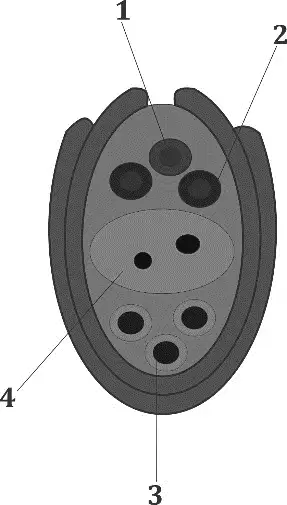
Hình dưới mô tả túi phôi ở thực vật có hoa, hãy cho biết mỗi nhận định sau đây Đúng hay Sai?
Các số chú thích là: (1) Tế bào kèm, (2) trứng, (3) tế bào đối cực, (4) tế bào nhân cực
Tế bào mẹ (2n) của noãn xảy ra các lần phân bào gồm một lần giảm phân và 3 lần nguyên phân để tạo ra túi phôi
Số (1) là hợp tử cái kết hợp với hợp tử đực tạo thành hợp tử 2n
Tinh tử kết hợp với tế bào nhân cực (2n) tạo thành nhân tam bội (3n)
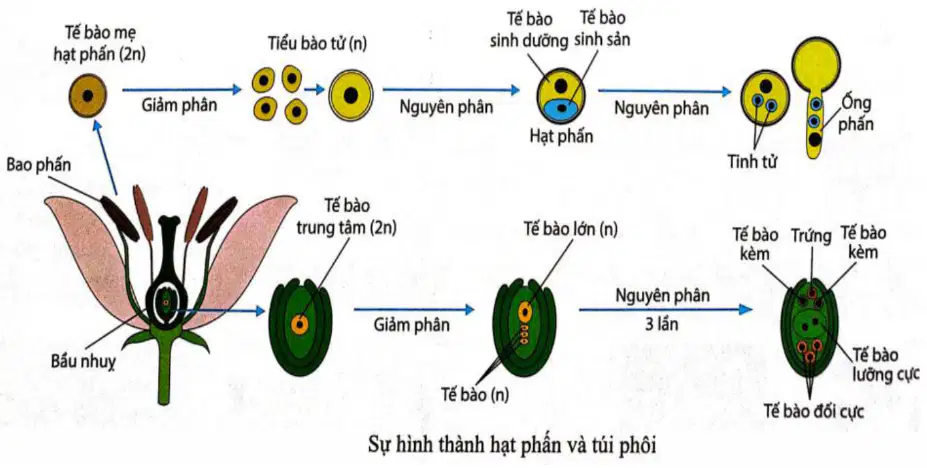
Nhận đinh nào sau đây là Đúng hay Sai khi nói đến quá trình hình thành hạt phấn và túi phôi (hình) ở thực vật có hoa?
Túi phôi (thể giao tử cái) được hình thành từ sự biến đổi của tế bào trong cấu trúc noãn
Tế bào mẹ đại bào tử (2n) nằm trong túi đại bào tử qua giảm phân rồi nguyên phân 3 lần tạo thành 8 tế bào (gồm 1 tế bào trứng, 2 tế bào nhân cực, 3 tế bào đối cực và 2 tế bào kèm), lúc này túi đại bào tử được gọi là túi phôi
Trong túi phôi gồm: 1 tế bào trứng, 2 tế bào nhân cực, 3 tế bào đối cực và 2 tế bào kèm
Tế bào trứng trong túi phôi sẽ kết hợp với tinh tử của hạt phấn tạo nên phôi nhũ

Quan sát Hình và cho biết mỗi nhận định sau đây là Đúng hay Sai khi nói về sinh sản của cây dưa chuột?
Sự sinh sản của dưa chuột diễn ra khi bào tử trong nhụy hoa được thụ phấn bởi phấn hoa từ bậc sinh dục khác
Quá trình thụ phấn này sẽ tạo ra hạt giống có đầy đủ vật chất di truyền giống cơ thể ban đầu
Trong quá trình sinh sản này, sự trộn lẫn của vật chất di truyền từ cả hai cá thể (đực và cái) nên cá thể mới luôn giống hệt thế hệ trước
Trong quá trình sinh sản này luôn sinh ra thế hệ con có những đặc điểm khác so thế hệ trước
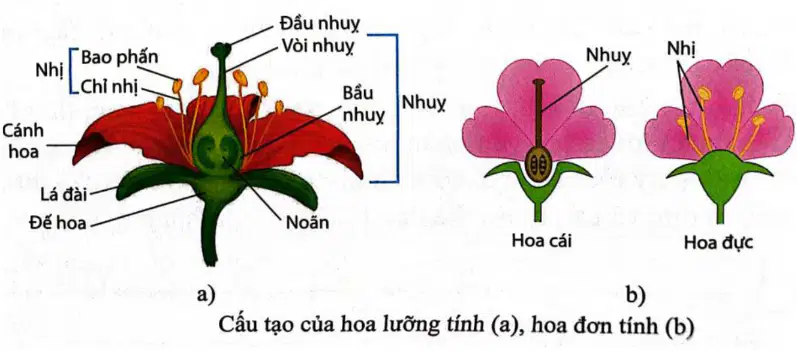
Nhóm học sinh A khi tìm hiểu về cấu tạo của hoa lưỡng tính và vai trò các bộ phận của hoa đã rút ra 4 kết luận sau: Mỗi kết luận sau đây của nhóm học sinh A là Đúng hay Sai?
Hoa lưỡng tính là hoa có cả cơ quan đực và cơ quan cái trên cùng một hoa.
Hoa đơn tính là hoa chỉ có một loại cơ quan sinh sản trên mỗi hoa, trên mỗi cây chỉ có hoa đực hoặc hoa cái
Nhụy hoa là cơ quan cái, và có chức năng tiếp nhận phấn hoa để thụ tinh.
Các nhị hoa chứa phấn hoa, là cơ quan đực, có thể sinh ra hạt phấn để thụ tinh.
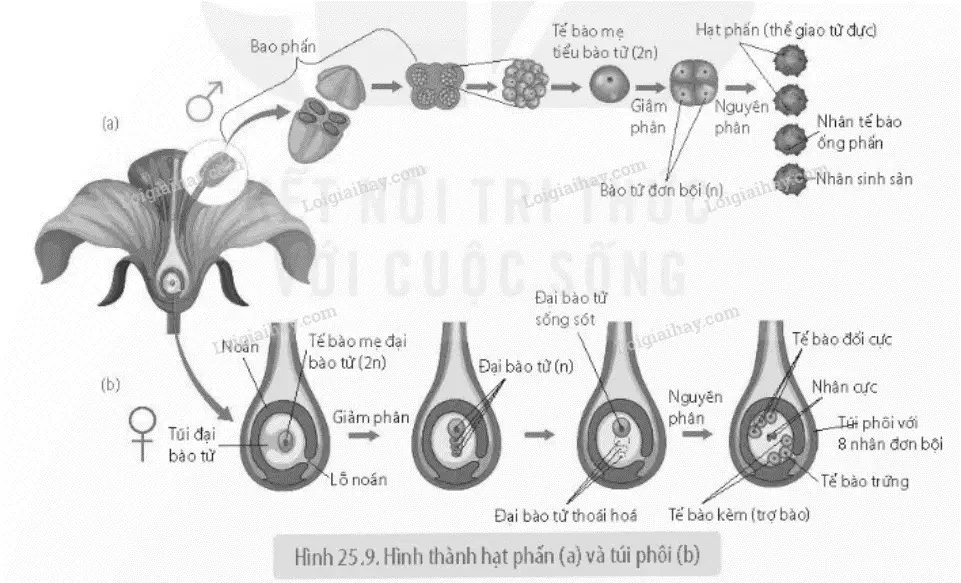
Dựa vào sơ đồ dưới đây, hãy cho biết nhận định nào Đúng, nhận định nào Sai khi nói về quá trình hình thành hạt phấn và túi phôi ở thực vật?
Một tế bào sinh noãn (2n) giảm phân tạo 4 tế bào đơn bội (n) nhưng 3 trong 4 tế bào bị thoái hoá.
Ở thực vật có hoa, hạt phấn chính là giao tử đực tham gia thụ tinh với noãn.
Túi phôi có noãn cầu và nhân cực (2n) tham gia thụ tinh kép.
Mỗi bao phấn chứa một tiểu bào tử (2n) và giảm phân hình thành 4 bào tử đơn bội (n), mỗi bào tử nguyên phân hình thành một hạt phấn.

