
 Worksheets
Networking Week 3
Total questions: 29
Worksheet time: 15mins
An IPv4 address can be broken down into two parts. These are:
Network portion and transport portion
Network portion and host portion
Gateway portion and host portion
Source portion and destination portion
How many bits make up an IPv4 address?
8
16
32
64

CHOOSE 3
A,B,G
A,E,G
B,F,D
I,H,F
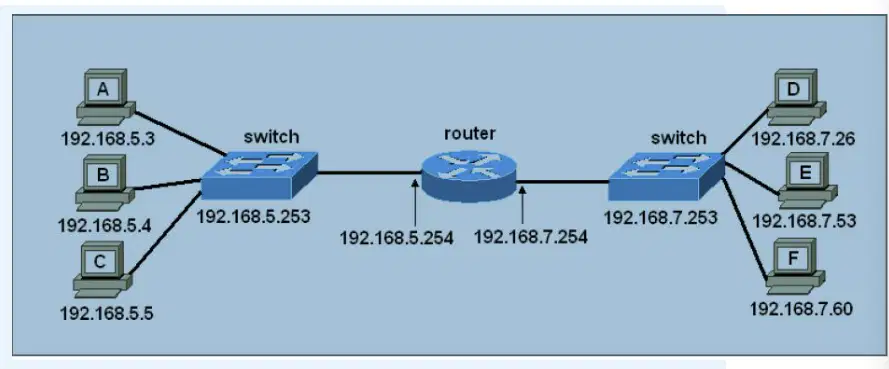
Refer to the diagram. A packet header has destination IP address 192.168.5.4 and source IP address 192.168.7.60. Which workstation should receive the packet?
A
B
C
D
E
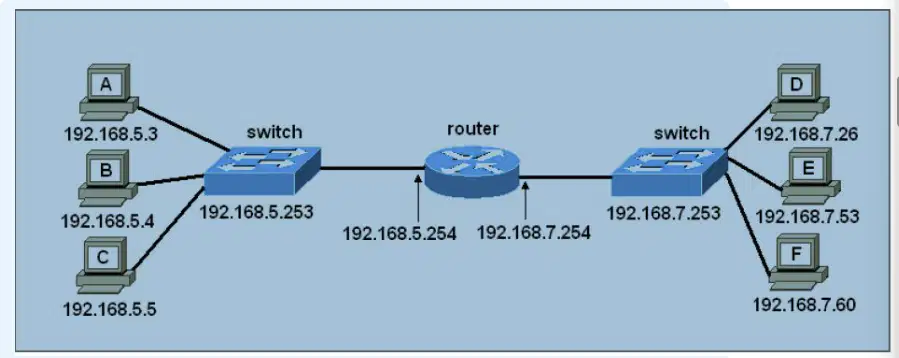
Refer to the diagram. A packet header has destination IP address 192.168.5.4 and source IP address 192.168.7.60. Which workstation originated the packet?
A
B
C
D
F
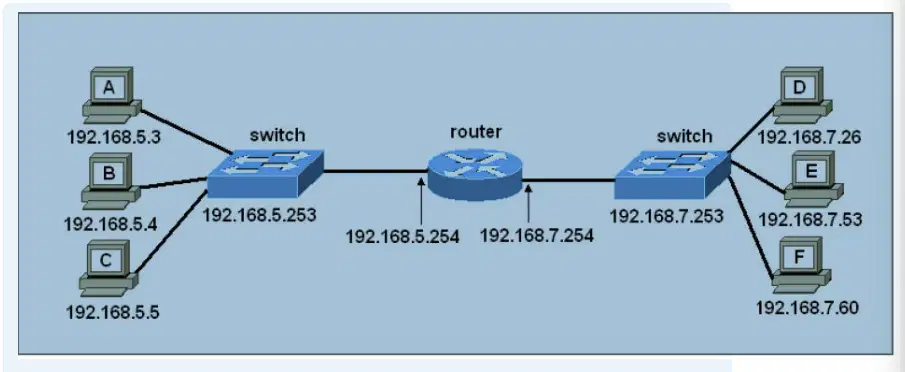
Refer to the diagram. Host A is sending a packet addressed to host F. What will the router do?
It will use the destination IP address to work out the network address
192.168.7.0 and forward the packet to this network.
It will use the destination IP address to work out the network address
192.168.5.0 and forward the packet to this network.
It will use the source IP address to work out the network address 192.168.7.0
and forward the packet to this network.
It will use the source IP address to work out the network address 192.168.5.0
and forward the packet to this network.
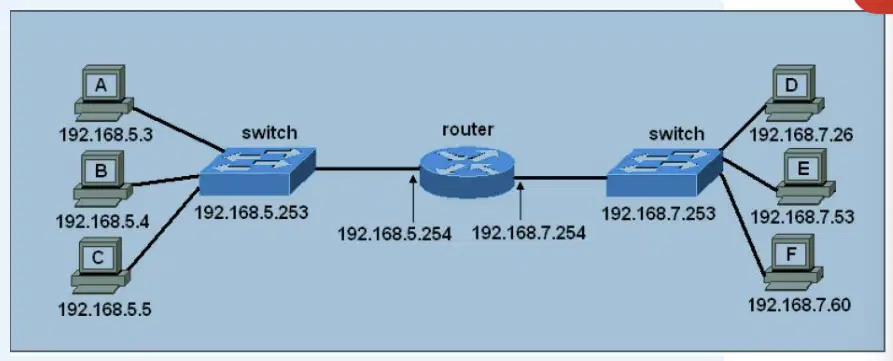
Refer to the diagram . If the default gateway configured on host A is wrong, what is the likely effect?
Host A will not be able to communicate with any other host.
Host A will be able to communicate with its local switch and router but not
with any other workstation.
Host A will be able to communicate with workstations B and C, but not D, E
or F.
Host A will be able to communicate with workstations D, E and F but not B or
C.
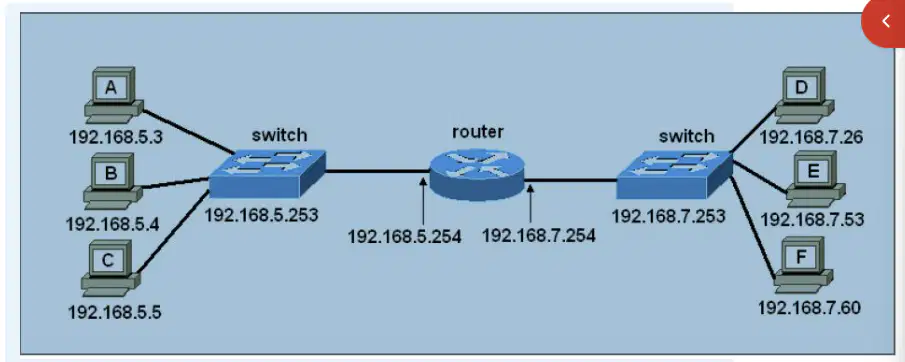
Refer to the diagram. The router receives a packet addressed to 192.168.6.24. What will the router do? (Choose 2 options.)
The router will drop the packet.
The router will send the packet on the default route if one exists.
The router will forward the packet to all connected networks.
The router will forward the packet to the 192.168.7.0 network.
The router will forward the packet to the 192.168.5.0 network.

Refer to the diagram. What is the address of the network that host D is on?
192.168.7.26
192.168.7.20
192.168.7.253
192.168.7.254
192.168.7.0
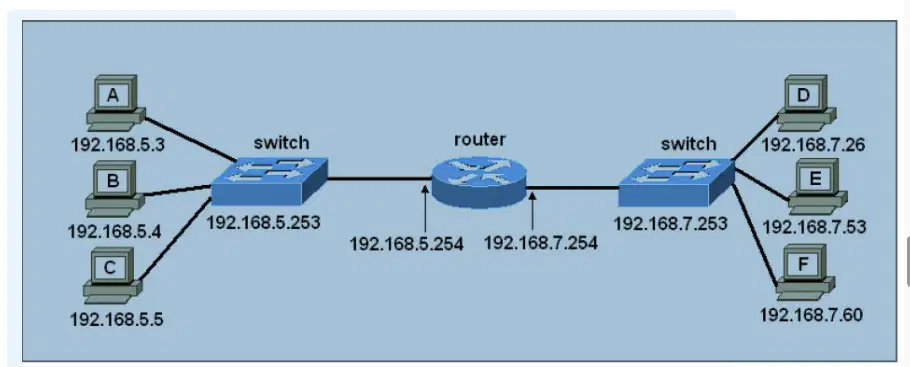
Refer to the diagram. What should be configured as the default gateway for host A?
192.168.5.3
192.168.5.253
192.168.5.254
192.168.7.254
.
192.168.7.253
The network layer PDU is called
A frame
A segment
A packet
A header
What contact does IPv4 make with the destination before sending a packet?
It sends a message to say that a packet will be arriving.
It sends a message to say that a packet will be arriving.
It checks that the destination host exists.
It checks that the destination host is ready to receive.
It does not make any contact before sending
What do routers use to share routing information and keep their routing tables up to
date?
A routing protocol
The network layer IP protocol
The transport layer TCP protocol
The transport layer UDP protocol
What information from a packet does a router use in order to choose a route for
forwarding the packet?
Source port number
Destination port number
Host portion of destination IP address
Host portion of source IP address
network portion of destination IP address
What is a broadcast message?
A message originated by a router.
A message originated by a switch.
A message addressed to all routers.
A message addressed to all hosts on the local network.
What name is given to a device that has an IPv4 address?
Server
Host
Switch
Workstation
Router
What name is given to one stage of a packet's journey as it moves from one router to
the next?
Trip
Hop
Step
Section
When would a PC need a default gateway address?
When it sends any packet.
When it sends a packet to another PC on its own network.
When it sends a packet to a host on a different network
When it does not know the IP address of the destination host.
Which addresses are added during encapsulation at the network layer? Choose all that
apply.
Source IP address
Source MAC address
Destination IP address
Destination MAC address
Destination port number
Which device can limit the spread of broadcasts?
Router
Switch
Hub
Hub
Which field in the IP packet header allows checking for data transmission errors?
Destination IP address
Source IP address
Type-of-service
Checksum
Protocol
Which field in the IP packet header allows some packets to have priority over others?
Destination IP address
Source IP address
Type-of-service
Time to live
Protocol
Which field in the IP packet header is used to prevent undeliverable packets from
circulating endlessly?
Destination IP address
Time to live
Type-of-service
Protocol
Source IP address
Which function is the responsibility of the network layer?
Encoding signals to put them on the transport medium.
Re-sending packets that have been lost in transmission
Finding the best route for a packet to travel to its destination.
Managing the access of hosts to the transport medium.
Which is true of dynamic routing?
The router forwards packets through a different interface each time
The router has been configured with a default route.
Routes are entered manually by an administrator.
The router learns routes from other routers
Which is true of static routing?
The router always sends packets on the same route.
The router been configured with a default route.
Routes are entered manually by an administrator.
The router learns routes from other routers.
Which layer of the OSI model is the network layer?
Layer 2
Layer 3
Layer 4
Layer 5
Layer 6
Which statements are true of IPv4? Choose all that apply.
It is connection-oriented
It is connectionless
It is best-effort
It is reliable
Why may a router have more than one IP address?
It needs an address for incoming packets and an address for outgoing packets.
Each router interface (port) is normally on a different network and needs an
address on that network.
It needs an address for communicating with hosts and separate addresses for
communicating with other routers.
It needs a separate address for each entry in its routing table

