
Font size
 Worksheets
PS Final Review 24-25
Total questions: 67
Worksheet time: 4hrs 10mins
Nickel (Ni) is an effective conductor of heat and electricity. Select all of the other elements that most likely to have similar conductivities.
Phosphorus (P)
Copper (Cu)
Krypton (Kr)
Iodine (I)
Potassium (K)
Elements with the same number of valence electrons are likely to:
have the same atomic number
have similar chemical properties
have the same neutron count
have the same number of energy levels
What type of reaction occurs when sodium reacts with chlorine to produce sodium chloride (NaCl)?
synthesis
decomposition
single displacement
double displacement
What is a key distinction between nuclear fission and nuclear fusion?
Fission splits larger atoms, while fusion does not.
Fission releases energy without needing an initial input, unlike fusion.
Fission combines smaller atoms, while fusion does not.
Fission requires energy to start a reaction, unlike fusion.
Burning wood and rusting iron are two processes that involve chemical changes. Why are these processes considered chemical changes?
They change the color of the material.
They produce new substances.
They change the temperature.
They absorb light.
In 1909, scientist Ernest Rutherford conducted an experiment by bombarding a thin sheet of gold foil with alpha particles. The observation that some particles were deflected at large angles led Rutherford to conclude that
gold atoms have a dense, positively charged nucleus.
gold atoms are capable of forming ionic bonds.
gold atoms have electrons that are free to move.
gold atoms are larger than other metal atoms.
What is the primary difference between the isotopes Plutonium-238 and Plutonium-242?
number of neutrons in the nucleus
position in the periodic table
amount of positive charge
chemical reactivity
What is the correct name for the compound with the formula FeO?
iron oxide
iron monoxide
iron(II) oxide
iron(III) oxide
Which of the following chemical equations illustrates the principle of conservation of mass?
2H₂ + O₂ → H₂O
CH₄ + 2O₂ → CO₂ + 2H₂O
2Na + Cl₂ → 2NaCl
Fe + S → Fe2S

While the substance is a solid, at what temperature do the molecules of the substance have the greatest average kinetic energy?
5°C
60°C
40°C
0°C
Which element on the periodic table would likely exhibit similar reactivity as the element Chlorine?
an element in the same group
an element in the same period
an element in the noble gasses
an element with the same atomic mass
Which statement best explains the process of evaporation?
Water changes state by releasing heat to the surroundings.
Water boils as it gains energy from underneath.
Water turns into vapor as it absorbs energy at the surface.
Water changes state as its heat is transferred to the air.
How did Thomson’s model describe the positively charged part of the atom?
particles that are identical to electrons but having an opposite charge
particles that are much bigger than the electron and having an opposite charge
a fluid mass with electrons embedded throughout with a total positive charge equal to the total negative charges of the electrons
a fluid mass surrounding the electrons with individual positive charges that overlap each electron
Which of the following pH values indicates a weak basic solution?
3
5
8
12
Based on its position in the periodic table of the elements, how many valence electrons does Boron (atomic number 5) have?
3
5
8
15
What are the reactants in the chemical reaction below? NaOH + HCl → NaCl + H₂O
sodium hydroxide and hydrogen chloride
sodium chloride and water
sodium, chlorine, hydrogen, and oxygen
sodium, chlorine, and water
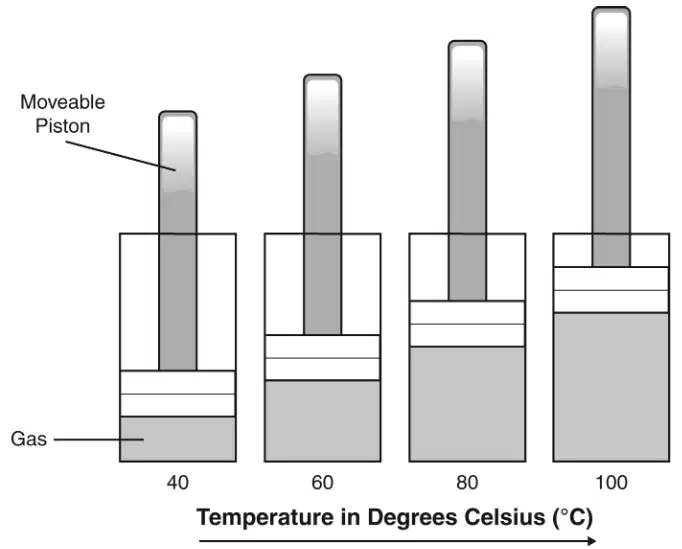
According to the diagram, what aspect of the gas is altered as temperature increases?
weight
volume
phase
mass
What is the result of burning a substance?
It vanishes completely.
It is entirely converted into light energy.
It transforms into different forms of matter and energy.
It simply changes into a vapor state.
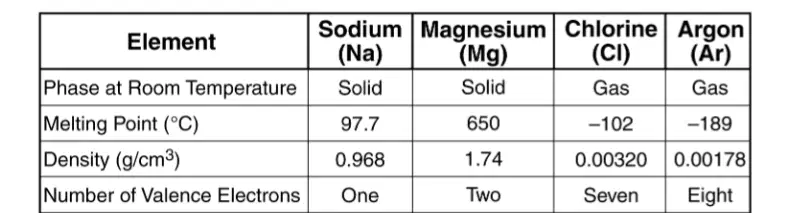
The table shows some physical properties of four elements. Which element on the periodic table most likely has physical properties similar to sodium?
calcium (Ca)
neon (Ne)
phosphorus (P)
potassium (K)
What information does a chemical equation give us?
the duration of the reaction
the method to safely conduct the reaction
the energy change involved in the reaction
the substances that are involved in the reaction

As part of the digestive process, enzymes split large carbohydrate molecules into smaller units. The diagram shows several products of the digestion of glycogen. If 4 grams (g) of glycogen is split into maltose, what is the total mass of the product?
1 g
2 g
3 g
4 g
On the pH scale, which value represents the most basic solution?
A. 2
B. 5
C. 8
D. 14
Which process will cause a chemical change?
placing the substance in the freezer
igniting the substance with a match
breaking the substance into smaller pieces
covering the substance with aluminum foil
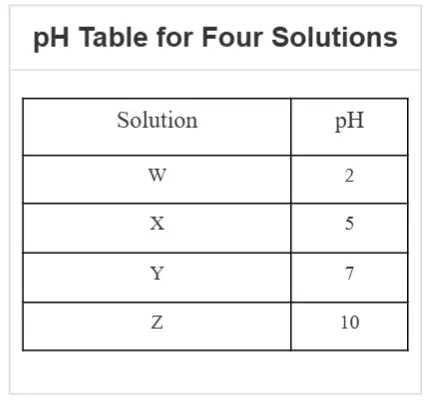
Which conclusion about Solution W is best supported by the data?
Solution W is less acidic than Solution X.
Solution W is neutral.
Solution W is more basic than Solution Y.
Solution W is more acidic than Solution X.
What pH range is typically associated with acidic solutions?
3–5
6–8
8–10
11–13
Name the following compound: P5Cl2
Phosphorus Dichloride
Pentaphosphorus Dichloride
Pentapotassium Dichloride
Phosphorus Chloride
Which of the following is an example of a chemical change?
milk turning sour
ice melting into water
salt dissolving in water
glass breaking
Elements in the same group on the periodic table all have
the same energy levels.
similar electron configurations.
strong radioactive properties.
few or no stable isotopes.
Two isotopes of the same element must have different numbers of
Protons
Electrons
Neutrons
Charge
A student knows that Sodium atoms and Chlorine atoms combine to form NaCl. The student correctly predicts that Sodium and Fluorine will combine to form Sodium Fluoride, NaF. On what is this prediction most likely based?
Chlorine and fluorine are in the same group with the same number of valence electrons.
Chlorine and fluorine are in the same period or row with the same number of neutrons.
Chlorine and fluorine are in the same period or row with the same number of protons.
Chlorine and fluorine are in the same group with the same number of energy levels.
What is nuclear fusion?
a process in which the nucleus of an atom combines with the nucleus of another atom to form a single heavier nucleus
a process in which the nucleus of an atom combines with the nucleus of another atom to form several lighter nuclei
a process in which the nucleus of an atom splits into individual protons and neutrons
a process in which the nucleus of an atom splits into two or more lighter nuclei
What pH should be added to make a substance more alkaline?
3.1
4.4
9.9
5.3
A balloon with an initial circumference of 30 cm was placed in a cold environment, causing the circumference to decrease to 28 cm. What is the most likely explanation for this observation?
The molecules inside the balloon gained energy from the cold.
The molecules inside the balloon lost energy to the cold.
The energy of the molecules inside the balloon remained constant.
The molecules inside the balloon were absorbed by the cold environment.
Ernest Rutherford made contributions to
(a) with his gold foil experiment.
kinetic molecular theory
plate tectonic theory
natural selection theory

Order the diagrams from lowest kinetic energy to highest kinetic energy.
Diagram II
Diagram I
Diagram III
What is the correct hyphen notation for an isotope that has 22 protons and 26 neutrons?
(a)
Iron-56
Iron-26
Titanium-26
Titanium-22
What is the correct formula for disulfur trifluoride?
S2F5
SF10
S2F3
S2F
Which atom is the product of this nuclear decay process?
91231Pa→ ? + 24He
89227Ac
87223Fr
93238Np
89223Ac

Mrs. Weitzel is preparing a demonstration with Lithium Chloride. She dissolves 80.0 g of the solute in 100.0 mL of water in a flask at a temperature of 80.0°C. She then allows the solution to cool to 20.0°C. According to the solubility chart, after cooling the solution is...
Unsaturated
Saturated
Supersaturated
Titrated
a substance that consists of just one type of atom
element
a small particle that is a building block of matter
atom
a combination of two or more substances physically blended together
mixture
anything that has mass and takes up space
matter
Match the following.
color
shape
size
texture
flammable
pH
ability to tarnish
state of matter
reaction to oxygen
A type of heterogeneous mixture that contains a liquid where the visible particles settle.
colloid
suspension
solution
Matter is separated into 2 main categories. (a) have a fixed position. (b) have a composition that can vary or physically combine.


Match the following
Pure Substance
One element or one compound.
Mixture
Two or more substances not combined.
Element
Contains only one kind of atom.
Compound
Contains two or more kinds of atoms.

Which box has a higher density?
A
B
They are the same
Label the diagram with the correct state of matter.
Solid
Liquid
Gas

Where on the graph is the substance a gas?
A to B
B to C
C to D
D to E
E to F
Where on the graph is the substance a solid?
A to B
B to C
C to D
D to E
E to F

Why does this picture demonstrate the Law of Conservation of Matter?
the number of atoms of each element are the same on both sides
they start out separate and end up combined
the same elements are used
it doesn't demonstrate the Law of Conservation of Matter

What is the number of protons in this carbon atom?
12
6
18
24
Who was the first to state the concept of an atom?
Bohr
Dalton
Rutherford
Democritus
What did Rutherford's gold-foil experiment help him conclude?
The mass of the atom is equivalent to the number of protons alone.
The mass of the atom is negligible.
The mass of the atom is mostly located in a small nucleus.
The mass of the atom is equivalent to the number of neutrons alone.
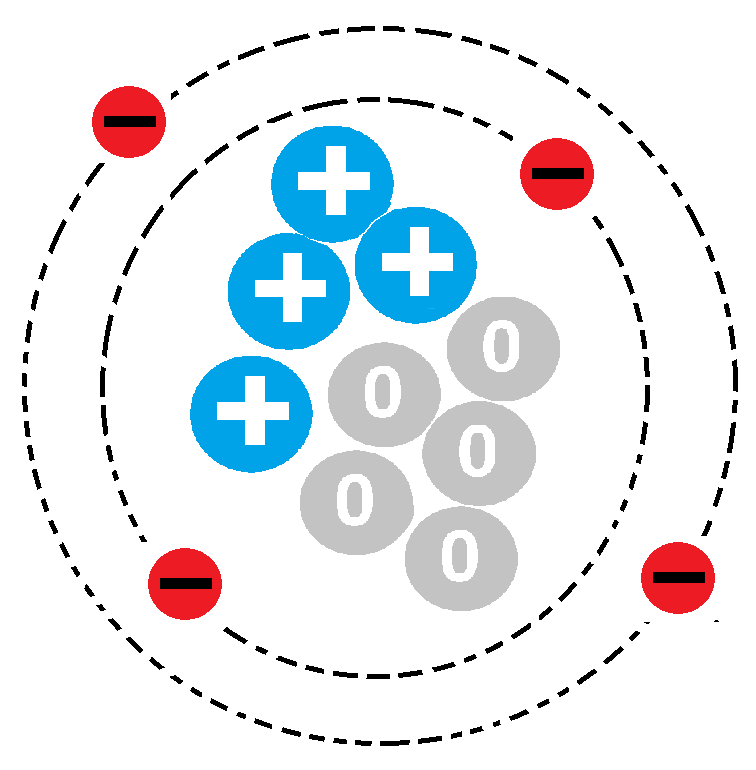

This picture best represents ___________________ atomic model.
Thomson's
Dalton's
Bohr's
Chadwick's

An atom has 12 protons and 13 neutrons in its nucleus. Which is the correct symbol?


What are the vertical columns on the periodic called?
groups
periods
nonmetals
metals
metalloids
What do the vertical columns on the periodic table tell us?
The number of orbitals
The number of valence electrons (electrons on the outer most shell)
What are the horizontal rows on the periodic table called?
periods
groups
metals
nonmetals
metalloids

What is the name of the element? (Periodic table will be needed)
sodium
magnesium
vanadium

Who discovered the nucleus?
Rutherford
Bohr
Thomson
Dalton

Who discovered the electron?
Rutherford
Bohr
Thomson
Dalton
How many valence electrons and energy levels does (Pb) lead have?
4 valence electrons and 6 energy levels (orbitals)
6 valence electrons and 4 energy levels (orbitals)
5 valence electrons and 5 energy levels (orbitals)
5 valence electrons and 10 energy levels (orbitals)
Which of the following elements is a noble gas?
Oxygen
Chlorine
Helium
Carbon

