

Wayground logo

Free Printable Worksheets

Font size

S
M
L
XL
Worksheets

Year 11 Edexcel Mixed Revision HPA

Total questions: 101

Worksheet time: 1hrs 16mins

Name
Class
Date
1.

What is meant by physical security controls

a)

systems put in place to stop people from accessing networks

b)

systems put in place to stop network servers and hardware from being stolen

c)

systems put in place to stop networks form accessing people

d)

systems put in place to help network servers and hardware being used

2.

What is a firewall

a)

a network security device that monitors network traffic and decides whether to allow or block specific traffic

b)

a network security device that monitors incoming and outgoing network traffic and decides whether to allow or block specific traffic based on a defined set of security rules

c)

a network security device that monitors incoming network traffic and decides whether to allow or block specific traffic based on a defined set of security rules

d)

a network security device that monitors outgoing network traffic and decides whether to allow or block specific traffic based on a defined set of security rules

3.

What is ‘authentication’ in computing?

a)

the process or action of verifying the identity of a computer

b)

the process or action of verifying the identity of a protocol

c)

the process or action of verifying the identity of a network

d)

the process or action of verifying the identity of a user or process

4.

A data packet header will not contain....

a)

the sending address

b)

the packet number

c)

the recipient address

d)

the senders name

5.

Packets contain data and a header

a)

True

b)

False

6.

Data packets are all sent together, via the same route, when transmitted across a network

a)

True

b)

False

7.

Data is broken into small pieces for transmission, the peices are called...

a)

Data pixels

b)

Data parcels

c)

Data pockets

d)

Data packets

8.

What does the Transport Layer of a protocol stack do?

a)

It is not a layer

b)

Manages end to end communications

c)

Manages end to end networks

d)

Manages end to end protocols

9.

What does the Application Layer of a protocol stack do?

a)

Interacts with otherprotocols to provide access to services and data

b)

Interacts with the ISP to provide access to services and data

c)

Interacts with the network to provide access to services and data

d)

Interacts with the user to provide access to services and data

10.

What does the Link Layer of a protocol stack do?

a)

Controls sending/receiving packets of data to the local network

b)

Controls sending packets of data to the local network

c)

Controls receiving packets of data to the local network

d)

It is not a Layer in a protocol stack

11.

Which two protocols would be used to transmit a file via the internet?

a)

DNS

b)

HTTPS

c)

SMTP

d)

FTP

12.

A protocol stack / suite is used for this

a)

To use several protocols together

b)

To use one protocol closely followed by the next

c)

To transfer protocols from one network to another

d)

To transfer data from one protocol to the next protocol

13.

Which statement is true

a)

SMTP is used for receiving and sending mail and POP3 is no longer used

b)

SMTP is used for receiving and sending mail and POP3 is used to open mail

c)

SMTP is used for receiving mail and POP3 is used to send mail

d)

SMTP is used for sending mail and POP3 is used to receive mail

14.

Which is IMAP more widely used?

a)

you do not need a protocol to use it

b)

it is faster than POP3

c)

you see the same messages wherever and however you access your email

d)

it is cheaper than POP3

15.

The protocol for mail transfer is

a)

HTTPS

b)

SMTP

c)

TCP/IP

d)

DNS

16.

The protocol for transmission control is

a)

HTTPS

b)

SMTP

c)

TCP/IP

d)

DNS

17.

The internet protocol is

a)

HTTPS

b)

SMTP

c)

TCP/IP

d)

DNS

18.

Which is not a protocol

a)

TCP/IP

b)

SMTP

c)

FTP

d)

OAP

19.

The disadvantage of ring topology is

a)

It is expensive to install

b)

Performance gets worse with more computers/traffic

c)

Damage to a cable is likely to mean whole network fails

d)

It needs a lot of cabling

20.

Network / transmission media refers to

a)

the means through which our data travels

b)

the means through which our data is seen

c)

the means through which our data is viewed

d)

the means through which our data stored

21.

What type of typology does the image represent

a)

bus

b)

Star

c)

part mesh

d)

mesh

22.

what topology does the picture represent?

a)

bus

b)

mesh

c)

ring

d)

star

23.

What type of typology does the image represent

a)

star

b)

bus

c)

circle

d)

mesh

24.

network topology can be describe as

a)

the pattern in which servers are connected

b)

the pattern in which peripherals are connected

c)

the pattern in which computers are connected

d)

the pattern in which nodes are connected

25.

Mesh topology is

a)

expensive to install

b)

easy to manage

c)

inexpensive to install

d)

difficult to manage

26.

A problem with a bus topology is that

a)

It requires the most cabling

b)

Performance gets worse with more computers/traffic

c)

It is the most expensive topology to install

d)

It is difficult to managfe

27.

Which is true of a star topology

a)

If 1 cable breaks then that device fails but the rest of the network still runs

b)

If 1 cable breaks all the devices fails

c)

If 1 cable breaks all devices still work

d)

If 1 cable breaks data is re-routed to that device

28.

The formula for calculating how long it takes to transmit a file over a network is

a)

size of file (in bytes) / network speed (in seconds)

b)

size of file (in bits) / network speed (in seconds)

c)

size of file (in bytes) / network speed (in bytes)

d)

size of file (in bits) / network speed (in bits)

29.

The speed of a network connection is measured

a)

how many bytes can be transferred in one second

b)

how many bits can be transferred in one second

c)

how many nibbles can be transferred in one second

d)

how many files can be transferred in one second

30.

which statement is not ture

a)

One server generally supports numerous clients.

b)

Clients can have bursts of activity and do nothing in between

c)

The server needs to know the address of the client prior to the connection being established.

d)

Servers have to remain in a state of readiness waiting for incoming requests from clients.

31.

for a client server network which statement is true

a)

The client needs to know of the existence and the address of the server, but the server does not need to know the address or even the existence of the client prior to the connection being established.

b)

The client needs to know of the existence and the address of the server,and the server needs to know the address and the existence of the client prior to the connection being established.

c)

The client does not need to know of the existence and the address of the server, and the server does not need to know the address or even the existence of the client prior to the connection being established.

d)

Only the client needs to know of the existence and the address of the server, the server does not need to know the address or even the existence of the client at any point during the interaction.

32.

for a client server network which statement is true

a)

Servers do not recieve incoming requests from clients.

b)

Servers have to remain asleep until they receive incoming requests from clients.

c)

Servers have to remain in a state of readiness waiting for incoming requests from clients.

d)

Servers send a request to the clients.

33.

A common home network would contain which of the following items

a)

Wireless router

b)

server

c)

modem

d)

several digital devices

34.

PAN stands for

a)

proper area network

b)

personal area network

c)

peopled area network

d)

possible area network

35.

One reason we use networks is ....

a)

to share websites

b)

because they are cheap

c)

to spy on each other

d)

to share physical resources

36.
A type of network that allows for centralized security and administration and provides much more capability for the network to grow.
a)
Peer-to-Peer
b)
WAN
c)
Client-Server
d)
WLAN
37.
A type of network that has no centralized administration or security but can be inexpensive to set up.
a)
Peer-to-Peer
b)
WAN
c)
Client-Server
d)
WLAN
38.
What is a disadvantage of a WAN?
a)
Due to it's typically massive size, WAN's are almost always slower then a LAN. The further the distance, the slower the network. 
b)
Limited to a small area.
c)
Data is easy to backup as all the data is stored on the file server.
d)
Site (software) licences are likely to be cheaper than buying several standalone licences.
39.
What is an advantage of a WAN?
a)
Viruses can spread to other computers throughout a computer network.
b)
Managing a large network is complicated, requires training and a network manager usually needs to be employed.
c)
Can cover near infinite geographical distance
d)
Easy to install and maintain.
40.
What is a disadvantage of a LAN?
a)
Site (software) licences are likely to be cheaper than buying several standalone licences.
b)
Security is good - users cannot see other users' files unlike on stand-alone machines.
c)
if the main cable fails or gets damaged the whole network will fail
d)
Purchasing the network cabling and file servers can be expensive.
41.
What is an advantage of a LAN?
a)
You can save money by sharing peripherals like printers.
b)
It is limited to a small area.
c)
Can cover near infinite geographical distance.
d)
Expensive to setup.
42.
Which network has the strongest security?
a)
LAN
b)
WAN
43.
Which network has the highest connection speed?
a)
LAN
b)
WAN
44.
Which network covers a large area? 
a)
LAN
b)
WAN
45.
What does WAN stand for?
a)
Wide Area Network
b)
Wide Arena Network
c)
World Area Network
d)
World Arena Network
46.
What does WAN stand for?
a)
Wide Area Network
b)
Wide Arena Network
c)
World Area Network
d)
World Arena Network
47.
What does LAN stand for?
a)
Local Arena Network
b)
Local Area Network
c)
Long Area Network
d)
Local Arena Name
48.
A mesh network is very robust. If one path fails, the rest can still be used - True or False?
a)
True
b)
False
49.
What is a standalone computer?
a)
A computer which is not connected to another
b)
A computer which has no friends
c)
A computer which stands on it's own
d)
A mobile phone
50.
Software that translates and executes a high level language program one line at a time is known as a?
a)
Compiler
b)
Interpreter
c)
Assembler
d)
Executor
51.
Which type of translator creates an executable file of machine code from a program written in a high level language? 
a)
Compiler
b)
Assembler
c)
Interpreter
d)
Executor
52.
The 3 main types of translators are...
a)
Assemblers, Compilers & Interpreters 
b)
Assemblers, Compilers & Converters 
c)
Assemblers, Scripters  & Interpreters 
d)
Converters, Scripters & Interpreters 
53.
What is the name for the software used to convert an assembly language program into machine code?
a)
Assembler
b)
Interpreter
c)
Compiler
d)
Translator
54.
Which of the following is not an advantage of using a low level language? 
a)
Makes more efficient use of primary memory.
b)
Tailor a program to a specific piece of hardware.
c)
To perform a task very quickly.
d)
To enable the program to be run on multiple platforms.
55.
To write a program for a specific device such as an air conditioning unit, which type of language would be used?
a)
Low Level
b)
High Level
c)
Java
d)
Binary
56.
The two categories of low level language are...
a)
Machine Code & Assembly
b)
Machine Code & Algorithms 
c)
Assembly & Algorithms
d)
Algorithms & Binary
57.
Languages that relate to the architecture and hardware of a specific computer are known as...
a)
High Level Languages
b)
Low Level Languages
c)
Simplex Languages
d)
Complex Languages
58.
Which of the following is not a high level programming language?
a)
Assembly
b)
C++
c)
Java
d)
Python
59.
Resolving errors in a program is known as...
a)
Debugging
b)
Refixing
c)
Error Checking
d)
Problem Solving
60.
A language that is close to human language and which is easy to write, debug and maintain is known as...
a)
A High Level Language
b)
A Low Level Language
c)
An Algorithm
d)
Machine Code
61.
A language that requires no knowledge of the hardware or the instruction set of the computer is called...
a)
A High Level Language
b)
A Low Level Language
c)
Machine Code
d)
An Algorithm
62.
When writing a computer program most program use...
a)
A High Level Language
b)
A Low Level Language
c)
A Machine Code
d)
An Algorithm 
63.
A list of instructions that enable a computer to perform a specific task is a...
a)
Computer Program
b)
Algorithm
c)
Machine Code
d)
Binary Code
64.
Before a computer can understand a program it must be...
a)
Translated into its machine code.
b)
Translated into a high level language.
c)
Translated into a low level language.
d)
Converted into binary.
65.
What is the only thing that computers understand?
a)
Machine Code
b)
Low Level Languages
c)
High Level Languages
d)
Algorithms
66.

It is free and can be easily modified are advantages for which type of software?

a)

Proprietary

b)

Open source

c)

Cloud

67.

Doesn't have as many features and can be unreliable are disadvantages for which type of software?

a)

Proprietary

b)

Open source

c)

Cloud

68.

Being expensive is a disadvantage for which type of software?

a)

Proprietary

b)

Open source

c)

Cloud

69.

It doesn't work without an internet connection is a disadvantage for which type of software?

a)

Proprietary

b)

Open source

c)

Cloud

70.

Being reliable is an advantage for which type of software?

a)

Proprietary

b)

Open source

c)

Cloud

71.

Google docs is an example of?

a)

Proprietary

b)

Open source

c)

Cloud

72.

Microsoft Word is an example of?

a)

Proprietary

b)

Open source

c)

Cloud

73.

Type of software created by a community online and the code can be easily modified.

a)

Proprietary

b)

Open source

c)

Cloud

74.

Type of software hosted online that doesn't need to be installed on your machine.

a)

Proprietary

b)

Open source

c)

Cloud

75.

Type of software you buy and the code is not accessible.

a)

Proprietary

b)

Open source

c)

Cloud

76.
description of utility software
a)
software�designed to help analyze, configure, optimize or maintain a computer
b)
software specially designed and written for a single organisation or group of users
c)
only as good as the data model it is based on. Mistakes can be hard to trace.
d)
cheaper than bespoke, available immediately, low training costs
77.
description of compression software
a)
software used to reduce the size of files for easier sending or storage without damaging their contents
b)
the exchange of computer-stored messages by telecommunication
c)
http://www.bbc.co.uk/bitesize/standard/computing/computer_systems/systems_software/revision/3/
d)
a computer program that software developers use to create, debug, maintain, or otherwise support other programs and applications
78.
description of backup software
a)
software that creates exact copies of files, databases or entire computers which can be used to restore the original contents in the event of data loss
b)
adverts and popups, very distracting, can send messages without checking
c)
inflexible, requires constant management, poor input/ poor output
d)
system that perform only one process at a given time, and it carries out the next process in the queue only after the current process is completed.
79.
benefits of compression software
a)
easier storage and sending of files
b)
software specially designed and written for a single organisation or group of users
c)
Doesn't get tired or overworked, makes rational decisions without feelings, expert advice available at all times
d)
adverts and popups, very distracting, can send messages without checking
80.
list of utility software
a)
disk defrag/virus scanner/registry cleaner
b)
a basic and crude protocol with no error detection
c)
cheaper than bespoke, available immediately, low training costs
d)
cheaper than bespoke, available immediately, low training costs
81.
limitations of backup software
a)
slow data restoration, privacy of backed up data, offsite provider might go out of business
b)
easy to keep track, team members can be anywhere, action taken quickly
c)
Supports one user at a time, Easy to maintain:, Less chance to damage:
d)
system that perform only one process at a given time, and it carries out the next process in the queue only after the current process is completed.
82.
limitations of anti-virus software
a)
conflicts, slow down or network, limited detection techniques,doesnt fully protect
b)
a protocol for collecting information from, and configuring, network devices, such as servers, printers, hubs, switches, and routers on an Internet Protocol (IP) network
c)
software that is available free of charge and often distributed informally for evaluation, after which a fee may be requested for continued use
d)
the process of scanning, identifying, diagnosing and resolving problems, errors and bugs in software
83.
benefits of backup software
a)
Additional Security, Fully Automated, recovery far easier, easy data sync
b)
software that combines text, sounds, images and video to present information
c)
program can be costly, may make things complicated
d)
payroll/accounting/hr/bis
84.
Task Manager
a)
Utility Software
b)
Application Software
85.
This is the scrambling of data so that no one else can understand it.
This stops hackers from reading sensitive information
a)
Encryption
b)
Compression
c)
Defragmentation
d)
Backup
86.
Name four commonly used operating systems
a)
Windows, Mac OSX, Android, IOS
b)
PowerPoint, Word, Publisher, Notepad
87.
An operating system has the following functions - memory management, peripheral management, multi-tasking, security and providing a user interface - TRUE or FALSE?
a)
True
b)
False
88.
A function within an operating system is peripheral management - which is the most appropriate definition?
a)
Manages all of the computer input and output by managing requests from programs to use devices like printers, speakers, keyboards and hard disk drives. It communicates with devices through software called drivers.
b)
It is in charge of the RAM. Programs often use RAM throughout their operation, some use more memory than others. The memory manager checks requests from programs for memory space are valid and then allocates memory space.It also de-allocates space.
89.
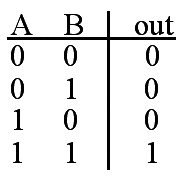
What gate is this table for?
a)
AND
b)
XOR
c)
OR 
d)
NOT
90.
What gate is this table for?
a)
AND
b)
OR
c)
NOT
d)
NOR
91.
The disadvantage of this type of storage is that it is easily scratched.
a)
Magnetic storage
b)
Optical storage
c)
Solid state storage
92.
Which best describes optical storage?
a)
Read/written by magnetic fields, stored on a disc
b)
Read/written by electric pulses, stored on a chip
c)
Stored on a chip based on the motherboard
d)
Read/written by lasers, stored on a CD
93.
Which best describes magnetic storage?
a)
Uses magnetic fields to read/write data onto a metal disc.
b)
Uses electronic pulses to read/write data onto a metal disc
c)
Uses a magnetic chip to store data
d)
Uses a laser to read/write data onto a metal disc
94.
The correct order is
a)
Fetch, Decode, Execute
b)
Decode, Execute, Fetch
c)
Execute, Decode, Fetch
d)
Decode, Fetch, Execute
95.
Barry has a 1GHZ dual core CPU. He improves it to a 4GHZ quad core CPU. What is the effect on the performance of his computer?
a)
The number of instructions executed per second doubles
b)
The number of instructions executed per second triples
c)
The number of instructions executed per second quadruples
d)
The number of instructions executed per second improves by 8 times
96.
Clock speed is:
a)
Number of times the computer is used
b)
Number of instructions a computer can handle per second
c)
Time on a computer
97.
ROM is volatile
a)
FALSE
b)
TRUE
98.
Makes the file smaller by deleting parts of the file permanently (forever)
a)
Lossy Compression
b)
Lossless Compression
99.
Used to transmit data between areas of the processor.
a)
Data bus
b)
Address bus
c)
Control bus
100.
Used to send control signals from control unit to other parts of the processor.
a)
Data bus
b)
Control bus
c)
Address bus
101.
Used to carry the address to which the data is being transmitted.
a)
Data Bus
b)
Address bus
c)
Control Bus
