
 Worksheets
G10.PHY102
Total questions: 120
Worksheet time: 2hrs 0mins

What is the resultant of these two vectors?
+17 m
+3 m
-17 m
-3 m

What is the magnitude of the resultant vector, r?
3
4
5
7
Which of the following is a vector? (Select all that apply.)
Acceleration
Velocity
Speed
Distance
Which of the following is a scalar? (Select all that apply.)
Acceleration
Speed
Displacement
Distance
A vector includes ______ and ________.
direction, magnitude
magnitude, units
direction, units
scalars, scalars

Which of the following describes the vector above?
45 cm
45 cm at 30 degrees North of East
45 cm at 30 degrees East of North
45 cm North East

Describe the direction of the vector above.
30 degrees
30 degrees North East
30 degrees North of East
30 degrees East of North
If the force P is 100 N with an angle of 30 degrees north of east, then the magnitude of force P along vertical is _____.
A. 50.0 N
B. 57.7 N
C. 86.6 N
D. 88.9 N

What is the x component of the vector?
14cos(30)
14sin(30)
14tan(30)
14tan-1(30)

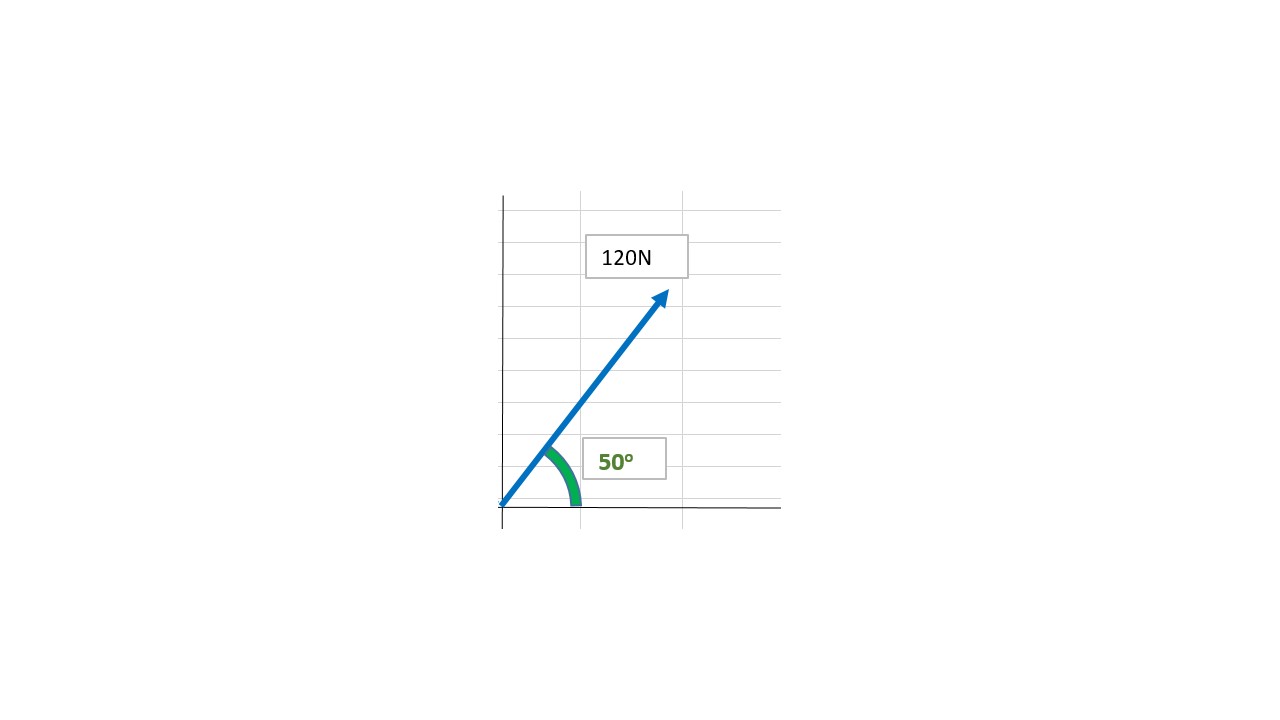

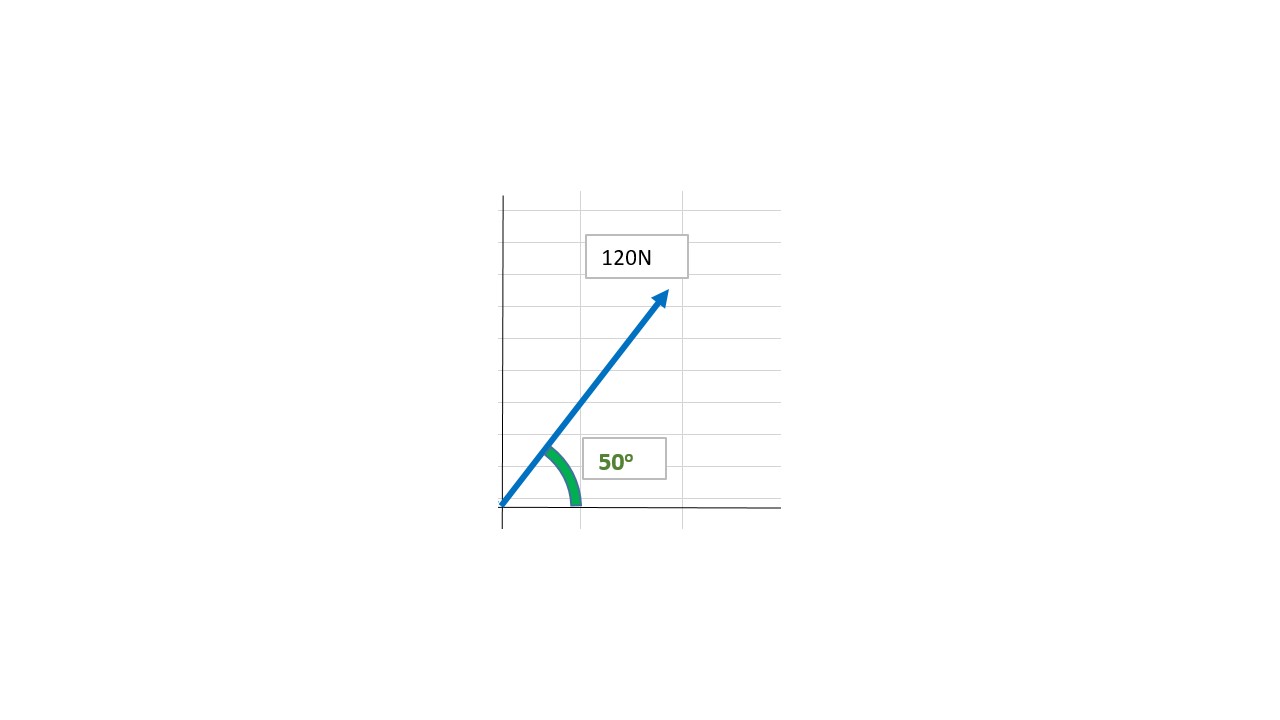
If vector A has an x component of 12 units and a y component of 7 units, what is the magnitude of vector A?
19 units
13 units
14 units
193 units
A resultant vector is
equal to the sum of one vector.
equal to the sum of two or more vectors.
equal to the difference of one vector.

If two vectors to be added are at right angles, you will need to....
Multiply
Divide
Pythagorean Theorem
Use trigonometry

Check out this super cool vector (☞゚ヮ゚)☞
Calculate the horizontal component of the velocity
69 m/s
20 m/s
35 m/s
23 m/s

Aww snap, it's another vector (☞゚ヮ゚)☞
Find the vertical component of its velocity
52 m/s
30 m/s
35 m/s
9 m/s
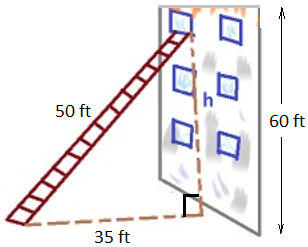


Where will be the centre of mass of a uniform rod lies ?
At its end
At its middle point
At its centre of its cross sectional area
Depends upon its material
What is the average speed of an object that travels 6.00 meters north in 2.00 seconds and then travels 3.00 meters east in 1.00 second?
9.00 m/s
4.24 m/s
3.00 m/s
0.333 m/s
The speedometer in a car does not measure the car’s velocity because velocity is a
vector quantity and has a direction associated with it
vector quantity and does not have a direction associated with it
scalar quantity and has a direction associated with it
scalar quantity and does not have a direction associated with it
A toy car moves 8 m in 4 s at the constant velocity. What is the car’s velocity?
1 m/s
2 m/s
3 m/s
4 m/s
A train moves at a constant velocity of 50 km/h. How far will it move in 0.5 h?
10 km
20 km
25 km
45 km
Which of the following is a vector quantity?
time
velocity
speed
distance
A car at accelerates from 0 m/s to 25 m/s in 5 seconds. What is the average acceleration of the car?
30 m/s2
50 m/s2
125 m/s2
5 m/s2
A car at accelerates from 0 m/s to 25 m/s in 5 seconds. What is the average acceleration of the car?
30 m/s2
50 m/s2
125 m/s2
5 m/s2
What is the unit of measurement used in physics for speed?
seconds
seconds per meter
meters
meters per second
Velocity is a vector measurement because it has both a magnitude and a ________.
Time
Distance
Direction
Temperature
If the velocity decreases, the acceleration is-----------.
zero
positive
negative
The area under the v-t graph gives-----------.
velocity
displacement
acceleration
The slope of v-t graph gives-----------.
velocity
displacement
acceleration
Speed and velocity are the same quantities.
True
False

During which interval is the object speeding up?
A to B
B to C
D to E
E to F

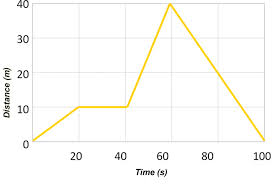

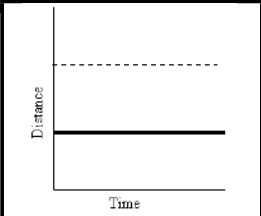
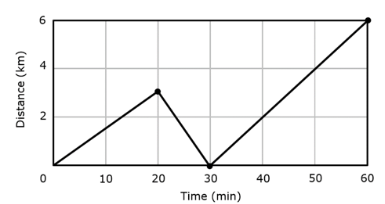
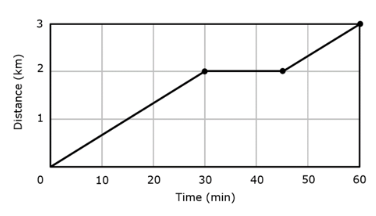
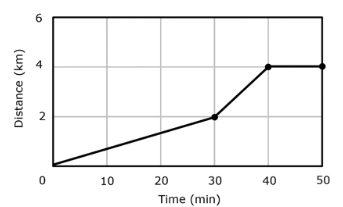
A student walks 2.0 km in a time of 30 minutes. The student then stop for 15 minutes to eat a snack then travels 1.0 km in 15 minutes.
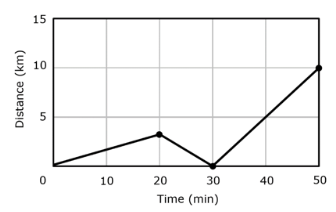

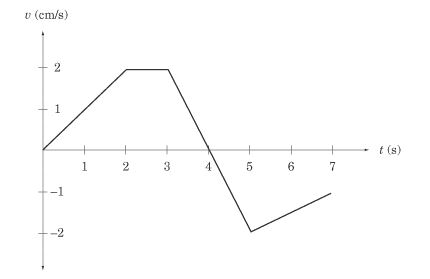
What is happening between 2 and 3 seconds?
The object is not moving.
The object is not accelerating.
The object is slowing down.
The object is speeding up.


During which segment did the car come to a complete stop?
Segment A to B
Segment B to C
Segment C to D
Segment D to E
During which segment did the car travel back toward its starting position?
Segment A to B
Segment B to C
Segment C to D
Segment D to E
During which segment did the car travel the fastest?
Segment A to B
Segment B to C
Segment C to D
Segment D to E

On this position vs time graph, what is the velocity?
40 m/s
8 m/s
5 m/s
0 m/s

On this position vs time graph, what is the velocity from 15 to 40 seconds?
-4 m/s
-10 m/s
-25 m/s
-100 m/s

What is the velocity at 12.5 seconds?
0 m/s
2 m/s
10 m/s
20 m/s
What is the acceleration during interval A?
0 m/s/s
2 m/s/s
10 m/s/s
20 m/s/s
What is the acceleration during interval B?
0 m/s/s
2 m/s/s
10 m/s/s
20 m/s/s
What is the displacement from 0-10 seconds?
10 m
10 m
100 m
200 m
What is the displacement from 15-30 seconds?
150 m
-150 m


What is occurring on this graph?
Negative acceleration
moving at a constant speed in the positive direction
positive acceleration
negative net force

Calculate the displacement traveled in section C. Hint: Remember the area under a v-t graph = displacement and you will need to use TWO shapes!
200 m
100 m
50 m
400 m

Calculate the displacement traveled in section B. Hint: Remember the area under a v-t graph = displacement!
150 m
50 m
100 m
200 m

Find the velocity from the given graph.
-2m/s
−21 sm
2m/s
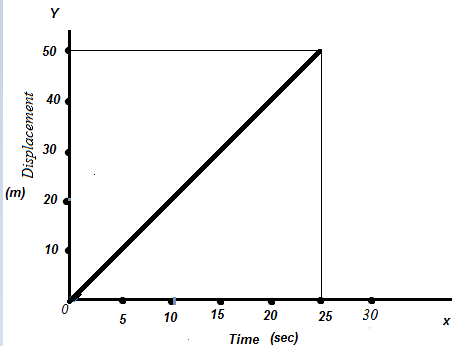
Find the velocity from the given graph.
2 m/s
21 m/s
100 m/s
-2m/s
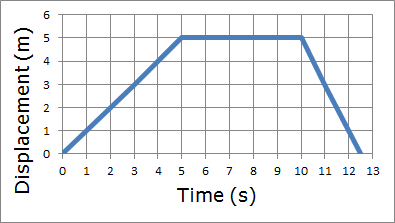


The graph represents the motion of a car over 10 seconds. What is the average speed of the car during the first 4 seconds?
.4 m/s
2.5 m/s
10 m/s
40 m/s

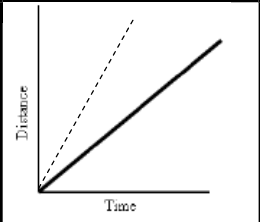
What does the solid line on this graph represent?
Constant speed
Acceleration
Not moving
deceleration

A man pushes a car with a force of 20N. He pushes it 5m. How much work is done?
4J
100J
50J
150J
A ball is thrown 25m with a force of 8N. What is the work done?
200J
175J
250J
225J
What is the unit of work?
Newton
Joule
Watt
meter
if you push a cart with a force of 60 N for 2 m... how much work have you done
120 J
30 J
120 N
30 N
Big H jumps over a fence to get a football. He uses 2000J of energy, and a force of 100N. How high was the fence?
2m
20m
0.2m
3m
work is done when
the object you apply a force on moves
any force is applied to an object, regardless if it moves or not
the force is zero
the force and direction of motion are perpendicular
Which form of energy is involved in a pencil falling from a desk?
kinetic
nonmechanical
gravitational potential
elastic potential
An object in motion
potential energy
elastic potential energy
nonmechanical energy
kinetic enerty
Energy stored due to the interactions between objects
potential
positional
total
kinetic
What is the rate at which energy is converted?
potential energy
kinetic energy
mechanical energy
power
The ability to do work is called
energy
force
power
machine
Which picture shows more power?


You move a 0.8 kg object five meters in 4 seconds. How much power have you generated?
160 watts
10 watts
6.4 watts
17 watts
What is the relationship between Power and Work?
Power is the rate which Work is done
Work is not related to Power
Power is the result of work times the time it takes to complete it
Brutus is a weightlifter. He completes a lift in 3.5 s, what is the power of Brutus, if he performed 660.0J of work?
2310 J
He performs no work
189 J
The law of conservation states that
energy can be created and destroyed, and cannot change form
energy does not exist
energy cannot be created or destroyed, but can be changed from one form to another
energy moves in different ways
Select three example of energy from this list
Kinetic
Sound
Rain
Water
Nuclear

What energy is wasted ion this diagram?
electrical
light
heat

Is this light bulb efficient?
I don't know
Yes it is
No it isn't
Select an example of non renewable energy
Coal
Wind
Geothermal
Solar
Where will be the centre of gravity of a uniform rod lies ?
At its end
At its middle point
At its centre of its cross sectional area
Depends upon its material
Where do you hang the plumb line when determining the CG?
It doesn't matter, because it always goes through the CG
Only from the corners
From the point where you are suspending the object
At the right angle
Where does the center of gravity of a circle lie?
At its centre
Anywhere on its radius
Anywhere on its circumference
Anywhere on its diameter
What is one way you might increase the stability of an object?
Lower the center of gravity
Raise the center of gravity
Increase the height of the object
Shorten the base of the object
If we suspend lamina at different positions, its center of gravity will still lie along the
Plumb line
Line of force
Line of weight
Gravity line
What is the Unit for Torque
Nm
N
W
J
A wrench is used to tighten a nut. A 15N perpendicular force is applied 50cm away from the axis of rotation, and moves a distance of 10 cm as it turns. What is the torque applied to the wrench?
7.5 Nm
1.5 Nm
750 Nm
150 Nm

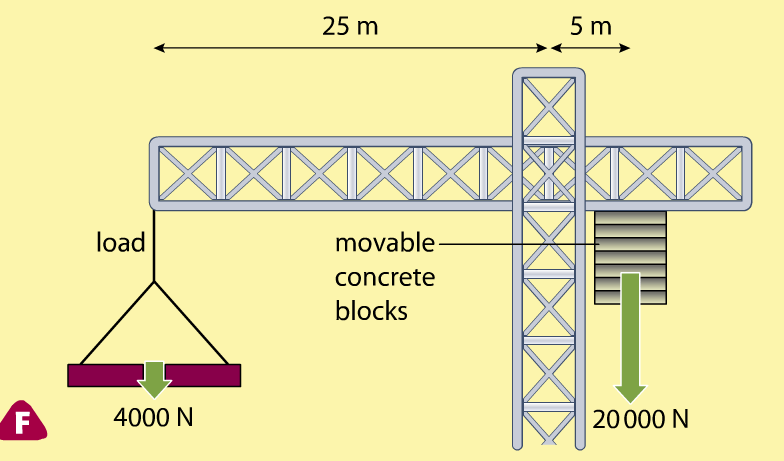
What is the anti-clockwise torque (moment)acting on this crane?
80,000Nm
100,000Nm
120,000Nm
140,000Nm


A state of equilibrium is also seen below. Each of the cars weighs the same 9800 N. Despite the fact that there is only one car on the left-hand side that is 9 m from the fulcrum, the torques balance because, the cars on the right-hand side, are ____meters from the fulcrum.
4.5 m
3 m
1 m
2 m

