wayground logo

Free Printable Worksheets

Font size

S
M
L
XL
Worksheets

Int.Science Final Review Practice

Total questions: 117

Worksheet time: 3hrs 47mins
Name
Class
Date
1.
Chlorophyll absorbs a higher percentage of _____ and _______ light.
a)
purple and green
b)
red and blue
c)
black and orange
d)
yellow and green
2.
Most plants appear green because chlorophyll
a)
absorbs green light.
b)
absorbs violet light.
c)
reflects green light.
d)
does not absorb violet light.
3.
The reactants of photosynthesis are
a)
sugar and water.
b)
sugar and oxygen.
c)
carbon dioxide and water.
d)
carbon dioxide and oxygen.
4.
What are the products of photosynthesis?
a)
Carbon dioxide and water
b)
Carbon dioxide and oxygen
c)
Glucose and oxygen
d)
Glucose and water
5.
What pigment absorbs sunlight for photosynthesis?
a)
chloroplast
b)
thylakoid
c)
grana
d)
chlorophyll
6.
Which of the following is the correct equation for PHOTOSYNTHESIS?
a)
6CO2 + 6H2O --> 6O+ C6H12O6
b)
6CO+ C6H12O6 + 6H2O --> O
c)
6O2 + 6H2O --> 6CO+ C6H12O6
d)
C6H12O6 + 6O2 ---> 6H2O + 6CO2 
7.
After the nucleus of a radioactive element undergoes changes, the element can transform into ...
a)
  (a)  a different isotope of the same element.
b)
(b) an entirely different element.
c)
Both (a) and (b)
d)
Neither (a) nor (b)
8.
The type of radioactive particle that can be stopped by a sheet of paper is the ____.
a)
alpha particle
b)
beta particle
c)
gamma ray
d)
uranium
9.
The most penetrating type of radiation is the ____.  
a)
alpha particle
b)
gamma ray
c)
beta particle
d)
uranium
10.
Negatively charged particles emitted from a nucleus at a high speed are ____.  
a)
alpha particle
b)
gamma rays
c)
beta particles
d)
X rays
11.
How is nuclear fusion different from nuclear fission?
a)
In fusion, the product is a larger atomic nucleus.
b)
Fission produces energy but fusion does not.
c)
Fusion produces energy but fission does not.
d)
In fission, the product is a larger atomic nucleus.
12.
Do all stars make energy through fusion?
a)
Yes
b)
No
c)
Just our sun
d)
Only large stars
13.
Nuclear power uses ____ for fuel.
a)
steel
b)
coal
c)
uranium
d)
hydrogen
14.
The splitting of a nucleus into smaller nuclei is
a)
fusion
b)
fission
c)
decay
d)
gamma radiation
15.
What is a chain reaction?
a)
When electrons are emitted causing electricity
b)
When a nuclear fission reaction occurs, the protons emitted can strike other nuclei in the sample, and cause them to split
c)
When a nuclear fission reaction occurs, the neutrons emitted can strike other nuclei in the sample, and cause them to split
d)
When a nuclear fission reaction occurs, the electrons emitted can strike other nuclei in the sample, and cause them to split
16.
Nuclear energy uses _____ to turn turbines to power a generator.
a)
wind
b)
water
c)
steam
d)
solar
17.
One disadvantage of nuclear energy is ___.
a)
it is a fossil fuel
b)
it leaves behind radioactive waste
c)
it emits large amounts of pollution into the atmosphere
d)
there are no disadvantages
18.
Isotopes of the same element have different ____________. 
a)
 numbers of protons  
b)
numbers of electrons
c)
 symbols 
d)
numbers of neutrons
19.
When does radioactive decay occur?
a)
When the nucleus of an isotope is unstable
b)
When the nucleus of an isotope is stable
c)
When the electrons of an isotope are spinning
d)
When the electrons of an isotope are shared with another isotope
20.

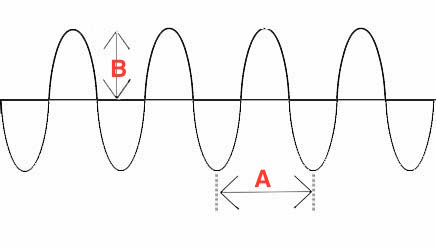
What property of this wave is represented by the letter "A"

a)

amplitude

b)

crest

c)

trough

d)

wavelength

21.
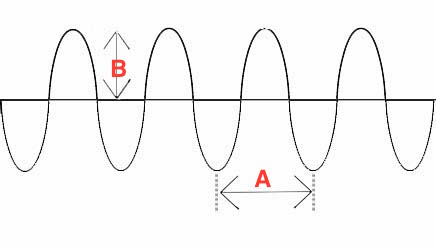
What property of the wave is represented by the letter "B"?
a)
amplitude
b)
crest
c)
trough
d)
wavelength
22.
The number of wavelengths that pass a point each per second is:
a)
frequency
b)
period
c)
longitudinal 
d)
transverse wave 
23.
Electromagnetic waves include the following except
a)
radio waves
b)
X-rays
c)
doing the wave at a football game
d)
microwaves
24.
One end of the rope is vibrated to produce a wave with a wavelength of .25 m.  The Frequency of the wave is 3.0 Hz.  What is the speed of the wave?
a)
3.00 m/s
b)
2.50 m/s
c)
.75 m/s
d)
1.25 m/s
25.
 A wave has frequency of 50 Hz and a wavelength of 10 m. What is the speed of the wave?
a)
500 m/s
b)
50 m/s
c)
5 m/s
d)
0.5 m/s
26.

Which electromagnetic wave carries the most energy?

a)

Radio waves

b)

Ultraviolet waves

c)

Gamma rays

d)

Visible light

27.
A wave that does not require a medium
a)
A. electromagnetic  wave. 
b)
B. surface wave
c)
C. medium
d)
D. transverse wave
28.
A wave in which the particles of the medium vibrate parallel to the direction of the wave motion
a)
A. mechanical wave
b)
B. surface wave
c)
C. longitudinal wave
d)
D. wave
29.
This is referred to as the energy currency of the cell
a)
ADP
b)
ATP
c)
Mitochondria
d)
Nucleus
30.
This process releases chemical energy from sugars and other carbon-based molecules to make ATP when oxygen is present.
a)
photosynthesis
b)
light-independent reaction
c)
cellular respiration
d)
light-dependent reaction
31.
Glycolysis 
a)
does not need oxygen
b)
does need oxygen
32.
This process does not make ATP alone, but it allows glycolysis to continue making ATP when oxygen is unavailable for cellular respiration.
a)
Fermentation
b)
Electron Transport Chain
c)
Glycolysis
d)
Kreb's cycle
33.
This means that oxygen is needed
a)
anaerobic 
b)
aerobic
34.
What  is the formula to calculate heat energy required to raise the temperature of any substance?
a)
Q=mc∆t
b)
Q=mc
c)
Q= ½mv
d)
m=QC
35.
What unit do you use to measure Thermal Energy?
a)
J/Kg ºC
b)
Kg
c)
ºC
d)
J
36.
The specific heat of aluminum is 0.21 cal/g°C.  How much heat(Q) is released when a 10 g piece of aluminum foil is taken out of the oven and cools from 100° to 50°?
a)
105 J
b)
10.5 J
c)
1.05 J
37.
20 g of water. specific heat of water is 4.18 J/x°C.  temperature changes from 25° C to 20° Chow much heat energy (Q) moves from the water to the surroundings?
a)
418 Joules
b)
209 J
c)
83 J
d)
4.18 J
38.
What is Specific Heat?
a)
The  amount of thermal energy required to increase the temperature of 1kg of a material by 1°C.
b)
The  amount of radiant energy required to increase the temperature of 1kgof a material by 1°C
c)
The  amount of energy required to increase the temperature of 1kgof a material by 1°C.
d)
The  amount of friction  required to increase the temperature of 1kgof a material by 1°C.
39.
A reaction is performed in a beaker with a temperature probe recording the temperature changes of the reaction.  If the temperature began at 15.0 degrees Celsius and ended at 27.5 degrees Celsius.  If the reaction is our system, is the system endothermic or exothermic?
a)
Exothermic
b)
Endothermic
40.
What would be the effect on the particles if more heat is supplied to the system?
a)
They would slow down
b)
They would stop moving
c)
They would speed up
d)
There would be no effect
41.
Energy is created by....
a)
running
b)
the Hoover Dam
c)
a hamster wheel
d)
none of them
42.
______ transfers thermal energy in a vacuum.
a)
Conduction
b)
Convection
c)
Radiation
d)
Conviction
43.
50 kg of hot water is added to 25 kg of cold water. The heat lost by the hot water is _____ the heat gained by the cold water.
a)
less than
b)
greater than
c)
equal to
d)
Not enough information to determine.
44.
burning your hand on a hot stove
a)
conduction
b)
convection
c)
radiation
45.
What is the definition of CONVECTION
a)
When heat transfers through waves.
b)
When heat transfers from objects that are touching.
c)
a  hot liquid or air that  expands, becomes less dense, and rises or becomes more dense, and sinks.
d)
Heat traveling from the sun
46.
What is the definition of CONDUCTION?
a)
When heat is transferred from objects like rays of light or electromagnetically.
b)
a  hot liquid or air that  expands, becomes less dense, and rises or becomes more dense, and sinks.
c)
When heat transfers from objects that are touching.
d)
When heat transfers through the heater or AC in your house.
47.
You are stirring your hot chocolate with a metal spoon, and notices that the spoon is getting hot. This is most likely caused by which type of heat?
a)
conduction
b)
convection
c)
radiation
d)
insulation
48.
Which is an example of radiation?
a)
boiling a pot of noodles for dinner
b)
getting hot from lying in the sun
c)
feeling warm while taking a hot shower
d)
burning yourself after touching a hot plate
49.
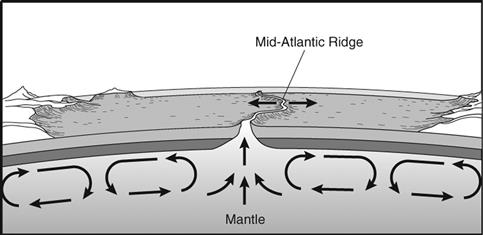
The diagram represents the movement of the mantle under the earth's crust. Which process is represented by the diagram?
a)
rotation
b)
conduction
c)
radiation
d)
convection
50.
The first law of thermodynamics states that energy is
a)
created
b)
destroyed
c)
conserved
d)
created and destroyed
51.
Temperature is a measure of the...
a)
total energy in a substance
b)
total kinetic energy in a substance
c)
average potential energy in a substance
d)
average kinetic energy of molecules in a substance
52.
As time progresses, Energy will naturally become more spread out.  It can only come together if you make it.
a)
Zeroth Law of Thermodynamics
b)
First Law of Thermodynamics
c)
Second Law of Thermodynamics
d)
Third Law of Thermodynamics
53.
When you get cut, your skin cells release hormones that signal platelets to come and stop the bleeding. Platelets then release more hormones that signal even more platelets to help stop bleeding. The hormone signals continue until the cut is closed.
a)
Positive Feedback Response
b)
Negative Feedback Loop 
54.
When glucose levels in the blood rise, your brain sends a signal to your pancreas. The pancreas releases insulin, which opens channels in cell membranes to allow glucose to enter the cell, lowering blood sugar levels. 
a)
Positive Feedback Response
b)
Negative Feedback Loop 
55.
Rapid growth during puberty causes your body to release more and more growth hormones. As you grow, more and more growth hormones are released until puberty is reached, and then the hormones stop.
a)
Positive Feedback Response
b)
Negative Feedback Loop 
56.
An organism that uses an outside source of energy like the sun to create energy-rich food molecules.
a)
Consumer
b)
Producer
c)
Decomposer
d)
Parasite 
57.
Animals that eat primary producers (also known as herbivores)
a)
Producers
b)
Primary Consumers
c)
Secondary Consumers
d)
Tertiary Consumers
58.
Which is the correct order of tropic levels? 
a)
Primary Consumer, Producer, Secondary Consumer, Tertiary Consumer
b)
Tertiary Consumer, Primary Consumer, Secondary Consumer, Producer 
c)
Producer, Primary Consumer, Secondary Consumer, Tertiary Consumer
d)
Quaternary Consumer, Tertiary Consumer, Secondary Consumer, Producer  
59.
The efficiency of energy transfer from a lower trophic level to the next highest level is roughly
a)
1%
b)
10%
c)
100%
d)
1000%
60.
In the energy pyramid here, how much of the energy in each level gets lost as heat or used by the organism for survival?
a)
80%
b)
90%
c)
10%
d)
20%
61.
What absorbs ultraviolet rays in the atmosphere?
a)
troposphere
b)
stratosphere
c)
ozone layer
d)
greenhouse gases
62.
Which of these sets of three items produce CFCs
a)
cars, factories, and cardboard
b)
spray cans, cardboard, insulation
c)
spray cans, refrigerant, cardboard
d)
spray cans, refrigerant, insulation
63.
How many oxygen atoms does a molecule of ozone contain?
a)
1
b)
2
c)
3
d)
4
64.
What do we call gases such as carbon dioxide, methane, nitrous oxide, water vapor, and ozone in the atmosphere which are involved in the greenhouse effect?  
a)
Bad Gases
b)
Ozone Gases
c)
Greenhouse Gases
d)
Atmospheric Gases
65.
What chemical is responsible for breaking up the ozone?
a)
CFCs
b)
Carbon Dioxide
c)
Nitrogen
d)
Oxygen
66.
This protects us from harmful UV rays from the sun
a)
Troposphere
b)
Stratosphere
c)
Greenhouse Effect
d)
Ozone Layer
67.
 Which of the following activities contributes the most to carbon emissions globally?
a)
Deforestation
b)
Agriculture
c)
Burning fossil fuels
d)
Respiration
68.

What chemical is responsible for breaking up the ozone?

a)

CFCs

b)

Carbon Dioxide

c)

Nitrogen

d)

Oxygen

69.

Which of the following has NOT been done to eliminate ozone-depleting substances from the stratosphere?

a)

Replace CFCs with trigger sprays or air repellents in aerosols.

b)

Outlaw dumping of refrigerators, A/C units, and other hazardous materials.

c)

Reward appliance stores to recycle used refrigerators.

d)

Add chemicals in the atmosphere that bind to chlorine atoms to prevent them from reacting with ozone molecules.

70.
As you move down the periodic table atoms get bigger.  This is because ____________.
a)
The atoms have more mass.
b)
The atoms have more protons.
c)
The atoms have more energy levels
d)
The atoms have more nuetrons
71.
In the modern periodic table elements are arranged by:
a)
atomic mass
b)
atomic number
c)
valence electrons
d)
number of isotopes
72.
How many electrons does Oxygen need to fill its outer shell?
a)
3
b)
4
c)
1
d)
2
73.
How many Valance electrons does Iodine Have?
a)
6
b)
16
c)
7
d)
17
74.
Elements in the same ________ are more chemically similar.
a)
group
b)
period
c)
club
d)
table
75.
Which elements have the most similar chemical properties?
a)
K and Na
b)
K and Ca
c)
K and Cl
d)
K and S
76.
The atomic number of this pictured element is
a)
28
b)
58.6934
c)
Ni
d)
Nickel
77.
A negatively charged particle that moves around the nucleus is a(n)
a)
proton
b)
neutron
c)
electron
d)
quark
78.
How many electrons do atoms need to be stable?
a)
1
b)
2
c)
6
d)
8
79.
Which of the following would produce an anion?
a)
Ca
b)
Al
c)
K
d)
F
80.
Cations are
a)
positive
b)
negative
c)
on the right side of the periodi table.
d)
nonmetals
81.
Valence electrons are: 
a)
Electrons farthest away from the nucleus
b)
Electrons closest to the nucleus
c)
Electrons that just come and go - they don't stay with the atom
82.
Ions are: 
a)
atoms with a positive or negative charge
b)
atoms with no charge
c)
atoms with ONLY a positive charge
d)
atoms with ONLY a negative charge
83.
What is the charge does a sodium ion have?
a)
+2
b)
+1
c)
-1
d)
-2
84.
What are ionic bonds?
a)
valence electrons transferred between atoms
b)
Inner most electrons transferred between atoms
85.
Why do ionic bonds form?
a)
so the number of protons equals the number of electrons
b)
to fill the outermost energy level
c)
so an atom can become unstable
86.
a proton has what charge?
a)
positive
b)
negative
c)
no charge
d)
it depends
87.
Zinc Fluoride
a)
ZnF2
b)
ZnF
c)
Zn2F
d)
Zn2F4
88.
Na2S
a)
Sodium Sulfide
b)
Sodium Sulfate
c)
Sodium Sulfite
d)
Disodium Sulfide
89.
How many electrons should Hydrogen have around its Lewis dot model?
a)
1
b)
2
c)
7
d)
8
90.
How many electrons does Si contain? (click to see image)
a)
14
b)
28
c)
2
d)
None of these
91.
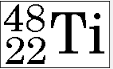
How many protons does this isotope of titanium have?
a)
48
b)
22
c)
26
d)
70
92.
How many neutrons does the isotope of lithium have?
a)
8
b)
3
c)
4
d)
5
93.
What do these isotopes of carbon all have in common?
a)
neutrons & mass number
b)
atomic number and neutrons
c)
atomic number and electrons
d)
protons, atomic number, and mass number
94.
In a correctly written symbol what would be located in the "A" position?
a)
number of neutrons
b)
atomic number
c)
number of electrons 
d)
mass number
95.
?
a)
Helium
b)
Hydrogen
c)
Argon
d)
Silver
96.
?
a)
Boron
b)
Carbon
c)
Nitrogen
d)
Lithium
97.

This is a correct dot diagram for nitrogen (N)

a)

true

b)

false

98.

This is a correct dot diagram for magnesium (Mg)

a)

true

b)

false

99.

This is a correct dot diagram for neon (Ne)

a)

true

b)

false

100.

By replacing the element symbol, this could be the diagram of which element?

a)

O

b)

B

c)

Li

d)

Ne

101.
Which problem is balanced?
a)
PbO2 + 2H2
b)
SO2 + H20 --> H2SO4
c)
2Na + 2H2O --> 2NaOH + H2
102.
Is the equation balanced?: 2H2O + O2 --> 4MgO + 3Fe
a)
Yes
b)
No
103.
Balance this equation:
MgCl2 --> Mg4+ Cl2
a)
It's already balanced.
b)
4MgCl2 --> Mg4+ 4Cl2
c)
4MgCl2 --> Mg4+ 5Cl2
104.
Balance this equation:
 2Li + Cl2 -> LiCl
a)
2Li + Cl2 -> 4LiCl2
b)
2Li + Cl2 -> LiCl2
c)
2Li + Cl2 -> 2LiCl
105.
Energy due to motion is ____________ energy. 
a)
Potential 
b)
Energy
c)
Kinetic
d)
Friction
106.
At which point is potential energy greatest?
a)
W
b)
X
c)
Y
d)
Z
107.
The SI unit in which kinetic energy is measured is 
a)
Newton
b)
Kilogram
c)
Joules
d)
Metres per second
108.
Calculate the kinetic energy of a moving 4 kg object travelling at a velocity of 3 m/s.
a)
18 J
b)
36 J
c)
12 J
d)
6 J
109.
What is the kinetic energy of a 4kg shotput thrown with a velocity of 13m/s
a)
676 J
b)
3.25 J
c)
17J
d)
338 J
110.
I have the most potential energy if I am: 
a)
5 feet high
b)
10 feet high
c)
15 feet high
d)
20 feet high
111.
Use the diagram below to answer the next four questions.
Which car has:  KE = 75 PE = 25
a)
A
b)
B
c)
C
d)
D
112.
What is the unit of measurement for potential energy?
a)
Watts
b)
Joules
c)
Newtons
d)
Meters
113.
At which point is potential energy the greatest?
a)
Top of a hill
b)
bottom of a hill
c)
moving down a hill 
d)
moving up a hill
114.
What is the potential energy of a boulder that is 50 kg sitting on top of cliff at 10 meters? ((Hint: gravity is 9.8 m/s))
a)
4,900 Joules
b)
500 joules
c)
5 Joules
115.
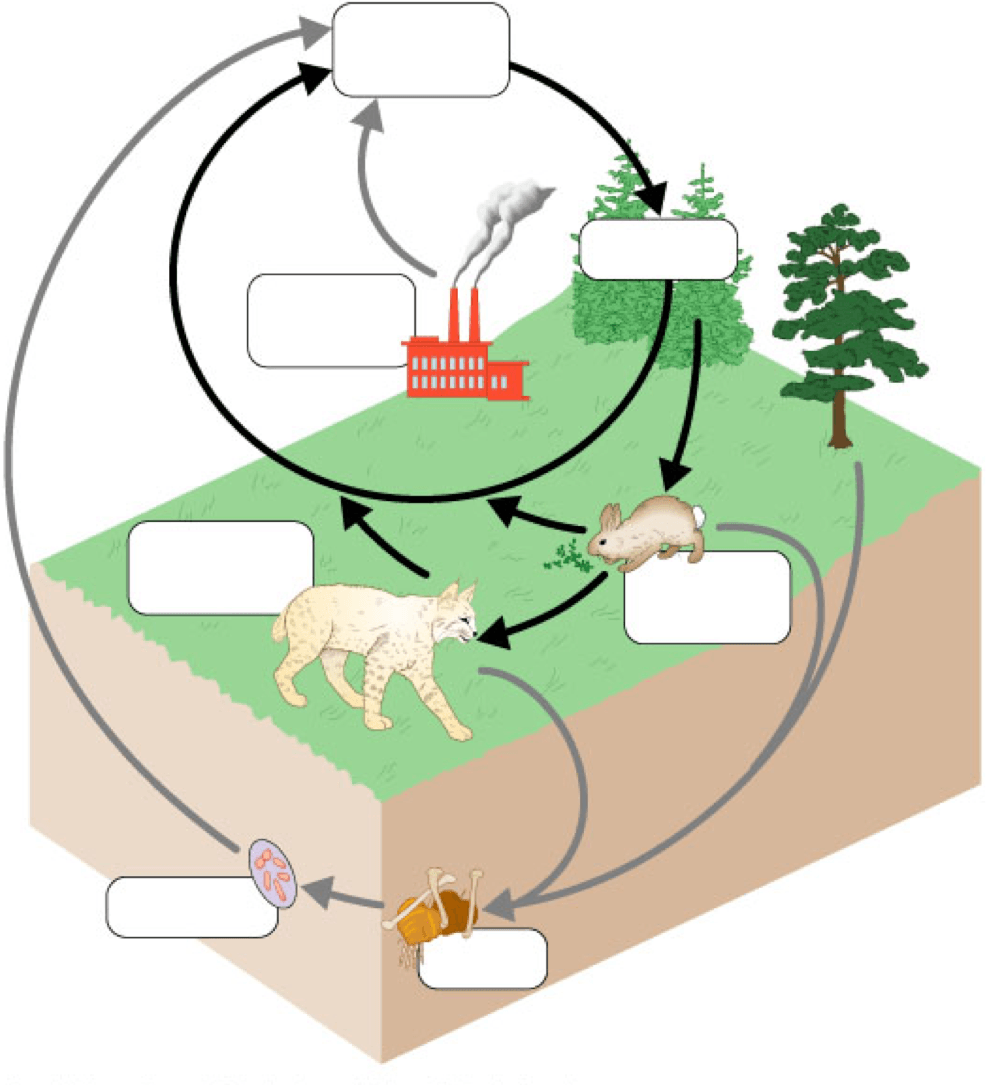
When humans burn fossil fuels, most of the carbon quickly enters the                       as carbon dioxide.
a)
Water
b)
Atmosphere
c)
Sun
d)
Air
116.
What does not produce carbon dioxide?
a)
Photosynthesis
b)
Burning Fossil Fuels
c)
Animal respiration
d)
Plants decaying
117.
In what process is Carbon transformed into chemical energy?
a)
Photosynthesis
b)
Respiration
c)
Primary Production
d)
Secondary Production