wayground logo

Free Printable Worksheets

Font size

S
M
L
XL
Worksheets

Midterm Exam - A&P - Wagner HS

Total questions: 114

Worksheet time: 1hrs 25mins

Name
Class
Date
1.
Which of the following is not one of the four tissue types? 
a)
Blood
b)
Connective
c)
Epithelial
d)
Nervous 
2.
Where is epithelial tissue found?
a)
glands
b)
covering body surfaces
c)
lines organs
d)
all of the above
3.
Which tissue is this?
a)
Simple Squamous
b)
Stratified Squamous
c)
Simple cuboidal
d)
Pseudostratified columnar
4.
Identify:
a)
Columnar
b)
Cuboidal
c)
Pseudostratified
d)
Transitional
5.
Identify:
a)
Smooth Muscle
b)
Columnar
c)
Transitional
d)
Pseudostratified
6.
Identify:
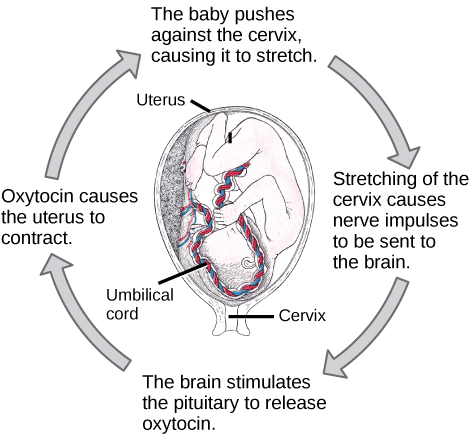
a)
Smooth Muscle
b)
Columnar
c)
Transitional
d)
Pseudostratified
7.
Flattened cells
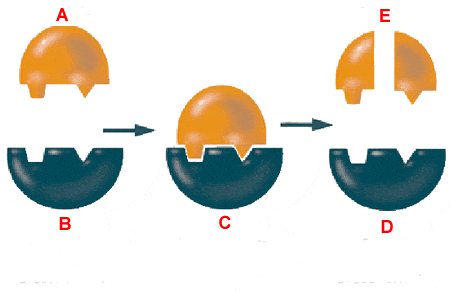
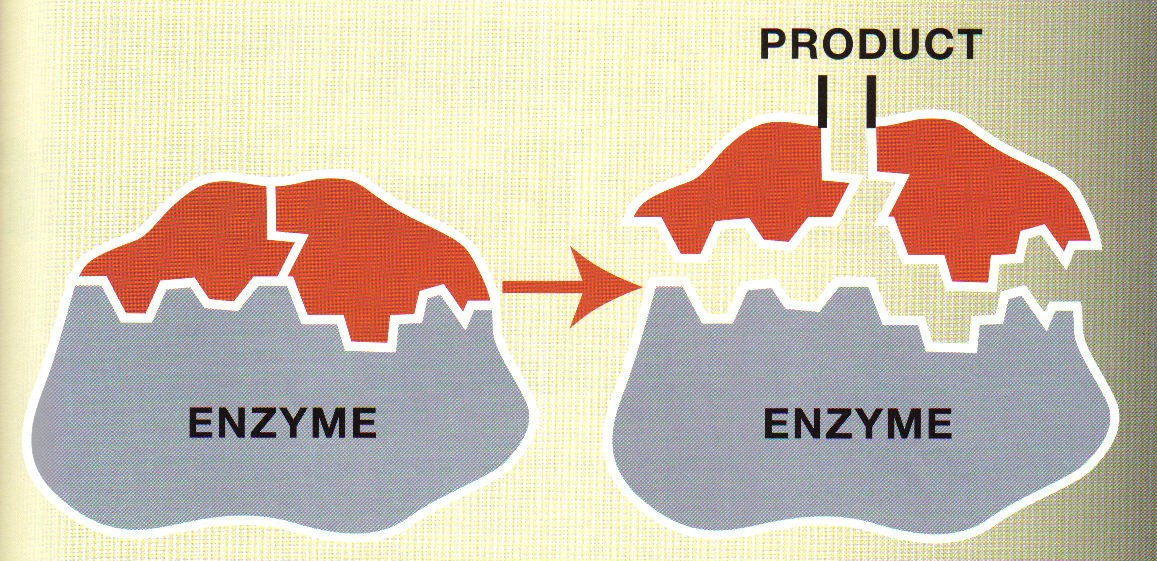
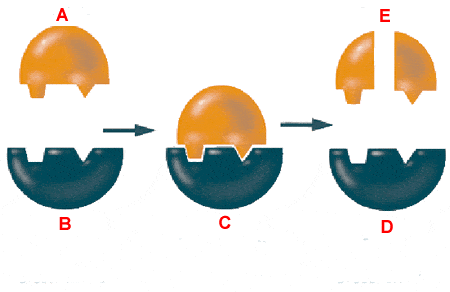
a)
Squamous
b)
Cuboidal
c)
Columnar
8.
This type of epithelium has only one layer of cells
a)
Stratified epithelium
b)
Simple epithelium
9.
Epithelium with more than one layer of cells
a)
Stratified epithelium
b)
Simple epithelium
10.
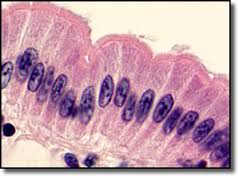
which tissue is this?
a)
Pseudostratified columnar
b)
Stratified Squamous
c)
Simple Columnar
d)
Transitional
11.
Which type of muscle tissue would line the intestines?
a)
Smooth
b)
Cardiac
c)
Skeletal
d)
Transitional
12.
What type of Connective Tissue are TENDONS and LIGAMENTS
a)
Dense Connective Tissue
b)
Osseous Tissue
c)
Loose connective Tissue
d)
Cartilage
13.
What is the MATRIX of Blood tissue?
a)
Collagen
b)
Calcium and Salts
c)
Plasma
d)
Fat
14.
What type of muscle tissue is VOLUNTARILY controlled
a)
Skeletal Only
b)
Skeletal and Cardiac
c)
Smooth and Cardiac
d)
Cardiac Only
15.
Which type of epithelial tissue stretches and is found in the bladder and other urinary organs?
a)
Transitional
b)
Simple Cuboidal
c)
Stratified Squamous
d)
Stratified Columnar
16.

Define tissue with regards to anatomy

a)

Multiple sheets of thin paper used to clean your nose

b)

The smallest structural and functional unit of an organism

c)

A series of different cells in the same area

d)

A group of structurally and functionally related cells that come together to perform common functions
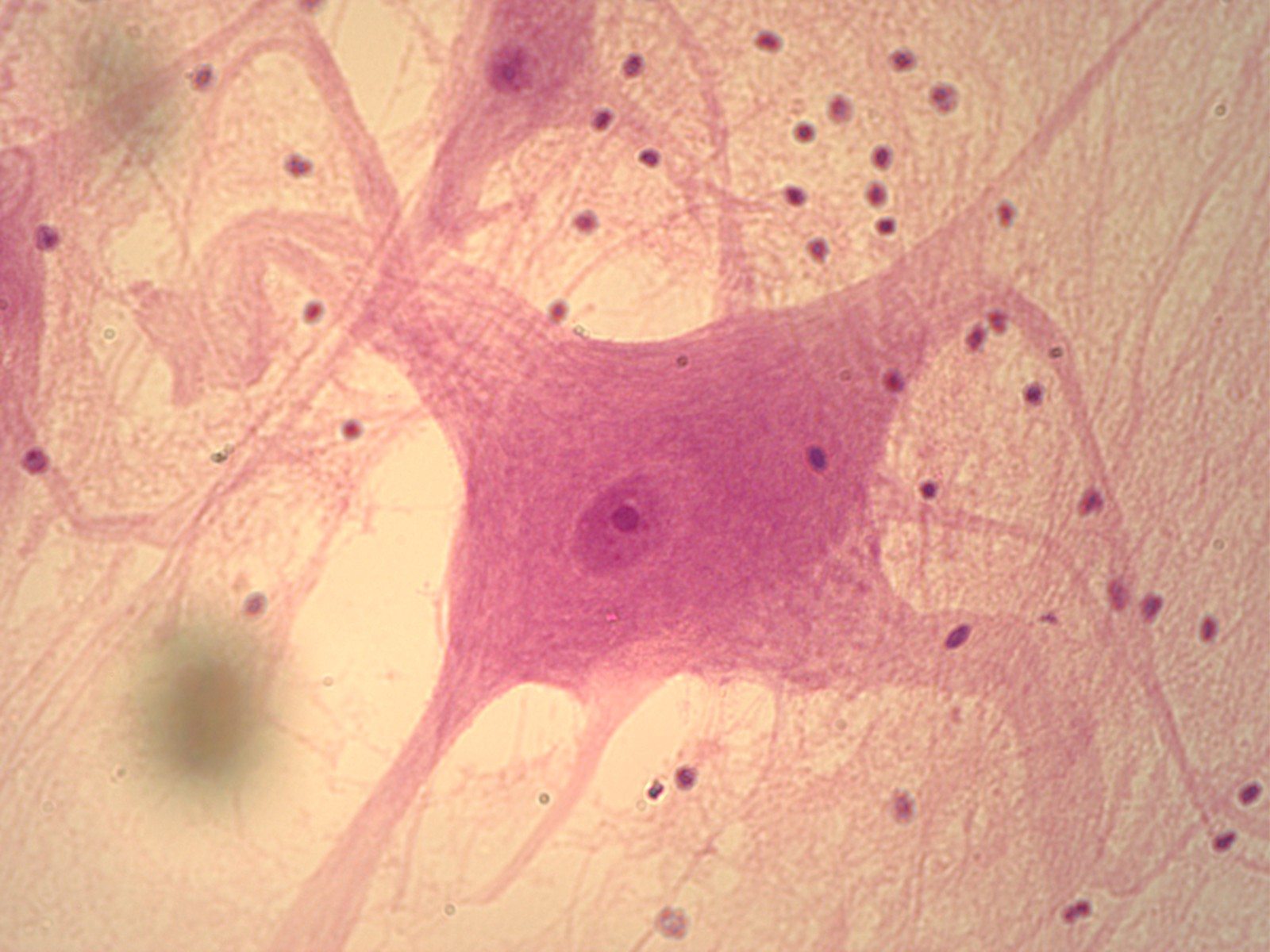
17.
What tissue type is this?
a)
Nervous tissue
b)
Cardiac muscle
c)
Smooth muscle
d)
Connective tissue proper
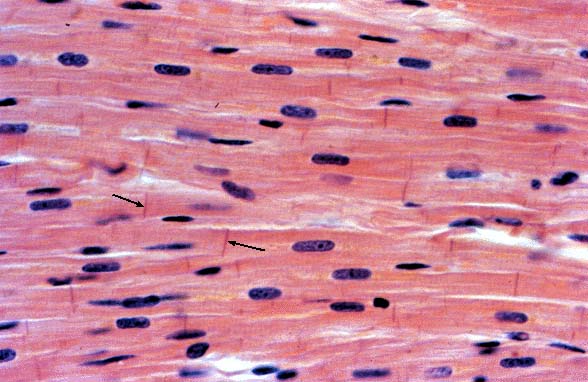
18.
What tissue type is this? (The arrows are a clue)
a)
Cardiac muscle
b)
Skeletal muscle
c)
Smooth muscle
d)
Nervous tissue
19.

What type of Connective tissue is found at the ends of bones to reduce friction?

a)

Dense connective tissue

b)

Cartilage

c)

Adipose Tissue

d)

Loose connective tissue

20.
a)
smooth muscle
b)
bone
c)
nerve
d)
blood
21.
The common term for adipose tissue is
a)
Fat
b)
Blood
c)
Bone
d)
Cartilage
22.
What are the four main tissues found in the body?
a)
Epithelial, Connective, Bone, Blood
b)
Muscle, Connective, Blood, Epithelial
c)
Nervous, Muscle, Connective, Epithelial
d)
Nervous, Muscle, Connective, Bone
23.

Collagen is a protein that is particularly abundant in

a)

covering and lining epithelium

b)

dense regular connective tissue

c)

smooth muscle

d)

adipose tissue

24.
What tissue type is this?
a)
Skeletal muscle
b)
Nervous tissue
c)
Adipose tissue
d)
'Specialised' connective tissue
25.
Which of the following tissues is made up of cells that contract when stimulated?
a)
Epithelial
b)
Connective
c)
Muscle 
d)
Nervous
26.
Which of the following tissues is made up of cells that conduct impulses?
a)
Epithelial
b)
Connective
c)
Muscle 
d)
Nervous
27.
The muscle tissue shown is called ______.
a)
Skeletal
b)
Cardiac
c)
Smooth
28.

What tissue is this?

a)

Epithelial

b)

Nervous

c)

Connective

d)

Muscular

29.
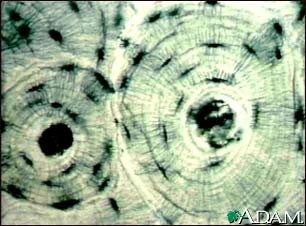
Name this tissue
a)
Bone
b)
Cartilage
c)
Blood
d)
Adipose
30.
The long, fiber like part of a neuron which the cell sends information to receiving neurons
a)
axon 
b)
dendrite
c)
axon terminal
d)
gene
31.
The part of the neuron that insulates the axon and increases the speed of the neural message within the neuron.
a)
Synapse
b)
Dendrite
c)
Myelin Sheath
d)
Axon Terminal Button
32.
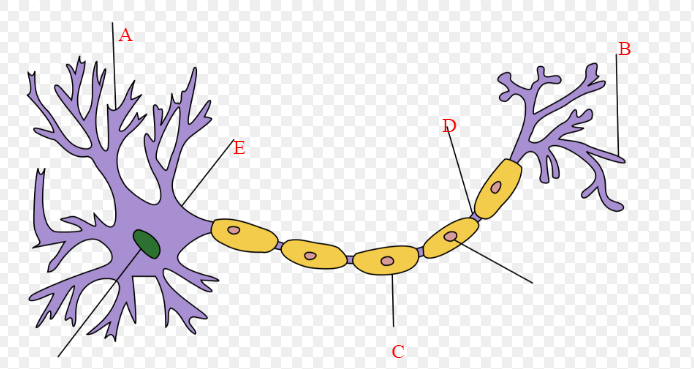
A
a)
Dendrite
b)
Axon
c)
Axon Terminal
d)
Cell Body
33.
B
a)
Dendrite
b)
Axon
c)
Axon Terminal
d)
Cell Body
34.
E
a)
Synapse
b)
Cell Body
c)
Axon 
d)
Dendrite
35.
The correct direction of the neural impulse within one neuron.
a)
Axon Terminal to Dendrite
b)
Dendrite to Axon Terminal
c)
Cell Body to Axon
d)
Axon Terminal to Cell Body
36.
What is another name for a nerve cell?
a)
Muscle Fiber
b)
Connective Tissue
c)
Impulse
d)
Neuron
37.
The part of the neuron that takes information away from the cell body is called a(n) _____________.
a)
dendrite
b)
axon
c)
cell body
d)
Schwann cell
38.
8 is pointing to
a)
Compact Bone
b)
Spongy or Cancellous Bone
39.
9 is pointing to
a)
Compact Bone
b)
Spongy or Cancellous Bone
40.
This type of bone is solid throughout except for the central canals and lacunae.
a)
Compact Bone
b)
Spongy or Cancellous Bone
41.
This type of bone is porous, allowing blood vessels to move through it and containing bone marrow.
a)
Compact Bone
b)
Spongy or Cancellous Bone
42.
What happens during the S phase?
a)
A checkpoint over the connection of the spindle fibers
b)
The cell grows
c)
DNA is replicated
d)
The cell enters the G0 phase
43.
What happens in cytokinesis?
a)
The cell fully splits into two cells
b)
The cell digests its extra DNA
c)
The cell prepares for mitosis
d)
There are eight important checkpoints there
44.
Which of the following phases is not included in interphase?
a)
G1
b)
S
c)
G2
d)
M
45.
After mitosis and cytokineses, one cell becomes...
a)
Two identical cells
b)
Two genetically different cells
c)
Four identical cells
d)
Four genetically different cells
46.
During which phase of the cell cycle does the cell spend the most time?
a)
Mitosis
b)
Cytokinesis
c)
Interphase
47.
During which part of the cell cycle does the cell divide?
a)
Interphase
b)
Mitosis
c)
S phase
48.
During which parts of the cell cycle does the cell grow?
a)
G1 and G2
b)
G1 and S
c)
M phase and cytokinesis
49.
What kind of cells are made in MEIOSIS?
a)
Haploid cells
b)
Diploid Cells
c)
Skin Cells
d)
Liver Cells
50.
If the Diploid number of Carrots is 18, the haploid number is
a)
18
b)
9
c)
27
d)
36
51.
Which cellular process is shown?
a)
meiosis
b)
endocytosis
c)
mitosis
d)
phagocytosis
52.
Meiosis makes sperm and egg cells. In humans, sperm and egg cells each have _____ chromosomes. Therefore a fertilized human egg cell (sperm and egg cell combined) would create a cell with _____ chromosomes.
a)
23, 46
b)
46, 23
c)
2, 4
d)
50, 100
53.
This picture represents what type of cell transport?
a)
endocytosis
b)
exocytosis
c)
osmosis
d)
passive transport
54.
Which is true about active transport?
a)
It requires energy
b)
it does not require energy
c)
It moves substances down the concentration gradient
d)
it moves material from high to low concentration
55.
If the environment gets cold, we will often shiver in order to:
a)
keep body temperature the same as the external temperature
b)
decrease body temperature
c)
increase body temperature
d)
regulate blood pressure
56.
Negative Feedback Loops:
a)
amplify processes
b)
prevent small changes from getting larger
c)
are initiated during childbirth
d)
are found only in plants
57.
The two types of feedback systems that help organisms maintain homeostasis are:
a)
positive and negative 
b)
receptor and effector
c)
static and dynamic
d)
minor and major
58.
When glucose levels in the blood rise, your brain sends a signal to your pancreas. The pancreas releases insulin, which opens channels in cell membranes to allow glucose to enter the cell, lowering blood sugar levels. 
a)
Positive Feedback Response
b)
Negative Feedback Loop 
59.

What is the point of a feedback loop?

a)

To provide the body with more energy

b)

To provide the body with more food

c)

To make sure the conditions in the body are always changing

d)

To make sure the conditions in the body remain stable

60.

Which answer models central dogma?

a)

DNA to protein to RNA

b)

RNA to DNA to protein

c)

DNA to RNA to protein

d)

protein to RNA to DNA

61.

What is the result of translation?

a)

The synthesis of RNA from protein

b)

The synthesis of protein from RNA

c)

The synthesis of protein from DNA

d)

The synthesis of RNA from DNA

62.

At which organelle does translation occur?

a)

Nucleus

b)

Ribosome

c)

Mitochondria

d)

Golgi apparatus

63.
If the environment gets cold, we will often shiver in order to:
a)
keep body temperature the same as the external temperature
b)
decrease body temperature
c)
increase body temperature
d)
regulate blood pressure
64.
The "cause" for something to happen is the
a)
response
b)
effect
c)
stimulus
d)
homeostasis
65.
The "effect" of a given stimulus is the...
a)
response
b)
stimulus
c)
cause
d)
result
66.
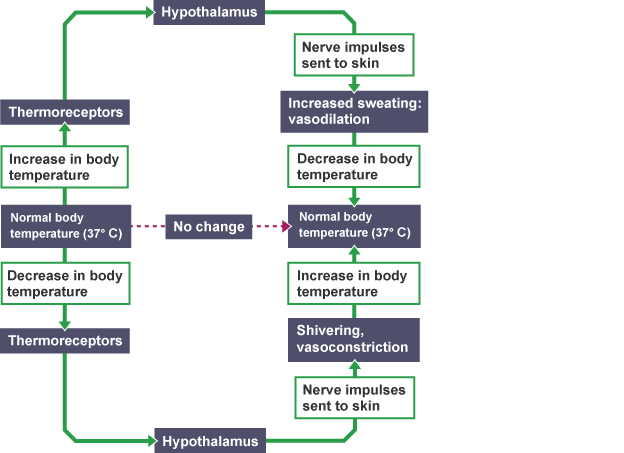
What type of feedback loop is shown?
a)
Positive
b)
Neutral
c)
Negative
67.
What type of feedback loop is shown?
a)
negative
b)
neutral 
c)
positive
68.
Failure to maintain homeostasis could result in:
a)
lack of internal balance
b)
eventual death
c)
difficulty carrying on metabolism 
d)
all three
69.
Negative Feedback Loops:
a)
amplify processes
b)
prevent small changes from getting larger
c)
are initiated during childbirth
d)
are found only in plants
70.
The two types of feedback systems that help organisms maintain homeostasis are:
a)
positive and negative 
b)
receptor and effector
c)
static and dynamic
d)
minor and major
71.
Maintaining body temperature is an example of a:
a)
negative feedback loop
b)
positive feedback loop
72.
When glucose levels in the blood rise, your brain sends a signal to your pancreas. The pancreas releases insulin, which opens channels in cell membranes to allow glucose to enter the cell, lowering blood sugar levels. 
a)
Positive Feedback Response
b)
Negative Feedback Loop 
73.

What is the point of a feedback loop?

a)

To provide the body with more energy

b)

To provide the body with more food

c)

To make sure the conditions in the body are always changing

d)

To make sure the conditions in the body remain stable

74.

According to the feedback loop, what does high blood sugar promote?

a)

Insulin Release

b)

Glucagon Release

c)

Insulin Uptake

d)

Glycogen Uptake

75.
When you get cut, your skin cells release hormones that signal platelets to come and stop the bleeding. Platelets then release more hormones that signal even more platelets to help stop bleeding. The hormone signals continue until the cut is closed.
a)
Positive Feedback Response
b)
Negative Feedback Loop 
76.
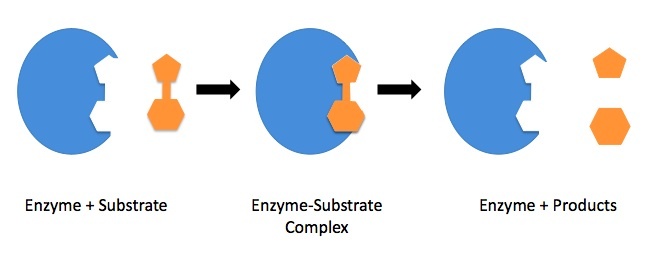
This reaction shows a(n) ____________ reaction
a)
Catabolic
b)
Anabolic
c)
Dehydration Synthesis
d)
Halogenation
77.
The area that the substrate fits into on the enzyme is called the:
a)
Active Site
b)
Allosteric Site
c)
DiSulphide Bridge
d)
β-Pleated Sheet
78.
Enzymes catalyze reactions by ___________ Activation Energy.
a)
Increasing
b)
Decreasing
79.
Most enzymes have the ending:
a)
-ase
b)
-ose
c)
-ic acid
d)
-ate
80.
Chemical bonds form when atoms
a)
combined nuclei
b)
give up neutrons
c)
gain protons
d)
share or transfer electrons
81.
If an atom loses two electrons what charge will it have?
a)
+ 2
b)
 - 2
c)
+1
d)
-1
82.
If an atom gains one electron what charge will it have?
a)
-2
b)
-1
c)
+1
83.
Covalent compounds
a)
Share electrons
b)
transfer electrons
c)
contain a sea of electrons
d)
conduct electricity
84.
A bond that forms when electrons are transferred is called a/an
a)
ionic bond
b)
covalent bond
c)
hydrogen bond
85.

What is a long chain of amino acids called?

a)

Polysaccharide

b)

Lipid

c)

Carbohydrate

d)

Polypeptide

e)

Nucleic acid

86.

Which statement about enzymes is FALSE?

a)

They are made from amino acids

b)

They can be used multiple times

c)

They lower the energy needed for reactions

d)

A single enzyme has many different functions

87.
If the activation energy is lowered, the reaction will take...
a)
More energy 
b)
Less energy
c)
The same amount of energy
d)
No energy
88.
The molecule that an enzyme binds to is known as the...
a)
Product 
b)
Active site
c)
Activation energy
d)
Substrate 
89.
Energy is released from an ATP molecule when...
a)
Converts a phosphate group to ADP
b)
Attaches an extra phosphate group
c)
Produces a sugar molecule
d)
It loses a phosphate group
90.

An anabolic reaction

a)

forms bonds

b)

combines smaller molecules into larger ones

c)

requires energy

d)

All are correct

91.
The top layer of the skin is called the _________________.
a)
dermis
b)
oil gland
c)
nerve
d)
epidermis
92.
The coloring in the skin; found in the epidermis.
a)
Melanin
b)
Oil
c)
Perspiration
d)
Pores
93.
The waterproofing protein that fills the cells in the upper layers of the epidermis.
a)
Keratin
b)
Melatonin
c)
Melanin
d)
Actin
94.
What gland is responsible for keeping our hair soft and is a barrier for bacteria and fungi?
a)
Sudoriferous
b)
Sebaceous
c)
Melanin
d)
Carotene
95.
What is the condition called when your skin is a yellowish tint?
a)
Jaundice
b)
Albino
c)
Cyanosis
d)
Erythema
96.
Goosebumps are caused by contractions of the ______ muscle
a)
Arrector pili
b)
Apocrine
c)
Eccrine
d)
Sebaceous
97.
Which layer contains accessory structures such as sweat glands, sebaceous glands, and hair follicles?
a)
epidermis
b)
dermis
c)
hypodermis
d)
hyperdermis
98.
Oil glands that are found all over the skin, except on the palms and soles, are called _____.
a)
merocrine glands
b)
sebaceous glands
c)
apocrine glands
d)
sweat glands
99.
What causes acne?
a)
clogged sebaceous glands
b)
clogged apocrine glands
c)
clogged merocrine glands
d)
clogged sweat glands
100.
Which layer of the skin does NOT contain blood vessels? 
a)
epidermis
b)
hypodermis
c)
dermis
101.
What cell produces a dark brown pigment?
a)
Keratinocytes
b)
Melanocytes
c)
Merkel (Tactile) Cells
d)
Langerhans (dendritic) cell
102.
What layer of epidermis does cell division occur?
a)
stratum lucidum
b)
stratum basale
c)
stratum granulosum
d)
stratum corneum
103.
The oldest cells of the epidermis will be found here
a)
Stratum Corneum
b)
Stratum Basale
c)
Stratum Spinosum
d)
Stratum Granulosum
104.

The function of the integumentary system includes all of these except what?

a)

Homeostasis

b)

Cooling system

c)

Synthesis of Vitamin A

d)

Excretion of wastes

105.
a)
First Degree Burn
b)
Second Degree Burn
c)
Third Degree Burn
d)
Fourth Degree Burn
106.
A sunburn might be an example of a:
a)
1st degree burn
b)
2nd degree burn
c)
3rd degree burn
d)
4th degree burn
107.
Sweating to regulate body temperature is an example of
a)
negative feedback
b)
positive feedback
c)
a homeostatic imbalance
d)
aging
108.

________ in the skin gather information from the environment about pressure, temperature, and pain.

a)

nerves/receptors

b)

glands

c)

skin

d)

hair

109.
A major function of skin is protection from:
a)
Abrasion
b)
UV light 
c)
Entry of microorganisms
d)
All of the above 
110.
This gland releases an oil known as sebum.
a)
Sebacious gland
b)
Apocrine Gland
c)
Eccrine Gland
d)
All of the above
111.
Which layer of the skin is made up of fatty tissue?
a)
epidermis
b)
dermis
c)
hypodermis
d)
hyperdermis
112.
With the help of the sun, what vitamin is produced by our skin?
a)
Vitamin A
b)
Vitamin B
c)
Vitamin C
d)
Vitamin D
113.
A 3rd degree burn affects which layers of the skin?
a)
Epidermis
b)
Epidermis, Dermis
c)
Epidermis, dermis, and hypodermis
d)
Epidermis dermis, and cutaneous layer
114.
Sweating and shivering are your body's way of regulating _________.
a)
Water loss
b)
Temperature
c)
Hair growth
d)
Vitamin D absorption