wayground logo

Free Printable Worksheets

Font size

S
M
L
XL
Worksheets

Biology Review

Total questions: 114

Worksheet time: 4hrs 45mins

Name
Class
Date
1.

Which type of bond allows the atoms in a water molecule to stay together?

a)

covalent

b)

ionic

c)

hydrogen

d)

metallic

2.

Why is carbon able to form a large number of different molecules?

a)

carbon only forms ionic bonds

b)

carbon only forms ring structures

c)

carbon can form four covalent bonds

d)

carbon forms small simple structures

3.
What word describes when water is attracted to other substances?
a)
cohesion
b)
adhesion
c)
capillary action
d)
surface tension
4.

When water and other liquids stick together to form drops or thin films called ________________.

a)

adhesion

b)

capillary action

c)

cohesion

d)

surface tension

5.
molecule in which opposite ends have opposite electric charges
a)
cohesion
b)
polar molecule
c)
hydrogen bond
d)
solution
6.
Which biomolecule is made of nucleotides and contain you DNA?
a)
Carbohydrate
b)
Lipids
c)
Protein
d)
Nucleic Acid
7.
The 4 macromolecules are
a)
vitamins, lipids, water, micronutrients
b)
micronutrients, macronutrients, water, vitamins
c)
Lipids, Waxes, Vitamin A, Water
d)
Carbohydrates, Lipids, Proteins, Nucleic Acids
8.
Which biomolecule is important source of energy for humans; glucose for human cells, tissues, and organs; provides fiber, sugar, and starches; provides structural support, cell wall, and cell membrane maker?
a)
Nucleic Acid
b)
Lipid
c)
Carbohydrate
d)
Protein
9.

What are proteins made of?

a)

amino acids

b)

monosaccharides

c)

nucleic acids

d)

fatty acids

10.
Which biomolecule functions include enzymes­ which speeds the rate of chemical reactions, structural components in cells, mechanical functions in muscles and cytoskeleton, cell signaling, and immune response; provides structure and helps with chemical reactions 
a)
Protein
b)
Lipids
c)
Carbohydrate
d)
Nucleic Acid
11.
Which biomolecule includes fats, such as triglycerides, oils, waxes, and steroids (cholesterol); insoluble in water; provides energy storage, insulation, part of cell membrane, and hormones 
a)
Nucleic Acid
b)
Lipids
c)
Carbohydrate
d)
Protein
12.

Organisms whose cells do not have a nucleus are called _____.

a)

Eukaryotes

b)

Bicellular

c)

Multicellular

d)

Prokaryotes

13.


The densely packed area of a cell that has the DNA and controls the cell's activities.

a)

Chloroplast

b)

Golgi Body

c)

Nucleus

d)

Mityochondria

14.

When an organism has cells with a nucleus, they are called....

a)

Archaea

b)

Prokaryotes

c)

Bacteria

d)

Eukaryotes

15.

Name the outermost layer of a plant cell that protects and supports it

a)

cell membrane

b)

golgi body

c)

cell wall

d)

cytoplasm

16.

What surrounds the cytoplasm of all cells and controls what goes in and out of the cell?

a)

cell membrane

b)

cellophane

c)

cell wall

d)

nucleus

17.

Which organelle converts energy found in food into a form that cells can use?

a)

Mitochondria

b)

Nucleus

c)

Ribosomes

d)

Nucleolus

18.

Which organelle assembles proteins from amino acids?

a)

Lysosomes

b)

Carbohydrates

c)

Ribosomes

d)

Nucleic Acids

19.

Which of the following are components of cell theory?

a)

Cells must contain DNA

b)

Cells only come from other cells

c)

All living things are made of cells

d)

Cells are the basic unit of life

20.

What is the process in which a plant makes usable energy?

a)

ATP

b)

Glycolysis

c)

Cellular respiration

d)

Transmission

21.

What do plants make during photosynthesis?

a)

water

b)

sugar

c)

CO2

d)

oxygen

22.
This is a ____.
a)
Golgi body
b)
plasma membrane
c)
lysosome
d)
cell wall
23.
Why will a plant die if you water it with a salt water?
a)
hypotonic solution
b)
hypertonic solution
c)
isotonic solution
d)
silly solution
24.
Which process involves the movement of molecules from high concentration to low concentration?
a)
Endocytosis
b)
Active transport
c)
osmosis
d)
phagocytosis
25.
The amount of particles in a given space.
a)
diffusion
b)
concentration
c)
permeable
d)
active transport
26.
When the concentration of particles inside of a cell is the same as the concentration of particles outside of the cell. 
a)
active transport
b)
concentration
c)
diffusion
d)
equilibrium
27.

Which is true about active transport?

a)

requires energy

b)

does not require energy

c)

moves substances down the concentration gradient

d)

moves material from high to low concentration

28.
This cell structure helps organisms maintain homeostasis by controlling what substances may enter or leave cells.
a)
vacuole
b)
nucleus
c)
cell membrane
d)
cell wall
29.
What type of transport is illustrated?
a)
facilitated diffusion
b)
active transport
c)
diffusion
d)
osmosis
30.
The movement of molecules across a membrane from high concentration to low concentration is called:
a)
Osmosis
b)
Diffusion
c)
Endocytosis
d)
Active Transport
31.
Active Transport typically uses ______ to transport materials across the cell membrane.
a)
ATP
b)
Glucose
c)
Na+
d)
K+
32.
How do cells get energy to perform their necessary functions?
a)
Cells get energy by dissolving waste products of the body.
b)
Cells get energy by moving water from one organelle to another.
c)
Cells get energy by taking in nutrients from food.
d)
Cells get energy only by taking in oxygen from the atmosphere.
33.
What is the function of stomata in plants?
a)
to transport materials from the soil to the leaves
b)
to allow gas exchange between the environment and the inside of leaves
c)
to absorb light energy from the Sun
d)
to transport materials from the leaves to the soil
34.
Which of the following are reactants in the process of cellular respiration?
a)
glucose and oxygen
b)
carbon dioxide and water
c)
glucose and water
d)
carbon dioxide and oxygen
35.
Photosynthesis is carried out by which of the following?
a)
plants, but not animals
b)
bacteria, but neither animals nor plants
c)
animals, but not plants
d)
all living organisms
36.
Through the process of hydrolysis, cells remove phosphate groups from molecules of ATP to form molecules of ADP.  
This hydrolytic reaction results in 
a)
the breaking of high-energy bonds to produce free energy.
b)
the formation of low-energy bonds to store free energy.
c)
the breaking of low-energy bonds to produce free energy.
d)
the formation of high-energy bonds to store free energy.
37.
A plant cell is shown.
Cellular respiration occurs in the __________ .
a)
cell wall
b)
chloroplast
c)
mitochondrion
d)
vacuole
38.
Which of these would increase the rate of photosynthesis and lead to the production of more glucose?
a)
increase in available sunlight and available carbon dioxide
b)
decrease in available sunlight and available carbon dioxide
c)
increase in available sunlight and decrease in available carbon dioxide
d)
decrease in available sunlight and increase in available carbon dioxide
39.
The by-products of cellular respiration include
a)
energy and oxygen.
b)
glucose and oxygen.
c)
carbon dioxide and water.
d)
glucose and carbon dioxide.
40.
 ATP is considered to be an energy carrier molecule. Where is the energy actually located in this molecule?
a)
attached to the phosphate group
b)
in the bonds between phosphate groups
c)
attached to the nucleotide
d)
between the sugar and the phosphate
41.

During which phase does chromatin condense to chromosomes?

a)

Prophase

b)

Metaphase

c)

Anaphase

d)

Telophase

42.

Which phase of mitosis shows the nuclear membrane reforming around the chromosomes?

a)

Prophase

b)

Anaphase

c)

Interphase

d)

Telophase

43.

During which stage of the cell cycle is the cell spending most of its time growing?

a)

Interphase

b)

Metaphase

c)

Prophase

d)

Cytokinesis

44.

Which phase is being shown?

a)

Anaphase

b)

Telophase

c)

Metaphase

d)

Prophase

45.

Which phase is being shown?

a)

Telophase

b)

Anaphase

c)

Metaphase

d)

Interphase

46.

What phase is being shown?

a)

Metaphase

b)

Anaphase

c)

Telophase

d)

Prophase

47.

What phase is being shown?

a)

Interphase

b)

Anaphase

c)

Prophase

d)

Metaphase

48.

What phase is being shown?

a)

Telophase

b)

Anaphase

c)

Metaphase

d)

Prophase

49.

During which phase is DNA replicated (duplicated/doubled)?

a)

G1

b)

G2

c)

S

d)

M

50.

During which phase does the cell continue to grow and checks for DNA replication errors?

a)

G1

b)

G2

c)

S

d)

M

51.

Which of the following do eukaryotes NOT use mitosis for?

a)

Growth

b)

Healing & Replacement

c)

Regeneration

d)

Reproduction

52.

Mitosis is the division of the cell's _____________.

a)

Cytoplasm and membrane

b)

DNA

c)

Nucleus

d)

Organelles

53.

Cytokinesis is the division of the cell's __________________

a)

Cytoplasm and cell membrane

b)

Nucleus

c)

Organelles

d)

DNA

54.

What is being shown in the image?

a)

Spindles

b)

Chromosomes

c)

Centriole

d)

Chromatin

55.

What are the pink lines being shown in the cell?

a)

Chromosomes

b)

Centromeres

c)

Spindle fibers

d)

Nucleus

56.

The yellow and blue parts of the chromosomes are called....

a)

Homologous pair

b)

Chromosome

c)

Centromere

d)

Sister chromatids

57.

Which lists the correct order of the phases of mitosis?

a)

anaphase, metaphase, telophase, prophase

b)

prophase, metaphase, anaphase, telophase

c)

interphase, metaphase, telophase, anaphase

d)

telophase, G1, G2, S

58.

Codominant and incompletely dominant traits have three phenotypes instead of two. How many alleles (versions of the gene) are involved?

a)

1

b)

2

c)

3

d)

4

59.

In snapdragons, flower color is an incompletely dominant trait. Which genotype will lead to a third blended phenotype?

a)

Homozygous dominant

b)

Heterozygous

c)

Homozygous recessive

d)

Codominant

60.

Red is incompletely dominant to white in snapdragons. Which cross would result in 100% pink flowers?

a)

RR x rr

b)

rr x rr

c)

Rr x Rr

d)

RR x RR

61.

In chickens, black is co dominant with white feathers. Which cross would result in 50% black and white feathers?

a)

BW x BW

b)

BB x WW

c)

BW x WW

d)

WW x BB

62.

In a certain breed of cattle, both red and white hairs show up together. This is an example of which type of inheritance pattern?

a)

incomplete dominance

b)

codominance

c)

multiple alleles

d)

polygenic inheritance

63.

What is name for traits that are controlled by many genes such as height and skin color?

a)

complete dominance

b)

incomplete dominance

c)

co dominance

d)

polygenic

e)

multiple alleles

64.

A child has blood type AB. Which blood types would his parents most likely have?

a)

B and O

b)

O and A

c)

A and B

d)

AB and O

65.
What is the percentage of homozygous recessive offspring?
a)
0%
b)
25%
c)
50%
d)
75%
66.
Two brown eyed parents (Bb) have a baby. What is the chance the baby is blue eyed?
a)
0 %
b)
25%
c)
50%
d)
75%
67.
The different forms of a gene are called
a)
traits
b)
pollinators
c)
alleles
d)
hybrids
68.
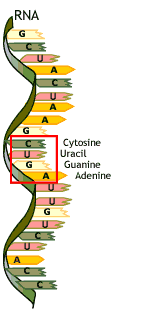
In RNA, Uracil pairs with ______. 
a)
cytosine
b)
adenine
c)
guanine
d)
thymine
69.
The process to go from DNA to mRNA is _______
a)
translation
b)
transcription
c)
replication
70.
The process to go from mRNA to a protein is called ____
a)
transcription
b)
rRNA
c)
replication
d)
translation
71.
The main function of tRNA is to...
a)
carry a message that, when translated, forms proteins
b)
form a portion of ribosomes
c)
string together complementary RNA and DNA strands
d)
bring amino acids from the cytoplasm to the ribosomes
72.
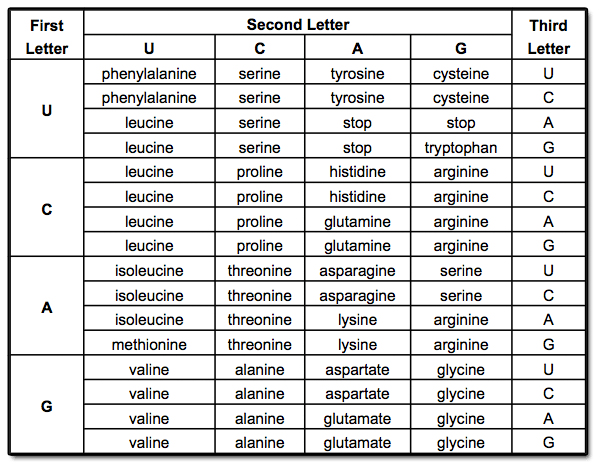
What amino acid is represented by the codon UUA?
a)
Phenylalanine
b)
Tyrosine
c)
Leucine
d)
Stop codon
73.
Which component of DNA determines the traits of an organism? 
a)
Nitrogen Bases
b)
Sugar-Phosphate Backbone
c)
Hydrogen bonds
74.
What is the three base sequence of mRNA that codes for a single amino acid?
a)
Anticodon
b)
Codon
c)
Protein
75.
Which is the mRNA molecule that would be transcribed from this DNA template:
TGGCAAGTACGT
a)
ACCGTTCATGCA
b)
UGGCAAGUACGU
c)
UCCGUUCUUGCU
d)
ACCGUUCAUGCA
76.
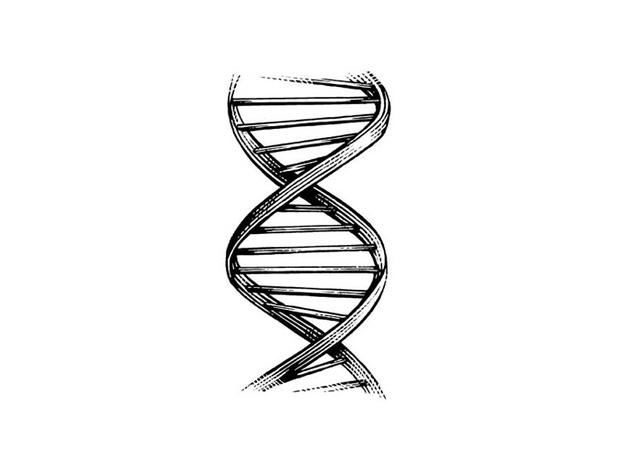
DNA has a _____________ structure. 
a)
double helix
b)
single strand
c)
ring 
d)
chain
77.
How many amino acids are coded for by this sequence of nucleotides:
ATG GGA ACT CCA
a)
4
b)
2
c)
6
d)
12
78.
What type of RNA carries the DNA message out of the nucleus to the ribosomes?
a)
mRNA
b)
tRNA
c)
RNA
d)
DNA
79.

The tRNA binds to specific codons. What part of the tRNA binds with a specific codon?

a)

anti-codon

b)

mRNA

c)

rRNA

d)

antisense

80.
_______ is made during transcription and ________ is made during translation.
a)
mRNA / a protein
b)
a protein / mRNA
c)
Ribosome / Nucleus
d)
mRNA / tRNA
81.

the sequence for amino acids are originally copied from

a)

DNA

b)

mRNA

c)

rRNA

d)

tRNA

82.
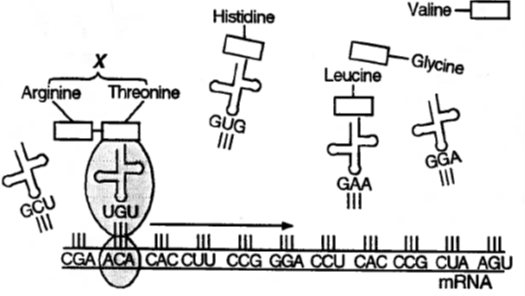
What process is going on in this photo? 
a)
Transcription 
b)
Translation 
c)
Replication 
d)
All the above 
83.

What is a mutation?

a)

Adenine

b)

a change/mistake in DNA

c)

a copy of the original DNA

d)

Guanine

84.
Why are advantageous traits more likely to be passed onto offspring?
a)
Because they are more likely to survive and reproduce.
b)
Because they come from dominant alleles.
c)
Because they come from recessive alleles.
d)
Because the trait is an acquired phenotype.
85.
Change over time
a)
Natural Selection
b)
Selective Breeding
c)
Homeostasis
d)
Evolution
86.

Structures with the same parts have different functions; suggests that organisms share a common ancestry

a)
vestigial structures
b)
homologous structures
c)
adaptive radiation
d)
fossil
87.

Whales are aquatic mammals that contain a pelvis (hip) bone. Even though it does not aid in its movement, the function must have been used by a common ancestor of the whale. Thus, the pelvis is referred to as a(n)

a)

vestigial structure

b)

analogous structure

c)

homologous structure

88.
The ability of an organism to survive and reproduce in its specific environment 
a)

diversity

b)
evolution
c)
adaptation
d)
 fitness
89.
Genetic differences between organisms of the same species
a)
Variation
b)
Adaptation
c)
Behavior
d)
Environment
90.

The study of organisms at their earliest stage of life

a)

embryology

b)

the fossil record

c)

DNA

d)

vestigial structures

91.

Which structure is shown in the picture?

a)

analogous structure

b)

homologous structure

c)

vestigial structure

d)

DNA

92.

Who developed the theory of natural selection?

a)

Jean-Baptiste Lamarck

b)

Charles Darwin

c)

James Hutton

d)

Gregor Mendel

93.

What type of selection is depicted in the picture?

a)

stabilizing

b)

directional

c)

disruptive

94.
What type of selection?
a)
Directional 
b)
Stabilizing
c)
Disruptive
95.
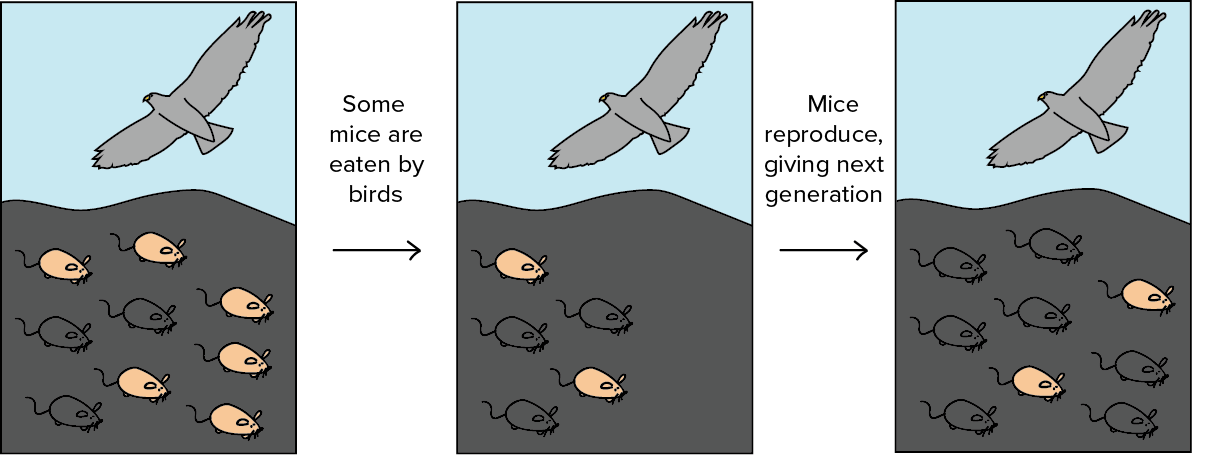
Why is the mouse population changing over time?
a)

The light mice can reproduce more successfully than the dark mice

b)

The hawks eat more dark mice than light mice because the dark mice taste better

c)

The hawks eat more light mice than dark mice because they can see the light mice more easily

d)

The hawks eat more dark mice than light mice because they can see the dark mice more easily
96.
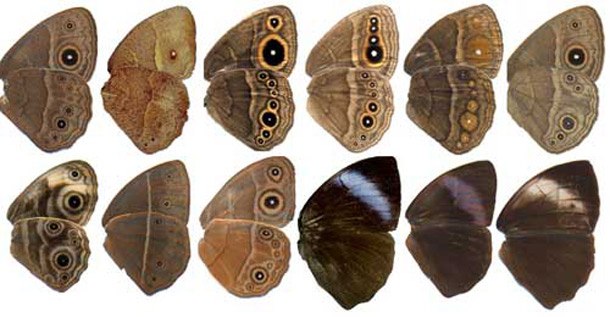
These moths are all the same species. The differences between their wings is an example of ________________
a)

Natural Selection

b)

Variation

c)

Homeostasis

d)

Extinction

97.

Insects become resistant to pesticides very quickly, sometimes in one generation. If an insect is resistant to the chemical, most of the offspring will also be resistant. Considering that insect generations can be a matter of weeks, insects in an area can become immune to a chemical within months.

a)

Mutation

b)

Genetic drift

c)

Natural selection

d)

Gene flow

98.

Genetic drift is driven by random chance, not natural selection.

a)

True

b)

False

99.

The more similarities in DNA two organisms share, the more ______ we can assume they are.

a)

evolved

b)

ancient

c)

distant

d)

related

100.

Which is not a piece of evidence for evolution

a)

comparative anatomy

b)

fossils

c)

overproduction

d)

biogeography

101.
which symbiosis is this 
a)
parasitism 
b)
mutualism
c)
commensalism
d)
nonalism 
102.
What is the term for each step in the transfer of energy and matter within a biological community?
a)
energy path
b)
food web
c)
trophic level
d)
food pyramid
103.
symbiotic relationship in which both organisms benefit
a)
competition
b)
Mutualism
c)
nitrogen fixation
d)
energy pyramid
104.
The amount of energy that usually transfers from one trophic level to the next...
a)
10%
b)
20%
c)
80%
d)
50%
105.
Organisms that feed on both living producers and other consumers.
a)
Carnivores
b)
Omnivores
c)
Herbivores
d)
Detritivores
106.
Green plants are
a)
producers
b)
consumers
c)
herbivores
d)
omnivores
107.
symbiotic relationship in which one organisms benefits and the other organism is not affected
a)
invasive (non-native) species
b)
mutualism 
c)
nitrogen fixation
d)
commensalism
108.
Water temperature would be an example of ...
a)
A biotic factor
b)
An abiotic factor
109.
The carrying capacity of an environment for a particular species at a particular time is determined by the
a)
number of individuals in the species.
b)
distribution of the population.
c)
reproductive potential of the species.
d)
supply of the most limited resources
110.
What is this called?
a)
Food Web
b)
Food Chain
c)
Abiotic Factors
111.
Which of these organisms would receive energy from the snake?
a)
Plant
b)
Rabbit
c)
Mouse
d)
Hawk
112.
What is a producer? 
a)
Organism that creates their own food.
b)
Organism that eat other organisms for energy
c)
Organism that eat other dead organisms
113.

How is a food web different from a food chain?

a)

Food webs contain only producers, not consumers.

b)

Food webs do not include decomposers.

c)

Food webs contain many different, linked food chains.

d)

Food webs exist in aquatic environments; food chains exist in terrestrial environments.

114.

What would happen to the rabbit population if the fox population moved out of the area represented by the food web?

a)

The rabbit population would increase

b)

The rabbit population would decrease

c)

The rabbit population would neither increase nor decrease