wayground logo

Free Printable Worksheets

Font size

S
M
L
XL
Worksheets

FINAL CURVE ASSIGNMENT QUIZIZZ

Total questions: 200

Worksheet time: 3hrs 20mins
Name
Class
Date
1.
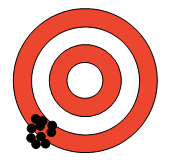
This bullseye demonstrates...
a)
High Accuracy & High Precision
b)
High Accuracy & Low Precision
c)
Low Accuracy & High Precision
d)
Low Accuracy & Low Precision
2.

Describe the accuracy and precision of the image

a)

Very accurate and somewhat precise

b)

Very accurate but not precise at all

c)

Not accurate at all but very precise

d)

not accurate and not very precise

3.

A set of data are all close in value to each other, but they are not close to the actual value. This set of data can be described as _________________.

a)

precise

b)

accurate

4.

Accuracy means

a)

the measurements are close to each other

b)

the measurement is close to the true value

c)

the measurements are close to each other

d)

the measurements are close to each other and the true value.
5.

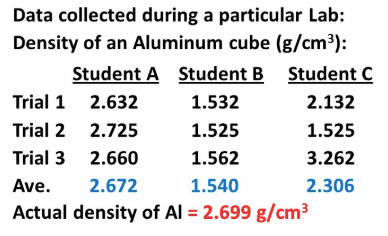
Which student is the most ACCURATE?

a)

A

b)

B

c)

C

6.
a)

Student A

b)

Student B

c)

Student C

d)

Cannot be determined

7.
The metric unit of measurement for length is ____________________. 
a)
Liter
b)
Meter
c)
gram
d)
inch
8.

The metric system is based on multiples of:

a)

100

b)

20

c)

10

d)

1

9.

The SI unit for volume is the __________.

a)

meter

b)

kilogram

c)

liter

d)

second

10.

The SI unit for mass is the __________.

a)

meter

b)

kilogram

c)

liter

d)

second

11.
How many significant figures: 216 m
a)
1
b)
2
c)
3
d)
0
12.
How many significant figures: 2016 m
a)
1
b)
2
c)
3
d)
4
13.
How many significant figures: 153.0 mL
a)
1
b)
2
c)
3
d)
4
14.
How many significant figures: 0.012 km
a)
1
b)
2
c)
3
d)
4
15.
How many significant figures: 1000 mL
a)
1
b)
2
c)
3
d)
4
16.
What is Avogadro's Number? 
a)
6.02 x 10²³
b)
- 6.02 1023
c)
6.02 x 10²²
d)
6,020,000,000,000
17.
Avogadro's number of representative particles is equal to one_____.
a)
kilogram
b)
gram
c)
kelvin
d)
mole
18.
A mole of Neon contains
6.02 x 10²³ _____.
a)
atoms
b)
formula units
c)
ions
d)
molecules
19.
Find the percent composition of N2S2.
a)
N: 69.6%  S: 30.4%
b)
N:36% S: 75.6%
c)
N: 96.6% S: 3.4%
d)
N: 30.4% S: 69.6%
20.
What is the molar mass of Carbon Dioxide (CO2)?
a)
12 amu
b)
12 g
c)
44 g
d)
44 amu
21.
How many moles of carbon atoms are there in 5g of carbon?
a)
60 mol
b)
17 mol
c)
0.42 mol
d)
7 mol
22.
How many grams is 1.2 moles of Neon?
a)
0.05 grams
b)
16.6 grams
c)
21.2 grams
d)
24 grams
23.
Convert 28.0 grams of O2 to moles.
a)
1.14 moles
b)
1.75 moles
c)
0.571 moles
d)
0.875 moles
24.
How many molecules are there in 31.8 moles of water?
a)
5.28 x 10⁻²³ molecules
b)
1.91 x 1025 molecules
25.

What is the molar mass of PbSO4?

a)

303.27 g/mol

b)

255.27 g/mol

c)

163.87 g/mol

d)

372.27 g/mol

26.
What is the molar mass of C2H4O2?
a)
40g
b)
50g
c)
60g
d)
68g
27.
How many particles would be in 8.4 moles of Octane (C8H18)?
a)
5.77 x 10²³
b)
5.04 x 1024
c)
5.77 x 1026
d)
5.04 x 10²³
28.
How many molecules are there in 5.9 moles of NaCl?
a)
3.5x1024molecules
b)
9.79x10⁻²⁴molecules
c)
1.02x10²³molecules
29.
How many moles are in 4.3 x 1024 molecules of H2O?
a)
6.02 x 10²³
b)
7.14
c)
18.02
d)
128.66 
30.

Calculate the molar mass of KOH.

a)

28 g/mol

b)

56 g/mol

c)

84 g/mol

d)

112 g/mol

31.

Calculate the molar mass for Al(OH)3

a)

78.0 g/mol

b)

72 g/mol

c)

28 g/mol

d)

25 g/mol

32.
What is the percent by mass of magnesium in MgO?
a)
20%
b)
40%
c)
50%
d)
60%
33.
What is the percent by mass of fluorine in CaF2 (gram-formula mass = 78 g/mol)?
a)
24%
b)
49%
c)
51%
d)
65%
34.
What is the empirical formula for the following:
Pb5Cr5O20
a)
Pb2Cr2O10
b)
PbCr2O7
c)
Pb9Cr4O2
d)
PbCrO4
35.

What is the empirical formula for C4H6?

a)

CH

b)

CH3

c)

C2H3

d)

C4H6

36.
A formula with the lowest whole # ratio of elements in a compound is called
a)
Molecular Formula
b)
Chemical Formula
c)
Empirical Formula 
d)
Distance Formula
37.

You are given the following percentages: 40.05% S and 59.95% O. Find the empirical formula for these elements.

a)

SO

b)

SO2

c)

SO3

d)

SO4

38.

Given the following: 42.07% Na, 18.89% P, and 39.04% O, determine the empirical formula.

a)

NaPO2

b)

Na2PO3

c)

Na3PO4

d)

NaPO4

39.

A compound consists of 72.2% magnesium and 27.8% nitrogen by mass. What is the empirical formula?

a)

Mg4N3

b)

MgN2

c)

Mg3N2

d)

MgN

40.
You are given the following percentages: 40.05% S and 59.95% O. Find the empirical formula for these elements.
a)
SO
b)
SO2
c)
SO3
d)
SO4
41.
What is the molecular formula for a compound with the empirical formula: K2SOand a molecular mass of 696g.
a)
K2SO
b)
K8SO16
c)
K8S4O
d)
K8S4O16 
42.
Glycerol has a molar mass of 92.09g/mol. Its percent composition is: 39.12% C, 8.75% H, and 51.12% O. What is the molecular formula for glycerol?
a)
C2H3O2
b)
CH2O
c)
C2H4O2
d)
C3H8O3
43.
A chemical formula that shows the actual # and kinds of atoms present in one molecule of a compound is called_________
a)
ionic formula
b)
covalent formula
c)
empirical formula
d)
molecular formula
44.
2NaClO3 (s)  2NaCl (s) + 3O2 (g)  
12.00 moles of NaClO3 will produce how many grams of O2?
a)
256 g of O2
b)
576 g of O2
c)
288 g O2
45.
Cl2 + 2KBr → Br2 + 2KCl
How many grams of potassium chloride (KCl) can be produced from 356 g of potassium bromide (KBr)?
a)
749 g
b)
223 g
c)
479 g
d)
814 g
46.
N2 +  3H2 −->  2NH3 
How many moles of hydrogen are needed to react with 2 moles of nitrogen?
a)
6
b)
2
c)
3
d)
1
47.
2 KClO3 → 2 KCl + 3 O2
How many moles of oxygen are produced when 6.7 moles of KClO3 decompose completely?
a)
6.7 mol
b)
1.0 mol
c)
10.1 mol
d)
4.5 mol
48.

Given the following chemical equation:

2 Al + 3 CuCl2 → 3 Cu + 2 AlCl3

How many moles of copper (II) chloride must be consumed in order to produce 12 moles of aluminum chloride?

a)

14

b)

6

c)

12

d)

18

49.

Given the following chemical equation:

4 Al + 3 O2 → 2 Al2O3

How many moles of aluminum oxide will be produced if 12 moles of aluminum are consumed?

a)

12

b)

4

c)

8

d)

6

50.

In the reaction

2RbNO3 → 2RbNO2 + O2

how many moles of O2 are produced when 5.0 mol of RbNO3 decompose?

a)

1.0 mol

b)

2.5 mol

c)

3.0 mol

d)

7.5 mol

51.
What is a limiting reactant?
a)
the reactant that determines how much product can be made
b)
the reactant that is in excess
c)
the product that you can make the most of
d)
the amount of reactants that react with each other
52.
You need 2 pieces of bread, 1 tablespoon of peanut butter and 2 tablespoons of jelly to make a sandwich.  If you have 10 pieces of bread, 4 tablespoons of peanut butter and 20 tablespoons of jelly, what is the limiting reactant?
a)
bread
b)
jelly
c)
peanut butter
d)
sandwich
53.
When 12 moles of O2 reacts with 1.1 mole of C10H8 what is the limiting reactant?  C10H8 + 12 O2 --> 10 CO2 + 4 H2O
a)
Oxygen
b)
C10H8
c)
Water
d)
Carbon Dioxide
54.
The limiting reactant
a)
slows the reaction down
b)
is used up first
c)
is the reactant that is left over
d)
controls the speed of the reaction
55.
Use the equation 2 Al + 3 Cl2 ---> 2 AlCl3.  If 2 moles of aluminum and 2 moles of chlorine are reacted, identify the limiting reactant.
a)
AlCl3
b)
Cl2
c)
Al
56.
P+ 3O--> P4O
What is the limiting reactant is 12 moles of Preact with 15 moles of O2?
a)
P4
b)
O2
c)
P4O
d)
none of the above
57.
Fe + S --> FeS
If 7.62g Fe react with 8.67g S, what is the limiting reactant?
a)
Fe
b)
S
c)
FeS
d)
none 
58.
The ______________ yield is the maximum amount of product possible in a reaction. This determines the amount of product that should be produced in a perfect setting
a)
Percent
b)
actual
c)
stoichiometry
d)
theoretical
59.

When reacting Na with Cl2, we calculated that the theoretical yield should be 13 grams. Our actual yield was 12.5 grams. What is the percent yield?

a)

90.4%

b)

104%

c)

96.15%

d)

1.04%

60.

2Fe2O3 + 3C → 4Fe + 3CO2

You add 28 grams of carbon. You find the actual yield to be 81.2 grams of CO2. What is the percent yield of CO2? (Hint: calculate theoretical yield of CO2 first)

a)

58.83%

b)

308%

c)

6435%

d)

79.14%

61.
Theoretical yield = 73g
Actual yield = 62g
Calculate the percent yield.
a)
1.16%
b)
116%
c)
85%
d)
76%
62.

Which of the following is an assumption of the kinetic-molecular theory of gases?

a)

Collisions between gas particles are inelastic.

b)

Gases consist of closely spaced particles.

c)

Gas particles move around in an orderly manner.

d)

The temperature of a gas depends on the average kinetic energy of the gas particles.

63.
Solids are described as having a 
a)
definite shape and indefinite volume
b)
indefinite shape and indefinite volume
c)
definite shape and definite volume
d)
indefinite shape and definite volume
64.
Which of the following states of matter has the lowest kinetic energy? 
a)
solid
b)
liquid 
c)
gas
65.
Gas particles move around at __________ speeds. 
a)
low
b)
slow
c)
high
d)
unknown
66.
Adding thermal energy to matter casues its particles to _________________.
a)
move slower
b)
move faster
c)
melt
d)
feeze
67.
How do gas molecules move? 
a)

in an orderly fashion 

b)

constantly and randomly

c)

in straight line paths

d)

in a circular motion

68.

Gas pressure is caused by ______.

a)

gravity.

b)

gas molecules colliding with each other.

c)

gas molecules colliding with surfaces of the container.

d)

gas molecules reacting with each other.

69.
True or False: Gases can be compressed. 
a)

True

b)

False

70.

What will happen to the volume of a balloon if you warm it up into over hot water?

a)

Volume will increase

b)

Volume will decrease

c)

Volume will not change

71.

If the temperature of a gas decreases, the pressure of the gas will...

a)

Decrease

b)

Increase

c)

Not change

d)

Cannot be determined

72.

Which container has higher pressure?

a)

Container A

b)

Container B

c)

Container A and B have the same pressure.

73.

Pressure decreases when..

a)

Temperature increases.

b)

Temperature decreases.

c)

Number of particles increase.

d)

Volume decreases.

74.

In an "inverse relationship", such as Boyle's Law, when one variable shows an increase the other variable...

a)

increases as well

b)

remains constant

c)

shows a flat line on a graph

d)

decreases

75.

In a "direct relationship", such as Charles' Law, when one variable shows an increase the other variable...

a)

increases as well

b)

remains constant

c)

shows a flat line on a graph

d)

decreases

76.

A student measures the pressure and volume of an empty water bottle to be 1.4 atm and 2.3 L. She then decreases the pressure to 0.65 atm. What is the new volume?

a)

2.1 L

b)

5.0 L

c)

8.2 L

d)

3.9 L

77.

What is the pressure of a car tire that had an initial pressure of 1.8 atm but was heated from 38°C to 123°C?

a)

0.9 atm

b)

2.29 atm

c)

1.6 atm

d)

3.4 atm

78.
In order to convert to Kelvin, you add ______ to the Celsius measurement.
a)
372
b)
273
c)
237
d)
732
79.
What is 50 °C in Kelvin?
a)
223
b)
323
c)
100
d)
50
80.

A sample of gas with a volume of 30.0 mL at 25.0oC is heated to 50.0oC. What is the new volume of the gas?

a)

60.0 mL

b)

15.0 mL

c)

27.5 mL

d)

32.5 mL

81.
You have a gas that has a pressure of 2 ATM and a volume of 10L.  What would be the new volume if the pressure was changed to 1 ATM?
a)
5 L
b)
20 L
c)
It would stay at 10L
d)
1 L
82.
A gas is heated from 263K to 298K. The volume is increased from 24.0L to 35.0L. If the original pressure was 1.00 atm, what is the new pressure?
a)
0.78 atm
b)
1.65 atm
c)
1.28 atm
d)
0.61 atm
83.
What is the formula for Boyle's Law?
a)
P1V1=P2V2
b)
P1V1/P2V2
c)
P1V2=P2V1
d)
P1/V1=P2/V2
84.
What is the formula Charles' Law?
a)
V = T
b)
VT = VT
c)
T1 / V1 = T2 / V2
d)
V1 / T1 = V2 / T2
85.
If the pressure outside today is 0.921 atm, what is it in mmHg?
a)
760 mmHg
b)
.00121 mmHg
c)
700 mmHg
d)
95.2 mmHg
86.
A gas that has a pressure of 2 atm and a volume of 10 L.  What would be the new volume if the pressure was changed to 1 atm?
a)
P1/T1 = P2/T2
b)
P1V1 = P2V2
c)
V1/n1 = V2/n2
d)
PV = nRT
87.
A sample of a gas has a volume of 852 mL at 298 K. What temperature is necessary for the gas to have a volume of 945 mL?
a)
Pt = P1 + P2 + P3 + ...
b)
P1V1 = P2V2
c)
V1/T1 = V2/T2
d)
P1V1/T1 = P2V2/T2
88.
If a nitrogen gas occupies a volume of 500 ml at a pressure of 0.971atm. What volume will the gas occupy at a pressure of 1.50 atm?  
a)
P1V1 = P2V2
b)
PV = nRT
c)
P1/T1 = P2/T2
d)
V1/n1 = V2/n2
89.
Determine the number of moles in a container of gas at STP with a volume of 99.2 L. 
a)
V1/n1 = V2/n2
b)
PV = nRT
c)
P1/T1 = P2/T2
d)
V1/T1 = V2/T2
90.
A sample of gas with a volume of 30.0 mL at 25.0oC is heated to 50.0oC.  What is the new volume of the gas?
a)
P1V1 = P2V2
b)
P1/T1 + P2/T2
c)
PV = nRT
d)
V1/T1 = V2/T2
91.
A gas fills a balloon at a temperature of 27 oC and 1 atm of pressure. What will the pressure of the balloon be if the gas is heated to 127 oC?
a)
P1V1 = P2V2
b)
PV = nRT
c)
P1/T1 = P2/T2
d)
V1/T1 = V2/T2
92.
A 1.25 L volume of gas contains 4.5 moles.  How many moles will be in 0.75 L?
a)
PV = nRT
b)
P1V1 = P2V2
c)
P1V1/T1 = P2V2/T2
d)
V1/n1 = V2/n2
93.

Assume that 5.6 L H2 at STP reacts with excess CuO according to the following equation:

CuO (s) + H2 (g) ---> Cu (aq) + H2O (l)


How many moles of Cu are produced?

a)

0.250 mol

b)

2.50 mol

c)

25.0 mol

d)

25.00000 mol

94.
You have 3.5 L of H2 (g) at STP. How many moles of gas are there?
a)
22.4 mol
b)
22.4 L
c)
0.16 mol
d)
0.16 L
95.

What is the significance of boiling point in determining intermolecular forces?

a)

The boiling point has no relation to intermolecular forces.

b)

Higher boiling points suggest weaker intermolecular forces.

c)

The boiling point indicates the molecular weight of a substance.

d)

Higher boiling points suggest stronger intermolecular forces.

96.

What are London dispersion forces?

a)

Weak intermolecular forces arising from temporary dipoles due to electron movement.

b)

Strong forces that hold molecules together in ionic compounds.

c)

Attractive forces between molecules with permanent dipoles.

d)

Repulsive forces that occur between charged particles.

97.

What are intermolecular forces?

a)

Forces that hold the nucleus of an atom together.

b)

Forces of attraction or repulsion between neighboring particles (molecules, atoms, or ions).

c)

Forces that occur only in ionic compounds.

d)

Forces that determine the color of substances.

98.
Intermolecular forces are the forces
a)
within molecules
b)
between molecules
99.

Which of the following is an intramolecular force?

a)

hydrogen bonding

b)

polar covalent bonding

c)

London dispersion forces

d)

dipole-dipole interaction

100.

What type of intermolecular force occurs between molecules with hydrogen bonded to nitrogen, oxygen, or fluorine?

a)

Covalent bonding

b)

Van der Waals forces

c)

Hydrogen bonding

d)

Ionic bonding

101.

What type of intermolecular force occurs between polar molecules?

a)

Hydrogen bonding

b)

London dispersion forces

c)

Ionic bonding

d)

Dipole-dipole forces

102.

The ascension of liquids through slim tube, cylinder or permeable substance due to adhesive and cohesive forces interacting between the liquid and the surface is called_____.

a)

surface tension

b)

cohesion

c)

capillarity

d)

adhesion

103.

What is the term for the resistance of a liquid to flow?

a)

Cohesion

b)

Viscosity

c)

Adhesion

d)

Surface tension

104.

What is the term for the attraction of molecules in a liquid to the container?

a)

Cohesion

b)

Viscosity

c)

Adhesion

d)

Surface tension

105.

Which type of intermolecular force is the weakest?

a)

Ionic forces

b)

Covalent forces

c)

London dispersion forces

d)

Hydrogen bonding

106.

What is the term for the attraction of molecules in a liquid to each other?

a)

cohesion

b)

repulsion

c)

adhesion

d)

dispersion

107.
Ionic bonds are between _______ and ________. 
a)
nonmetals and nonmetals 
b)
metals and metals 
c)
metals and nonmetals
d)
none
108.
Molecular solids are made from ______. 
a)
metals 
b)
atoms
c)
sodium
d)
non-metals 
109.

Which of the following is a property of ionic solids?

a)

Low density

b)

Good conductors of electricity in solid state

c)

High melting and boiling points

d)

Soft and flexible

110.

contain a "sea of electrons" which makes them good conductors

a)

amorphic solids

b)

ionic solids

c)

metallic solids

d)

network solids

111.

What is a key property of ionic solids?

a)

Malleable and ductile

b)

Conduct electricity in solid state

c)

High melting points

d)

Soft with low melting points

112.

What is a characteristic feature of amorphous solids?

a)

Long-range order

b)

Well-defined melting points

c)

Irregular arrangement of particles

d)

High electrical conductivity

113.

Which type of solid is known for having a well-defined geometric shape?

a)

Amorphous solids

b)

Metallic solids

c)

Crystalline solids

d)

Molecular solids

114.

Phase change going from Liquid to Solid...

a)

Melting

b)

Freezing

c)

Condensation

d)

Sublimation

115.

Phase change going from a Gas to a Liquid...

a)

Sublimation

b)

Deposition

c)

Ionization

d)

Condensation

116.

Phase change going from a Liquid to a Gas...

a)

Vaporization

b)

Deposition

c)

Condensation

d)

Melting

117.

Phase change going from a Solid to a Liquid...

a)

Freezing

b)

Condensation

c)

Melting

d)

Sublimation

118.
All changes in the state of matter of a substance requires
a)
vibration
b)
water
c)
permission
d)
energy
119.
What happens to particles when they are heated?
a)
They speed up and spread out
b)
They slow down and compress
c)
They stop moving
d)
They move closer together and speed up
120.
Between which points is the temperature of the substance remaining constant?
a)
A-B only. 
b)
A-B, C-D, E-F
c)
B-C only. 
d)
B-C, D-E
121.
A substance's heating curve is shown in the graph.  What is its boiling point?
a)
100 C
b)
60 C
c)
80 C
d)
20 C
122.
What line segment represents only the solid state?
a)
A-B
b)
B-C
c)
C-D
d)
D-E
123.

Which segment of the graph represents an increase in average kinetic energy?

a)

AB and BC

b)

BC and DE

c)

DE and EF

d)

AB and CD

124.
Describe the substance between letters D and E. 
a)
Gas
b)
Liquid
c)
Melting
d)
Evaporating
125.

The melting point of the sample is

a)

-60 ºC

b)

-100 ºC

c)

60 ºC

d)

100 ºC

126.
Water exists as a _____________ at 700 mmHg and 50 °C.
a)
solid
b)
liquid
c)
gas
d)
supercritical fluid
127.
What state of matter is X?
a)
solid 
b)
liquid
c)
gas
d)
supercritical fluid
128.
What state of matter is Z?
a)
solid 
b)
liquid
c)
gas
d)
supercritical fluid
129.
What change occurs from E to C?
a)
sublimation
b)
freezing
c)
melting
d)
boiling
130.
What change occurs from C to D?
a)
condensation
b)
vaporization
c)
melting
d)
sublimation
131.
What is point A?
a)
triple point
b)
critical point
c)
equilibrium point
d)
normal melting point
132.
What is a substance that is dissolved in another substance? 
a)
solution
b)
solute
c)
solvent
d)
compound
133.
What is a solvent?
a)
The substance that does the dissolving in a solution.
b)
The substance that is being dissolved in a solution.
c)
The mixing of different substances.
d)
The process in which neutral molecules lose or gain electrons
134.
This solution would be considered
a)
Unsaturated
b)
Supersaturated
c)
Saturated
d)
Undefined
135.
This graph represents a(n) ___ solution
a)
saturated
b)
supersaturated
c)
unsaturated
d)
undefined
136.
How many grams of ammonium chloride are needed to make a saturated solution at 80o C?
a)
50 grams
b)
80 grams
c)
65 grams
d)
75 grams
137.
What is the molarity of a 2 liter solution containing 5 moles of NaCl?
a)
2.5
b)
0.4
c)
2.5 moles/liter
d)
10 moles/liter
138.

___________ refers to the amount of solute dissolved in a given amount per volume of solution

a)

Concentration

b)

Dilution

c)

Precipitation

d)

None of the above

139.

What is the percent by mass of a solution made by dissolving 20.0 g of NaCl into 180.0 g of water?

a)

10.0 %

b)

11.1 %

c)

80.0 %

d)

20.0 %

140.

How many grams of NaNO3 are needed to prepare 100 g of 15.0 % by mass NaNO3 solution? (MM = 85 g/mol)

a)

15 g

b)

1275 g

c)

12.75 g

d)

150 g

141.

How many grams of solute are dissolved in 0.125 L of 5.00 M NaCl (MM = 58.45)?

a)

0.625 g NaCl

b)

625 g NaCl

c)

36.5 g NaCl

d)

0.04 mol NaCl

142.
How many moles are needed to make 2.5 L of a 3.8 M solution? 
a)
9.5 mol
b)
0.66 mol
c)
1.5 mol
d)
15 mol
143.

Molality (m) = moles of solute / _________________________.

a)

kilogram of solvent

b)

kiloliter of solvent

c)

kilometer of solvent

d)

ounces of solvent

144.

What is the molality of a solution made from 2.4 moles of NaCl and 0.80 kg of water?

a)

1

b)

1

c)

1

d)

1

145.
What is the molality of 1.2 g of HCl in 750 g of solution?
a)
0.04 m
b)
0.00004 m
c)
0.0016 m
146.

Molarity is measured in _____.

a)

moles per g.

b)

moles per L.

c)

moles per mm.

d)

moles per mL.

147.

Gases are more soluble at ______temps and _____pressures

a)

high, low

b)

low , high

c)

high, high

d)

low, low

148.
What is the molality of 1.2 g of HCl in 750 g of solution?
a)
0.04 m
b)
0.00004 m
c)
0.0016 m
149.

How much of a 5M stock solution would you need to make 1L of a 1M solution?

a)

0.2 L

b)

5 L

c)

100 L

d)

0.5 L

150.

A dilution is when

a)

solute is added to the volume of stock solution

b)

water is added to the volume of stock solution

c)

solute is removed from the volume of stock solution

d)

water is removed from the volume of stock solution

151.

To what volume must 1.0 L of a 6.0 M solution of HCl be diluted in order to prepare a 0.2 M solution?

a)

30L

b)

60L

c)

15L

d)

45L

152.

2Al + 3H2SO4 -> Al2(SO4)3 + 3H2

How many grams of aluminum sulfate would be formed if 250 mL of 0.50 M H2SO4 completely reacted with aluminum?

a)

1.3x10⁵ g

b)

14 g

c)

5.7x10⁴ g

d)

57 g

153.

Which is affected by temperature?

a)

molarity

b)

molality

c)

neither

d)

both

154.

When you make a dilution, which of these values remains constant?

a)

The molarity (M)

b)

The total moles of solute

c)

The volume (V)

d)

The concentration

155.

How much of a 5M stock solution would you need to make 1L of a 1M solution?

a)

0.2 L

b)

5 L

c)

100 L

d)

0.5 L

156.

A substance that is 3 on the pH scale would be a(n):

a)

acid

b)

base

c)

neutral

d)

solute

157.
A substance that changes color when mixed with an acid or base is a(n) ___.
a)
indicator
b)
neutralizer
c)
corrosive
d)
electricity
158.
Bases are located where on the pH scale?
a)
any number can be a base
b)
below 7
c)
above 7
d)
number 7 is a base
159.
A substance that is a 10 on the pH scale would be a(n) ____.
a)
acid
b)
neutral
c)
base
d)
indicator
160.
At what location on the pH scale can you find acids?
a)
number 7 on the pH scale is acidic
b)
below 7
c)
above 7
d)
you can find acids all throughout the scale
161.

Taste bitter

a)

acids

b)

bases

c)

neutral

d)

pH paper

162.

Taste sour

a)

acids

b)

bases

c)

neutral

d)

pH scale

163.

According to the pH scale, which item is more acidic than lemons?

a)

battery

b)

vinegar

c)

milk

d)

blood

164.

According to the pH scale, which item is a stronger base than soap?

a)

baking soda

b)

ammonia solution

c)

tomato

d)

bleach

165.
The lower the pH, the greater the concentration of :
a)
OH-
b)
H+
166.
A pH of 14 is a .....
a)
strong acid
b)
weak acid
c)
Strong base
d)
Weak base
167.
What is another name for base?
a)
Sugar
b)
Alkaline
c)
Acid
d)
pH
168.
Pure water has a pH of 7. Pure water _______.
a)
is a base
b)
is a neutral substance
c)
could be either an acid or a base
d)
is an acid
169.
Water is neutral because the number of hydrogen and hydroxide ions is _________.
a)
the same
b)
different
170.
This substance releases OH- into solution
a)
Acid
b)
Base
c)
Neutral
171.
The table below shows the pH of several solutions. Which solution has the greatest concentration of H+ ions?
a)
vinegar
b)
milk
c)
water
d)
bleach
172.

A basic ( alkaline ) solution has a

a)

higher concentration of hydrogen ions than hydroxide ions

b)

equal concentration of hydroxide ions and hydrogen ions

c)

higher concentration of hydroxide ions than hydrogen ions

173.

An acidic solution has a

a)

higher concentration of hydrogen ions than hydroxide ions

b)

higher concentration of hydroxide ions than hydrogen ions

c)

equal concentration of hydrogen ions and hydroxide ions

174.

According to Arrhenius, what is the definition of an ACID?

a)

a substance that contains hydroxide and ionizes to produce OH-

b)

a substance that contains hydrogen and ionizes to produce H+

c)

a substance that contains hydrogen and ionizes to produce OH-

d)

a substance that contains hydroxide and ionizes to produce H+

175.

Neutralization is the process of an acid and a base reacting to form what? Select all that apply

a)

An ionic salt

b)

Hydronium ions

c)

NaCl

d)

Water

176.

According to the Arrhenius theory, an acid is a substance that

a)

changes litmus from red to blue

b)

changes phenolphthalein from colorless to pink

c)

produces hydronium ions as the only positive ions in an aqueous solution

d)

produces hydroxide ions as the only negative ions in an aqueous solution

177.

An arrhenius base

a)

produces H+ ions

b)

produces OH- ions

c)

is insoluble

d)

has an i of 2

178.

A Bronsted Lowry acid:

a)

donates H+ to another substance

b)

accepts H+ from another substance

c)

produces H+

d)

produces OH-

179.

A Bronsted Lowry base:

a)

donates H+ to another substance

b)

accepts H+ from another substance

c)

produces H+

d)

produces OH-

180.

In the equation below, what is the Bronsted Lowry acid (donates H+)?

HCl + NH3 → Cl- + NH4+

a)

HCl

b)

NH3

c)

Cl-

d)

NH4+

181.

In the equation below, what is the Bronsted Lowry base (accepts H+)?

HCl + NH3 → Cl- + NH4+

a)

HCl

b)

NH3

c)

Cl-

d)

NH4+

182.

Which product in the following equation is a conjugate base?

H2O + HCl → H3O+ + Cl-

a)

Water

b)

Hydrogen chloride

c)

Hydronium

d)

Chloride

183.

What is the conjugate acid in the following equation?

PO4-3 + HNO3 → NO3- + HPO4-2

a)

PO43-

b)

HNO3

c)

NO3-

d)

HPO42-

184.

What would be the pH of a solution with an [H+] of 0.001?

a)

3

b)

1

c)

-3

d)

-1

185.

What would be the pOH of a solution with [H+] of 0.024?

a)

1.6

b)

-1.6

c)

12.4

d)

0.95

186.

What would be the pOH of a solution with [OH-] of 0.06?

a)

1.22

b)

-1.22

c)

12.78

d)

0.06

187.

What would be the pOH of a solution with [OH-] of 0.00054?

a)

3.26

b)

-3.26

c)

10.74

188.

For a solution, pH + pOH =

a)

7

b)

14

c)

1.0 x 10⁻¹⁴

d)

-log (1.0 x 10 -14)

189.

If the pH of a solution is 4.0, what is the pOH?

a)

4.0

b)

10.0

c)

1.0 x 10 -4

d)

cannot be determined from the information

190.
What are the products to a neutralization reaction?
a)
H2 + Ionic Salt
b)
H2O + Ionic Salt
c)
H3O+ + Ionic Salt
d)
OH- + Ionic Salt
191.

What is collision theory?

a)

Molecules must collide in the correct orientation with enough energy to bond.

b)

Molecules need enough energy to collide and react.

c)

Atoms constantly collide and react.

d)

The minimum energy needed for atoms to react

192.

What is the rate of reaction?

a)

How much energy is needed for a reaction to occur.

b)

The energy required to break a bond.

c)

The time it takes for a reaction to occur.

d)

Collision Theory

193.

What factors effect rate of reaction?

a)

Temperature, Concentration, Pressure and Energy

b)

Surface Area, Concentration, Energy and Pressure

c)

Temperature, Pressure, Concentration and Surface area

d)

Pressure, Surface area, Density and Energy

194.

Increasing the temperature of your solution will.......

a)

Not affect the rate of reaction.

b)

Speed up the rate of reaction

c)

Slow down the rate of reaction

195.

If you shrink the container size that your gas substance is in what will happen?

a)

The reaction rate will stay the same

b)

The reaction rate will speed up

c)

The reaction rate will slow down

196.
More collisions correspond to a: 
a)
Faster reaction rate  
b)
Slower reaction rate
c)
Constant reaction rate 
d)
None of the above
197.
When the rate of the forward reaction is equal to the rate of backward reaction, the system is said to be in
a)
Chemical Equilibrium
b)
Chemical Balance
c)
Chemical Constant
d)
Chemical Reaction
198.
If a reaction is reversible and has reached equilibrium, what can be said about the amounts of reactants and products?
a)
some reactant, some product
b)
no reactant, all product
c)
all reactant, no product
199.
What is the activation energy?
a)
The energy of the products
b)
The energy of the reactants
c)
The minimum energy needed by the reactants to form the products.
d)
The energy lost in the reaction
200.
Which factors increase the rate of a reaction.
a)
increasing temperature
b)
increasing concentration
c)
increasing surface area
d)
all of these