wayground logo

Free Printable Worksheets

Font size

S
M
L
XL
Worksheets

Saturday School Ecology Review

Total questions: 166

Worksheet time: 3hrs 32mins

Name
Class
Date
1.
Which of the following is an organism that eats only meat?
a)
herbivore
b)
carnivore
c)
omnivore
2.
Which of the following terms describes an area where an organism lives?
a)
community
b)
habitat
c)
area
3.
Which is represented by all of the bullfrogs living around a pond?
a)
community
b)
habitat
c)
population
4.
Which is an example of a parasitic relationship?
a)
a bee pollinates a flower
b)
a tapeworm takes nutrients from a dog
c)
an orchid lives in a tree but does not harm the tree
5.
In which type of relationship do both species benefit?
a)
parasitism
b)
mutualism
c)
commensalism
6.
Barnacles grow on whales.  Whales give the barnacles a place to live but the barnacles do not help or harm the whale.  Which type of relationship is this?
a)
commensalism
b)
mutualism
c)
parasitiesm
7.
An organism that needs to eat other organisms to obtain energy is known as a:
a)
Autotroph
b)
Producer
c)
Consumer
d)
Mutualist
8.
Consumer that eats plants
a)
heterotroph
b)
herbivore
c)
producer
d)
community
9.
What does a food web represent?
a)
All connections of energy flow throughout all organisms in a habitat.
b)
The specific ways that mutualism is carried out.
c)
A single pathway or energy flow between organisms. 
d)
How carnivores get their food. 
10.
Where an organism lives
a)
habitat
b)
niche 
c)
heterotrogh
d)
biosphere
11.
An illustration that uses arrows to show the MANY possible directions in which matter and energy can pass through the organisms in an ecosystem.
a)
Food chain
b)
Food web
c)
Energy Pyramid
d)
Succession Map
12.
The nonliving aspects of an ecosystem.
a)
Abiotic factors
b)
Biotic factors
13.
A collection of organisms that make up a community as well as all of the nonliving aspects of the environment.
a)
Population
b)
Community
c)
Habitat
d)
Ecosystem
14.
 plants that convert energy from the sun
a)
decomposer
b)
primary consumer
c)
secondary consumer
d)
producer
15.
Different populations living and interacting with each other in the same area
a)
Biome
b)
Ecosystem
c)
Community
d)
Niche
16.

What happens when different species try to occupy the same niche?

a)

The species compete with each other

b)

The species cooperate with each other

c)

The species coexist with each other

d)

All of the above

17.

What is a niche?

a)

The habitat that an organism lives in

b)

An organism’s “role” in an ecosystem

c)

A type of consumer

d)

The relationship between a producer and consumer

18.

The first organism in a food chain is ALWAYS a:

a)

producer

b)

consumer

c)

decomposer

d)

Any of the above

19.

What is biodiversity?

a)

The different ways species reproduce

b)

The degree of variation of life on Earth

c)

A way to describe similarities between different species

d)

The process of creating new species

20.

The Florida panther once occupied areas from Florida to Louisiana. It now lives only in the southwestern tip of Florida. What is the most likely cause of the decline of the Florida panther population?

a)

Competition for territory between panthers.

b)

The weakening of species due to inbreeding

c)

The loss of natural habitat due to human settlement.

d)

The increase in the population of white-tailed deer

21.

Which of the following describes a native population where there has been a decrease in the availability of food ?

a)

An extinct wolf population remains extinct in a local forest.

b)

A goldfish population that has fewer individuals than the prior year.

c)

A pigeon population that has the same number of offspring as the past two years.

d)

A frog population has more adults in a pond than when they were counted last year

22.

A farmer wants to expand the family farm, but doesn't want to negatively affect the local red tail hawk population. The farmer knows the following about the red tail hawk. 1. They nest in the nearby forest in the tall parts of the trees. 2. They eat fish, rats, mice, rabbits, lizards and birds. 3. They hunt in open fields, plains, lakes and rivers. What choice below would have the largest negative impact on the red tail hawk population?

a)

Cut down the forest to plant a wheat field.

b)

Change the flow a nearby river to open up a field to plant corn

c)

Plant an apple orchard on part of an open field.

d)

Build a barn to park the tractor

23.

Which of the following best describes the role of bacteria in the food web above?

a)

Uses energy from light, to combine oxygen, carbon dioxide and water and converts it into energy in the form of sugar.

b)

Uses energy from dead organisms or waste material to break down dead organisms and waste material into nutrients.

c)

Controls the population by removing energy from living organisms

d)

Uses energy from dead organisms or waste material to transfers energy

24.

Gopher tortoises create their homes by digging holes in wee drained sandy soils throughout the southeast region of the U.S. The florida pine snakes will sometimes share the hole with the tortoises to shelter from weather or fire. Which of the following example demonstrates the same type of relationship?

a)

Moths lay eggs in the seedpods of the yucca plant, the larvae hatch and feed on some but not all of the seeds and the moth acts as a pollinator for the plant.

b)

The goby fish and blind shrimp live in a tunnel in the sand created by the shrimp and when a predator is near the goby fish will touch the shrimp to warn it.

c)

Tapeworms live in the digestive system and eat partially digested food which eventually deprives the host of food and nourishment

d)

A Pseudoscorpion is a tiny scorpion with no stinger that moves from place to place by hitching a ride on much larger insects

25.

Mealy bugs are small insects that live on various types of plants and feed on their sap. When there is a large population of mealy bugs occupying a plant, they may remove too much sap causing the plant to change color or wilt. Ladybugs eat mealy bugs and are often used in greenhouses to control the population. Which type of relationship exists between the mealybugs’ ladybugs and plants?

a)

The relationship between the ladybugs and mealybugs are an example of competition.

b)

The ladybugs and mealybugs are an example of predation while the mealybugs and plants are an example of parasitism.

c)

The ladybugs and plants are an example of mutualism while the mealybugs and plants are an example of parasitism.

d)

The mealybugs and plants are an example of commensalism while the ladybugs and plants are an example of predation.

26.
A tree is a ....
a)
composer
b)
decomposer
c)
producer
27.
What is a herbivore?
a)
an animal that gets energy from eating other animals
b)
an organism that gets energy from eating only plants
c)
an animal that gets energy by eating both plants and other animals
d)
an animal that eats only herbs
28.
What is this called?
a)
Food Web
b)
Food Chain
c)
Abiotic Factors
29.
All food chains begin with a ____________.
a)
primary consumer
b)
secondary consumer
c)
producers
d)
scavengers
30.

Barnacles are animals that cannot move. In order to get food, they attach to whales and catch any floating plankton in the water. The whale is neither helped nor harmed in the interaction. What type of symbiosis is this?

a)

Mutualism

b)

Commensalism

c)

Parasitism

d)

Neutralism

31.

In the wild, some alligators gets their teeth cleaned by birds. The birds gets their food from the alligators' teeth.

What type of symbiosis is this?

a)

Mutualism

b)

Commensalism

c)

Parasitism

d)

Neutralism

32.
symbiotic relationship in which both organisms benefit
a)
competition
b)
Mutualism
c)
nitrogen fixation
d)
energy pyramid
33.
symbiotic relationship in which one organisms benefits and the other organism is not affected
a)
invasive (non-native) species
b)
mutualism 
c)
nitrogen fixation
d)
commensalism
34.

Aphids are small insects that live on various types of plants and feed on their sap. When there is a large population of aphids occupying a plant, they may remove too much sap causing the plant to change color or wilt. Ladybugs eat aphids and are often used in greenhouses to control the aphid population. Which type of relationship exists between the aphids ladybugs and plants?

a)

The relationship between the ladybugs and aphids are an example of competition.

b)

 The aphids and plants are an example of commensalism while the ladybugs and plants

c)

The ladybugs and aphids are an example of predation while the aphid and plants are an example of parasitism.

d)

 The ladybugs and plants are an example of mutualism while the aphid and plants are an example of parasitism. 

35.

Which of the following  best describes the role of bacteria in this food web?

a)

 Obtain energy from dead organisms and waste material and transfers that energy to living organisms

b)

 Controls the population by removing energy from the living organisms

c)

 Uses energy from dead organisms or waste material to break down dead organisms and waste material into nutrients. 

d)

 Uses energy from light, to combine oxygen, carbon dioxide and water and converts it into energy in the form of sugar. 

36.

Which of the following best describes a relationship in the food web?

a)

The green plant is a decomposer because it is consumed by the rabbit.

b)

The goat is a primary consumer because it is consumed by the jackal.

c)

The wild cat is a secondary consumer because it consumes the rabbit.

d)

The mouse is a producer because it consumes the green plant.

37.
A tick and a dog have this type of relationship.
a)
mutualism
b)
commensalism
c)
neutralism
d)
parasitism
38.
a relationship that occurs when two or more organims of the same species need the same resource at the same time
a)
competition
b)
symbiosis
c)
predation
39.
In this food web, the snake and the mouse have this relationship
a)
mutualism
b)
commensalism
c)
predation
d)
parasitsm
40.
Which one is NOT an example of a decomposer?
a)
mushroom
b)
leaves
c)
mold
d)
worm
41.
Examples of a producer
a)
frog
b)
algae
c)
worm
d)
mouse
42.
Example of a decomposer
a)
fungus
b)
mouse
c)
plants
d)
frogs
43.
What is a producer?
a)
an organism that gets energy from eating other organisms
b)
an organisms that uses sunlight to make its own food
c)
an organism that gets energy from eating dead organisms, non-living material or waste
d)
an organism that uses chemical energy to make its own food
44.
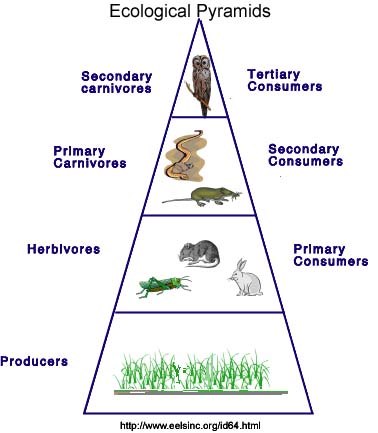
In the energy pyramid here, which organisms have the most energy available?
a)
Producers
b)
Carnivores
c)
Herbivores
d)
Top Predator
45.
In the energy pyramid below, which organism has the least amount of energy available?
a)
Producers
b)
Herbivores
c)
Carnivores
d)
Top Predator
46.
If there is 1000 Kcal available in the producers in trophic level 1, how much energy is available in the herbivores in trophic level 2?
a)
10 Kcal
b)
1 Kcal
c)
100 Kcal
d)
1000 Kcal
47.
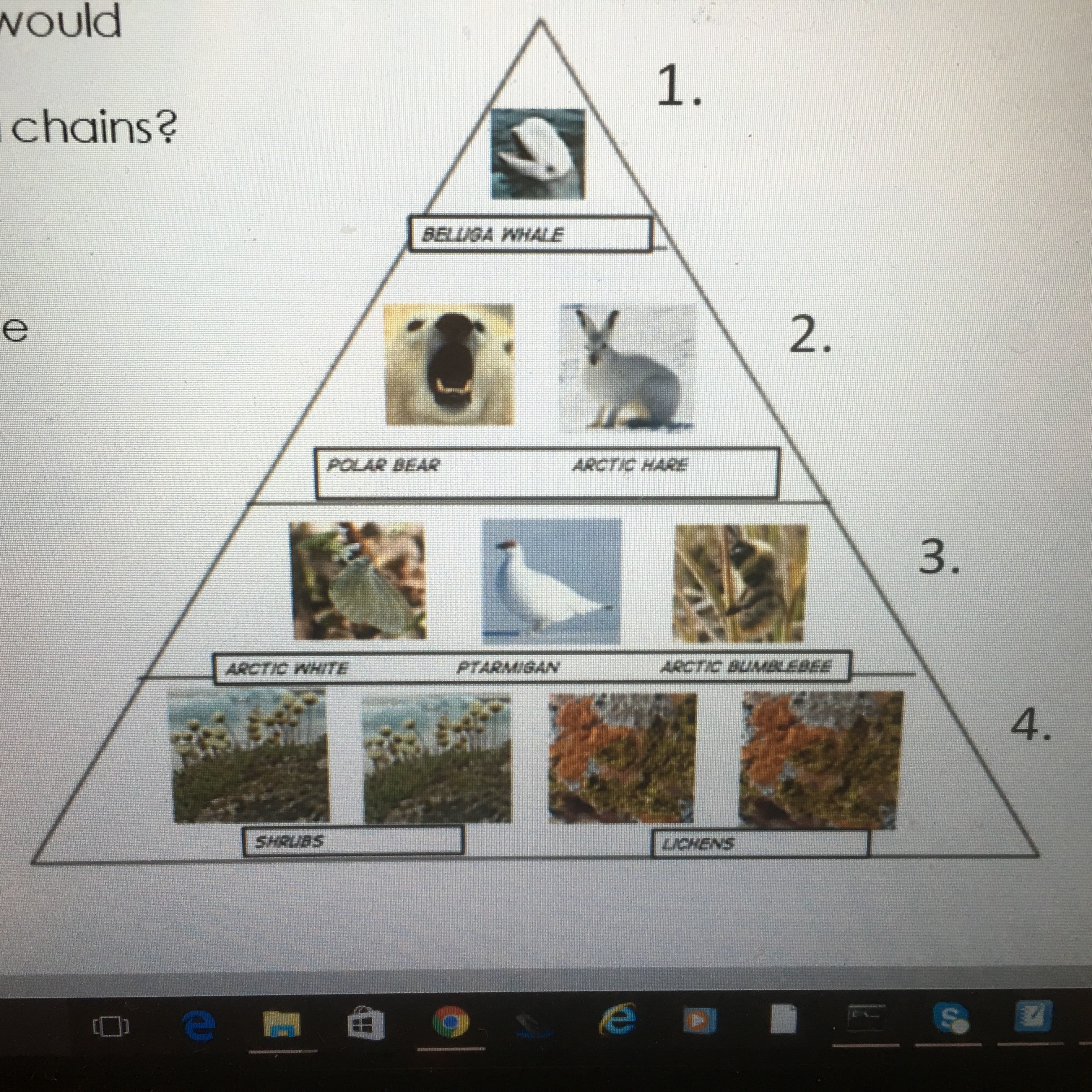
If these organisms were arranged in a food pyramid, which organism would have the least amount of total energy available?
a)
coyote
b)
insect
c)
lizard
d)
shrub
48.
Which organism recieves the least amount of energy from the producer?
a)
Owl
b)
Grasshopper
c)
Lilypad
d)
Mouse
49.
The largest group of organisms found in a food web would be:
a)
Primary Consumers
b)
Producers
c)
Decomposers
d)
Tertiary Consumers
50.
A food pyramid represent the relative amount of energy in trophic levels. Which of the following correctly shows a food pyramid?
a)
A
b)
B
c)
C
d)
D
51.
A third-level consumer has to be which type?
a)
Carnivore.
b)
Decomposer.
c)
Producer.
d)
Herbivore.
52.
A secondary consumer 
a)
eats primary consumers
b)
eats producers
c)
eats plants
53.
Level 1 is called the _____________ trophic level. 
a)
Tertiary consumer
b)
Tertiary producer
c)
Primary consumer
d)
Primary producer
54.

What amount of percentage does the energy decrease as it goes up the pyramid?

a)

100%

b)

1000%

c)

10%

d)

1%

55.

How does the energy flow in an energy pyramids?

a)

up the pyramid

b)

down the pyramid

56.
Which is the smallest level of an ecosystem?
a)
organsism
b)
population
c)
community
d)
ecosystem
57.
a system of food chains that shows the transfer of energy  is termed
a)
food web
b)
food chain
c)
prey
d)
predator
58.
Biodiversity is 
a)
the variety of species within an ecosystem
b)
a large number of the same species in an ecosystem
c)
an abundant amount of the same primary consumers 
d)
the ability to have an abundant source from the same species
59.

Photosynthesis is important because...

a)

it makes carbon dioxide

b)

it makes food for the food webs

c)

it makes water

d)

it's not important

60.

A chimpanzee eats fruits, nuts, leaves, and small mammals. What kind of organism is a chimpanzee?

a)

carnivore

b)

decomposer

c)

producer

d)

omnivore

61.

Which of the following is NOT an example of a predator with its prey?

a)

a fox and a rabbit

b)

a bear and a fish

c)

a honeybee and flower

d)

a spider and a fly

62.

Which statement is true about predators?

a)

a predator is an organism that eats other organisms

b)

a predator is an organism that is eaten by other organisms

c)

a predator can never be eaten by other organisms

d)

a predator is an organism that eats decaying organisms

63.

What type of relationship between organisms is one in which one organism benefits and the other is not affected?

a)

predation

b)

parasitism

c)

commensalism

d)

mutualism

64.

What is a niche?

a)

the range of tolerance an organism has

b)

the location where an organism lives

c)

the first trophic level of a food chain

d)

the role an organism plays in its environment

65.

Which of the following refers to a community of living organisms and the way they interact with nonliving parts of their environment?

a)

trophic

b)

biome

c)

habitat

d)

ecosystem

66.

If a prey species becomes extinct, what else is most likely to happen?

a)

The climate the species lived in will change.

b)

The plants the species ate will also go extinct.

c)

The predators that eat the prey may be threatened.

d)

The habitats that the species lived in will be threatened.

67.
Which example shows a relationship between a living thing and a non-living thing?
a)
An insect is food for salmon.
b)
Water carries a rock downstream.
c)
A tree gets nutrients from the soil.
d)
A flower makes food for a butterfly.
68.
All the ponds in an area dried up during a drought. Which organism is most affected by the drought?
a)
deer
b)
frog
c)
hawk
d)
snake
69.
In an Energy Pyramid, the most energy is located...
a)
at the top
b)
at the bottom
c)
in the middle
d)
in the center
70.
A food web is composed of many...
a)
food webs
b)
food chains
c)
fast-food chains
d)
bike chains
71.
A series of events in which one organism eats another and obtains energy is called a
a)
ecosystem
b)
food web
c)
food chain
d)
Pokemon (Gotta Catch 'Em All!)
72.
There are 3 roles an organism can play in an ecosystem are:
a)
producer, consumer, decomposer
b)
herbivore, carnivore, omnivore
c)
producer, director, actor
d)
predator, prey, scavenger
73.
An organism that can make its own food is called a 
a)
consumer
b)
producer
c)
decomposer
d)
composer
74.
An organism that obtains energy by feeding on other organisms is called a
a)
consumer
b)
producer
c)
decomposer
d)
brujeria
75.
A consumer that eats only other organisms is called a
a)
herbivore
b)
carnivore
c)
omnivore
d)
scavenger
76.
Nonliving parts of an ecosystem are called
a)
abiotic factors
b)
biotic factors
c)
rocks and dirt
d)
funiture
77.
Living parts of an ecosystem are called
a)
biotic factors
b)
abiotic factors
c)
crazy critters
d)
animals and plants
78.

Heterotrophs that eat producers and other heterotrophs are called...

a)

autotrophs

b)

herbivores

c)

carnivores

d)

omnivores

79.
A group of organisms of the same species living in the same area are called a/an ________.
a)
community
b)
habitat
c)
population
d)
ecosystem
80.
Green plants are
a)
producers
b)
consumers
c)
herbivores
d)
omnivores
81.

What type of relationship is this?

a)

parasitism

b)

mutualism

c)

commensalism

d)

competition

82.

symbiotic relationship in which both organisms benefit

a)

competition

b)

mutualism

c)

predation

d)

commensalism

83.
What does a food web represent?
a)
All connections of energy flow throughout all organisms in a habitat.
b)
The specific ways that mutualism is carried out.
c)
A single pathway or energy flow between organisms. 
d)
How carnivores get their food. 
84.

symbiotic relationship in which one organisms benefits and the other organism is not affected

a)

competition

b)

mutualism

c)

parasitism

d)

commensalism

85.
Organisms that breaks down and absorbs nutrients from dead organisms 
a)
consumer
b)
trophic level
c)
decomposer
d)
species
86.
An organism that needs to eat other organisms to obtain energy is known as a:
a)
Autotroph
b)
Producer
c)
Consumer
d)
Mutualist
87.
Consumer that eats plants
a)
heterotroph
b)
herbivore
c)
producer
d)
community
88.
The rabbit in this food web would be considered a:
a)
Decomposer
b)
Producer
c)
Secondary Consumer
d)
Primary Consumer
89.
An illustration that uses arrows to show the MANY possible directions in which matter and energy can pass through the organisms in an ecosystem.
a)
Food chain
b)
Food web
c)
Energy Pyramid
d)
Succession Map
90.

What are plants that convert energy from the sun called?

a)

decomposer

b)

primary consumer

c)

secondary consumer

d)

producer

91.
Which one is NOT an example of a decomposer?
a)
mushroom
b)
leaves
c)
mold
d)
worm
92.
What is a producer?
a)
an organism that gets energy from eating other organisms
b)
an organisms that uses sunlight to make its own food
c)
an organism that gets energy from eating dead organisms, non-living material or waste
d)
an organism that uses chemical energy to make its own food
93.
The shrew provides energy for the _______?
a)
cricket
b)
grasshopper
c)
frog
d)
snake
94.

Ecology is the study of:

a)

only the living things in the environment

b)

only the nonliving things in the environment

c)

how living things interact with each other and the nonliving things in the environment

d)

scientists who perform research on living things

95.

What term do ecologists use to describe where an animal lives (an animal’s home)?

a)

Ecosystem

b)

Ecologist

c)

Habitat

d)

Population

96.

What is a species?

a)

Different animals that compete for the same resources

b)

A group of similar organisms that can reproduce with each other

c)

A group of organisms that live together

d)

A group of organisms that are physically and functionally very different from each other

97.

Which of the following is an example of a living thing?

a)

A bacterium

b)

A shell

c)

Water

d)

Sweat

98.

Which of the following is NOT a nonliving thing? (which one is living?)

a)

Sun

b)

Rocks

c)

Milk

d)

Wood

99.

What type of organism can make its own food?

a)

A producer (an autotroph)

b)

A consumer (a heterotroph)

c)

A decomposer

d)

All of the above

100.

Organisms that can make their own food do so by the process of:

a)

decomposition

b)

respiration

c)

photosynthesis

d)

scavenging

101.

What type of consumer eats plants?

a)

Herbivore

b)

Omnivore

c)

Carnivore

d)

Both herbivore and omnivore

102.

What is a food chain?

a)

A representation of an organism’s life cycle

b)

A way to show the feeding relationships between organisms

c)

The sequence of events that occurs during photosynthesis

d)

A way to show how animals interact with nonliving parts of the environment

103.

The first organism in a food chain is ALWAYS a:

a)

producer

b)

consumer

c)

decomposer

d)

Any of the above

104.

How much energy is transferred between trophic levels?

a)

25%

b)

20%

c)

10%

d)

90%

105.

What is a niche?

a)

The habitat that an organism lives in

b)

An organism’s “role” in an ecosystem

c)

A type of consumer

d)

The relationship between a producer and consumer

106.

What happens when different species try to occupy the same niche?

a)

The species compete with each other

b)

The species cooperate with each other

c)

The species coexist with each other

d)

All of the above

107.

In what type of relationship do both organisms benefit from the relationship?

a)

Parasitism

b)

Mutualism

c)

Commensalism

d)

Predation

108.

How does oxygen cycle between plants and animals?

a)

Plants and animals both release oxygen

b)

Plants and animals convert water into oxygen

c)

Plants take in oxygen that is produced by animals

d)

Animals take in oxygen that is produced by plants

109.

Which statement best describes how water cycles in the environment?

a)

Water only cycles from plants to animals

b)

Water only cycles between plants and the soil

c)

Water only cycles between animals and the hydrosphere

d)

Water cycles between living things and the nonliving parts of Earth

110.

What is evaporation?

a)

The change of solid water (ice) into liquid water

b)

The change of liquid water into water vapor

c)

The change of water vapor into liquid water

d)

The falling of liquid water from the atmosphere

111.

What do you call water that flows on Earth’s surface from high elevation to low elevation?

a)

Clouds

b)

Precipitation

c)

Runoff

d)

Groundwater

112.

When we say that a species adapts to changes in the environment, we mean that:

a)

the species becomes extinct

b)

the species has to move to a new environment

c)

the species adjusts and copes with the changes

d)

the species is completely unaffected by the changes

113.

What is biodiversity?

a)

The different ways species reproduce

b)

The degree of variation of life on Earth

c)

A way to describe similarities between different species

d)

The process of creating new species

114.
What would most likely happen if the rabbit population was removed from the food chain grass —› rabbit —› fox?
a)
their would be more grass
b)
there would be less rabbits
c)
there would be more fox
115.
Which is an example of a parasitic relationship?
a)
a bee pollinates a flower
b)
a tapeworm takes nutrients from a dog
c)
an orchid lives in a tree but does not harm the tree
116.
In which type of relationship do both species benefit?
a)
parasitism
b)
mutualism
c)
commensalism
117.
Barnacles grow on whales.  Whales give the barnacles a place to live but the barnacles do not help or harm the whale.  Which type of relationship is this?
a)
commensalism
b)
mutualism
c)
parasitiesm
118.
What does every food chain start with? (Even if it's not drawn or written there!)
a)
producers
b)
sun
c)
consumer
d)
decomposers
119.
The rabbit in this food web would be considered a:
a)
Decomposer
b)
Producer
c)
Secondary Consumer
d)
Primary Consumer
120.
In this Food Web Pyramid Which type of consumer gets only 10% of the energy stored in plants?
a)
Herbivore
b)
Carnivore
c)
Omnivore
d)
Secondary Consumer
121.
What is the term for each step in the transfer of energy and matter within a biological community?
a)
energy path
b)
food web
c)
trophic level
d)
food pyramid
122.
The nonliving aspects of an ecosystem.
a)
Abiotic factors
b)
Biotic factors
123.
The living portions of the ecosystem.
a)
Biotic factors
b)
Abiotic factors
124.
As you move upward, from level to level, in an energy pyramid, energy _____.
a)
increases
b)
decreases
c)
stays the same
d)
increases exponentially
125.

If the amount of food or resources available increases, the carrying capacity for an animal.....

a)

Stays the same

b)

Increases

c)

Decreases

d)

Fluctuates

126.
What growth pattern describes a population whose growth rate slows or stops following a period of exponential growth?
a)
logistic growth
b)
population growth
c)
exponential growth
d)
predator-prey cycle
127.

Water, sunlight, shelter, and space are resources that are often........

a)

abiotic limiting factors

b)

biotic limiting factors

c)

non-limiting factors

d)

exponetial factors

128.

Predator population lags behind prey population because......

a)

Increase in predators leads to decrease in prey

b)

Increase in predators leads to increase in prey

c)

Increase in predators leads to decrease in producers

d)

Increase in producers leads to increase in prey

129.
Members of a species in a defined area
a)
Ecosystem
b)
community
c)
biodiversity
d)
population
130.
Consumer that eats plants
a)
heterotroph
b)
herbivore
c)
producer
d)
community
131.
Series of steps in which organisms transfer energy by eating and being eaten
a)
foodweb
b)
consumer
c)
food chain
d)
omnivore
132.
Organisms that relies on other organisms for food; consumer
a)
herbivore
b)
decomposer
c)
heterotroph
d)
species
133.
What may happen if the snowshoe hare was removed from the food web pictured?
a)
The insects in the habitat would increase.
b)
The shrew population would decrease due to being only hawk food source.
c)
The willow tree population would decrease.
d)
Foxes would dies due to no food source. 
134.
In the energy pyramid here, how much of the energy in the producers gets passed to the herbivores?
a)
10%
b)
20%
c)
80%
d)
90%
135.
Which of the following leads to a decrease in biodiversity?
a)
protection of ecosystems
b)
pollution control
c)
selective cutting
d)
introduction of exotic or invasive species
136.
In the food web shown, the snail would be considered...
a)
primary consumer
b)
secondary consumer
c)
tertiary consumer
d)
producer
137.

What is the correct order for this food chain?

a)

Owl, Mouse, Grasshopper, Grass

b)

Grass, Mouse, Owl, Grasshopper

c)

Grass, Owl, Grasshopper, Mouse

d)

Grass, Grasshopper, Mouse, Owl

138.

Volcano erupting would be an example of what type of succession?

a)

Primary

b)

Secondary

c)

Tertiary

139.

All of the biotic and abiotic factors.

a)

community

b)

ecosystem

c)

population

140.

symbiotic relationship in which both organisms benefit

a)

competition

b)

mutualism

c)

predation

d)

commensalism

141.

What are plants that convert energy from the sun called?

a)

decomposer

b)

primary consumer

c)

secondary consumer

d)

producer

142.
The shrew provides energy for the _______?
a)
cricket
b)
grasshopper
c)
frog
d)
snake
143.
Which of the following illustrates the correct ordering of trophic levels?
a)
decomposers-carnivores-autotrophs-herbivores
b)
herbivores-autotrophs-carnivores-decomposers
c)
producers-herbivores-carnivores-decomposers
d)
carnivores-producers-omnivores
144.
Which organism recieves the least amount of energy from the producer?
a)
Owl
b)
Grasshopper
c)
Lilypad
d)
Mouse
145.

Rabbits introduced into Australia over 100 years ago have become a serious pest to farmers. Rabbit populations increases so much that they displaced many native species of plant eaters. What is the most logical explanation for their increased numbers?

a)

Rabbits have a high death rate.

b)

There are few effective predators.

c)

Additional rabbit species have been introduced.

d)

There is an increase in rabbit competitors.

146.
An organism that cannot adapt to changes in the environment will most likely - 
a)
produce more offspring
b)
die
c)
change its traits to survive
d)
store more food
147.
All of the following are examples of environmental changes that can be caused by humans except - 
a)
clearing land for housing developments
b)
pesticides
c)
volcanic eruption
d)
pollution
148.
Scientists gathered the following data on lizard populations for several years. The results are shown in the table. Which environmental factor most likely contributes to the change in lizard population? 
a)
increase in available water and food
b)
increase in shelter
c)
increase in predators
d)
increase in light
149.
In the 1850s, Thomas Austin released approximately twenty-four rabbits from Europe into the Australian countryside. By 1900, tens of millions of rabbits were found all over the Australian continent. The warm Australian climate, abundant farmland, and crops provided the perfect habitat for the rabbits. The rabbits caused extensive damage to all vegetation, and the lack of plants increased soil erosion. Why were the rabbits so successful? 
a)
the rabbits competed with local herbivores for food
b)
the rabbits did not have natural predators
c)
erosion of soil benefited the rabbits
d)
diseases helped decrease rabbit populations
150.
A giraffe’s niche is feeding on the canopy of trees.  What physical biological trait must the giraffes keep in order to support this niche?
a)
a long neck
b)
small antenna
c)
short ears
d)
large brown spots
151.
This figure shows three warblers with different niches in a spruce tree habitat.  The warblers are feeding in different areas of the tree which allows them to avoid _
a)
competing with one another for food
b)
establishing a strict territory from one another
c)
creating a symbiotic relationship with one another
d)
caring for their young by supplying food
152.

An ______ includes all living and nonliving things together in an area.

a)

population

b)

ecosystem

c)

consumers

d)

producers

153.
First species to arrive in an area
a)
invasive species
b)
abiotic components
c)
pioneer species
d)
parasites
154.
Series of changes where other organisms have not previously lived
a)
primary succession
b)
secondary succession
c)
commensalism
d)
competition
155.
Series of changes where an existing community is destroyed
a)
primary succession
b)
secondary succession
c)
commensalism
d)
competition
156.
Stable, final stage of succession
a)
adaptation
b)
pioneer species
c)
niche
d)
climax community
157.
First species occuring in areas of primary succession are mosses and
a)
grasses
b)
wildflowers
c)
trees
d)
lichens
158.
Succession type?
a)
primary succession
b)
secondary succession
c)
tertiary succession
d)
variable succession
159.
Succession type?
a)
primary succession
b)
secondary succession
c)
tertiary succession
d)
variable succession
160.
Plant life starting to grow on a volcano
a)
primary succession
b)
secondary succession
c)
tertiary succession
d)
variable succession
161.
Individual plants or animals in a population with certain desired traits are chosen by breeders, farmers, or ranchers to mate. The people hope to get the desired traits in the offspring.
a)
Natural selection
b)
Selective breeding
c)
Gene flow
d)
Mutations
162.

Individuals in a population that have the traits needed to survive in the environment get to survive and reproduce. Their offspring inherit those traits. Over time, a greater percentage of the population will have those successful traits.

a)

Natural selection

b)

Selective breeding

c)

Artificial selection

d)

Mutations

163.

The process of natural selection leads to genetic change in a population.

Which factor causes the population to change in natural selection?

a)

Environmental conditions or challenges

b)

Individual choice

c)

Human intervention

d)

Migration over long distances

164.

Selective breeding leads to genetic change in a population.

Which factor causes the population to change in selective breeding?

a)

Environmental conditions or challenges

b)

Individual choice

c)

Human intervention

d)

Migration over long distances

165.

The coral snakes that were able to survive the summer drought reproduced. Their offspring will likely be able to tolerate drought.


Natural selection [or] Selective breeding?

a)

Natural selection

b)

Selective breeding

166.

Random changes in the DNA are -

a)

Natural selection

b)

Mutations

c)

Adaptations

d)

Genetic migration