
 Worksheets
Nervous System Review
Total questions: 163
Worksheet time: 3hrs 7mins
Name
Class
Date
1.
What is the central nervous system (CNS) made of?
a)
brain and spinal cord
b)
brain and cranial nerves
c)
spinal cord and spinal nerves
d)
cranial nerves and spinal nerves
2.

cause of a response. (happens 1st) Thing or event that evokes a reaction.
a)
stimulus
b)
response
3.
Damage to the cerebellum would most affect the career of
a)
an architect
b)
a teacher
c)
an athlete
d)
a librarian
4.
Damage to the medulla would most likely result in
a)
impaired planning abilities
b)
death
c)
a coma
d)
blindness
5.
Damage to the prefrontal cortex would most likely result in
a)
diminished planning abilities
b)
death
c)
blindess
d)
coma
6.
The amygdala, the hypothalamus and the hippocampus are a part of
a)
limbic system
b)
cerebral cortex
c)
hindbrain
d)
forebrain
7.
The cerebral cortex is made of
a)
white matter
b)
gray matter
c)
pink goo
8.
A person has a stroke on her occipital lobe. What might happen to her?
a)
reduced planning abilities
b)
deafness
c)
coma
d)
blindness
9.
A tumor on the temporal lobe would most affect the career of
a)
an architect
b)
a musician
c)
a professor
d)
a researcher
10.
Controls heartbeat and breathing
a)
Pons
b)
Medulla
c)
Cerebellum
d)
Thalamus
11.
Receives sensory information and relays it to the proper part of brain for further processing
a)
Hypothalamus
b)
Reticular Formation
c)
Cerebellum
d)
Thalamus
12.
Known as the "Little Brain" and is in charge of balance and coordinating movements
a)
Thalamus
b)
Reticular Formation
c)
Hypothalamus
d)
Cerebellum
13.

Damage this and you won't form new memories
a)
Hypothalamus
b)
Hippocampus
c)
Amygdala
d)
Thalamus
14.

Controls motivational behaviors, including: feeding, fight-flight response, and fornicating
a)
Hippocampus
b)
Amygdala
c)
Reticular Formation
d)
Hypothalamus
15.
Where the pleasure centers of the brain are located...also controls Endocrine System
a)
Amygdala
b)
Pons
c)
Hippocampus
d)
Hypothalamus
16.
Wrinkled part of the brain's surface where the body processes information
a)
Forebrain
b)
Cerebral Cortex
c)
Corpus Callosum
d)
Cerebellum
17.
Makes decisions, plans, reasons, and carries out behaviors
a)
Frontal Lobe
b)
Parietal Lobe
c)
Occipital Lobe
d)
Temporal Lobe
18.
Possesses the Sensory Cortex
a)
Frontal Lobe
b)
Occipital Lobe
c)
Temporal Lobe
d)
Parietal Lobe
19.
Controls hearing, and language comprehension
a)
Frontal Lobe
b)
Temporal Lobe
c)
Occipital Lobe
d)
Parietal Lobe
20.
Processes visual information
a)
Frontal Lobe
b)
Temporal Lobe
c)
Occipital Lobe
d)
Parietal Lobe
21.

A person has difficulty speaking possibly due to a stroke.
a)
Broca's Aphasia
b)
Wernicke's Aphasia
c)
Visual Agnosia
d)
Neglect Syndrome
22.

Records the waves of electrical activity (studies seizures)
a)
EEG
b)
MRI
c)
CT Scan
d)
fMRI
23.

a)
frontal
b)
temporal
c)
occipital
d)
parietal
24.

a)
Cerebrum
b)
Cerebellum
c)
Brain Stem
d)
Diencephalon
25.

a)
Thalamus
b)
Frontal lobe
c)
Pons
d)
Hipocampus
26.

What functions does this lobe carry out?
a)
Hearing and auditory processing
b)
Vision and visual processing
c)
Processing fear
d)
Judgment, impulse control, planning
27.

This lobe receives and processes visual information and then sends it to other parts of the brain for further processing and storage.
a)
Occipital Lobe
b)
Parietal Lobe
c)
Temporal Lobe
d)
Frontal Lobe
28.

In order create a midsagittal plane, it involves the cutting of this
a)
Cerebral Cortex
b)
Cerebellum
c)
Corpus Callosum
d)
Caudate Nucleus
29.

Letter A
a)
frontal
b)
parietal
c)
occipital
d)
temporal
30.

Letter B
a)
Gyrus
b)
Sulcus
c)
Transverse Fissure
d)
Longitudinal Fissure
31.

Letter C
a)
Midbrain
b)
Pons
c)
Corpus collusum
d)
Medulla Oblongata
32.

Letter D
a)
Frontal
b)
Parietal
c)
Occipital
d)
Temporal
33.

Letter E
a)
Hypothalamus
b)
Thalamus
c)
midbrain
d)
medulla oblongata
34.

Letter F
a)
Thalamus
b)
Hypothalamus
c)
Cerebellum
d)
Midbrain
35.

Letter G
a)
Thalamus
b)
Hypothalamus
c)
Pituitary Gland
d)
Midbrain
36.

Letter H
a)
Pituitary gland
b)
hypothalamus
c)
thalamus
d)
midbrain
37.

Letter J
a)
pons
b)
medulla oblongata
c)
midbrain
d)
cerebellum
38.

Letter K
a)
pons
b)
medulla oblongata
c)
cerebellum
d)
midbrain
39.

Letter M
a)
corpus collosum
b)
transverse fissure
c)
longitudinal fissure
d)
gyrus
40.

Letter N
a)
frontal
b)
parietal
c)
temporal
d)
occipital
41.

What is the name of this type of neuron
a)
Multipolar Neuron
b)
Bipolar Neuron
c)
Pseudounipolar Neuron
d)
Anaxonic
42.

What is the name of this type of neuron?
a)
Multipolar Neuron
b)
Bipolar Neuron
c)
Psedounipolar Neuron
d)
Anaxonic
43.

What is the name of this type of neuron?
a)
Anaxonic
b)
Multipolar Neuron
c)
Bipolar Neuron
d)
Pseudounipolar Neuron
44.

Label the Neuron-What does the letter "A" represent?
a)
Axon
b)
Dendrite
c)
Axon Terminal
d)
Cell Body
45.

Label the Neuron-What does the letter "B" represent?
a)
Myelin Sheath
b)
Schwann Cell
c)
Cell Body
d)
Nucleus
46.

Label the Neuron-What does the letter "C" represent?
a)
Cell Body
b)
Dendrite
c)
Axon Terminal
d)
Myelin Sheath
47.

Label the Neuron-What does the letter "D" represent?
a)
Dendrite
b)
Axon
c)
Myelin Sheath
d)
Node of Ranvier
48.

Label the Neuron-What does the letter "E" represent?
a)
Schwann Cell
b)
Node of Ranvier
c)
Axon Terminal
d)
Myelin Sheath
49.

Label the Neuron-What does the letter "F" represent?
a)
Schwann Cell
b)
Node of Ranvier
c)
Myelin Sheath
d)
Axon
50.

Label the Neuron-What does the letter "G"
represent?
represent?
a)
Axon Terminal
b)
Node of Ranvier
c)
Nucleus
d)
Myelin Sheath
51.

Label the Neuron-What does the letter "H" represent?
a)
Schwann Cell
b)
Axon
c)
Axon Terminal
d)
Dendrite
52.
The part of the neuron that brings information to the cell body is called a(n) ___________.
a)
dendrite
b)
axon
c)
nucleus
d)
node of Ranvier
53.

What is the name of this type of neuron
a)
Multipolar Neuron
b)
Bipolar Neuron
c)
Pseudounipolar Neuron
d)
Anaxonic
54.
The part of the neuron that takes information away from the cell body is called a(n) _____________.
a)
dendrite
b)
axon
c)
cell body
d)
Schwann cell
55.
Location at which a neuron can transfer an impulse to another cell with the use of neurotransmitters is called __________.
a)
myelin sheath
b)
axon
c)
threshold
d)
synapse
56.

What is the name of this type of neuron?
a)
Pseudounipolar Neuron
b)
Multipolar Neuron
c)
Anaxonic
d)
Bipolar Neuron
57.
What is the chemical used by a neuron to transmit an impulse across a synapse to another nerve cell?
a)
Neurotransmitters
b)
Synapse
c)
Threshold
d)
Impulse
58.
What is the insulating membrane that surrounds parts of the axon that helps the impulses travel faster called?
a)
Axon
b)
Dendrites
c)
Node of Ranvier
d)
Myelin Sheath
59.
Part of the neuron that insulates the axon to speed up action potentials
a)
cell body
b)
node of Ranvier
c)
Schwann cell
d)
neurotransmitter
60.
The substance inside Schwann cells that enables them to insulate neurons is
a)
cytoplasm
b)
calcium
c)
dopamine
d)
myelin
61.
The location of neurotransmitters
a)
axon terminals
b)
dendrites
c)
Schwann cells
d)
cell body
62.
During which stage of an action potential does sodium rush into the cell?
a)
depolarization
b)
hyperpolarization
c)
resting potential
d)
repolarization
63.
During which stage of an action potential does extra potassium leave the cell, preventing additional action potentials?
a)
depolarization
b)
hyperpolarization
c)
resting potential
d)
repolarization
64.
During repolarization, what ion does what?
a)
potassium enter
b)
potassium leaves
c)
sodium enters
d)
potassium leaves
65.
During depolarization, what ion does what?
a)
potassium enter
b)
potassium leaves
c)
sodium enters
d)
potassium leaves
66.
Calcium's job in the actions at the synapse is to
a)
open sodium channels
b)
release neurotranmitters
c)
incite vesicles to move toward the synapse
d)
reuptake excess neurotransmitter from the synapse
67.

Which part of the neuron is the pre-synaptic neuron in the diagram?
a)
axon terminals
b)
dendrite
c)
Schwann cell
d)
axon
68.

Which part of the neuron is the post-synaptic neuron in the diagram?
a)
axon terminals
b)
dendrite
c)
Schwann cell
d)
axon
69.

Identify the part of the neuron
a)
axon
b)
axon terminal
c)
dendrite
d)
Node of Ranvier
70.

Which part of the actions at the synapse is identified in the diagram?
a)
Calcium entering
b)
Reuptake of neurotransmitters
c)
Release of neurotransmitters
d)
Neurotransmitter binding to receptors
71.

Which part of the actions at the synapse is identified in the diagram?
a)
Calcium entering
b)
Reuptake of neurotransmitters
c)
Release of neurotransmitters
d)
Neurotransmitter binding to receptors
72.

What is being identified with the arrows?
a)
calcium channels
b)
neurotransmitters
c)
receptors
d)
vesicles
73.
After calcium enters a pre-synaptic neuron, what happens?
a)
neurotransmitters are released
b)
vesicles move toward the synapse
c)
neurotransmitters are taken up by reuptake channels
d)
neurotransmitters bind to receptors on the post-synaptic neuron
74.
What is the central nervous system (CNS) made of?
a)
brain and spinal cord
b)
brain and cranial nerves
c)
spinal cord and spinal nerves
d)
cranial nerves and spinal nerves
75.

Heartbeat would be accomplished by which branch of the nervous system?
a)
Central
b)
Autonomic
c)
Motor
d)
Somatic
76.
This nervous system branch causes increases in heart rate and breathing.
a)
Sympathetic
b)
Parasympathetic
c)
Somatic
d)
Sensory
77.
Which part of the neuron is a long fiber that sends information to other cells?
a)
dendrite
b)
terminal
c)
cell body
d)
axon
78.
Which nervous system contains motor and sensory neurons?
a)
central nervous system
b)
peripheral
c)
sympathetic nervous system
d)
sensory
79.
The neural impulse changes to _______________ as it moves ACROSS the synapse to other neurons.
a)
an electrical message
b)
a chemical message
c)
an electro-chemical message
d)
liquid
80.
If I step on a nail what type of neuron will take that signal TO the CENTRAL NERVOUS SYSTEM?
a)
interneurons
b)
motor
c)
sensory
d)
receptors
81.
What is another word for autonomic?
a)
voluntary
b)
involuntary
c)
central
d)
brain
82.
Which of the following processes is governed by the autonomic nervous system?
a)
writing
b)
chewing
c)
running
d)
digesting food
83.
Release of adrenaline occurs in which part of the nervous system?
a)
parasympathetic
b)
sympathetic
c)
somatic
d)
central
84.
The two major subsystems of the nervous system are the central nervous system and the
a)
autonomic nervous system
b)
sympathetic nervous system
c)
peripheral nervous system
d)
somatic nervous system
85.
Amy has an itch on her nose and would like to scratch it. What part of her nervous system will control the movement of her arm to scratch her nose?
a)
Somatic
b)
Sympathetic
c)
Parasympathetic
d)
Autonomic
86.
The Fight, flight or freeze response is associated with which nervous system?
a)
Sympathetic
b)
Parasympathetic
c)
Central
d)
Somatic
87.
_____ neurons carry messages away from the central nervous system.
a)
Motor
b)
Inter
c)
Sensory
d)
Flower
88.
The tiny gap between neurons where nerve impulses are sent from one neuron to another. It is where communication occurs between an axon and dendrite
a)
synapse
b)
axon terminal
c)
impulse
d)
myelin
89.
This nervous system moves your skeletal muscles
a)
Autonomic Nervous System
b)
Sympathetic Nervous System
c)
Parasympathetic Nervous System
d)
Somatic Nervous System
90.
What do neuroglia do?
a)
Release neurotransmitters
b)
Support and nourish neurons
c)
Release calcium to activate neurons
d)
Absorb nutrients from neurons
91.
Astrocytes are responsible for:
a)
producing cerebrospinal fluid
b)
creating the blood brain barrier
c)
producing myelin sheath
d)
destroying cancer cells
92.
Shelton fell off of a ladder while cleaning the gutters. He can not stand up without assistance and is unable to catch a ball. Which is the most likely affected part of the brain?
a)
Cerebellum
b)
Cerebrum
c)
Cerebral Cortex
d)
Corpus Callosum
93.
Which part of the brain would be most active with planning and decision-making?
a)
cerebral cortex
b)
corpus callosum
c)
medulla
d)
reticular formation
94.
Craig blurts out whatever he is thinking and is rude to whoever is around. He can't control his temper and has become very aggressive.
What is the most likely affected area of the brain?
What is the most likely affected area of the brain?
a)
Motor cortex
b)
Cerebellum
c)
Temporal lobe
d)
Limbic system
95.
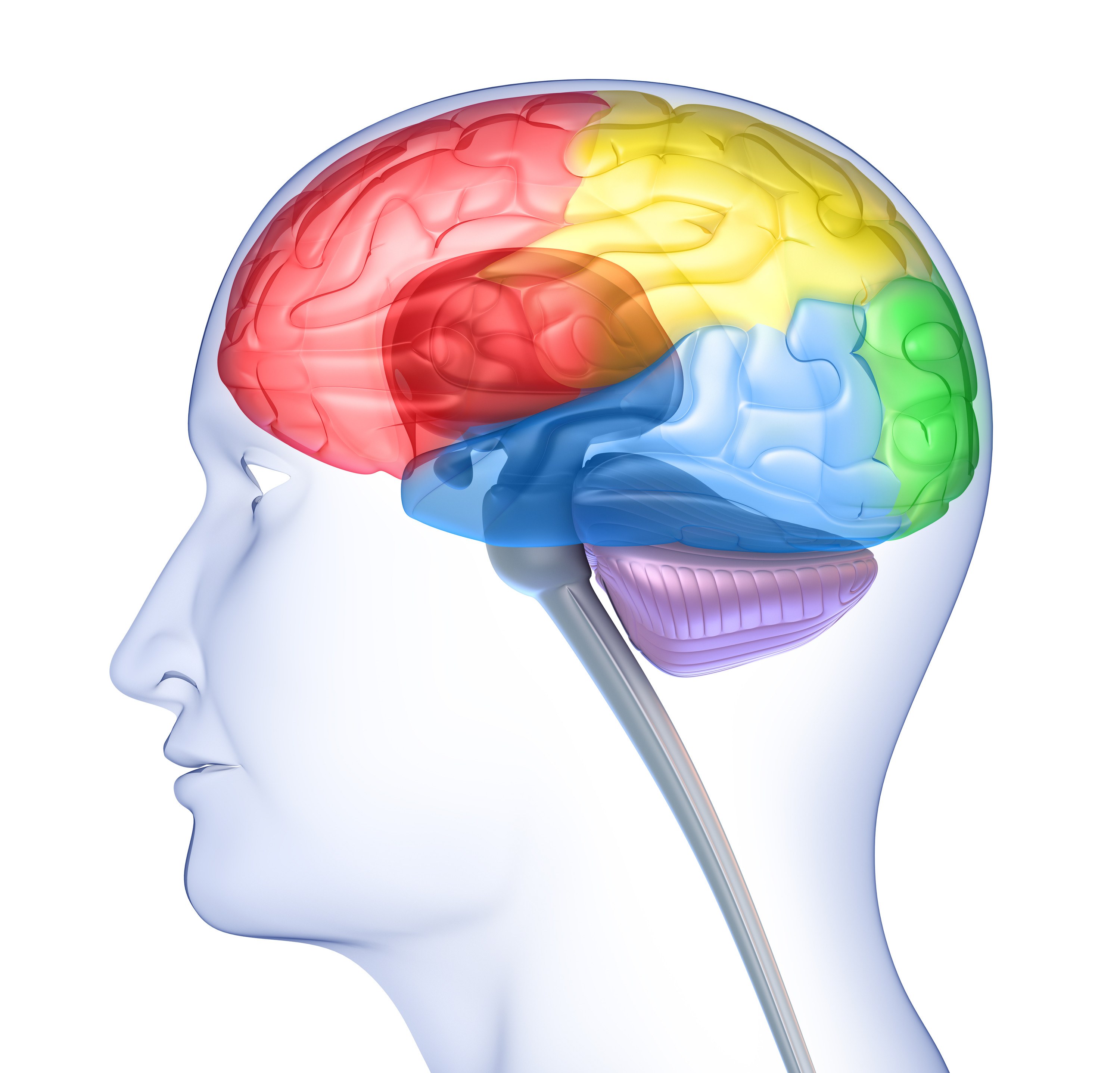
The four regions of the cerebral cortex are referred to as:
a)
lesions
b)
lobes
c)
pons
d)
corpus callosum
96.

This image is showing the __ which helps us learn and remember ___.
a)
Pituitary gland, muscle memory
b)
Pons, peoples faces
c)
Amygdala, fear
d)
Parietal Lobe, language
97.
The sensory cortex is most important for out sense of
a)
smell
b)
taste
c)
sight
d)
touch
98.
Which part of the brain controls breathing and heart rate?
a)
Frontal
b)
Medulla
c)
Thalamus
d)
Pons
99.
Controls hearing, and language comprehension
a)
Frontal Lobe
b)
Temporal Lobe
c)
Occipital Lobe
d)
Parietal Lobe
100.

In this picture, the red line represents a(n)
a)
motor neuron
b)
sensory neuron
c)
receptor
d)
interneuron
101.

In this picture, the green line represents
a)
motor neuron
b)
sensory neuron
c)
interneuron
d)
receptor
102.

In this picture, the blue line represents a(n)
a)
interneuron
b)
motor neuron
c)
sensory neuron
d)
effector
103.
When you touch the hot handle of a pan, this causes a reflex which happens at the __________ level without having the brain process the impulse first.
a)
Brain Stem
b)
Frontal Lobe
c)
Spinal Cord and Parietal Lobe
d)
Spinal Cord
104.
What is known as a quick, automatic response to a stimulus?
a)
Reaction
b)
Reflex
c)
Procedural Memory
d)
After-image
105.
Area of gray matter (butterfly) on the back posterior of the spinal cord
a)
Dorsal Horn
b)
Ventral Horn
c)
Anterior Column
d)
Posterior Column
106.
AFFERENT Neurons that transmit impulses TO the CNS are called
a)
neuoglia
b)
sensory
c)
efferent
d)
association
107.

Which is the sensory nerve pathway?
a)
1
b)
6
108.
"Fight of Flight" can be used to describe the actions of which division of the Peripheral Nervous system
a)
Somatic Nervous System
b)
Central Nervous System
c)
Sympathetic Nervous Sytem
d)
Parasympathetic Nervous System
109.
The parasympathetic nervous system would be responsible for _________ blood flow to the intestines, _________ heart output, and activating _______ glands.
a)
increasing, decreasing, salivary
b)
decreasing, increasing, salivary
c)
increasing, decreasing, sweat
d)
decreasing, increasing, sweat
110.
What are the two systems found in the PNS?
a)
Somatic and autonomic
b)
Autonomic and systemic
c)
Automatic and somatic
d)
Systematic and automatic
111.
What does the P in PNS stand for?
a)
Peretal
b)
Peripheral
c)
Poetal
d)
Prevalent
112.
What might happen if you lacked cerebrospinal fluid and meninges?
a)
messages from body couldn't reach brain
b)
spinal cord could become damaged more easily
c)
spinal cord would not be flexible
d)
you wouldn't be able to stand up straight
113.
Where in your spinal cord would you find the most grey matter and the least white matter?
a)
neck
b)
between shoulder blades
c)
middle of back
d)
lower back
114.
Which of these is an autonomic reflex? Closing your eyes __________.
a)
during a scary movie
b)
when you're thinking hard
c)
when you sneeze
d)
when you're trying to fall asleep
115.
Which is the sensory nerve pathway?
a)
1
b)
6
116.

Which is the dorsal root ganglion?
a)
2
b)
3
c)
4
d)
5
117.

Which is the ventral root?
a)
2
b)
3
c)
4
d)
5
118.
The human nervous system is separated into two major divisions the ____________ and ____________.
a)
Central Nervous System and Autonomic Nervous System
b)
Central Nervous System and the Peripheral Nervous System
c)
Peripheral Nervous System and Autonomic Nervous System
d)
Brain and Spinal Cord
119.
What are the three layers of connective tissue in which the brain and spinal cord are wrapped in for protection called?
a)
Vertebral Column
b)
Cerbrospinal Fluid
c)
Blood-Brain Barrier
d)
Meninges
120.
What is the thick bundle of neural fibers connecting the right and left hemispheres of the brain called?
a)
Corpus Callosum
b)
Cerebral Cortex
c)
Cerebellum
d)
Brain Stem
121.

Which letter represents the Cervical Region of the spinal cord?
a)
A
b)
B
c)
C
d)
D
122.
Which part of the brain controls messages between the brain and the body. Also maintains vital signs and coordinates involuntary reflexes?
a)
Parietal Lobe
b)
Cerebellum
c)
Brain Stem
d)
Spinal Cord
123.
The ____________ is the main pathway for information connecting the brain and the peripheral nervous system?
a)
Spinal Cord
b)
Brain Stem
c)
Cerebellum
d)
Frontal Lobe
124.
nerve responsible for the sensation of smell
a)
phrenic
b)
oculomotor
c)
olfactory
d)
trigeminal
125.
nerve responsible for the sensation of equilibrium
a)
vestibulocochlear
b)
oculomotor
c)
hypoglossal
d)
trigeminal
126.
nerve responsible for the sensation of vision
a)
phrenic
b)
oculomotor
c)
optic
d)
trigeminal
127.
nerve responsible for the sensation of hearing
a)
vestibulocochlear
b)
oculomotor
c)
optic
d)
trigeminal
128.
nerve responsible for the sensation of equilibrium
a)
vestibulocochlear
b)
oculomotor
c)
hypoglossal
d)
trigeminal
129.
this twelfth cranial nerve helps move the tongue
a)
vestibulocochlear
b)
oculomotor
c)
hypoglossal
d)
trigeminal
130.
the fifth cranial nerve; it is a mixed nerve that innervates the face and jaw
a)
vestibulocochlear
b)
oculomotor
c)
hypoglossal
d)
trigeminal
131.
in addition to moving the eyeball, this nerve raises the eyelid and constricts the pupil
a)
vestibulocochlear
b)
oculomotor
c)
hypoglossal
d)
trigeminal
132.
called the “wanderer,” this tenth cranial nerve wanders throughout the abdominopelvic cavity, innervating many of the organs
a)
vestibulocochlear
b)
oculomotor
c)
hypoglossal
d)
vagus
133.
the inflammation of this seventh cranial nerve causes Bell’s palsy; facial expression is lost on the affected side of the face
a)
facial
b)
phrenic
c)
hypoglossal
d)
vagus
134.
Trochlear Nerve
a)
II
b)
IV
c)
V
d)
VIII
135.
Allows you to swallow your food
a)
Trigeminal
b)
Facial
c)
Glossopharyngeal
d)
Hypoglossal
136.
Sense of smell
a)
I
b)
II
c)
III
d)
VII
137.
Numbed by the dentist when you're getting a cavity filled in the lower jaw
a)
Occulomotor
b)
Trigeminal
c)
Facial
d)
Glossopharyngeal
138.
Slows the heart rate
a)
Glossopharyngeal
b)
Vagus
c)
Accessory
d)
Hypoglossal
139.
Shrugs the shoulders
a)
Accessory
b)
Vestibulocochlear
c)
Abducens
d)
Trigeminal
140.
Balance
a)
Optic
b)
Trigeminal
c)
Vestibulocochlear
d)
Vagus
141.
Moves eyes laterally away from the nose
a)
abducens
b)
facial
c)
trigeminal
d)
accessory
142.
A loss of hearing could be associated with which cranial nerve?
a)
Olfactory
b)
Trigeminal
c)
Vestibulocochlear
d)
Accessory
143.
Taste sensation on the anterior 2/3 of the tongue
a)
facial
b)
trigeminal
c)
glossopharngeal
d)
hypoglossal
144.
Stimulates peristalsis
a)
Vagus
b)
Trochlear
c)
Abducens
d)
hypoglossal
145.
Sight
a)
I
b)
II
c)
III
d)
IV
146.
Moves the tongue
a)
Trigeminal
b)
Facial
c)
Hypoglossal
d)
Accessory
147.
Some boxers have permanent vision damage from their years of fighting, which of the lobes would incur damage to create this result?
a)
Frontal
b)
Parietal
c)
Occipital
d)
Temporal
148.
Some schizophrenics who claim to be experiencing auditory hallucinations have irregular activity where in their brain?
a)
Frontal Lobe
b)
Parietal Lobe
c)
Occipital Lobe
d)
Temporal Lobe
149.
Damage to nerve cells without myelin sheaths is permanent, because regeneration of nerve cells can only happen when ________ cells are present.
a)
Chwann
b)
Schann
c)
Swan
d)
Schwann
150.
A nerve is a bundled unit of nerve fibers located ________ the brain and spinal cord, connecting various parts of the body.
a)
alongside
b)
inside
c)
outside
d)
distant from
151.
The development of the child’s nervous system begins at about ________ weeks.
a)
2
b)
4
c)
6
d)
8
152.
A stroke, known in medicine as a cerebrovascular accident (CVA), is the ________ leading cause of death in the United States.
a)
1st
b)
2nd
c)
3rd
d)
4th
153.
Spina bifida is the most frequently occurring, permanently disabling, and devastating of all birth defects. It affects approximately one out of every ________ newborns in the United States.
a)
100
b)
1,000
c)
10,000
d)
100,000
154.
Sciatica usually occurs on ________ of the body.
a)
both sides
b)
one side
c)
the left side
d)
the right side
155.
Paraplegia refers to paralysis from approximately from the ________ down.
a)
shoulders
b)
waist
c)
neck
d)
knees
156.
Encephalitis is an inflammation of the:
a)
brain
b)
liver
c)
stomach
d)
eye
157.
There are ________ pairs of cervical nerves.
a)
2
b)
4
c)
6
d)
8
158.
There are ________ pairs of lumbar nerves.
a)
3
b)
5
c)
7
d)
9
159.
There are ________ pairs of lumbar nerves.
a)
3
b)
5
c)
7
d)
9
160.
The disease of the CNS that presents with resting tumors, rigidity, and shuffling gait?
a)
Bell palsy
b)
Parkinson disease
c)
shingles
d)
cerebral palsy
161.
A disorder of the nervous system in which the patient experiences recurrent seizures is called
a)
multiple sclerosis
b)
Parkinsons Disease
c)
dementia
d)
epilepsy
162.
Characterized by early dementia, confusion , restlessness , loss of recognition of the familiar
a)
Alzheimer disease
b)
epilepsy
c)
dementia
d)
bipolar disorder
163.
Pertaining to below the dura mater
a)
hyperdural
b)
subdural
c)
mental
d)
neuroid
100 %

