
Font size
 Worksheets
Four Phases of British War Strategy
Total questions: 45
Worksheet time: 25mins
Phase one of the British war strategy (1775-76) was a show of force, foiled by American resistance, which included the enlistment of how many troops?
16,000 troops
5,000 troops
25,000 troops
10,000 troops
In phase two (1776-1777) of the British war strategy, which British General arrived on Long Island with 32,000 troops and took New York?
British General William Howe
British General John Burgoyne
British General Charles Cornwallis
British General Henry Clinton
Phase three (1777-79) of the British war strategy aimed to subdue which colonies and take which city?
The middle colonies and Philadelphia
The southern colonies and Charleston
The New England colonies and Boston
The western territories and New Orleans
What was the main focus of phase four (1779-81) of the British war strategy?
Southern strategy
Naval blockade of France
Invasion of Canada
Peace negotiations with Spain

According to the map, which battle took place on September 11, 1777?
Princeton
Brandywine
Germantown
Monmouth

Which city served as the winter headquarters for Washington's troops in 1777-1778 according to the map?
Valley Forge
Philadelphia
Boston
New York

On what date did the battle of Long Island occur, as shown on the map?
August 27, 1776
July 4, 1776
September 15, 1776
October 19, 1776

Which of the following battles happened first according to the map?
Germantown
Princeton
Brandywine
Monmouth

According to the map, which color represents the movement of British troops?
Blue
Red
Green
Yellow

The battle of Monmouth took place on _________
June 28, 1778
July 4, 1776
September 3, 1783
October 19, 1781

Which battle occurred after the British troops moved from New York City on August 25, 1777, according to the map?
Brandywine
Saratoga
Yorktown
Lexington
What historical event is depicted in the painting titled 'Washington Crossing the Delaware'?
The signing of the Declaration of Independence
Washington Crossing the Delaware
The Boston Tea Party
The Battle of Gettysburg
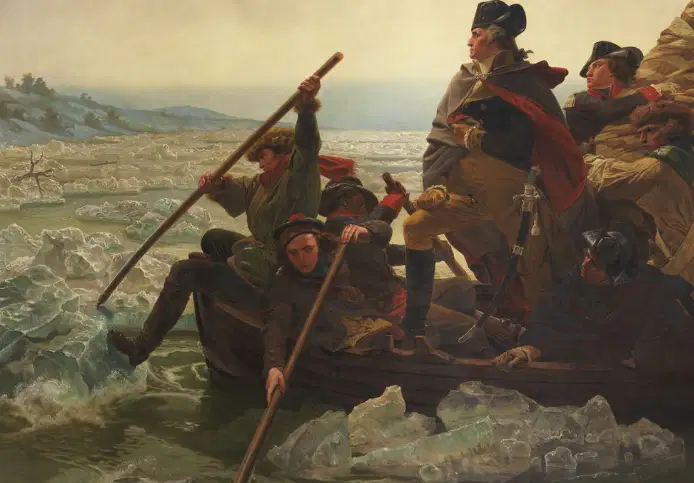
Who is the central figure standing in the boat in the painting 'Washington Crossing the Delaware'?
Thomas Jefferson
Benjamin Franklin
George Washington
Alexander Hamilton
The painting 'Washington Crossing the Delaware' shows George Washington leading his troops across the _______ River during the American Revolutionary War.
Delaware
Mississippi
Hudson
Potomac
According to the passage, who crossed the Delaware River during a storm on Christmas Day and routed a Hessian garrison at Trenton, NJ?
General Howe
George Washington
Hessian mercenaries
British troops
Washington's army captured 900 ______ mercenaries during the Battle of Trenton.
Hessian
British
French
Spanish
The victory at Trenton helped reinforce support for the American Revolution at a precarious time.
True
False
What was the motto adopted by Washington and his troops during the crossing of the Delaware River?
Liberty or Death
Victory or Death
Freedom for All
No Surrender
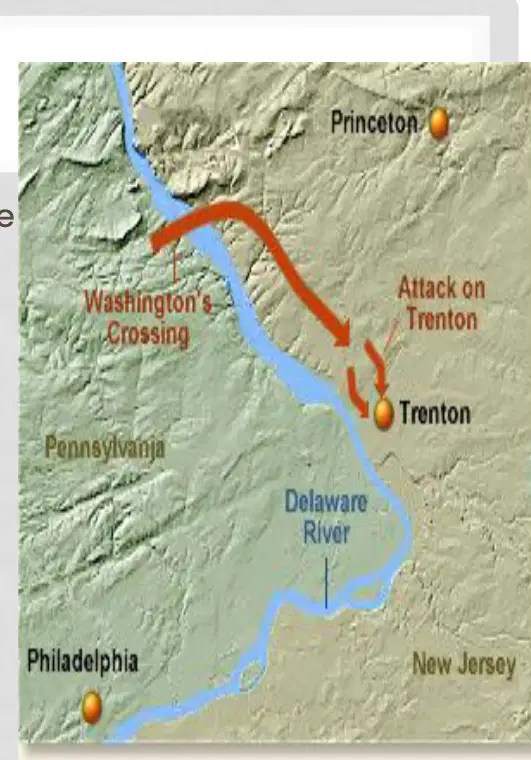
According to the map, which river did Washington and his troops cross to attack Trenton?
Hudson River
Delaware River
Mississippi River
Potomac River
Who surrendered nearly 6,000 British troops at Saratoga, NY during the Battle of Saratoga (1777)?
General George Washington
General John Burgoyne
General Horatio Gates
General Charles Cornwallis
What was the significance of the Battle of Saratoga for the Continental Army?
It was a minor skirmish
It was the first large-scale, decisive victory and a major turning point in the war
It resulted in the loss of New England
It ended the war immediately
As a result of the victory at Saratoga, the ______ recognized the Americans as a sovereign nation and agreed to enter an alliance with them in early 1778.
French
Spanish
Dutch
Portuguese
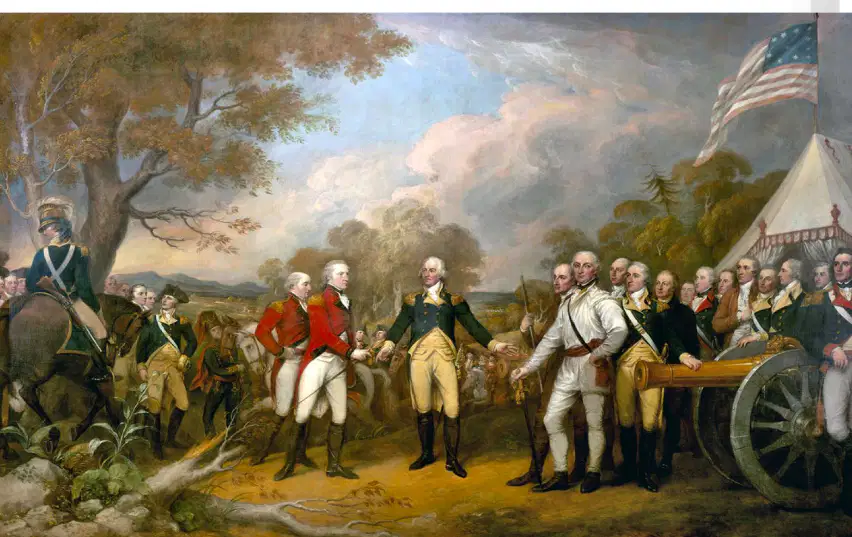
According to the painting, who surrendered to Gen. Horatio Gates at Saratoga in October 1777?
Gen. Burgoyne
Gen. Cornwallis
Gen. Howe
Gen. Clinton
What was the main purpose of the Treaty of Amity and Commerce between America and France in February 1778?
To promote trade and commercial ties between the two countries
To end the war
To divide territories
To form a military alliance
The Treaty of Alliance between America and France in 1778 established a wartime partnership.
True
False
The Treaty of Amity and Commerce allowed the presence of foreign ________, while formally recognizing American independence.
consuls
soldiers
merchants
ambassadors
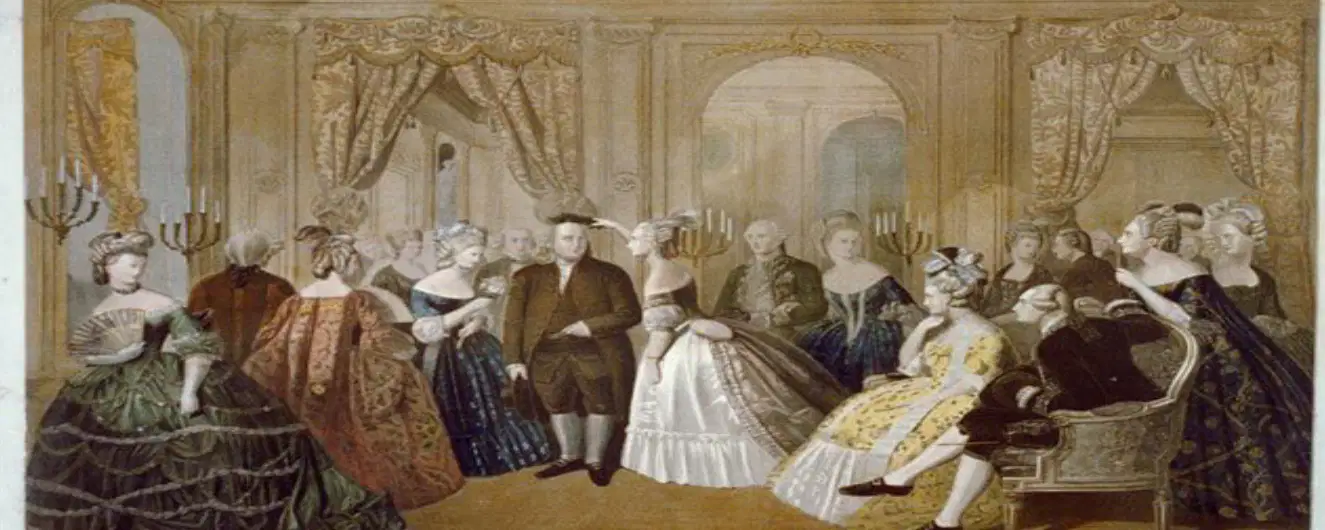
What historical event is depicted in the image titled 'Franklin & French Entry into the War'?
The signing of the Treaty of Paris
The Boston Tea Party
The French alliance with the American colonies during the Revolutionary War
The drafting of the Declaration of Independence
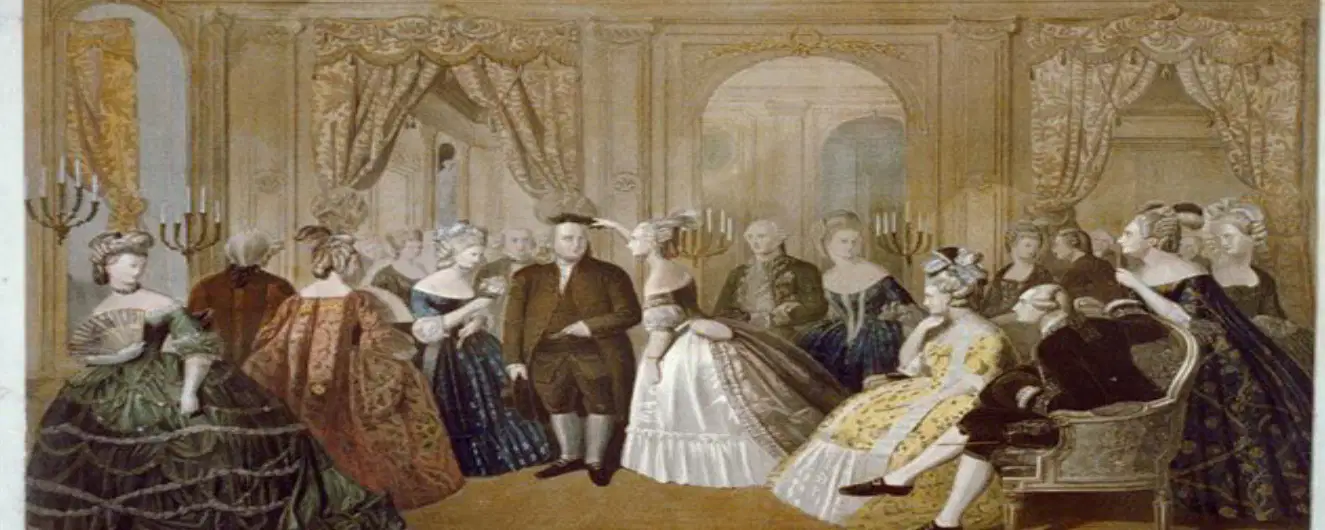
Who is shown as America's first diplomat at the Court of Versailles in March 1778, according to the image?
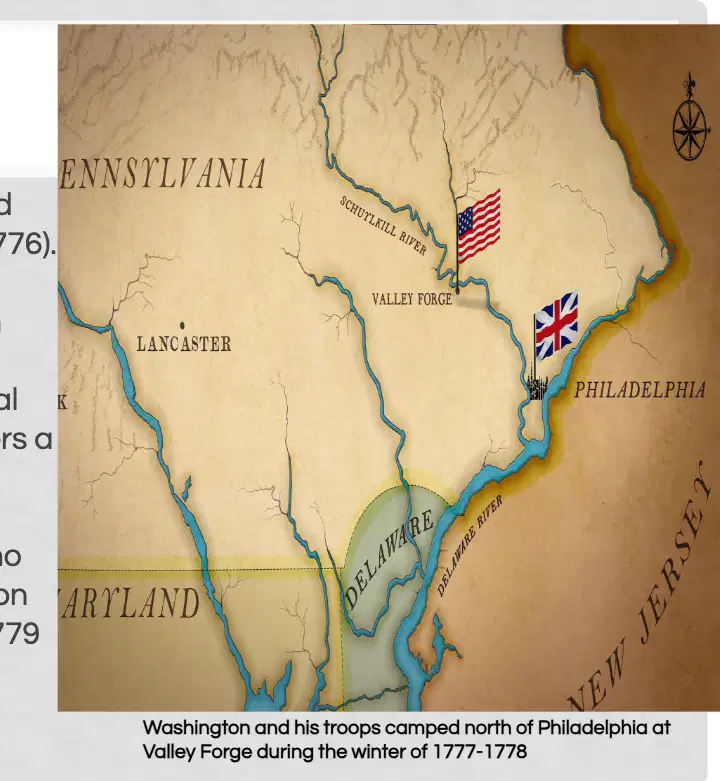
Which city was occupied by the British in September 1777?
New York
Philadelphia
Valley Forge
Lancaster
What was one of the main problems faced by Washington's army at Valley Forge during the winter?
Lack of weapons
Short-term enlistments and high desertion rates
Overabundance of food
British reinforcements
Congress could not raise money during the American Revolution because it had no ______ to tax.
power
permission
plan
reason
Loans from abroad helped ease the fiscal crisis faced by the American rebels in 1779.
True
False
The British evacuated ________, along with 3,000 loyalists, to attend to the French fleet in the Atlantic.
Philadelphia
Boston
New York
Charleston
Final Phase of the War: Southern Strategy (1778-1781)
True
False
Who was trapped at Yorktown, VA in 1781?
George Washington
Cornwallis
Benedict Arnold
Thomas Jefferson
The problem of governance in the new nation: The war was a unifying force, but could America devise a government that preserved that unity? Indeed, was a “unified” nation something even to be desired? Confederationists were individuals who:
Wanted a strong central government and weak state governments
Favored powerful state governments and a loose union
Supported monarchy over republicanism
Advocated for no government at all
The problem of governance in the new nation: The war was a unifying force, but could America devise a government that preserved that unity? Indeed, was a “unified” nation something even to be desired? Two approaches to this question: “Nationalists” - Who were they? Why did they want a strong national government, and how would republicanism fit into their vision?
Nationalists were individuals who supported a strong national government to maintain unity and believed republicanism could be preserved through a centralized authority.
Nationalists were opposed to any form of government and wanted complete independence for each state.
Nationalists wanted a monarchy to replace the existing government structure.
Nationalists believed in dissolving the union and forming separate countries.
In a republican government, representation in government is based on the consent of the _____.
people
president
military
judges
Political liberty is freedom from arbitrary interference; no one person or group should have the capacity to _____ another.
dominate
ignore
assist
observe
Where monarchies maintained authority through hereditary privilege and patronage, a republic depended on independent thinking and moral virtue of individual ______
citizens
kings
soldiers
aristocrats
Fill in the blank: Power should not be _____ (fear of concentrated power) in a republican government.
centralized
distributed
shared
limited
The Confederation government consisted of a ________ congress with delegates elected by state legislatures. (Delegates face three-year term limits)
one-chamber
two-house
bicameral
federal
Under the Articles of Confederation, Congress had the power of direct taxation and could force states to provide troops for war.
True
False
Under the Articles of Confederation, there was no national ________ and no national judiciary.
executive
legislature
army
currency
Ultimate authority regarding American law would reside with the ________.
states
President
Supreme Court
Congress

