
 Worksheets
Inorganic Chemistry Exam
Total questions: 100
Worksheet time: 50mins
Which quantum number contributes to numbers of angular node?
principal
azimuthal
magnetic
spin
What is the maximum number of electrons in the fourth main shell?
8
16
24
32
Which of the following is an allowable set of quantum numbers?
n=4, l =4, ml=4, ms=+1/2
n=3, l =3, ml=3, ms=+1/2
n=4, l =3, ml= -3, ms=−1/2
n=3, l =4, ml= -4, ms=−1/2
A gas-phase hydrogen atom absorbs a photon of visible light and then emits a photon of ultraviolet light. What is TRUE about its initial and final principal quantum number n?
initially n=1 and finally n=2
initially n=2 and finally n=1
initially n=2 and finally n=4
This scenario is impossible because ultraviolet light is more energetic than visible light.
An energy of 3.3×10⁻¹⁹ J/atom is required to cause a cesium atom on a metal surface to lose an electron. Calculate the longest possible wavelength of light that can ionize a cesium atom.
200 nm
400 nm
600 nm
800 nm
The ionization energy of hydrogen is 13.6 eV. What is the difference in energy between the n=1 and n=6 levels?
11.3 eV
68 eV
13.6 eV
13.2 eV
What happens to a 720-nm wave if it becomes three times more energetic?
it becomes 240 nm.
it becomes 2160 nm.
it remains 720 nm.
none of the above
The following electronic transitions occur when lithium atoms are sprayed into a hot flame. The steps are numbered for identification. Which of these would result in the emission of light?
I II III IV V
2s -> 2p -> 3d -> 3p -> 4s -> 2p
All of the steps
I, II, and V only
III and V only
III, IV, and V only
How many radial nodes does a 4s orbital have?
2
3
4
5
How many unpaired electrons are there in a ground-state titanium atom?
0
1
2
3
What is the orbital angular momentum quantum number, l, of the electron that is most easily removed when ground-state aluminum is ionized?
3
2
1
0
What is the maximum electron capacity of the fifth main shell?
5
10
25
50
Which species has the largest radius?
K+
Ar
Cl-
S2-
Which series correctly arranges the atoms, Ba, Cs, Mg, Na in order of increasing size?
Cs < Na < Mg < Ba
Ba < Mg < Na < Cs
Mg < Na < Ba < Cs
Mg < Ba < Na < Cs
From top to bottom of Group 1, first ionization energy ______ and electronegativity ______;
increases; decreases
decreases; increases
decreases; decreases
increases; increases
To which of the following species, all in the gaseous state, must be the largest amount of energy be added to remove one electron?
K+
Ar
Kr
Cl2-
Which of the following will an electron be easiest to remove?
Cl
Cl-
Cl+
same energy
Which of the following is arranged correctly in order of increasing ionization energy?
C < Si < Li < Ne
Ne < Si < C < Li
Li < Si < C < Ne
Ne < C < Si < Li
Which of the following best describes the trend in electron affinity of Group 1 and 2 elements in the same period?
More energy is released by Group 1 elements because there is less electron-electron repulsion in the ions.
More energy is released by Group 1 elements because the added electron enters an s orbital rather than a p orbital.
More energy is released by Group 2 elements because they have more protons in the nucleus.
More energy is released by Group 2 elements because addition of an electron to a Group 1 element disrupts an unusually stable half-filled s subshell.
Which element releases the greatest amount of energy upon addition of an electron to a gas-phase atom?
N
O
I
S
The chemical reactivity (ease of oxidation) among Group I and Group II elements ______.
decreases within a group with increasing atomic number
is probably smallest for beryllium
increases from Group I to Group II
is probably largest for lithium
What is the most abundant element in the Earth's crust?
Carbon
Oxygen
Magnesium
Silicon
Which is the most abundant noble gas in Earth's atmosphere?
Ne
He
Ar
Kr, Xe, Rn
Which element does NOT have multiple allotropes?
Carbon
Oxygen
Fluorine
Phosphorus
Which will NOT react with sodium metal?
Water
mineral oil
ethanol
carbon tetrachloride
Four elements were tested in the laboratory and gave the results in the given table. Which element is a metalloid?
Slight luster, High Conductivity, Bubbles slowly
Shiny, low conductivity, No reaction
Dull, None, No reaction
Shiny, High conductivity, Bubbles rapidly
Which of the following compounds produces H2 gas when added to water?
LiH
CH4
NH3
H2S
Which of the following contains the incorrect pairing?
HClO4 : perchloric acid
HClO2 : chlorous acid
HClO3 : chloric acid
HClO : chlorous acid
Which oxides exist as individual molecules?
I. Al2O3
II. SiO2
III. P4O10
III only
I and II only
I. Al2O3
III. P4O10
II. SiO2
Titanium tetrachloride, TiCl4, is a liquid at room temperature and has a very high vapor pressure. Which statement best explains these observations?
Titanium tetrachloride is an ionic compound, with Ti4+ and Cl- ions arranged in a lattice.
Titanium tetrachloride is a molecular substance, with TiCl4 molecules held together by covalent bonds.
The bonding in titanium tetrachloride is metallic, with a sea of electrons being shared equally between all atoms in a sample.
Titanium tetrachloride is a network covalent substance, with an essentially infinite lattice of covalently-bonded Ti and Cl atoms.
Between NaF and NaBF4, which is likely to be more soluble in water?
NaF
NaBF4
Both are equally soluble.
Cannot be determined.
Which of the following is the correct order for solubility in water?
Something
NaBF4 . NaF
Something
All of the above
The reaction of nitrogen dioxide with water yields ______.
HNO3 only
HNO2 only
HNO3 and NO
HNO2 and NO2
Which of the following is NOT one of the uses of ammonia?
Production of nitric acid.
Ammonia is used as a refrigerant.
Ammonia can be used as fertilizer.
Ammonia is used for killing bacteria in sewers.
What is the total number of valence electrons in the perchlorate ion?
26
31
32
35
Which molecule has no unpaired electrons?
NO
O2
SO2
ClO2
The peroxymonosulfate anion, HSO_5^-, has:
5 S-O bonds and no O-O bonds
4 S-O bonds and 1 O-O bond
3 S-O bonds and 2 O-O bonds
1 S-O bonds and 4 O-O bonds
PCl5 exists but not NCl5, because:
I. NCl5 is very unstable.
II. There are no vacant d orbitals in NCl5.
III. Nitrogen is larger than phosphorus.
IV. Nitrogen is inert.
I and II
III and IV
I only
II only
Which of the following is the best description of the geometry of PCl5?
Trigonal pyramidal
Square pyramidal
Octahedral
Trigonal bipyramidal
What is the molecular geometry of iodine dichloride ion (ICl2+)?
Linear
Bent
Tetrahedral
Trigonal bipyramidal
Which comparisons of bond angles are TRUE?
I. The bond angle in NH3 is greater than the bond angle in NF3
II. The bond angle in NH3 is greater than the bond angle in PH3
I only
II only
Both I and II
Neither I nor II
Which molecule has a nonzero dipole moment?
O2
O3
S8
SO3
The least polarized anion is:
SO42-
IO4-
ClO4-
C2O42-
Which species has the strongest carbon-oxygen bond?
CO
CH₂O
CO₂
CH₃OH
Which is the least stable molecule?
SF₂
SF₄
OF₄
OF₂
SF₄ adopts a see-saw geometry with two axial F atoms with a F-S-F angle of about 180° and two equatorial F atoms at about 90° from the axial fluorine atoms. Which statement describes the axial and equatorial S-F bonds?
The axial S-F are longer because the two fluorine atoms must share bonding to the same orbital on sulfur.
The axial S-F are longer because they experience greater repulsion from the other F atoms.
The equatorial S-F are longer because the equatorial F-S-F bond angle is the smallest in the molecule.
The equatorial S-F are longer because they experience greater repulsion from S lone pair.
Which statement about FNNF is NOT correct?
It is planar.
It exists as two distinct geometric isomers.
Its nitrogen-nitrogen bond is longer than that in N₂F₄.
It is more stable than its structural isomer with both F bonded to the same N.
Which series correctly arranges the ions in increasing average N-O bond length?
I. NO₃⁻, NO₂⁻, NO⁺
II. NO⁺, NO₃⁻, NO₂⁻
III. NO₂⁻, NO₃⁻, NO⁺
IV. NO⁺, NO₂⁻, NO₃⁻
IV
II
III
I
The melting point of silicon dioxide is higher than silicon. What is the best explanation for this?
Si-O bonds are stronger than Si-Si bonds.
Silicon dioxide is polar while silicon is nonpolar.
Silicon dioxide is an ionic solid while silicon is a metallic solid.
Silicon dioxide forms tetragonal crystals while silicon forms cubic crystals.
Which of the following molecules would exhibit the weakest interactive forces in solid form?
Ca
C
SiC
CO₂
The increase in boiling points from F₂ to I₂ is the result of an increase in which of the following?
Ionic bonding
Covalent bond strength
Electron affinity
Van der Waals forces
Which of the following hydrogen molecules has the highest vibrational frequency?
H - hydrogen D - deuterium T - tritium
I. HD = HT
II. D2
III. H2
IV. T2
I
II
IV
III
Which of the following molecules will exhibit a pure rotational absorption spectrum?
I. Cl2
II. HCl
III. CH4
IV. PF3
I and III only
II and IV only
II only
I and II only
Which of the following molecules has the greatest bond energy?
N2
O2
F2
Cl2
The bond in gas-phase O2 (121 pm) is significantly longer than the gas-phase O2+ (112 pm). What is the best explanation for this difference?
O2 has one more antibonding electron than O2+
O2 has two unpaired electrons while O2+ has one.
The bond in O2 has less ionic character than the bond in O2+
It requires more energy to remove an electron from O2 to form O2+ than it does to remove an electron from O to form O+.
Nitric oxide, NO, has a smaller first ionization energy than either N atoms or O atoms. Which is the best explanation for this observation?
The electron that is ionized in NO occupies an antibonding orbital.
NO forms a strong bond, which lowers the ionization energy
NO has a large dipole moment, which increases electron-electron repulsion.
N atoms have a half-filled 2p subshell, while O is very electronegative.
Which is the least important consideration in determining the strength of interaction between AOs on two atoms as they combine to form MOs?
How close the atoms are to one another.
How close in energy the orbitals are.
What the orbitals' relative orientation is.
Whether the orbitals have the same principal quantum number.
Which is the best explanation for phosphorus favoring formation of P4 over P2 molecules, while nitrogen forms only N2 molecules?
P-P π bonds are weaker than N-N π bonds.
P can have an expanded octet while N cannot.
The nonbonding electrons on P occupy an unhybridized s orbital while the nonbonding electrons on N occupy hybrid orbitals.
The larger size of P allows the bonding electrons to be closer together.
Calculate the number of vibrational modes of PF5.
12
10
8
6
Identify the molecular orbital of BeH2.
2SBe-(1SHA+1SHB)
2P2Be+(1SHB -1SHB)
2P2Be-(1SHA+1SHB)
2SBE+(1SHA-1SHB)
Determine the point group of naphthalene.
C2v
C2h
D2h
D2d
Trans-1,2-dichloroethylene contains the following symmetry operations EXCEPT ______.
C2
i
σh
σv
For the species below, which has the following identified correctly: Hybrid orbital used by the central atom, the principal rotation axis, and point group
I. SiF4 (sp3,C3,Td)
II. SF6(d2sp3,C4,Oh)
III. SO42-(sp3,C2,D3)
IV. BCl3(sp2,C3,C3v)
Something
I, II and III only
II, III and IV only
I and II only
Which of the following is the strongest acid in water?
H3BO3
HClO
H2S
HClO4
Which of the acids below has the most ionizable hydrogen atoms per molecule?
I. H3PO4
II. H3PO3
III. H3PO2
I only
II only
III only
All the same number of ionizable H
Which of the following statements are incorrect?
I. H2SO4 is more acidic than H2SeO4.
II. H2SeO4 is more acidic than H2SO4.
III. CH2ClCOOH is more acidic than CHCl2COOH.
IV. CH2ClCOOH is as acidic as CHCl2COOH.
II and III
II and IV
I, II, and III
II, III, and IV
The strongest base in liquid ammonia is
NH3
NH2-
NH4+
OH
When ferric oxide, Fe2O3, is dissolved in 6M HNO3, which iron-containing species predominates in solution?
FeOH3
FeOH4-
Fe(H2O6)2+
Fe(H2O6)3+
The acidity of the Group 16 hydrides increases going down the group (H2O≪H2S
The electronegativity of the Group 16 elements increases down a group.
The polarizability of the Group 16 elements increases down a group.
The polarity of the X-H bond increases down a group.
The H-X-H angle increases down a group.
Which cation will be most hydrated?
Mg2+
Na+
Cs+
Sr2+
The oxide of which element is the most ionic?
B
C
Si
Al
CsI is ______ soluble in H2O than CsF; LiF is ______ soluble than LiI.
more; less
more; more
less; less
less; more
Of the following ionic substances, which has the greatest lattice enthalpy?
MgO
MgS
NaF
NaCl
The solid-state structures of the principal allotropes of elemental boron are made up of which of the following structural units?
B12 icosahedral
B6 octahedra
B4 tetrahedra
B8 cubes
What is the best explanation for why PCl5 is an ionic compound in the solid state?
The significant difference between the electronegativities of P and Cl results in a greater ionic character in the P-Cl bond.
PCl5 disproportionates to PCl4+ and PCl6- in the solid state.
In the solid state, PCl5 is reduced to PCl6-.
In the solid state, the chlorides in PCl5 are oriented in a configuration that results in a net negative charge.
At 25°C and 1 atm, cesium is body-centered cubic. At the same temperature but at high pressure, cesium undergoes a phase transition to yield a structure much denser than body-centered cubic. Which of the following is likely the structure of cesium at high pressure?
Primitive orthorhombic
Primitive tetragonal
Cubic close-packed
Amorphous
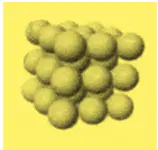
A portion of solid potassium is shown. What type of unit cell are the atoms arranged in?
Primitive cubic
Body-centered cubic
Face-centered cubic
Hexagonal closest packed
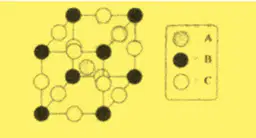
A unit cell of a crystalline compound with the formula ABC3 is shown. What is the arrangement of nearest neighbors around C atoms?
Linear arrangement of B atoms
Square planar arrangement of A atoms
Cubic arrangement of A atoms
Cubic arrangement of C atoms
What is the formula of the oxide whose unit cell is shown?
Ce7O4
CeO
Ce2O3
CeO2
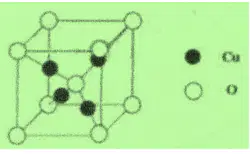
A mineral containing Cu and O has the cubic unit cell shown. What is its formula?
Cu2O
CuO
Cu3O2
Cu4O9
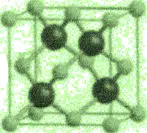
A unit cell of the cubic form of ZnS is shown (large spheres = Zn, small spheres = S). How many of each type of atom are present in a unit cell?
1 Zn, 1 S
2 Zn, 4 S
4 Zn, 4 S
4 Zn, 14 S
Nickel crystallizes in a face-centered cubic structure. The edge of a unit cell has a length of 352 pm. What is the distance between the nuclei of two adjacent nickel atoms in this lattice?
117 pm
176 pm
249 pm
305 pm
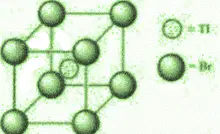
Thallium(I) bromide adopts the cubic unit cell shown with edge length a=397 pm. What is the density of TlBr?
5.42 g/cm3
7.55 g/cm3
18.0 g/cm3
22.4 g/cm3
What is the name of this coordination compound? NH42[NiC2O42H2O2]
Diamminediaquabis(oxalato)nickel(II)
Ammonium diaquabis(oxalato)nickelate(II)
Ammonium diaquadioxaldonickelate(II)
Ammonium diaquabis(oxalato)nickelate(0)
In the octahedral complex CoNH2CH2CO23, each glycinate ion NH22CH22CO2−2− binds to Co through its N atom and one of its O atoms. How many stereoisomers of the complex are there?
2
4
6
8
The energy (J) required for an electronic transition in a Bohr hydrogen atom from n = 2 to n = 3 is ______ J. (RH = 2.180 x 10^-18 J)
4.00 x 10 ^-19
-3.00 x 10^-19
3.00 x 10^-19
-7.9 x 10^-19
How many unpaired electrons are present in an octahedral t2g3eg2 configuration
1
2
3
4
Which element is used to dope silicon to form p-type semiconductor
Al
As
C
Ga
The term electrophile is an appropriate description for all of the following except
NO2+
BH3
(CH3)3C+
NH3
The highest occupied molecular orbital (HOMO) for a carbon monoxide (CO) molecule is the
1 π
2π
2σ
3σ
Which of the following complexes shows geometrical isomerism?
[Co(NH3)5Cl]SO4
[Co(NH3)5Cl)Cl2
[Co(NH3)6]Cl3
K[Co(NH3)2Cl4
Low-spin [Ru(ox)3]3- has _____ unpaired electrons and a total spins, sT, of _____
0,0
1, 1/2
3, 3/2
4, 2
All of the following are examples of hard acids except ______.
H+
BF3
Na+
Mg2+
Which two molecules of M(L-L)x2y2 are identical
Basta drawing hin stereocentric nga M an butnga tas papalibutan hin X, L ngan Y
I and III
II and IV
II and V
IV and V
Which of the two molecules in the previous number above are enantiomers (after han M (L-L) X2y2 nga question nga karan coordination compound)
I and III
II and IV
II and V
IV and V
A weak-field, tetrahedral d0 complex will have a ∆T equal to ______
-3/5∆T + 4π
7/5∆T + 4π
∆T + 4
-2/5∆T + 4π
For a given electron configuration, which of the following term symbols has the lowest energy?
1S(1/2)
3P1
2D0
1S0
Of the series of chromium complexes, which one will have the largest ∆O
[CrF6]3-
[Cr(H2O)6]3+
[Cr(en)3]3+
[Cr(CN)6]3-
A metal ion has a triplet multiplicity has a total spin of ____ and spin-only magnetic moment of ______
1/2, 1.73
1, 2.83
2, 2.83
3/2, 3.87
A metal crystalizes with a face centered cubic lattice. The edge of the unit is cell is 409pm. The diameter of the metal atom is _____
145pm
205pm
289pm
409pm

