
 Worksheets
Econ Units 6-7 Practice Questions
Total questions: 69
Worksheet time: 46mins
Which of the following statements below describes a regressive tax system?
the amount of tax paid increases with income
the average rate of tax falls as income increases
the average rate of tax decreases with less income
the average rate of tax is constant as income increases
Jim Smith, Jr. earns $50,000, and Little Johnny earns $150,000 a year. They each make a $40,000 purchase at 5% sales tax. The cost of the tax for Jim is $2000, or 4% of his income. The cost of the tax is also $2,000 for Johnny, which is 1% of his total income .This is an example of a(n) (a) tax.
Proportional
Progressive
Income
What happens when the federal government achieves a balanced budget?
Expenditures are greater than revenues
Expenditures are less than revenues
The national debt decreases
The national debt does not change
The most common way for governments to cover budget deficits is by...
Raising taxes
Printing money
Borrowing money by selling bonds
Defaulting on loans
Which of the following newspaper headlines represents expansionary fiscal policy of the federal government?
Recession Continues, Government to Lower Tax on Income
4th Quarter GDP Numbers Strong, Government Continues Rise in Income Tax
Federal Government to Cut Spending on Strong Jobs Report
Booming Economy, Federal Government Spending Falls
Supply-siders generally favor
Tax increases
Decreases in aggregate demand
Deregulation of businesses
Increased government intervention
7. Keynesian economic policies are designed to lower unemployment by
A severe economic recession results in
Rising prices
Increased aggregate demand
Falling prices
Decreased government regulation
In Keynes’s view, a short-term budget deficit due to government spending or tax cuts is
To be avoided at all costs
Sometimes necessary to help stimulate the economy
Economically impossible
Morally wrong
According to Keynesian economics, which sector of the economy could offset a decline in business spending?
Consumer
Investment
Government
Net exports
If national unemployment is at 20% the government should adopt ___ fiscal policy.
Mandatory
Compulsory
Contractionary
Expansionary
What will happen to the equilibrium price level and the equilibrium quantity of output if a major hurricane destroys much of the plant and equipment in Florida?
The equilibrium price level increases while the equilibrium quantity of output decreases
The equilibrium price level decreases while the equilibrium quantity of output increases
The equilibrium price level and quantity of output increase
The equilibrium price level and quantity of output decrease
One drawback of using fiscal policy to close a recessionary gap is that
What requires banks to keep (rather than lend) a portion of their total deposits?
The discount rate
Wage-price controls
Open market operations
The fractional reserve system
Which of the following would lead to an expansion of the money supply?
The Fed raises the discount rate
The Fed buys government bonds in the secondary market
The federal government deficit spends
The Fed raises reserve requirements
The Fed’s Board of Governors has (a) members, each serving (b) -year terms.
14, 7
7, 14
8, 8
8, 10
What are the Fed’s main tools for conducting monetary policy?
Reserve requirement, open market operations, and discount rate
Easy money policy, discount rate, and the quantity theory of money
Easy money policy, tight money policy, and the quantity theory of money
Reserve requirement, open market operations, and wage-price controls
Which of these is a feature of open market operations?
The Fed sells government bonds and securities
The Fed lowers the federal funds rate
The Fed raises the reserve requirement
The Fed purchases member bank reserves
Which of these is a prominent feature of monetary policy?
Adjusting government expenditures to stimulate the economy
Adjusting tax rates to stimulate the economy
Adjusting interest rates to stimulate the economy
Low interest rates are an incentive to _____, whereas high interest rates are an incentive to _____.
Borrow/save
Save/borrow
Save/save
Borrow/borrow
Which of the following would lead to a decrease in the money supply?
The Fed lowers the discount rate
The Fed sells government bonds in the secondary market
The federal government spends less money
The Fed lowers reserve requirements
Which of the following lists contains only Fed actions that will increase the money supply?
Raise reserve requirements, lower the discount rate, sell bonds
Raise reserve requirements, lower the discount rate, buy bonds
Lower reserve requirements, lower the discount rate, sell bonds
Lower reserve requirements, lower the discount rate, buy bonds
According to monetary policy, a decrease in the money supply would
Lower interest rates, which would encourage borrowing and therefore increase spending
Raise interest rates, which would discourage borrowing and therefore increase spending
Raise interest rates, which would discourage borrowing and therefore reduce spending
Lower interest rates, which would discourage borrowing and therefore reduce spending
In order to conduct easy money policy, the Fed could use open market operations to
Buy Treasury bonds in order to raise the federal funds rate
Buy Treasury bonds in order to lower the federal funds rate
Sell Treasury bonds in order to raise the federal funds rate
Sell Treasury bonds in order to lower the federal funds rate
If the Federal Reserve raised the reserve requirement ratio from 8 percent to 10 percent, other things the same this will
The total amount of money the U.S. owes over the course of history is the (a) , while the (b) is the amount of money the government owes in one fiscal year.
total debt
annual deficit
GDP
national budget
According to Keynesian economics, how can the government prevent, or reduce the severity of, inflation?
by increasing federal spending
by increasing transfer payments
by applying a contractionary fiscal policy
by applying an expansionary fiscal policy
Keynesian economic policies are designed to lower unemployment by
Stimulating aggregate supply
Stimulating aggregate demand
Reducing aggregate demand
Reducing aggregate supply
Supply-side policies aim to
Strengthen the government’s role in the economy
Strengthen the economy by increasing taxes
Reduce the government’s role in the economy
Increase regulation of corporations
Fiscal policy may involve
Estimating the GDP
Regulating labor unions
Recognizing an economic problem
Taxing corporations
Why does the government sometimes use an expansionary fiscal policy?
to control the demand for consumer goods and services
to encourage growth and try to stop, or prevent, a recession
to expand the government's control over non-defense spending
What typically happens to consumer and business spending when interest rates go up?
Both types of spending increase
Both types of spending decrease
Consumer spending increases and business spending decreases
Business spending increases and consumer spending decreases
What do Fed member banks do with customer deposits?
They use them to conduct monetary policy
They use them to enforce wage-price controls
They keep a portion as legal reserves and loan out a portion at interest
They use a portion to calculate interest rates and keep a portion as legal reserves
If the Fed buys bonds in the secondary market
The money supply will increase
The money supply will decrease
The money supply will not be affected
The discount rate would be affected
Which of the following statements best describes trade between two nations?
It is mutually beneficial
It avoids specialization
It involves low cost for both nations
It is legally required
What does a protective tariff seek to protect?
Protectionists
Revenue
Free trade
Domestic industries
Which of the following is most directly affected by an embargo established by the United States?
US tariffs
US imports
US exports
US free traders
A strong dollar leads to
higher exports
lower imports
cheaper foreign goods
increased foreign investment
Under flexible exchange rates, trade deficits tend to correct themselves automatically through
Supply and demand
Price ceilings
Price floors
Government subsidies
What would a free-trader most likely support?
The infant industries argument
A revenue tariff
USMCA
An embargo
are taxes on (a)
When a country has a balance of trade deficit
It must make up the difference by shipping gold to its creditors
Its exports exceed its imports
Its currency will appreciate
Its imports exceed its exports
Tariffs and quotas on imports
Result in higher domestic prices
Promote trade between nations
Do not necessarily affect domestic prices
Affect domestic prices: the former raises them while the latter lowers them
If the value of the US dollar depreciates, then US
Imports will rise
Unemployment will rise
Net exports will fall
Exports will rise
You are planning a graduation trip to Japan. All things remaining the same, if the dollar appreciates relative to the Yen, which of the following occurs?
the dollar buys fewer Yen, and you will need less dollars to purchase the goods in Japan.
the dollar buys fewer Yen, and you will need more dollars to purchase Japanese goods.
the dollar buys more Yen and you will need less dollars to purchase the goods in Japan.
the dollar buys more Yen, and you will need more dollars to purchase Japanese goods.
If the U.S. dollar appreciates in value, then U.S. goods become
less expensive relative to foreign goods, which makes exports rise and imports fall.
less expensive relative to foreign goods, which makes exports fall and imports rise.
more expensive relative to foreign goods, which makes exports rise and imports fall.
more expensive relative to foreign goods, which makes exports fall and imports rise.
If a country's currency appreciates, what is the likely effect on its exports?
Exports will increase as they become cheaper for foreign buyers
Exports will decrease as they become more expensive for foreign buyers
There will be no effect on exports
Exports will only be affected if imports also change
Economic development is important in countries because it
Reduces the gross national product (GNP) and population growth
Usually means a zero population growth (ZPG) policy is established
Reduces poverty and increases social and political stability
Usually means a country produces more than it consumes
Two obstacles to a nation’s economic development are
High literacy and external debt
Population growth and disease
Corruption and zero population growth policies
Which of the following are global organizations that were organized to promote trade between nations?
WTO and ASEAN
GATT and WTO
IMF and EU
UN and COMESA
Which of the following are regional trading blocs that promote trade between nations?
OPEC and EU
USMCA and ASEAN
IMF and COMESA
World Bank and NAFTA
One trend with globalization is
A growing reliance on the World Bank among nations
A growing economic interdependence among nations
Less political stability among nations
Less political cooperation among nations
Which of the following factors can slow or halt the process of globalization in the world?
Growth in the number of multinationals
Greater ability to control population
More specialization
Perceived threat to a nation’s culture, politics, or religion
Which statement best identifies the two developments that have occurred that Malthus did not predict?
The world population growth rate has slowly declined, and advances in productivity have enabled a rising standard of living
The world population growth rate has increased, and advances in productivity have enabled a rising standard of living
A worldwide decrease in productivity has lowered the standard of living, and the world population growth rate has slowly declined
A worldwide increase in population and a decrease in productivity have lowered the standard of living
COMESA is a
Common market for South American countries
Common market for eastern and southern African countries
A growing trend of globalization is
More political independence and fewer nations defaulting on loans
Specialization and high wages in production
Less economic dependence among nations
Specialization and division of labor in production
Which of these results from the implementation of a tight money policy?
a decrease in interest rates
a decrease in the price of credit
an increase in the price of credit
an increase in wage-price controls
Assume the unemployment rate is 4 percent and the CPI is 7 percent and rising. Which action would be the most effective in stabilizing the economy?
The Fed buys bonds and the federal government increases spending.
The Fed sells bonds and the federal government decreases spending.
The Fed raises the discount rate and the federal government raises taxes.
The Fed lowers the discount rate and the federal government decreases taxes.
How does capital investment differ from personal investment?
Capital investment is an investment by the government.
Capital investment is an investment in assets held by the government.
Capital investment specifically refers to money lent to businesses to encourage production
How is the federal income tax a progressive tax?
Children pay no taxes, regardless of whether they earn a large income.
A person with a higher income pays more tax, but the percentage is less.
The higher the income a person has, the higher the percentage a person pays in taxes.
Two married people who file their taxes together will pay more taxes that a single person
What is a major reason that the federal government does not reduce the budget deficit by printing more money?
The Constitution forbids the government from doing so.
Having too much money in circulation leads to deflation.
Our creditors would not accept the money at face value.
Printing more money to cover a deficit can lead to hyperinflation
Which of the following statements best describes the Federal Reserve System (the Fed)?
It is a mostly independent agency that supervises and manages the financial system.
It is the agency through which Congress supervises and manages the financial system.
It is the agency through which the judiciary supervises and manages the financial system.
It is the agency through which the executive branch supervises and manages the financial system.
Capital investment specifically refers to individuals putting their money in a private savings for future use.
What is the relationship between interest rates and demand for money?
As interest rates increase, demand for money increases.
As interest rates increase, demand for money decreases.
Interest rates and demand for money are unrelated.
As interest rates decrease, demand for money decreases.
As interest rates increase, demand for cash increases. As interest rates increase, the money supply increases. As interest rates increase, demand for cash decreases. As interest rates decrease, demand for cash decreases. Which of the following is correct?
As interest rates increase, demand for cash increases.
As interest rates increase, the money supply increases.
As interest rates increase, demand for cash decreases.
As interest rates decrease, demand for cash decreases ग्रामीण
In recent years, some African nations have built up their economies by focusing on their vast oil reserves. How might this focus actually slow overall economic growth?
The oil reserves may run out very soon, leaving the countries with no major export items.
By relying on oil, the countries are not investing in other businesses necessary for a healthy economy.
Oil takes a long time to drill, refine, and transport, slowing the time it takes for companies to earn income.
The oil industry requires very little education; therefore the citizens have no incentive to improve education.
Which of these is associated with the economic philosophy of Adam Smith?
nonprice competition
laissez-faire price-fixing
natural and geographic monopolies
limited government economic involvement
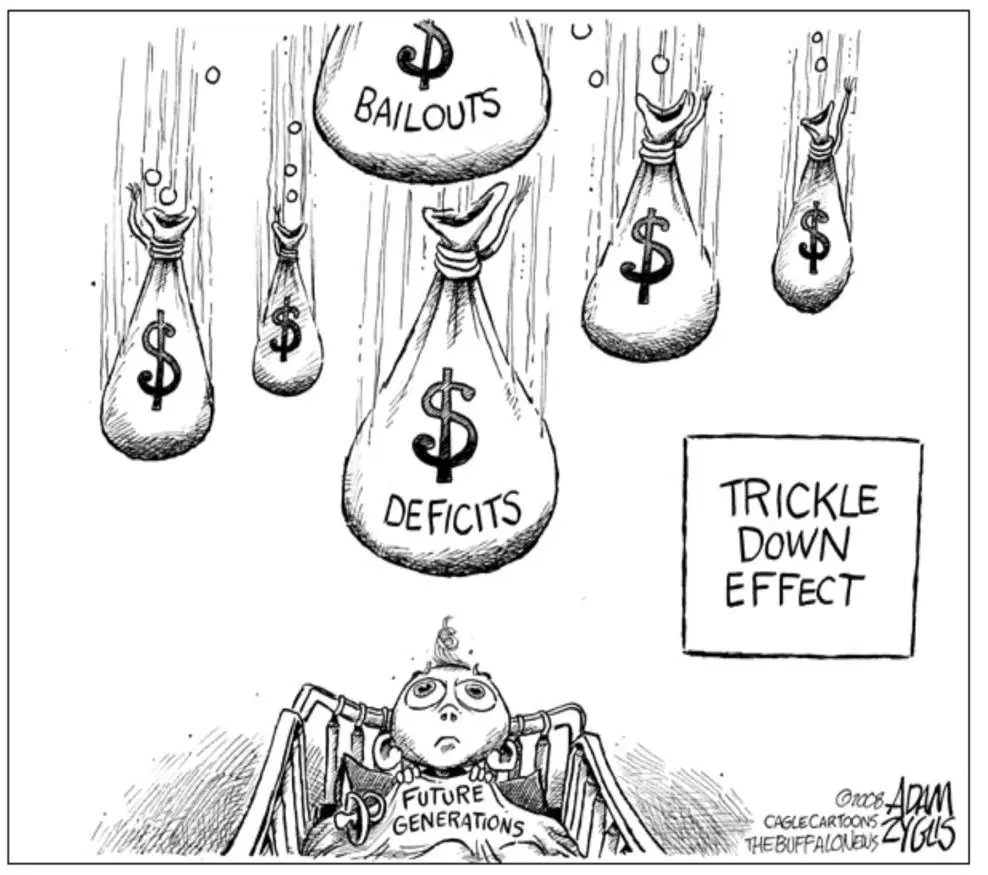
What is the artist’s main message is in this cartoon?
The government's current fiscal policies are good for children.
Babies and young children are affected the most by fiscal policies.
Future generations will reap huge profits from current fiscal policies.
Current fiscal policies will have a harmful effect on future generations.
Match the following
Believed recessions should be addressed with government spending to boost demand
Keynes
Warned that population growth would outpace food production, leading to widespread poverty
Malthus
Emphasized the role of monetary policy and control of the money supply to manage the economy
Friedman
Developed the theory of comparative advantage in international trade
Ricardo
Advocated for minimal government intervention, emphasizing the importance of free markets
Adam Smith

