Worksheets
1st 9 Weeks Review
Total questions: 71
Worksheet time: 36mins
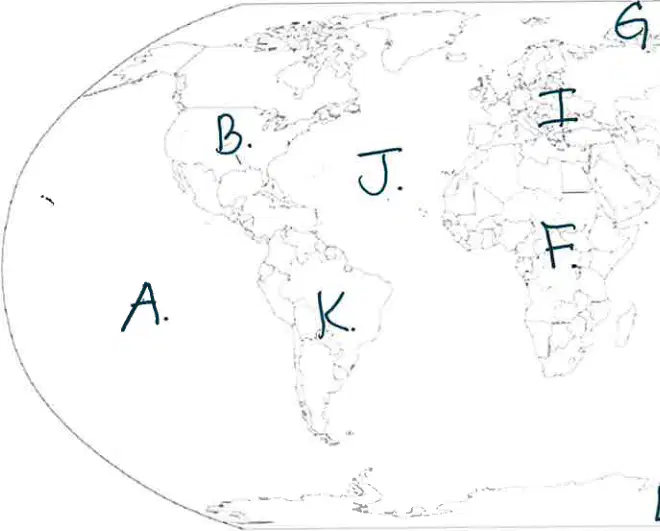
What letter on the map represents the Atlantic Ocean?
J
A
C
F
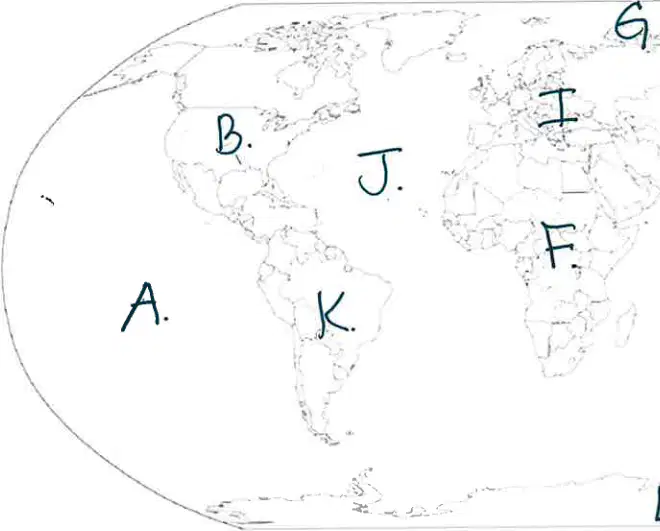
What letter on the map represents North America?
B
A
C
D
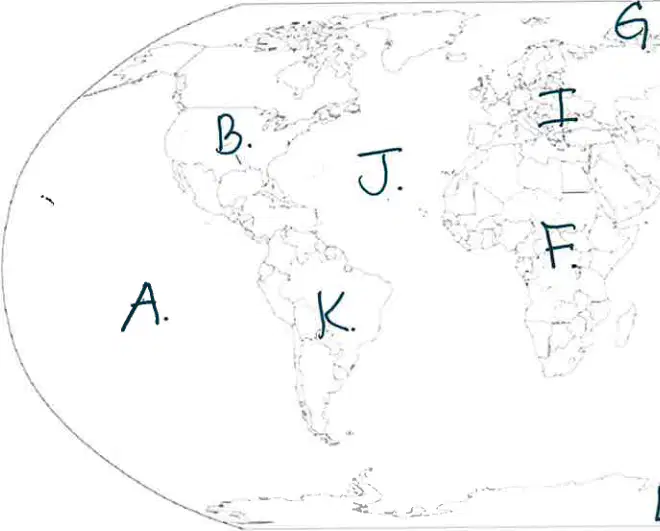
What letter on the map represents Europe?
I
A
C
F

What letter on the map represents Pacific Ocean?
A
B
C
D
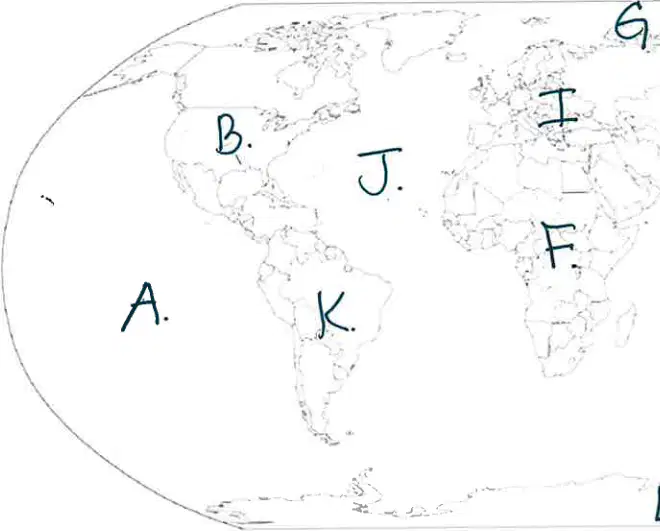
What letter on the map represents Africa?
F
A
C
D
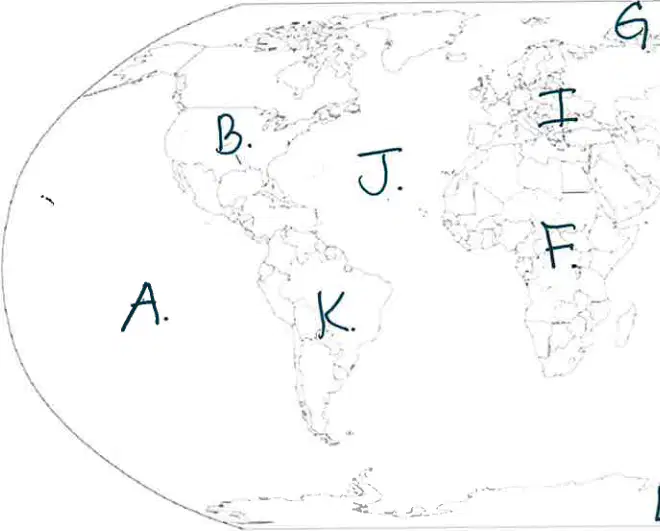
What letter on the map represents South America?
K
L
M
N
This tool is located on a map to show direction: _________.
Compass Rose
Scale Bar
Legend
Grid Lines
North, South, East, West are called what kind of directions?
Cardinal Directions
Intermediate Directions
Relative Directions
Secondary Directions
What 4 things does every map need to have?
Title, Compass Rose, Scale, Key/Legend
Latitude, Longitude, Equator, Prime Meridian
Title, Border, River, Mountain
Compass Rose, Ocean, City, Road
A man-made waterway through land for boats and ships is called a _________.
Canal
Bridge
Tunnel
Harbor
A group or chain of islands clustered together in a sea or ocean is called an _________
Archipelago
Peninsula
Isthmus
Continent
Name 2 geographic barriers.
Mountains, No access to waterways (river, seas or oceans)
Deserts, Skyscrapers
Bridges, Highways
Farms, Parks
Name 2 geographic assists.
Rivers, Flat land (plains)
Mountains, Deserts
Oceans, Volcanoes
Canyons, Plateaus
What would you wear in the Arctic Circle?
Hat, boots, and heavy coat
Shorts and sandals
Raincoat and umbrella
Swimsuit and flip-flops
What would you wear in the desert?
Shorts and tank top
Heavy winter coat and boots
Raincoat and umbrella
Ski suit and gloves
Define Glaciation and list some events/features resulting from it.
Glaciers move and change the land: U-shaped valleys
Glaciation is the process of desert formation: Sand dunes
Glaciation causes volcanic eruptions: Lava flows
Glaciation leads to earthquakes: Fault lines
Define Plate Tectonics and list some events/features resulting from it.
Plates underneath the earth move: earthquakes, tsunamis, mountains, volcanoes
Plates above the earth move: rain, snow, wind, clouds
Plates underneath the ocean move: tides, waves, currents, storms
Plates in the atmosphere move: lightning, thunder, rainbows, auroras
Define Volcanic Activity and list some events/features resulting from it.
Volcanoes erupt: lava, destruction of homes, fertile soil, ash
Earthquakes only: shaking ground, no lava, no ash
Tsunamis: large ocean waves, flooding, no lava
Hurricanes: strong winds, heavy rain, no volcanic eruptions
Define Erosion and list some events/features resulting from it.
Process of rocks and soil slowly breaking apart and being carried away: Canyons, Caves, Cliffs
Process of plants growing in soil: Forests, Meadows, Gardens
Movement of tectonic plates: Earthquakes, Volcanoes, Mountains
Condensation of water vapor: Clouds, Rain, Snow
Define Movement and give 1 example.
Movement is different ways things move place to place – Ideas and people. Example: INTERNET.
Movement is the process of water evaporating from the ocean. Example: Rainfall.
Movement is the way plants grow towards sunlight. Example: Sunflower.
Movement is the process of rocks breaking down into soil. Example: Weathering.
Define Region and give 1 example.
Region is an area that is defined by certain similar characteristics – Clothing, Religions, Ethnicities.
Region is a type of weather pattern found only in deserts.
Region is a type of government system used in cities.
Region is a type of animal found in forests.
Define Human Environment Interaction and give 1 example.
Human Environment Interaction is how humans interact with the environment. Example: Building Canals, Cutting down rainforests.
Human Environment Interaction is how animals adapt to the environment. Example: Birds migrating south for winter.
Human Environment Interaction is how plants grow in different climates. Example: Cacti in deserts.
Human Environment Interaction is how weather changes over time. Example: Rain turning into snow.
Define Location and give 1 example.
Location is where a place is located: exact address or coordinates.
Location is the type of weather in a place.
Location is the language spoken in a place.
Location is the kind of food found in a place.
Define Place and give 1 example.
Place is the physical and human features of a particular area. Example: Disneyland, Kemah.
Place is a type of weather pattern. Example: Rain, Snow.
Place is a kind of animal habitat. Example: Forest, Ocean.
Place is a type of transportation. Example: Car, Train.
What is a cultural Trait?
A cultural trait is a specific custom that is part of the everyday life of a culture.
A cultural trait is a type of government system.
A cultural trait is a natural landform found in a region.
A cultural trait is a scientific theory about human evolution.
What is a cultural region?
A cultural region is a geographic area in where people share a common history and belief system.
A cultural region is a place defined only by its physical features.
A cultural region is an area where only one language is spoken.
A cultural region is a region with no human settlement.
Define multicultural.
Multicultural means a geographic area in which there are many different cultures, languages, and ethnicities.
Multicultural means a place where only one culture is present.
Multicultural means a region with no cultural diversity.
Multicultural means an area where everyone speaks the same language.
How does climate influence culture?
Climate influences culture because weather affects the type of clothes you would wear. For example, in the Arctic Circle you wear a hat, boots, and heavy coat; in the desert, you wear shorts and a tank top.
Climate influences culture by determining the language people speak in different regions.
Climate influences culture because it decides the type of government a country will have.
Climate influences culture by affecting the kind of music people listen to.
What is Cultural Borrowing?
Cultural borrowing is when a culture borrows ideas, knowledge, skills, and technology from other cultures. Examples: RECIPES and DRESS, IDEAS, RELIGIONS, Languages.
Cultural borrowing is when a culture refuses to accept any ideas or practices from other cultures.
Cultural borrowing is the process of creating new traditions without any outside influence.
Cultural borrowing is the act of isolating a culture from all external contact.
What is Cultural Diffusion? (include 2 examples)
The spread or movement of ideas or cultural traits from one place to another. Examples: LANGUAGE AND RELIGION
The process of creating new languages within a single community. Examples: SLANG AND DIALECTS
The isolation of cultures to prevent outside influence. Examples: CLOSED COMMUNITIES AND TRADITIONAL PRACTICES
The forced adoption of one culture by another. Examples: COLONIZATION AND ASSIMILATION
What is the fastest way to diffuse information?
Internet
Newspaper
Radio
Word of mouth
List examples of what would go in the cultural institutions below.
Trade, export, import, banks
Temples, museums, theaters, libraries
Hospitals, clinics, pharmacies, ambulances
Farms, crops, livestock, irrigation
List examples of what would go in the cultural institutions below.
government, laws, president, voting
mountains, rivers, lakes, oceans
apples, bananas, oranges, grapes
cars, trains, airplanes, bicycles
List examples of what would go in the cultural institutions below. Religion
cross, temple, Pope, Christmas
parliament, president, election, law
factory, engineer, assembly line, product
market, money, trade, bank
List examples of what would go in the cultural institutions below. Education -
school, pencil, homework, teacher
hospital, nurse, medicine, patient
court, judge, lawyer, trial
market, shopkeeper, goods, customer
List examples of what would go in the cultural institutions below.
video games, reading, hiking, dancing, religion
apples, oranges, bananas, grapes, pears
cars, trucks, motorcycles, bicycles, scooters
tables, chairs, sofas, beds, desks
What does Diwali celebrate or honor?
Festival of Lights
Harvest Festival
New Year Celebration
Victory of Winter
What does Christmas celebrate or honor in Christianity?
Birth of the savior Jesus Christ
Resurrection of Jesus Christ
Ascension of Jesus Christ
Baptism of Jesus Christ
What does Ramadan celebrate or honor in Islam?
A "month of blessing" marked by prayer, fasting
The birth of Prophet Muhammad
The end of the Hajj pilgrimage
The creation of the Quran
What city is considered the “birthplace of Democracy?”
Athens, Greece
Rome, Italy
Cairo, Egypt
Beijing, China
What is an unlimited government? ________ can do what they want to. No Constitution stopping their power.
Government
Citizens
Judges
Teachers
What is a limited government? ________ cannot do what they want. Constitution limits their power. They must follow the laws.
Government
Citizens
Judges
Businesses
Representative governments include what? ________ is in the hand of the citizens, elects representatives to act on their behalf, guarantees individual rights.
Power
Wealth
Tradition
Monarchy
List some of the responsibilities of citizens in the US. ________ government officials to represent the people.
Elect
Ignore
Punish
Bribe
List some of the rights of citizens of the US?
Bill of Rights
Paying taxes
Serving in the military
Owning property
What documents make the United States a limited government?
Constitution
Declaration of Independence
Bill of Rights
Articles of Confederation
How many principles does the United States Constitution have?
7
3
5
10
How many amendments does the Bill of Rights have?
10
12
5
15
What freedoms does the 1st Amendment give?
Right to Petition
Right to Bear Arms
Right to a Fair Trial
Right to Privacy
What are the characteristics of Communism?
State provides for the needs of the people. No Private Property owned by the people.
Private ownership of all businesses and land.
Rule by a hereditary monarchy.
Economy based on free market competition.
Is Communism a limited or unlimited government?
Unlimited
Limited
Constitutional
Democratic
What are the characteristics of Direct Democracy?
EVERY citizen must vote on ALL laws. Rule by the People.
Only elected representatives make laws. Rule by a select few.
Laws are made by a monarch. Rule by one person.
Citizens have no say in lawmaking. Rule by the elite.
Is Direct Democracy a limited or unlimited government?
Limited
Unlimited
Authoritarian
Totalitarian
What are the characteristics of Absolute Monarchy?
King or Queen has complete control over the government. They make all the laws. Citizens have no power.
Citizens elect representatives to make laws.
The government is run by religious leaders.
Power is shared between a central government and regional governments.
Is Absolute Monarchy a limited or unlimited government?
Unlimited
Limited
Democratic
Federal
What are the characteristics of Democratic Republic?
People elect (vote) government officials to make laws for them. Constitution and Bill of Rights.
A single ruler holds all the power and makes laws without input from the people.
Religious leaders control the government and laws are based on religious texts.
Government officials are chosen based on family lineage and inheritance.
Is Democratic Republic a limited or unlimited government?
Limited
Unlimited
Monarchy
Dictatorship
What are the characteristics of Oligarchy?
Ruled by a few. Group of wealthy landowners make all laws.
Ruled by a single monarch with absolute power.
All citizens have equal say in government decisions.
Government is controlled by religious leaders.
Is Oligarchy a limited or unlimited government?
Unlimited
Limited
Democratic
Constitutional
What are the characteristics of Dictatorship?
Ruled by ONE person. Citizens have no rights. Military used to enforce rules/arrests.
Elected by the people. Citizens have many rights. Laws made by representatives.
Ruled by a group of religious leaders. Laws based on religion.
Power shared by several states. Citizens vote on all issues.
Is Dictatorship a limited or unlimited government?
Unlimited
Limited
Constitutional
Democratic
What are the characteristics of Theocracy?
Religious leaders. Rule on behalf of a religion.
Elected representatives. Rule based on majority.
Monarchs. Rule by birthright.
Military leaders. Rule by force.
Is Theocracy a limited or unlimited government?
Limited
Unlimited
Democratic
Federal
What are the characteristics of Constitutional Monarchy?
King or Queen is limited by a constitution. Constitution limits power of King and Queen. Citizens elect representatives to vote on laws.
King or Queen has absolute power over the government. No constitution exists.
Citizens have no role in the government. King or Queen makes all laws.
The government is run by religious leaders. Laws are based on religious texts.
Is Constitutional Monarchy a limited or unlimited government?
Limited
Unlimited
Absolute
Authoritarian
What does P in PEGS mean?
A) Political
B) Economic
C) Geographic
D) Social
What does E in PEGS mean?
A) Political
B) Economic
C) Geographic
D) Social
What does G in PEGS mean?
A) Political
B) Economic
C) Geographic
D) Social
What does S in PEGS mean?
Political
Economic
Geographic
Social