
Font size
 Worksheets
Natural Disasters Final Review 2025
Total questions: 70
Worksheet time: 40mins
1. A volcano is a ________ that contains melted (molten) rock.
mountain
river
forest
valley
2. Volcanoes most commonly occur at ________.
plate boundaries
deserts
polar regions
rainforests
When molten rock is below Earth's surface it is called ________.
magma
lava
basalt
granite
What kind of rocks are formed when molten rock cools?
igneous
metamorphic
sedimentary
all of these
These volcanoes do not erupt explosively. They ooze lava that spreads over a wide area. The layers and layers of lava build up to form wide, gentle slopes.
cinder cone
caldera
composite
shield
What simple type of volcano is made of lava fragments that have been ejected from a volcanic vent?
cinder cone
caldera
composite
shield
What type of volcano has steep sides and alternating layers of ash and lava?
cinder cone
caldera
composite
shield
Volcanoes only exist on land.
True
False
Volcanoes alter Earth's landscape much more quickly than many other geoscience processes.
True
False
Only some volcanoes are active.
True
False
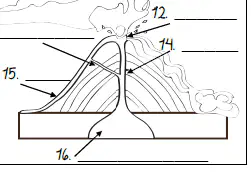
Label the parts of a volcano. What is part 11?
ash cloud
lava flow
magma chamber
crater
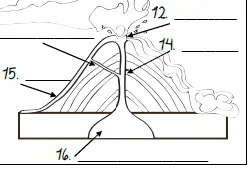
Label the parts of a volcano. What is part 12?
crater
magma chamber
vent
ash cloud
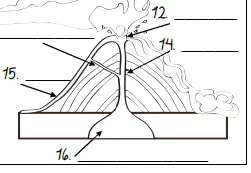
Label the parts of a volcano. What is part 13?
secondary vent
crater
vent
magma chamber
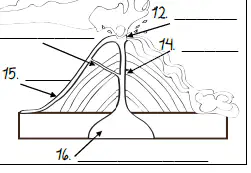
Label the parts of a volcano. What is part 14?
(a)
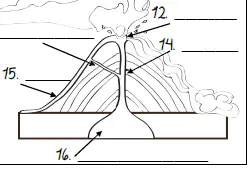
Label the parts of a volcano. What is part 15?
magma chamber
crater
ash cloud
lava flow
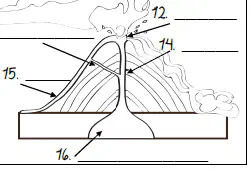
Label the parts of a volcano. What is part 16?
magma
ash cloud
crater
lava flow
The location deep inside the Earth where an earthquake began is called the
focus
epicenter
point zero
quake point
The strength of an earthquake is measured on a tool called a
seismogram
Richter scale
seismograph
spring scale
A 4.0 Earthquake release ___times more energy than a 2.0 earthquake.
2
20
10
100
Earthquakes can be mesured by
a shifting fault line
volcanic acitiity
tsunamis
both a and b
To be considered a major earthquake, the quake must measure a ___ or above on the Ritcher scale.
3
5
9
7
The epicenter of an earthquake is directly below the focus.
S-waves are neither the fastest or slowest waves.
What type of flood is caused by storm surges and tsunamis?
flash
river
coastal
surface
A fault is a giant wave.
A quake that measures 2 on the Richter scale always destroys houses.
Which of the following is NOT a natural cause of flooding?
rapid movement
deforestation
heavy rainfall
river jams
Floodplains are formed by ____.
river sediment deposition
coastal erosion
human construction
glacial movement
Flash floods are most likely to occur _____.
over a prolonged period
in cities and valleys
in coastal regions
in mountainous areas
The most dangerous type of flood due to its sudden onset is a ___ flood.
flash
coastal
river
surfaces
Which of the following is a characterisitc of surface floods?
caused by storm surges
caused by heavy rain saturating flat surfaces
caused by river overflow
caused by rapid snowmelt
Floodplains increase flood risk because they speed up water flow.
Just 6 inches of water can carry away most cars.
Urban floods are caused by overwhelmed drainage systems.
During a thunderstorm, which other type of weather will NOT form?
hail
flood
hurricane
tornado
Lightning is a very quick burst of ____.
bioluminescence
rain
electricity
thunder
Thunderstorm clouds are ____ clouds.
cumulus
cirrus
cumulonimbus
stratus
Thunder is the sound of ____.
lighthing hitting the ground
storm clouds colliding
electricity traveling through air
heated air expanding and contracting rapidly
Thunderstorms occur frequently in the winter.
Lightning never strikes the same place twice.
Thunderstorms always have lightning.
What is the primary cause of tsunamis?
Glacial melting
Underwater earthquakes
Hurricanes
Volcanic eruptions
Which type of cloud is most commonly associated with thunderstorms?
Cirrus
Altostratus
Cumulonimbus
Stratus
Most tsunamis occur in the _____ ocean.
Atlantic
Indian
Pacific
Artic
Tsunami waves travel in a ____ motion.
straight
crooked
circular
none of these
Tsunami waves can travel ____miles/hour.
100
200
500
1000
The raising and lowering of the sea floor can cause a tsunami.
Volcanic eruptions can also cause tsunamis.
Tidal waves have a circular motion.
How high can tsunami waves reach?
10 feet
100 feet
100 meters
500 meters
The word tsunami means....
What are the three components needed for fire?
oxygen, water, heat
heat, fuel, carbon dioxide
fuel, heat, oxygen
oxygen, fuel, nitrogen
What are some impacts of a wildfire in a forest?
habitat loss
air pollution
organism deaths
all of these
Which type of fire burns in the tops of trees?
spot fires
ground fires
crown fires
surface fires
Most wildfires are caused by _____.
electrical wires
accumulated dead matter
lightning
humans
Wildfires are never good for the environment.
A fire can start without help from humans.
Wildfires can trigger earthquakes.
Wildfires can allow new life to flourish.
Fire devils occurs when heat from a wildfire creates its own wind system.
What is a hurricane's energy source?
warm water
cold water
wind
warm air
Why does a hurricane slow down when it hits land?
it stops raining
the air is warmer
the winds stop it
it loses its energy source
What is another name for a hurricane south of the Equator (in Australia)?
cyclone
tornado
typhoon
hurricane
Hurricane season in the Atlantic goes from _____ 1st to _____ 30th.
June, November
May, October
June, October
April, September
A hurricane rotates _____.
all of these
clockwise
counterclockwise
in different directions in the northern and southern hemispheres
Hurricanes start as thunderstorms over warm, tropical oceans.
Tropical storm is another name for a hurricane.
. _____ cause(s) damage during a hurricane.
Winds
Storm surges
Flooding
All of these
What is the most powerful part of a hurricane?
As tsunami waves travle through shallow water, the wave height_____.
gets higher
gets shorter
doesn't change
none of these

