
 Worksheets
2025 ES Final Part 2
Total questions: 45
Worksheet time: 24mins
Which material had the greatest porosity (amount of open space between grains)?
Sand
Gravel
Soil
Why did it take longer for the water to pass through the sand compared to the gravel?
The pores were larger and the water was clogging into them.
The sand was more hydrophobic.
The sand has smaller pores causing the water to take longer.
Place the materials in order from MOST POROUS at the top of the list, to LEAST POROUS.
Soil
2
Gravel
1
Sand
3
As porosity increases, permeability also increases.
True
False
Soil is intentionally absorbent reducing its overall permeability.
True
False
An arrangement of light by wavelength is called a _.
Spectrum
Spectroscopy
X-Ray
Place the EM spectrum in order from LONGEST wave to SHORTEST wave. This means that you'll put the longest wave on top in your order.
Visible
Radio
Microwave
Microwave
UV
Infrared
X-Ray
Visible
Radio
UV
The overhead lights in the room are a Continuous Spectrum.
True
False
As the wavelength of light increases the frequency/energy _________
decreases
increases
remains the same
doubles
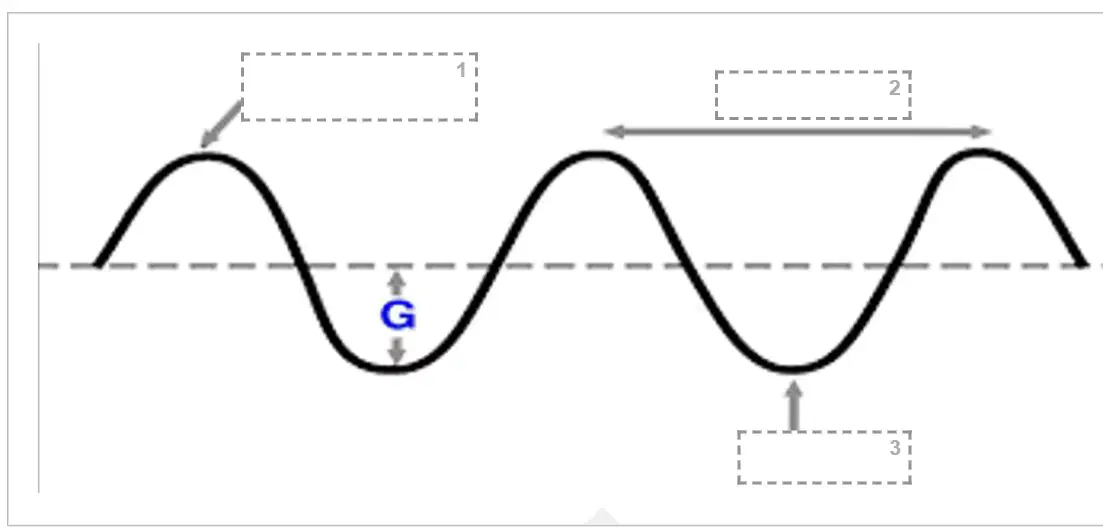
Label the wave below properly by matching the correct terms to the labeled parts of the wave diagram.
Crest
1
Wavelength
2
Trough
3
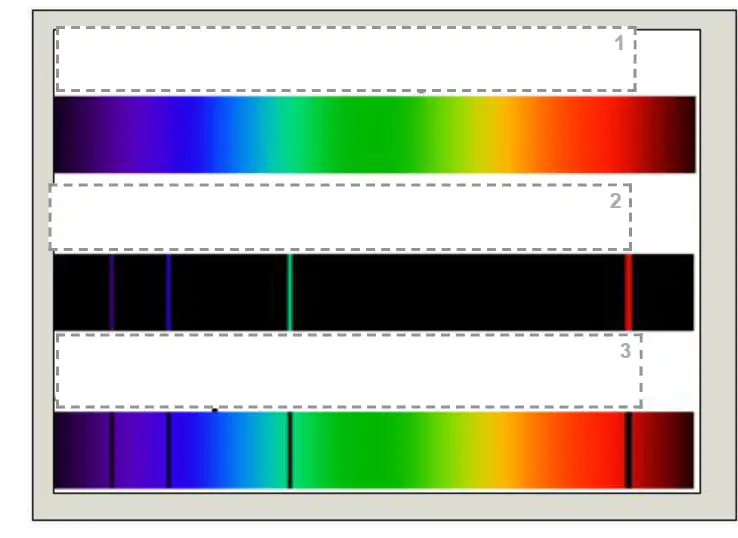
Identify the spectra. Match the numbers in the diagram to the correct type of spectra:
Continuous Spectra
1
Emission Spectra
2
Absorption Spectra
3
The Sun gives off a continuous, 'pure-white', spectra.
True
False
Where are protostars born?
supernova
planetary nebula
stellar nebula
Which type of star will enter the supernova stage?
high mass stars
low mass stars
average mass stars
What is the longest phase of a star's life cycle?
main sequence
red giant
white dwarf
What determines the life cycle of a star?
its brightness
its color
its mass
Which gas is exhausted when stars enter the giant or red giant stage?
neon
hydrogen
helium
What is a star called before it can fuse hydrogen into helium?
pulsar
protostar
neutron star
The sun is a main sequence star.
True
False
Stars 1.5 to 3 times bigger than the sun will end its cycle as this?
black hole
neutron star
planetary nebula
What process powers the Sun and allows it to release energy in the form of radiation?
Radioactive decay
Nuclear fusion
Nuclear fission
Which element is primarily fused in the core of the Sun to produce energy?
Helium
Carbon
Hydrogen
What is the eventual fate of the Sun as it reaches the end of its life cycle?
It will explode as a supernova.
It will collapse into a black hole.
It will become a white dwarf.
Which of the following provides the strongest evidence supporting the Big Bang Theory?
The motion of planets around the Sun
The redshift of distant galaxies
The presence of craters on the Moon
What does the cosmic microwave background radiation represent?
The leftover heat from the Big Bang
Energy produced by nuclear fusion in stars
The light from distant galaxies
What happens to galaxies as the universe expands?
A) They move closer together and slow down as they do so.
B) They shrink in size.
C) They move farther apart and speed up as they do so.
How are heavier elements, such as iron, primarily formed in the universe?
By the gravitational pull of black holes
By nuclear fusion in small stars
By supernova explosions of massive stars
What element is produced when hydrogen undergoes fusion in the core of a star?
Nitrogen
Oxygen
Helium
Which of the following correctly describes the process of nucleosynthesis in stars?
The creation of new elements through nuclear fusion.
The breakdown of atoms into smaller particles.
The cooling and shrinking of stars over time.
Which of the following is the primary source of energy driving Earth's climate system?
Radioactive decay in the Earth's crust
Solar radiation from the Sun
Geothermal heat from Earth's interior
What effect does an increase in greenhouse gases, such as carbon dioxide, have on Earth's energy balance?
It traps more heat in the atmosphere, leading to warming.
It allows more heat to escape into space, cooling the planet.
It increases the amount of energy reflected by Earth's surface.
Which of the following best explains how volcanic eruptions can impact global climate?
They produce heat that increases the temperature of the atmosphere.
They release large amounts of greenhouse gases, increasing warming.
They increase the salinity of the ocean, changing ocean currents.
Which of the following best describes the relationship between ocean circulation and climate?
Ocean currents distribute heat around the planet, influencing climate patterns.
Ocean currents release large amounts of greenhouse gasses, affecting climate.
The ocean remains at a constant temperature and has no effect on climateinge climate patterns
Which of the following provides the strongest evidence for the idea that Earth's systems and life have coevolved?
The presence of life on other planets
The movement of tectonic plates over time
The changing composition of Earth's atmosphere due to photosynthesis
How did the Great Oxygenation Event impact Earth's systems?
It resulted in a decrease in ocean temperatures.
It led to an increase in atmospheric oxygen, enabling the evolution of complex life.
It caused a mass extinction due to increased carbon dioxide levels.
What role do humans play in Earth's climate system?
Human activity only affects local weather, not global climate.
Human activities, such as burning fossil fuels, increase greenhouse gas levels.
Humans have no impact on climate systems.
How does the presence of life influence Earth's geology over time?
The Moon’s gravitational pull determines Earth’s geological changes that impact where life thrives
Life has no impact on Earth's geology.
Organisms, such as corals and plants, contribute to rock and soil formation.
Which of the following provides the strongest evidence for the theory of plate tectonics?
The movement of ocean tides
The matching fossil records on different continents
The variety of climate zones on Earth
What is the primary reason that oceanic crust is younger than continental crust?
Oceanic crust forms at mid-ocean ridges and is recycled by subduction.
Oceanic crust forms from meteorite impacts.
Continental crust is eroded more slowly than oceanic crust.
Which of the following is an example of how changes to Earth's surface can create feedback affecting other Earth systems?
A. Melting glaciers increase sea levels, which in turn affect ocean currents and climate.
B. Earthquakes only impact the lithosphere and do not affect other systems.
C. Erosion of rocks by wind does not influence the atmosphere.
What is the primary cause of convection currents in Earth’s mantle?
The movement of tectonic plates
The transfer of heat from the core through the mantle
The gravitational pull of the Moon
Which of the following best describes how thermal convection contributes to plate movement?
Volcanoes at divergent boundaries push plates apart.
Ocean currents push tectonic plates toward subduction zones.
Heated material rises, cools, and sinks, creating a cycle that moves plates.
How do mid-ocean ridges provide evidence of Earth's internal and surface processes?
They result from the cooling and solidification of magma at divergent boundaries.
They form due to erosion by ocean currents.
They develop when continents collide and form mountain ranges.
What geological feature forms when an oceanic plate is forced beneath a continental plate?
A mid-ocean ridge
A deep-ocean trench
A plateau
Match the following
All colors of light with no breaks in it. Appears as pure white light.
Continuous Spectra
Spectrum where certain colors of light are emitted (given off).
Emission Spectra
Created by all stars, this spectrum is missing colors. The missing colors appear as black lines missing from the rainbow.
Absorption Spectra

