Wayground logo

Free Printable Worksheets

Font size

S
M
L
XL
Worksheets

Nuclear Change, Solutions, Acid/Bases

Total questions: 55

Worksheet time: 2hrs 18mins

Name
Class
Date
1.

Match

a)

Alpha

1.

Changes the mass number

b)

Beta

2.

Raises the Atomic Number

c)

Gamma

3.

Emits a high energy Light particle.

2.

Organize these options into the right categories

Categorize the following

A large nucleus split into a smaller nucleus

23994Pu + 10n → 13454Xe + 10340Zr +3 10n\frac{239}{94}Pu\ +\ \frac{1}{0}n\ \rightarrow\ \frac{134}{54}Xe\ +\ \frac{103}{40}Zr\ +3\ \frac{1}{0}n  

Small Nuclei combine to form a more massive nucleus

4 11H→ 42He+ 2 01e4\ \frac{1}{1}H\rightarrow\ \frac{4}{2}He+\ 2\ \frac{0}{1}e  

Fission
Fusion
3.

What is the missing term from the following equation?

25299Es→ AZX +42He\frac{252}{99}Es\rightarrow\ \frac{A}{Z}X\ +\frac{4}{2}He

a)

247100Bk\frac{247}{100}Bk

b)

25299Es\frac{252}{99}Es

c)

24897Bk\frac{248}{97}Bk

d)

25392Pk\frac{253}{92}Pk

4.

What is the missing term from this fission equation?

23592U+ 10n→ 9038Sr + AZX +2 10n\frac{235}{92}U+\ \frac{1}{0}n\rightarrow\ \frac{90}{38}Sr\ +\ \frac{A}{Z}X\ +2\ \frac{1}{0}n

a)

42He\frac{4}{2}He

b)

17498Rp\frac{174}{98}Rp

c)

14454Xe\frac{144}{54}Xe

d)

23592U\frac{235}{92}U

5.
What kind of radiation is being given off in this diagram?
a)
alpha
b)
beta
c)
gamma
d)
delta
6.
Which particle type travels the fastest?
a)
alpha particles
b)
beta particles
c)
neutrons
7.
What particle completes this reaction?
a)
alpha particle
b)
beta particle
c)
gamma particle
d)
neutron
8.
The time needed for half of a radioactive sample to decay is called its __________.
a)
decay period
b)
period
c)
transmutation time
d)
half-life
9.
After the third half-life, how much of the sample is left?
a)
1/2
b)
1/3
c)
1/16
d)
1/8
10.
The half-life of strontium-90 is 25 years. How much strontium-90 will remain after 100 years if the initial amount is 4.0 g?
a)
3.0g
b)
0.25mg
c)
0.3g
d)
0.25g
11.
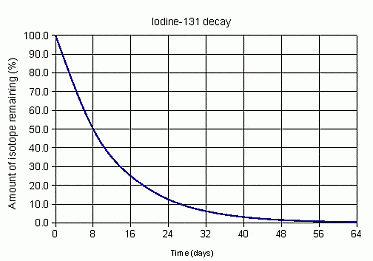
What is the half-life of iodine-131?
a)
32 days
b)
8 days
c)
16 days
d)
24 days
12.
Positively charged particles that consist of two protons and two neutrons are called
a)
alpha particles
b)
beta particles
c)
gamma rays
d)
neutron emissions
13.
The process of splitting heavier nuclei into lighter nuclei is called
a)
nuclear fission
b)
nuclear fusion
c)
radiation poisoning 
d)
chemotherapy
14.
The process in which lighter nuclei combine at extremely high temps and pressure, forming heavy nuclei and releasing energy is
a)
fission
b)
fusion
c)
decay
d)
the scientific method
15.
If you start with 100 grams of iodine-131 and the half life is 2 days, how many grams is left after 6 days?
a)
25
b)
12.5
c)
50
d)
200
16.

What does the alpha decay of Radium-226 ( 88226Ra^{226}_{88}Ra ) produce?

a)

86222Rn^{222}_{86}Rn

b)

86224Rn^{224}_{86}Rn

c)

87222Fr^{222}_{87}Fr

d)

88224Ra^{224}_{88}Ra

17.
Has the highest penetrating power.  Can penetrate our body.  Even several cm thick of lead or several meters thick of concrete cannot stop all of it.
a)
Alpha
b)
Beta
c)
Gamma
18.
Has the lowest penetrating power.  Can only penetrate 0.05 mm into the body and can be stopped by a piece of paper or clothing.
a)
Alpha
b)
Beta
c)
Gamma
19.
Solve this equation for beta decay.
614C = ___ + -10e
a)
410Be
b)
714N
c)
210He
d)
613C
20.
The three types of nuclear radiation in increasing order of penetrating power are ____.  
a)
  alpha, beta, gamma 
b)
X ray, beta, gamma
c)
alpha, gamma, beta 
d)
X ray, gamma, beta 
21.
The half-life of Zn-71 is 2.4 minutes. If one had 100.0 g at the beginning, how many grams would be left after 7.2 minutes has elapsed?
a)
100.0g
b)
50.0g
c)
12.5g
d)
8.5g
22.
 Fermium-253 has a half-life of 0.334 seconds. A radioactive sample is considered to be completely decayed after 10 half-lives. How much time will elapse for this sample to be considered gone?
a)
0.334 seconds
b)
3.34 seconds
c)
1.77 seconds
d)
13.4 seconds
23.

Which diagram best represents the percentage of this radioactive isotope sample that will remain after 2 half-lives?

a)
b)
c)
d)
24.
Pd-100 has a half-life of 3.6 days. If one had 620,310,740 atoms at the start, how many atoms would be present after 21.6 days?
a)
9.7x10⁶ atoms remain
b)
97.0x10⁶ atoms remain
c)
0.97x10⁶ atoms remain
d)
9.7x10⁵ atoms remain
25.

The half-life of Po-218 is three minutes. If it is allowed to decay from 150.0 grams to 2.34 grams, how many half lifes have occured?

a)

6 half lifes

b)

3 half lifes

c)

8 half lifes

d)

5 half lifes

26.

What type of decay is used by elements that need to decrease its number of neutrons and increase its number of protons?

a)

Beta decay

b)

Positron emission

c)

Alpha decay

d)

gamma radition

e)

electron capture

27.

What type of decay is used by elements that need to increase its number of neutrons and decrease its number of protons?

a)

Beta decay

b)

Positron emission

c)

Alpha decay

d)

gamma radition

e)

electron capture

28.

What type of radiation would result in Polonium-209 decaying into Bismuth-209?

a)

electron capture

b)

alpha decay

c)

beta emission

d)

neutron capture

29.

When Polonium-209 undergoes 2 consecutive alpha emissions and then a beta emission, what is the resulting nuclide?

a)

Thalium-209

b)

Thalium-201

c)

Lead-201

d)

Lead-209

e)

Gold-201

30.

Which of the following types of decay has no effect on the mass?

a)

beta emission

b)

electron capture

c)

alpha emission

d)

neutron capture

e)

positron emission

31.

Which of the following types of decay affects only mass of a nucleus?

a)

beta emission

b)

electron capture

c)

alpha emission

d)

neutron capture

e)

positron emission

32.
Selenium-83 has a half life of 25 minutes. How many minutes would it take for a 20 milligram sample to decay and only have 1.25 milligrams of it remaining? 
a)
25 minutes
b)
50 minutes
c)
75 minutes 
d)
100 minutes
33.

Barium-122 has a half-life of 2 minutes. A scientist needs 1.0 grams of Barium-122, and must order this isotope from a supplier. It will take the supplier 18 minutes to get the sample to the scientist. How much Barium-122 must he order to have 1.0 grams for his experiment?

a)

1.0 grams

b)

512 grams

c)

430 grams

d)

9 grams

34.

How many moles of HNO3 would be needed to react with 85mL of 0.75M KOH?

a)

113.3 mol

b)

1.13 mol

c)

.113mol

d)

0.06375mol

e)

63.75mol

35.

CaCO3 + 2 HCl --> CaCl2 + H2O + CO2

What volume (in mL) of 1.35 M HCl will be needed to completely react with 3.82 g of solid CaCO3?

a)

56.5 mL

b)

47.2 mL

c)

61.6 mL

d)

34.7 mL

e)

124 mL

36.

18.26 mL of a 1.50M hydrochloric acid reacts with excess magnesium hydroxide. Calculate the mass of magnesium hydroxide needed for the reaction.

Mg(OH)2 + 2 HCl -> 2 H2O + MgCl2

a)

4.68 g Mg(OH)2

b)

0.798 g Mg(OH)2

c)

0.0274 Mg(OH)2

d)

1.07 g Mg(OH)2

37.

What is the molarity of a 0.5L sample of a solution that contains 60.0 g of sodium hydroxide (NaOH)

a)

0.8 M

b)

1.5 M

c)

3.0 M

d)

6.0 M

38.

How many grams of H3PO4 are in 175 mL of a 3.5 M solution of H3PO4?

a)

60. grams

b)

4.9 grams

c)

612 grams

d)

20 grams

39.

How many moles would be in 85mL of 0.75M KOH?

a)

113.3 mol

b)

1.13 mol

c)

.113 mol

d)

0.064 mol

e)

63.75 mol

40.

What volume, in milliliters, of 10.0 M NaOH is needed to prepare 300.0 mL of 2.00 M NaOH by dilution?

a)

0.067 mL

b)

60.0 mL

c)

100 mL

d)

125 mL

41.

What volume, in milliliters, of 10.0 M NaOH is needed to prepare 300.0 mL of 2.00 M NaOH by dilution?

a)

0.067 mL

b)

60.0 mL

c)

100 mL

d)

125 mL

42.

What is the molality of a solution made by dissolving 2 moles of NaOH in 400 grams of water?

a)

5 mol/kg. solvent

b)

4 mol/kg solvent

c)

3 mol/kg. solvent

d)

2.5 moles /kg solvent

43.

What is the molality of a solution in which 3.0 moles of NaCl is dissolved in 1.5 Kg of water?

a)

2.0 M

b)

0.22 m

c)

135 m

d)

2.0m

44.

When CaBr2 is dissolved in water, how many particles will be in solution for each unit?

a)

1

b)

2

c)

3

d)

4

e)

5

45.

The boiling point of a solution is ___________ that of a pure solvent

a)

more than

b)

less than

c)

equal to

46.

At the same concentration, which salt will have the largest effect on the boiling point?

a)

CH4

b)

BCl3

c)

KBr

d)

AlF3

47.

Match the following

a)

higher than 7

1.

base

b)

lower than 7

2.

acid

c)

7

3.

neutral

48.

Match

a)

H+

1.

Acid

b)

OH-

2.

Base

c)

NaCl

3.

Salt

49.

Bases, also known as ​ (a)   will turn litmus paper ​ (b)   . This is because they have a pH ​ (c)   . They taste ​ (d)   .

Choose from the below words
alkali and OH-
blue
above 7
bitter
below 7
H+
red
sour
50.

Acids, also known as ​ (a)   , will turn litmus paper ​ (b)   . This is because they have a pH ​ (c)   . They taste ​ (d)   .

Choose from the below words
H+
red
below 7
sour
bitter
above 7
blue
51.
Which solution releases H+ in solution?
a)
Base
b)
Acid
c)
Buffer
d)
Water
52.

In a base phenolphthalein will give what color?

a)

Green

b)

Blue

c)

magenta

d)

Clear

53.
Many cleaning solutions are bases. Which of the following is a property of most bases?
a)
feels slippery
b)
white color
c)
can only be liquid
d)
tastes sour
54.

The taste of acids is...

a)

bitter and sweet

b)

sweet and salty

c)

slty

d)

sour

55.

Acids turn red litmus paper blue.

a)

True

b)

False