
 Worksheets
Physics Semster
Total questions: 35
Worksheet time: 1hrs 26mins

Object 1 and object 2 travel across a horizontal surface, and their horizontal velocity as a function of time is shown in the graph. Which of the following statements is correct about the two-object system?
A. The magnitude of acceleration for object 2 is greater than the magnitude of the acceleration of object 1.
B. After 2s, object 1 travels a greater distance than object 2 travels.
C. Object 1 and object 2 are at the same horizontal position at 2s.
D. After 4s, the speed of object 1 is greater than the speed of object 2.
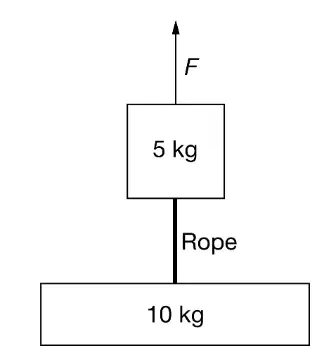
Two blocks are connected by a rope, as shown above. The masses of the blocks are 5 kg for the upper block and 10 kg for the lower block. An upward applied force of magnitude F acts on the upper block.
The system is moving and accelerating upward. A pair of scissors cuts the rope. Which of the following describes the motion of the 10 kg block immediately after the rope has been cut?
A. The block continues to move upward and to accelerate upward.
B. The block begins to move downward but continues to accelerate upward.
C. The block continues to move upward but begins to accelerate downward.
D. The block begins to move downward and to accelerate downward.
A student uses both hands to push a door such that it moves and swings open after the force has been applied. The student then makes the following claim: “I can use both of my hands to apply a constant force on my body so that my body falls backward.” Which of the following statements correctly justifies the student's claim?
The claim is correct because the situation is the same as if another person’s hands applied a force on the student.
The claim is correct because the student’s hands will exert a net force on the student’s body.
The claim is not correct because the student’s hands cannot exert a force on the student’s body.
The claim is not correct because the student’s body will exert a force of equal magnitude back on the student’s hands as a result of Newton’s third law of motion.
What is the formula for centripetal force?
Fc = mvr^2
Fc = m/r^2v
Fc = mv^2/r
Fc = mr^2/v
How does centripetal force keep an object in circular motion?
Centripetal force has no effect on the object's motion.
Centripetal force decreases the object's mass.
Centripetal force changes the direction of the object's velocity.
Centripetal force increases the object's speed.
What is the formula for gravitational force?
F = G * (m1 * m2) / r^2
F = G * (m1 - m2) / r^2
F = G * (m1 * m2) * r^2
F = G * (m1 + m2) / r^2


As the angle of the incline increases, what happens to the normal force?
The normal force increases
The normal force decreases
The normal force is not affected by the incline
The normal force is only dependent on the force due to gravity

Sam is hover boarding down they hall at a constant velocity. Assuming there is friction, which of the following must be true?
The force applied by the board must be greater than the frictional force
The frictional force must equal the force applied by the board
The force applied must equal zero
There is not enough information

If μk = 0.65 and μs = 0.7, acceleration would be equal to
0 m/s/s
9.8 m/s/s
3.35 m/s/s
-2.63 m/s/s

What is the force of tension acting between these to objects?
m1 =7.5 kg
m2 =10 kg
μk=0.5
(Round to 2 sig figs, no units)
(a)

A block with a mass M is attached to a spring with a spring constant k. The block undergoes SHM. Where is the block located when its velocity is a maximum in magnitude?
x = 0
x = +/-A
X = +A/2
X = -A/2
A block with a mass M is attached to a spring with a spring constant k. The block undergoes SHM. Where is the block located when its potential energy is a maximum?
x = 0
x = +/-A
X = +A/2
X = -A/2

The position as a function of time of a mass-spring oscillating system is presented by the graph. Which of the following is true about velocity and acceleration at the time 1.5 s?
V > 0, a < 0
V = 0, a > 0
V < 0, a = 0
V > 0, a = 0
A simple pendulum oscillates with a period T. If the length of the pendulum is doubled what is the new period of the pendulum?
2T
T
√2*T
T/√2

A block of mass M is attached to a horizontal spring k. The block undergoes SHM with amplitude of A. Which of the following graphs represents the elastic potential energy as a function of position x?


The larger the mass of an object...
The smaller the force of gravity.
The larger the force of gravity.
Mass has no effect on the amount of gravity an object experiences.

How does the graviational force the moon exerts on Earth compare to the force the Earth exerts on the moon?
Moon exerts less force
The moon exerts more force
The moon does not exert a force while the Earth does
The forces are equal
Halving (1/2 r) the distance between two objects...
...will double the force of gravity.
...will half the force of gravity.
...will quadruple the force of gravity.
...will quarter the force of gravity.
A semi-truck carrying a trailer has a total mass of 1500kg. If it is traveling up a slope of 5∘ to the horizontal at a constant rate of 20m/s, how much power is the truck exerting?
g=10m/s2
26000W
42000W
21000W
12000W
34000W
The work done by a centripetal force on an object moving in a circle at constant speed is __________.
equal to the kinetic energy of the object
zero
equal to the force exerted multiplied by the displacement
equal to the force exerted
If a 15kg ball takes five seconds to strike the ground when released from rest, at what height was the ball dropped?
50 m
125 m
200 m
250 m
75m

Another word for speed and direction is
inertia
momentum
velocity
All of these are forces except
friction
mass
gravity
inertia
One name for Newton's First Law of Motion is
Inertia
gravity
momentum
Motion is
forces
a change in position
none of the above
acceleration
What does force = mass x acceleration mean?
If an object has a lot of mass it will accelerate a lot
Force is dependent on an object's mass and acceleration
Acceleration can only happen if there is not too much mass
Force is not possible with mass and acceleration
Which law is this an example of: If a person throws a tennis ball and a balloon with the same amount of force, the tennis ball will go farther because it has more mass.
1st
2nd
3rd

