
 Worksheets
Honors Chem Final Exam Reivew
Total questions: 78
Worksheet time: 3hrs 18mins

The atomic mass for this element is __________.
26
Fe
55.845
iron
How many electrons can the d sublevel hold?
How many electrons can the p sublevel hold?
6
What electron configuration matches an oxygen atom?
1s22s22p63s2, 3p64s23d104p5
1s22s22p4
1s22s22p6
1s22s22p63s23p64s23d1
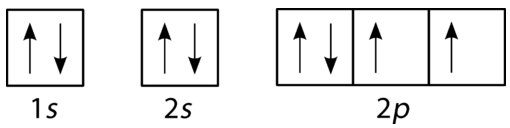

Which orbital is displayed correctly?
A
B
C
D
What atom matches this electron configuration?
[Xe] 6s25d8
Mercury
Gold
Platinum
Thallium
Rank the energy of the sublevels from lowest to highest (lowest energy on left)
s
p
d
f
Elements that are poor conductors, dull, and have a low melting point
metals
non-metals
metalloids
Positive ions are called
anions
cations
When an atom gains an electron, the size of atom
will increase
will decrease
will not change
When an atom loses an electron the size of atom
will increase
will decrease
will not change
Anions have ionic radii that are larger than their atomic radii.
True
False
Which species has the larger radius?
Cl
Cl-
Place the chlorine, aluminum, phosphorus and magnesium in order of decreasing atomic radius.
chlorine, aluminum, phosphorus, magnesium
aluminum, phosphorus,magnesium, chlorine
aluminum, phosphorus, chlorine, magnesium
Magnesium, aluminum, phosphorus, chlorine
How many valence electrons does Carbon have?
4
6
12
14
What is the atomic number of iron?
30
24
26
28
What is the symbol for the element with atomic number 11?
K
Cs
Na
Rb
What is the atomic mass of lithium?
85.47
39.10
22.99
6.94
Changing the number of ELECTRONS ____ the identity of the atom.
changes
does NOT change


How many neutrons are in the isotope pictured above?
29
34
63
92
How many neutrons are in Sodium-20?
9
11
20
0
Ionic or Covalent?
As2O5 (Hint: As is a metalloid that can act as a nonmetal)
Ionic
Covalent
Why are ionic compounds typically more brittle than covalent compounds?
The molecular bonds in ionic compounds are very flexible.
The ionic bonds form a rigid lattice that can shatter when stressed.
Covalent bonds are much weaker than ionic bonds.
Ionic compounds are not more brittle; it is the other way around.
Which of the following is a characteristic feature of substances with covalent bonds?
High solubility in water.
High electrical conductivity in solid form.
Low boiling points.
High melting points.
What type of bond will conduct electricity in a dissolved state?
ionic
covalent
What is the formula for Sodium Sulfide?
Na2S
NaS2
Na2S2
NaS

Where are the transition metals located on the periodic table?
blue square
red square
yellow square

What is the correct name for this compound?
fluorine chlorine
iron chloride
iron(II) chloride
iron(I) chloride
What is the formula for iron(III) oxide?
FeO
Fe(III) O
Fe2O3
Fe3O2
3Ca + 2AlCl3 → 3CaCl2 + 2Al
Synthesis
Single Displacement
Double Displacement
Decomposition
Determine the reaction type: 4Si + S8 → 4SiS2
Double displacement
Single Displacement
Synthesis
Decomposition
Balance the equation: __P4 + __O2 → __P2O3
balanced
1, 2, 3
2, 1, 3
1, 3, 2
Cu+ AgNO3-->

What are the products of this single replacement reaction: Mg + CuSO4
Cu + MgSO4
Cu + SO4Mg
Cu + Mg(SO4)2
No Reaction
Predict the products for the this Double Replacement reaction:
AgNO3 + KCl →
AgCl + KNO3
AgK + ClNO3
KAg + NO3Cl
AgCl + 3 KNO
How many significant figures are in the number 2.53 x 10^5?
2
3
4
5
6
Which of the following has four significant figures?
10001
1000
0.01204
0.010
Solve the following with the correct decimal places:
14.10 + 12.10 + 10.112
Which element is formed from plutonium-240 during alpha decay?
Uranium-236
Thorium-232
Lead-206
Radon-222
85209At = ___ + 24He
1.4 x 10²³ atoms of Chromium.
12.00 moles of NaClO3 will produce how many grams of O2?
How many grams of potassium chloride (KCl) can be produced from 356 g of potassium bromide (KBr)?
How many moles of hydrogen are needed to react with 2 moles of nitrogen?
Identify the limiting reagent when 6.00 g HCl combines with 5.00 g Mg to form MgCl2.
Mg + 2HCl --> MgCl2 + H2
Mg
H2
MgCl2
HCl

Percent yield=(________)÷(________)×100%
What is the volume of 1.75 mol CO2?
39.2 L
0.078 L
11.2 L
22.4 L
What is the significance of boiling point in determining intermolecular forces?
The boiling point has no relation to intermolecular forces.
Higher boiling points suggest weaker intermolecular forces.
The boiling point indicates the molecular weight of a substance.
Higher boiling points suggest stronger intermolecular forces.
How do dipole-dipole interactions occur?
Dipole-dipole interactions occur between nonpolar molecules, where the positive end of one molecule is repelled by the negative end of another.
Dipole-dipole interactions occur between polar molecules, where the positive end of one molecule is attracted to the negative end of another.
Dipole-dipole interactions occur between ionic compounds, where the positive ions attract the negative ions.
Dipole-dipole interactions occur between gases, where the molecules collide and interact randomly.
What type of intermolecular forces does NH3 exhibit?
Only hydrogen bonding
Hydrogen bonding, dipole-dipole interactions, and London dispersion forces
Only dipole-dipole interactions
Only London dispersion forces
Which molecule has the weakest intermolecular forces: HCl, NH3, or Br2?
HCl
NH3
Br2
CH4
What is the strongest type of intermolecular force?
Dipole-dipole interactions
London dispersion forces
Hydrogen bonding
Ionic bonding

When you have Zn-F, what is the polarity?
nonpolar
polar
ionic

NaNO3 soluble (aq) or insoluble (s)?
Soluble (aq)
Insoluble (s)


