
 Worksheets
2025 Intro to Business Final Exam
Total questions: 126
Worksheet time: 1hrs 3mins
Name
Class
Date
1.
1.Mandatory government spending includes which of the following?
a)
Infrastructure and science
b)
Social Security and Medicare
c)
Healthcare and military
d)
Education and agriculture
2.
2. What does the term "withholding" mean in reference to your paycheck?
a)
The amount of your paycheck that you are NOT being taxed on
b)
How much you are going to owe the government when you file your annual tax return
c)
How much you earn and includes salary, bonus and commissions
d)
How much is being taken out of your paycheck for things like taxes, employer sponsored health insurance, and retirement
3.
3. When do you start paying income taxes?
a)
When you turn 18
b)
When you get a full-time job (part-time does not count)
c)
When you make more than the minimum income requirement
d)
When you are notified by the IRS that you are required to pay federal income taxes
4.
4. Why is it important to be extremely careful when completing your 1040 form?
a)
Making a mistake will disqualify you from receiving future refunds
b)
The 1040 form determines whether you owe additional taxes or are entitled to receive a refund from the government
c)
Completing the 1040 incorrectly will mean the wrong amount of taxes will be withheld from your paychecks going forward
d)
Mistakes on your 1040 form make you ineligible for employment during the next year
5.
5. If your only income is salary paid by your employer, which of these statements about filing your taxes is true?
a)
You need to file your tax return by the end of the calendar year (typically December 31st)
b)
If your employer takes out federal income taxes through payroll withholdings, you do not need to file a tax return
c)
You must file your tax return by the deadline (typically April 15th of the following year) or request an extension by that date
d)
You do not need to pay any income taxes until April 15th, so you should ask your company to wait until after that date to withhold any money
6.
6. You are starting your first job and you are asked to complete some paperwork on your first day. Which form will determine how much money is withheld from your paycheck for taxes?
a)
W-4
b)
W-2
c)
I-9
d)
1040
7.
7. Which of the following paycheck withholdings puts money into a retirement investment fund that you will manage?
a)
Social Security
b)
Medicare
c)
401(k) contribution
d)
Federal income taxes
8.
8. When determining whether you NEED to file a federal tax return, each of these questions matters EXCEPT…
a)
How much income did you earn this year?
b)
What type of income did you earn this year?
c)
What state do you live in?
d)
Are you claimed as a dependent on anyone else's tax return?
9.
9. Juanita has a part-time job that pays $12/hour and works about 50 hours every month. Her withholdings are Social Security (6.2%), Medicare (1.45%) and federal income tax (10%). What is her approximate net pay?
a)
$120
b)
$500
c)
$600
d)
$700
10.

10. Which of the statements about this W-4 is TRUE?
a)
Mr. Khan is filing as married filing jointly
b)
Mr. Khan is requesting for an additional $50 to be withheld from his paycheck
c)
Mr. Khan submitted this W-4 two days after he started working at Little Company Inc.
d)
Mr. Khan’s paycheck will have less money withheld from his paycheck since he is claiming a dependent
11.
11. Elaine just accepted a new job and is working with the company’s HR department to fill out paperwork. Which of the following steps is she responsible for?
a)
Determine how much tax to withhold from her paychecks based on W-4 information
b)
Complete a W-4 form
c)
Send withholding amounts to the federal government
d)
Complete a W-2 form
12.
12. What is the name of the tax form that requires you to provide identification and proves you are eligible to work in the U.S.?
a)
I-9
b)
1099
c)
1040
d)
W-4
13.
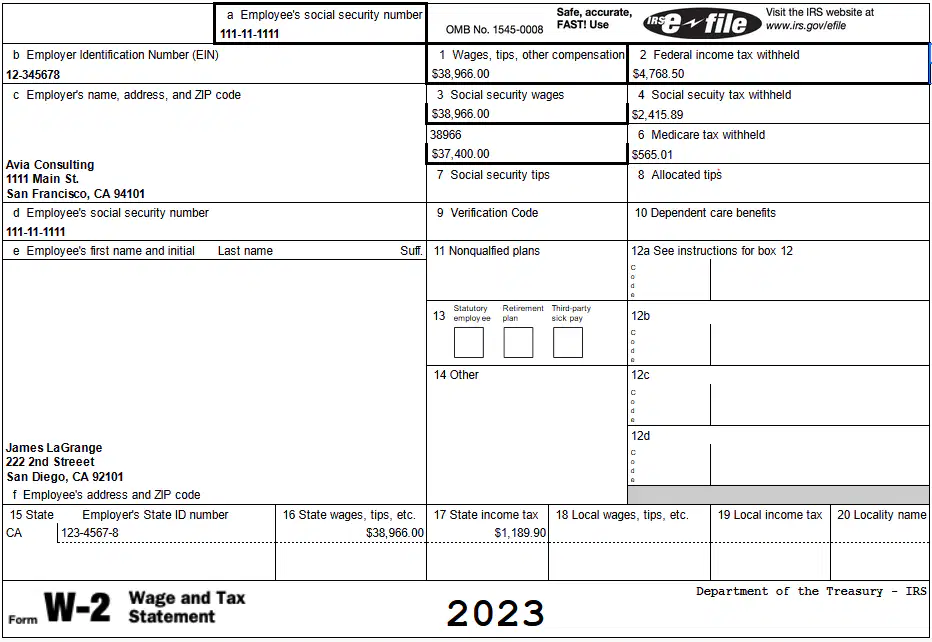
13. Which of the following statements about this W-2 form is true?
a)
Avia Consulting will use this W-2 to file their 1040 form
b)
James earned about $117,000 over the year based on the total of her Wages, Social Security wages, and Medicare wages
c)
James paid state income taxes of $1,189.90
d)
James works in the same city that Avia Consulting is based in
14.
14. When you complete your 1040 form, if you overpaid your taxes and the government owes you money, that is called a __________.
a)
withholding
b)
direct deposit
c)
deduction
d)
refund
15.
15. Your friend Laila is talking to you about the benefits of tax filing websites. Which of the following is true?
a)
Filing your taxes using a website is always free of charge
b)
You are guaranteed a higher refund than if you were to use a paper form or hire a professional
c)
If you owe money to the IRS, you receive a discount if you e-file use a tax filing website
d)
You can avoid the costs of having to pay a professional, though you may have to pay for e-filing online
16.
16. Jessica is 16 years old and earned $1,100 through her photography side gig. Her parents can claim her as a dependent on their tax return. All of the following statements are true EXCEPT…
a)
Jessica is required to file an income tax return
b)
Jessica should expect to receive a W-2 in January
c)
Jessica is required to pay a 15.3% self-employment tax
d)
Jessica can file her own tax return even though her parents are claiming her as a dependent
17.
17. Which of the following describes what a "dependent" is for tax purposes?
a)
A child or adult that you support financially
b)
Someone who is temporarily disabled
c)
An adult who financially supports you
d)
Someone who is a full-time student under the age of 30
18.
18. If a taxpayer fills out their W-4 in a way that does not withhold enough money to cover their tax obligation, what is the most likely outcome after they file their taxes?
a)
They will receive a refund
b)
They will owe a payment to the IRS
c)
They will be audited
d)
They will be charged with tax evasion
19.
19. Which of the following statements about the W-2 form is TRUE?
a)
A W-2 lists all the money you earned in cash over the last year
b)
The total wages you earned from ALL jobs you worked in the previous year appear on ONE W-2 form
c)
You need a separate W-2 form from EACH of your employers in order to file your taxes
d)
The W-2 includes information about the interest you earned from your investments
20.
20. Akshay worked at a cafe while he was a college senior in Boston, Massachusetts. After graduating in June, he moved back to his home in California and started a full-time job in September. Which of the following statements is true?
a)
Akshay will need to file only a federal tax return
b)
Akshay will need to file a federal tax return and a state tax return for Massachusetts
c)
Akshay will need to file a federal tax return and a state tax return for both Massachusetts and California
d)
Akshay will need to file a federal tax return this year and file state returns the following year
21.
21. Is any kind of non-cash payment, transaction, etc., that doesn't involve a paper.
a)
Bank Reconciliation Statement
b)
Electronic Monetary Transactions
c)
Monetary
d)
Financial Institution
22.
22. is a financial institution that receives deposits, makes loans, invests in securities, honors checks drawn on those deposits, and pays interest.
a)
Savings
b)
Credit
c)
Bank
d)
Financial Institution
23.
23. is an act of taking money out of an account.
a)
Credit
b)
Deposit
c)
Withdrawal
d)
Loans
24.
24. compares the cash balance to its bank statement.
a)
Bank Statement
b)
Bank Balance Report
c)
Payroll Register
d)
Bank Reconciliation Statement
25.
25 .is a deposit account with a financial institution or bank that allows a person to make a deposit or withdraw their money.
a)
Checking Account
b)
Credit Cards
c)
Deposit
d)
Savings
26.
26. are advances of sum of money to the borrower. In return, the borrower agrees to a particular set of terms, including any finance charges, interest, repayment date, and other conditions.
a)
Loans
b)
Deposit
c)
Credit
d)
Savings
27.
27. is a written order telling your bank to pay money to an individual or business.
a)
Bank
b)
Deposit
c)
Check
d)
Credit
28.
28. is relating to money or currency.
a)
Currency
b)
Monetary
c)
Credit
d)
Fiscal
29.
29. is responsible for conducting monetary policy and supervision and regulation of financial institutions.
a)
Revolving Credit
b)
United States Treasury
c)
Federal Deposit Insurance Corporation
d)
Federal Reserve Bank
30.
30. is a sum of money placed or kept in a bank account.
a)
Deposit
b)
Check
c)
Withdrawal
d)
Credit
31.
31. Cards issued in association with checking or savings accounts that allow point-of-sale purchases that are then deducted from bank balances and ATM withdrawals.
a)
Checking Account
b)
Loans
c)
Debit Cards
d)
Credit Cards
32.
32. Banks can help you access credit to acquire a home, car, student, or personal loan.
a)
Debit
b)
Credit
c)
Monetary
d)
Deposit
33.
33. Provide many services as retail banks but are ONLY online
a)
Investment Banks
b)
Retail Banks
c)
Central Banks
d)
Internet Banks
34.
34. are credit that comes with a card you can borrow on an ongoing basis; it has interest rates, a spending limit, and monthly payments.
a)
Loans
b)
Bank
c)
Checking Account
d)
Credit Cards
35.
35. When an individual puts money into an account, the bank offers its consumers interest rates.
a)
Savings
b)
Credit
c)
Loans
d)
Deposit
36.
36. is an organization or business that provides types of financial services to customers and deals with various monetary transactions that include cash deposits, loans, raising capital, and exchanging securities.
a)
Bank
b)
Credit cards
c)
Financial institution
d)
Credit union
37.
37. Financial institutions responsible for the oversight and management of all other banks. In the United States, the central bank is the Federal Reserve Bank.
a)
Retail Bank
b)
Savings & Loans Associations
c)
Central Bank
d)
Mortgage Companies
38.
38. You can write checks without having money in a checking account.
a)
True
b)
False
39.
39. Financial institutions exist to solve the problem of making money available to the people and businesses who need it.
a)
True
b)
False
40.
40. Banks profit from the difference in interest rates paid on deposits and charged on loans and collecting fees for services.
a)
True
b)
False
41.
41. The 3 reasons financial institutions are beneficial are economy, protection, and risk.
a)
True
b)
False
42.
42. Financial institutions exist to solve problems of making money available to the people and businesses who need it.
a)
True
b)
False
43.
43. Banks profit from the interest rates paid on deposits on loan and collecting fees for service.
a)
True
b)
False
44.
44. One of the 4 types of checking accounts is a joint-checking account.
a)
True
b)
False
45.
45. Traditional banks give customers higher interest rates.
a)
True
b)
False
46.
46. PayPal and Venmo are the only new emerging methods of transferring money.
a)
True
b)
False
47.
47. Credit can come in the form of a student loan.
a)
True
b)
False
48.
48. Which of the following is the most important part of managing your money?
a)
Open 3 different accounts
b)
Deciding where to keep your money
c)
Being able to pay off your debt
d)
Saving at least 5x your monthly income
49.
49. Which one is not one of the 3 reasons financial institutions are beneficial?
a)
Economy
b)
Protection
c)
Collections
d)
Convenience
50.
50. What does the FDIC do?
a)
Pay banks interest rates.
b)
Insures the money at banks and savings institutions.
c)
Manages all the worlds money.
d)
Issues credit to worth consumers.
51.
51. Which of the following is a type of transaction?
a)
Automatic Bank-to-Vendor Payment
b)
Credit Card
c)
ATM
d)
ACH
52.
52. What is a budget?
a)
a. A list of all debts
b)
b. A financial plan outlining expected income and expenses
c)
c. A summary of savings accounts
d)
d. A document detailing investments
53.
53. What does income refer to?
a)
a. The total expenses for a period
b)
b. The money received regularly for work or investments
c)
c. The amount saved for future use
d)
d. The excess money after expenses
54.
54. What is an expense?
a)
a. The income earned from investments
b)
b. The cost incurred in doing something
c)
c. The surplus income over budget
d)
d. The amount of debt owed
55.
55. What is savings?
a)
a. Money owed to others
b)
b. Income spent immediately
c)
c. The portion of income set aside for future use
d)
d. The forecast of future expenses
56.
56. What is debt?
a)
a. Money saved for future needs
b)
b. Income from investments
c)
c. Money owed or due to another party
d)
d. A surplus in the budget
57.
57. What is forecasting in financial terms?
a)
a. The process of repaying debts
b)
b. The allocation of funds for investments
c)
c. Estimating future financial outcomes based on past data
d)
d. Creating a budget surplus
58.
58. What does allocation mean in budgeting?
a)
a. Spending money on unnecessary items
b)
b. Distributing resources or funds for specific purposes
c)
c. Saving money for emergency situations
d)
d. Paying off outstanding debts
59.
59. What is expenditure?
a)
a. The income earned from work
b)
b. The total amount of savings
c)
c. The action of spending funds
d)
d. The amount of money owed
60.
60. What does deficit mean in a budget?
a)
a. The amount of savings set aside
b)
b. Expenses exceeding income, leading to a shortfall
c)
c. The income generated from investments
d)
d. A surplus in funds
61.
61. What is a surplus?
a)
a. Additional debt incurred
b)
b. Excess income over expenses
c)
c. The total expenses for a period
d)
d. Savings set aside for future use
62.
62. What are investments?
a)
a. Assets purchased for expected income or appreciation
b)
b. Money spent on daily expenses
c)
c. Income from regular work
d)
d. Savings set aside for emergencies
63.
63. What is financial literacy?
a)
a. The ability to save money effectively
b)
b. Understanding and using financial skills like budgeting
c)
c. The process of allocating funds
d)
d. The act of incurring expenses
64.
64. What is cash flow?
a)
a. The total expenses during a period
b)
b. Money owed to creditors
c)
c. The money transferred into and out of accounts
d)
d. The income from investments
65.
65. What does it mean to prioritize in financial terms?
a)
a. To save all income for future use
b)
b. To allocate funds without planning
c)
c. To arrange spending decisions by importance
d)
d. To ignore financial planning
66.
66. What is an expense report?
a)
a. A list of all saved amounts
b)
b. A document categorizing expenses for reimbursement
c)
c. A summary of income sources
d)
d. A forecast of future expenses
67.
67. An example of a surplus is:
a)
a. Spending more than you earn
b)
b. Having excess funds after all expenses are paid
c)
c. Owing money to a friend
d)
d. Receiving a regular paycheck
68.
68. A deficit occurs when:
a)
a. Income is greater than expenses
b)
b. All debts have been paid
c)
c. Expenses exceed income
d)
d. Savings match expenses
69.
69. The main goal of budgeting is to:
a)
a. Increase debt
b)
b. Forecast future expenses
c)
c. Ensure income exceeds expenses
d)
d. Spend all available income
70.
70. What results from effective financial literacy?
a)
a. Increased debt
b)
b. Better saving and investing decisions
c)
c. Higher expenses
d)
d. Unmanaged cash flow
71.
71. Why is cash flow important?
a)
a. It measures total debt
b)
b. It shows how much money is saved
c)
c. It outlines income and expense movement
d)
d. It predicts future income sources
72.
72. What is the main difference between savings and investing?
a)
Savings earn higher returns than investments
b)
Investing is completely risk-free
c)
Savings are completely risk-free while investing carries risk
d)
There is no difference between the two
73.
73. According to financial planners, what percentage of monthly net income should you save?
a)
10%
b)
15%
c)
20%
d)
25%
74.
74. Which type of savings account typically offers higher interest rates than traditional savings accounts?
a)
Passbook savings account
b)
High-yield savings account
c)
Regular checking account
d)
Basic savings account
75.
75. What is a Certificate of Deposit (CD)?
a)
A type of checking account
b)
A savings account with no interest
c)
A savings account with a specified maturity date and guaranteed interest rate
d)
A retirement account
76.
76. Which is NOT an advantage of savings plans?
a)
Low risk
b)
Defined interest rates
c)
High returns
d)
Easy accessibility
77.
77. What does owning stock represent?
a)
A loan to the government
b)
Ownership in a corporation
c)
A guaranteed return
d)
A savings account
78.
78. In the formula for calculating interest, what does 'P' stand for?
a)
Payment
b)
Principal
c)
Percentage
d)
Period
79.
79. Using simple interest, if you borrow $2000 at 10% for 2 years, how much interest will you pay?
a)
$200
b)
$400
c)
$600
d)
$800
80.
80. What is compound interest?
a)
Interest earned only on the principal
b)
Interest earned on principal and previously earned interest
c)
Interest that decreases over time
d)
Interest paid monthly
81.
81. Which investment typically carries the highest risk?
a)
Savings account
b)
Government bonds
c)
Stocks
d)
Certificates of deposit
82.
82. What is a mutual fund?
a)
A government savings bond
b)
A pool of money from multiple investors used to buy various investments
c)
A type of checking account
d)
A retirement plan
83.
83. What is a broker?
a)
Someone who only sells stocks
b)
A bank teller
c)
An intermediary between buyers and sellers of investments
d)
A financial institution
84.
84. Which is a type of investment income?
a)
Salary
b)
Unemployment benefits
c)
Dividends
d)
Social security payments
85.
85. What is a portfolio?
a)
A type of savings account
b)
A list of your investments and assets
c)
A government bond
d)
A retirement plan
86.
86. What is market risk?
a)
The risk of the market being closed
b)
The risk of losing money due to market fluctuations
c)
The risk of inflation
d)
The risk of bank failure
87.
87. What are expense ratios?
a)
The ratio of expenses to income
b)
The annual percentage a mutual fund charges for management
c)
The ratio of stocks to bonds
d)
The percentage of savings to investment
88.
88. What is the time-value of money concept?
a)
Money is worth less over time
b)
Money's potential to grow in value over time
c)
The time it takes to earn money
d)
The value of money today
89.
89. What is capital gain?
a)
Money earned from a job
b)
Interest earned from savings
c)
The positive difference between purchase and sale price
d)
Money inherited from family
90.
90.Which is an advantage of investing?
a)
Guaranteed returns
b)
No risk involved
c)
Government insurance
d)
Potential to grow with the economy
91.
91. What happens when you purchase stock?
a)
You loan money to the company
b)
You own a small piece of the company
c)
You become an employee
d)
You get guaranteed dividends
92.
92.What is a credit score?
a)
A measure of your annual income
b)
A number representing your creditworthiness
c)
Your total amount of debt
d)
A summary of your monthly expenses
93.
93. What is the general rule of thumb for how long it takes to recoup home purchase costs?
a)
2-3 years
b)
3-4 years
c)
5-7 years
d)
8-10 years
94.
94. Which of the following is NOT an advantage of buying a home?
a)
Home appreciation potential
b)
Consistent mortgage payments
c)
Tax benefits
d)
Lower maintenance costs
95.
95. According to the documents, which city is considered best for buying a home?
a)
San Francisco
b)
Cleveland
c)
New York City
d)
Seattle
96.
96. What is typically the largest expense when purchasing a home?
a)
Down payment
b)
Closing costs
c)
Property taxes
d)
Utilities
97.
97. Which step comes FIRST in the home buying process?
a)
Get preapproved for a mortgage
b)
Find a real estate agent
c)
Decide if you're ready to buy
d)
Calculate affordability
98.
98. What is NOT mentioned as a hidden cost when buying a car?
a)
Destination charge
b)
Insurance
c)
Entertainment system
d)
Sales tax
99.
99. According to Kelly Blue Book, what should you do LAST before buying a car?
a)
Calculate what you can afford
b)
Get the most out of your test drive
c)
Research online
d)
Know your shopping style
100.
100. Which is an advantage of renting rather than buying?
a)
Building equity
b)
Less responsibility for maintenance
c)
Control over property rules
d)
Stable monthly payments
101.
101. What must be completed before legally driving a newly purchased car?
a)
Destination charge payment
b)
Vehicle registration
c)
Maintenance check
d)
Fuel purchase
102.
102. Which financial factor should be considered before buying a home?
a)
Shopping preferences
b)
Emergency savings
c)
Rental history
d)
Family size
103.
103. What is a disadvantage of renting mentioned in the documents?
a)
High maintenance costs
b)
Property taxes
c)
Increasing rental rates
d)
Fixed monthly payments
104.
104. Which city is listed as best for renting?
a)
Tampa
b)
Pittsburgh
c)
Chicago
d)
Miami
105.
105. What step comes right before closing on a new home?
a)
Home inspection
b)
Final walkthrough
c)
Getting preapproved
d)
Making an offer
106.
106. Which car-buying expense relates to the immediate loss in value?
a)
Registration fees
b)
Insurance costs
c)
Depreciation
d)
Maintenance fees
107.
107. What is recommended regarding vehicle test drives?
a)
Only test on highways
b)
Drive on both highways and side roads
c)
Test only during daytime
d)
Drive only in city conditions
108.
108. Which of the following is a major credit reporting agency?
a)
Consumer Financial Protection Bureau
b)
Equifax
c)
Federal Reserve
d)
Internal Revenue Service
109.
109.What is an example of revolving credit?
a)
Mortgage
b)
Student loan
c)
Credit card
d)
Car loan
110.
110. What can negatively affect your credit score?
a)
Paying bills on time
b)
High credit card balances
c)
Having a variety of credit types
d)
Checking your own credit report
111.
111.What is the primary function of credit reporting agencies?
a)
To enforce tax laws
b)
To provide credit cards
c)
To compile credit information
d)
To offer loans
112.
112. How often can you get a free credit report from each major credit bureau?
a)
Once a month
b)
Once a year
c)
Once every five years
d)
Once every six months
113.
113. What is an installment credit?
a)
A credit card balance
b)
A payday loan
c)
A car loan
d)
A line of credit
114.
114. Which factor has the greatest impact on your credit score?
a)
Types of credit in use
b)
Length of credit history
c)
Payment history
d)
New credit inquiries
115.
115. What is a common mistake people make with credit?
a)
Keeping old credit accounts open
b)
Paying off balances in full
c)
Borrowing more than they can repay
d)
Using credit for emergencies only
116.
116. What should you do if you find an error in your credit report?
a)
Ignore it
b)
Report it to the credit bureau
c)
Contact your bank
d)
Close all credit accounts
117.
117. What is the typical range for credit scores?
a)
100 to 500
b)
300 to 850
c)
500 to 1000
d)
700 to 1000
118.
118. Why is having a good credit score important?
a)
It guarantees employment
b)
It ensures you will never be in debt
c)
It helps secure loans at better interest rates
d)
It increases the amount of tax you pay
119.
119. What type of credit is a mortgage considered?
a)
Revolving credit
b)
Secured credit
c)
Unsecured credit
d)
Student credit
120.
120. What is a consequence of making late credit card payments?
a)
Higher credit limit
b)
Improved credit score
c)
Late fees and potential interest rate increases
d)
Increased credit line
121.
121. What is a credit utilization ratio?
a)
The total amount of available credit
b)
The percentage of credit used compared to credit available
c)
The length of time credit has been used
d)
The number of credit accounts open
122.
122. What does an annual percentage rate (APR) represent?
a)
The total loan amount
b)
The interest rate charged annually on borrowed funds
c)
The minimum payment required
d)
The loan repayment period
123.
123. What is a secured credit card?
a)
A card with a low interest rate
b)
A card backed by a cash deposit
c)
A card that doesn't require a credit check
d)
A card with no spending limit
124.
124. What should you do before applying for a new credit card?
a)
Close all existing credit accounts
b)
Check your credit score
c)
Determine your net worth
d)
Spend your credit limit on current cards
125.
125. What is the main benefit of having a diverse mix of credit types?
a)
It guarantees approval for future loans
b)
It can positively impact your credit score
c)
It increases your debt
d)
It reduces monthly payments
126.
126. What is the first step in building credit if you have none?
a)
Apply for multiple credit cards
b)
Take out a large loan
c)
Open a secured credit card
d)
Avoid using credit altogether
100 %

