
 Worksheets
Atoms & APE MAN
Total questions: 73
Worksheet time: 37mins
1. Protons are found in which part of an atom, and what are their electrical charge and mass?
Nucleus; positive charge; mass of 1 amu
Electron cloud; negative charge; negligible mass
Nucleus; negative charge; mass of 0 amu
Electron cloud; positive charge; mass of 1 amu
Where are neutrons found in an atom and what electrical charge and mass do they have?
Neutrons are found in the nucleus, have no electrical charge, and have a mass similar to protons.
Neutrons are found in the electron cloud, have a positive charge, and have no mass.
Neutrons are found in the nucleus, have a negative charge, and have a mass much less than protons.
Neutrons are found in the electron cloud, have no charge, and have a mass similar to electrons.
3. Where are electrons found in an atom, and what electrical charge and mass do they have?
Electrons are found in the nucleus, have a positive charge, and a large mass.
Electrons are found in the electron cloud, have a negative charge, and negligible mass.
Electrons are found in the nucleus, have no charge, and a large mass.
Electrons are found in the electron cloud, have a positive charge, and negligible mass.
The “atomic number” of an atom identifies:
The number of protons in the nucleus
The number of neutrons in the nucleus
The total number of electrons and protons
The atomic mass of the atom
The “atomic mass” of an atom is:
The total number of protons and neutrons in the atom
The number of electrons in the atom
The number of protons in the atom
The number of neutrons in the atom
The atomic number of a particular element can ever change. Is this statement true or false?
True
False
Can the atomic mass of an atom of a particular element ever change? Why or why not?
Yes, because the number of neutrons can vary.
No, because the atomic mass is always constant.
Yes, because the number of protons can change.
No, because atoms cannot change mass.
What are electrons on the outermost energy level (also called orbital or shell) of electrons called?
Core electrons
Valence electrons
Protons
Neutrons
How many protons would atoms of the element Boron (B) have?
5
6
7
4
How many valence electrons would atoms of the element Boron (B) have?
3
1
5
7
How many protons would atoms of the element Sodium (Na) have?
11
12
10
23
How many valence electrons would atoms of the element Sodium (Na) have?
1
2
3
8
How many protons would atoms of the element oxygen (O) have?
8
6
12
16
How many valence electrons would atoms of the element oxygen (O) have?
6
4
2
8
How many protons would atoms of the element Neon (Ne) have?
10
8
12
14
How many valence electrons would atoms of the element Neon (Ne) have?
8
2
6
4
An element has 13 protons. What is its name? How many valence electrons does it have?
Aluminum (Al), 3 valence electrons
Magnesium (Mg), 2 valence electrons
Silicon (Si), 4 valence electrons
Sodium (Na), 1 valence electron
An element has 33 protons. What is its name? How many valence electrons does it have?
Arsenic (As), 5 valence electrons
Phosphorus (P), 3 valence electrons
Gallium (Ga), 2 valence electrons
Selenium (Se), 6 valence electrons
An atom has 38 protons. What is its name? How many valence electrons does it have?
Strontium (Sr), 2 valence electrons
Calcium (Ca), 4 valence electrons
Potassium (K), 1 valence electron
Rubidium (Rb), 8 valence electrons
An atom has 15 protons. What is its name? How many valence electrons does it have?
Phosphorus (P), 5 valence electrons
Nitrogen (N), 3 valence electrons
Sulfur (S), 6 valence electrons
Chlorine (Cl), 7 valence electrons
An atom has 36 protons. What is its name? How many valence electrons does it have?
Krypton (Kr), 8 valence electrons
Argon (Ar), 8 valence electrons
Bromine (Br), 7 valence electrons
Xenon (Xe), 6 valence electrons
Of the elements As, Se, Br, Cl, and Ar, which two would likely have similar chemical properties?
As and Se
Br and Cl
Se and Ar
As and Br
Of the elements As, Se, Br, Cl, and Ar, which would be the least reactive?
As
Se
Br
Cl
Ar
Of the elements As, Se, Br, Cl, and Ar, which would be the most reactive?
As
Se
Br
Cl
Ar

Each square in the periodic table represents a(n) _______________.
element
molecule
compound
mixture

The numerically smaller whole number in each element square is the ______________ ______________, which represents the number of ______________ in an atom of that element.
atomic number, protons
atomic mass, neutrons
mass number, electrons
isotope number, protons

The numerically larger non-whole number in each element square is the ______________-______________, which represents the number of _____________ and _____________ in an atom of that element.
atomic number, protons and electrons
atomic mass, neutrons and protons
valence electrons, neutrons and groups
groups. periods and protons

In electrically neutral atoms, the number of protons is the same as the number of _______________.
electrons
neutrons
molecules
isotopes

The horizontal (left-to-right) rows of elements are called _______________, which indicate the number of ______________ (shells) in an atom of those elements.
periods, energy levels
groups, protons
families, neutrons
columns, valence electrons
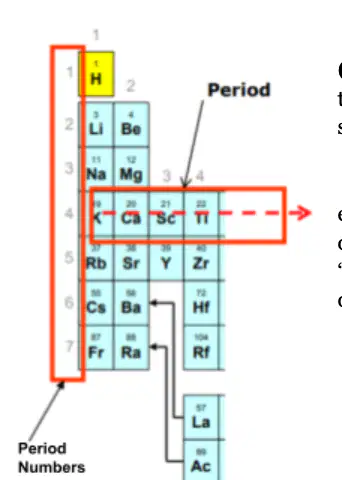
There are ______________ different periods.
seven (7)
five (5)
nine (9)
ten (10)
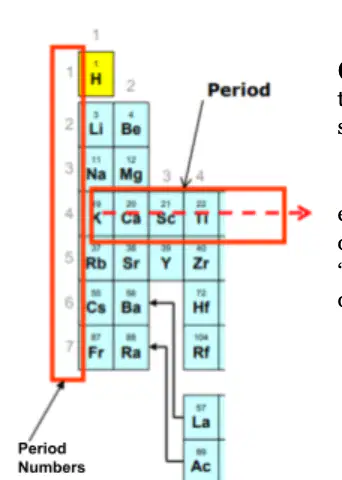
7. The physical and chemical properties of elements generally change gradually across a _______________.
period
group
family
block
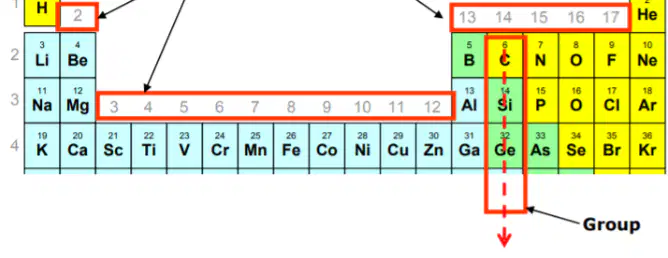
The vertical, up-and-down, columns of elements are called _______________.
groups
periods
rows
families
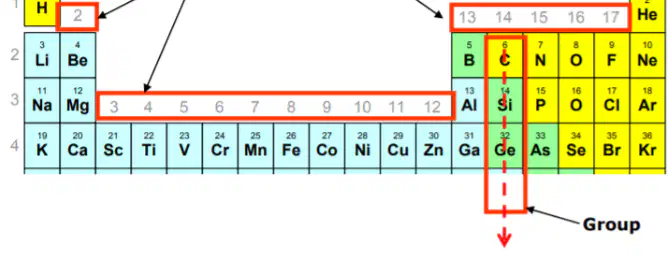
There are ______________ different groups.
eighteen (18)
ten (10)
twenty (20)
fifteen (15)
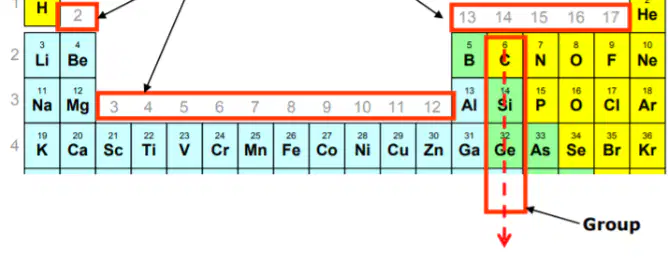
All of the elements in each column/group have similar ______________ because they have the same number of ______________ _______________.
properties, valence electrons
colors, protons
sizes, neutrons
masses, electrons
Write an example of an element using its name and symbol.
Oxygen (O)
Water (H2O)
Salt (NaCl)
Sugar (C6H12O6)
Write an example of a compound using symbols.
H2O
O2
Na
Fe
How many different elements are in Asbestos, H4Mg3Si2O9? Name each of the elements: _______
4 elements: Hydrogen (H), Magnesium (Mg), Silicon (Si), Oxygen (O)
3 elements: Hydrogen (H), Magnesium (Mg), Oxygen (O)
5 elements: Hydrogen (H), Magnesium (Mg), Silicon (Si), Oxygen (O), Nitrogen (N)
6 elements: Hydrogen (H), Magnesium (Mg), Silicon (Si), Oxygen (O), Nitrogen (N), Carbon (C)
Name each element in the following reaction: Zn + 2HCl ⇒ ZnCl2 + H2: _______, _______, _______
Zinc (Zn), Hydrogen (H), Chlorine (Cl)
Zinc (Zn), Helium (He), Carbon (C)
Zirconium (Zr), Hydrogen (H), Chlorine (Cl)
Zinc (Zn), Hydrogen (H), Calcium (Ca)
How many atoms of Zn are there on the reactant side of the chemical equation: Zn + 2HCl ⇒ ZnCl2 + H2
1 atom of Zn
2 atoms of Zn
3 atoms of Zn
4 atoms of Zn
How many atoms of each element are there in the formula? H2O2: Hydrogen— ____, oxygen— ____
H2SO4: Hydrogen—____, sulfur—____, oxygen—____
Hydrogen-1, Sulfur-2, Oxygen-3
Hydrogen-2, Sulfur-1, Oxygen- 4
Hydrogen-3, Sulfur-1, Oxygen-2
Hydrogen-2, Sulfur-4, Oxygen- 1
NaHCO3: Sodium—____, hydrogen—____, carbon—____, oxygen—____
Ca3(PO4)2: Calcium—____, phosphorous—____, oxygen—____
O2: Oxygen—____
Oxygen—2
Oxygen—1
Oxygen—3
Oxygen—0
CO2: Carbon—____, oxygen—____
Carbon—1, oxygen—2
Carbon—2, oxygen—1
Carbon—2, oxygen—2
Carbon—1, oxygen—1
Cu4: Copper—____
4
2
3
1
C2H6O: Carbon—____, hydrogen—____, oxygen—____
Carbon—2, hydrogen—6, oxygen—1
Carbon—1, hydrogen—6, oxygen—2
Carbon—2, hydrogen—4, oxygen—2
Carbon—3, hydrogen—6, oxygen—1
CH3CH2Br: Carbon—____, hydrogen—____, bromine—____
Carbon—2, hydrogen—5, bromine—1
Carbon—3, hydrogen—7, bromine—1
Carbon—2, hydrogen—6, bromine—2
Carbon—1, hydrogen—3, bromine—1
(NH4)CO3: Nitrogen—____, hydrogen—____, carbon—____, oxygen—____
Nitrogen—4, hydrogen—4, carbon—1, oxygen—3
Nitrogen—1, hydrogen—4, carbon—2, oxygen—3
Nitrogen—2, hydrogen—4, carbon—1, oxygen—2
Nitrogen—3, hydrogen—6, carbon—1, oxygen—3
In each of the following examples, circle whether the change is physical or chemical. If it is chemical, list the indicators of a chemical change and explain how they occur.
1. Chopping wood
Physical
Chemical
In each of the following examples, circle whether the change is physical or chemical. If it is chemical, list the indicators of a chemical change and explain how they occur.
3. (a) water
Physical
Chemical
In each of the following examples, circle whether the change is physical or chemical. If it is chemical, list the indicators of a chemical change and explain how they occur.
4. (a)
Physical
Chemical
In each of the following examples, circle whether the change is physical or chemical. If it is chemical, list the indicators of a chemical change and explain how they occur.
5. (a) Spoiling milk
Physical
Chemical
In each of the following examples, circle whether the change is physical or chemical. If it is chemical, list the indicators of a chemical change and explain how they occur.
6. (a) Cooking food
Physical
Chemical
In each of the following examples, identify whether the change is physical or chemical.
Mg and H2O are mixed together. No observable activity takes place. The temperature of the water remains constant. The appearance of the metal does not change.
No observable activity
Chemical Change
Physical Change
Chemical Property
In each of the following examples, indicate whether the change is physical or chemical.
Mg and HCl are mixed together. Bubbling occurs on the surface of the magnesium, the temperature of the liquid increases, the metal strip dissolves.
Physical Change
Chemical Change
Color Change
Physical property

Elements that do not conduct heat and electricity well are _______________.
Non-metals
Metals
Alloys
Metalloids
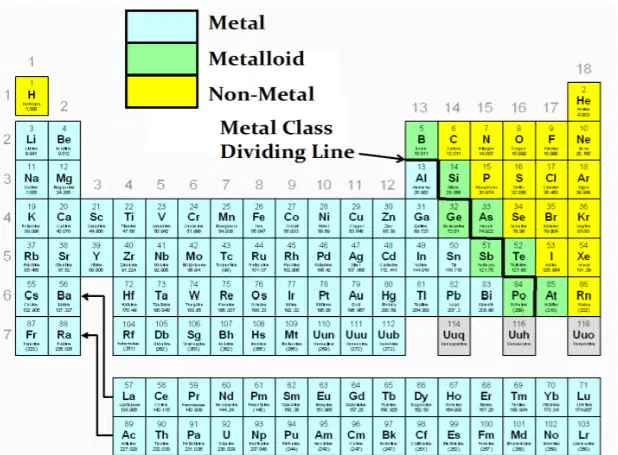
Elements that do not conduct heat and electricity well are _______________.
Non-metals
Metals
Alloys
Metalloids
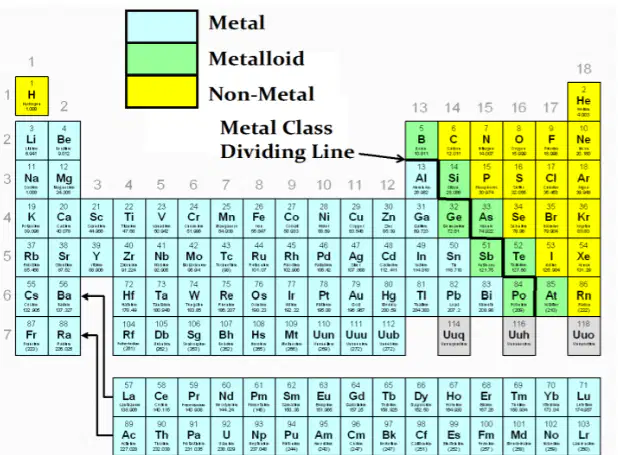
3. Semiconductors are often made from _______________.
Metalloids
Noble gases
Alkali metals
Halogens
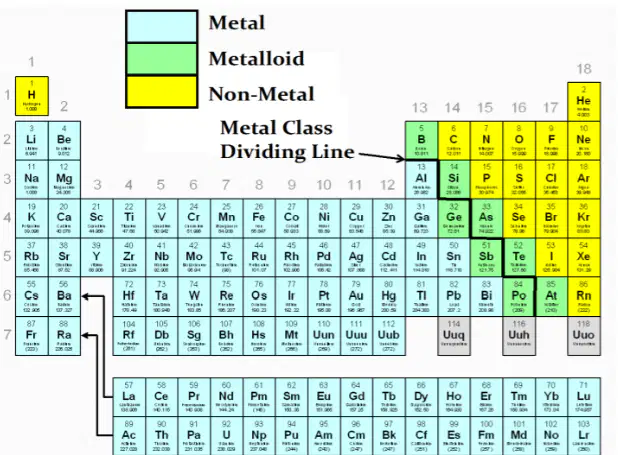
4. Ductile and malleable elements are _______________.
Metals
Non-metals
Metalloids
Noble gases

5. Brittle elements are _______________.
Non-metals
Metals
Alloys
Noble gases
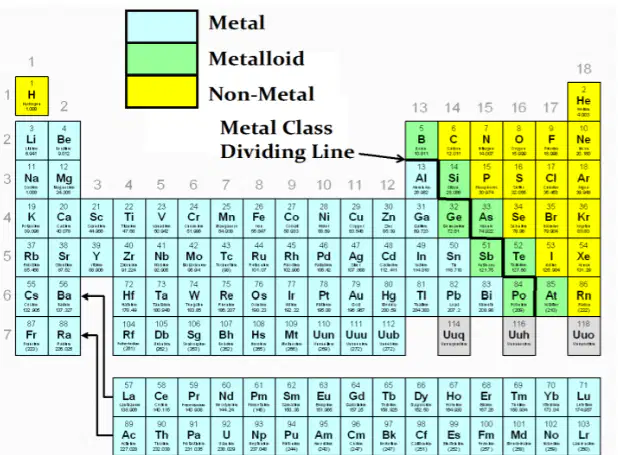
Elements that have a blend of properties between metals and nonmetals are _______________.
Metalloids
Noble gases
Halogens
Alkali metals

7. Most of the elements essential to life are _______________.
Non-metals
Metals
Noble gases
Halogens
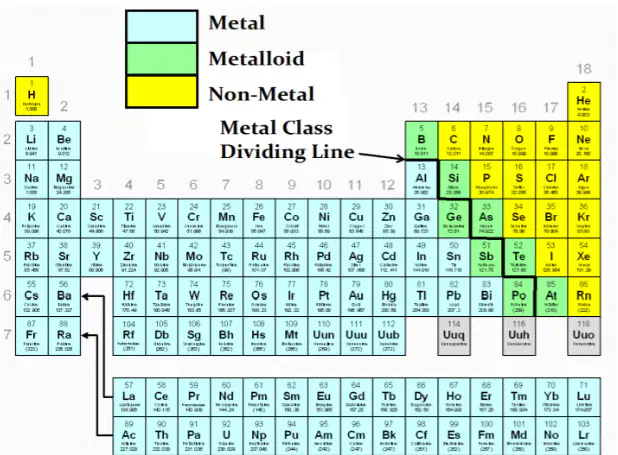
The elements touching the zig-zag line (except Aluminum) are _______________.
Metalloids
Noble gases
Alkali metals
Halogens
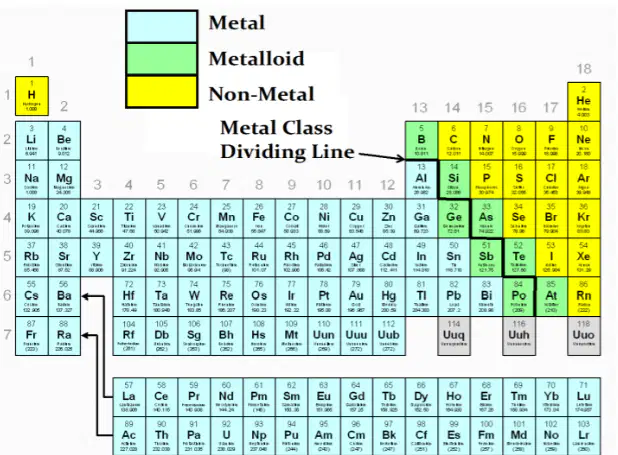
9. Elements on the right side of the Periodic Table are _______________.
Non-metals
Metals
Noble gases
Transition metals
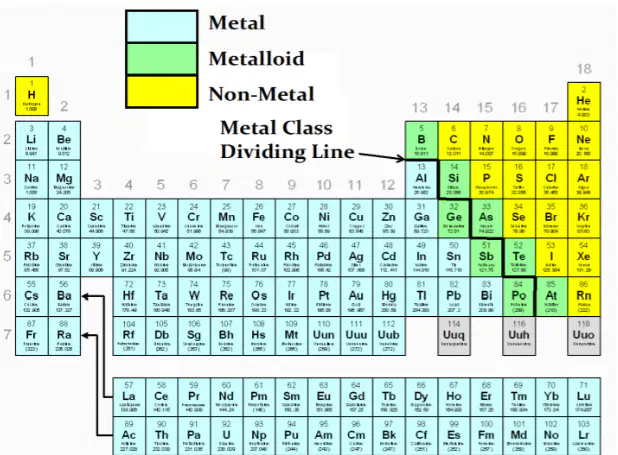
10. Elements on the left side of the Periodic Table are _______________.
Metals
Nonmetals
Noble gases
Metalloids
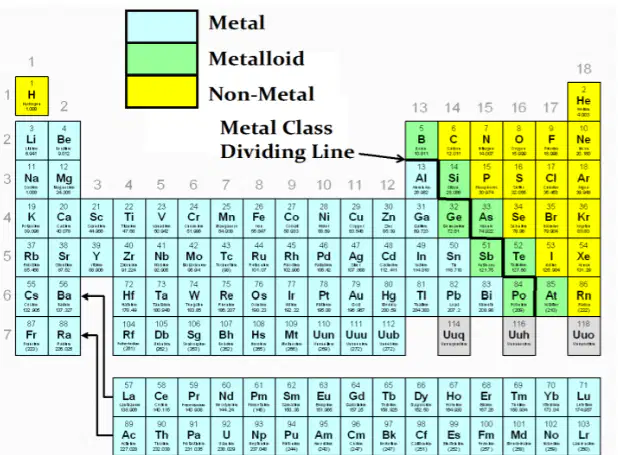
The element sodium (Na) is a _______________. What are its properties?
Metal. Properties: metallic luster, conducts heat and electricity well, malleable, ductile, solid at room temperature.
Nonmetal. Properties: dull, poor conductor of heat and electricity, brittle, often gaseous at room temperature.
Metalloid. Properties: has properties of both metals and nonmetals, semi-conductive, often brittle.
Noble gas. Properties: colorless, odorless, inert, gaseous at room temperature.
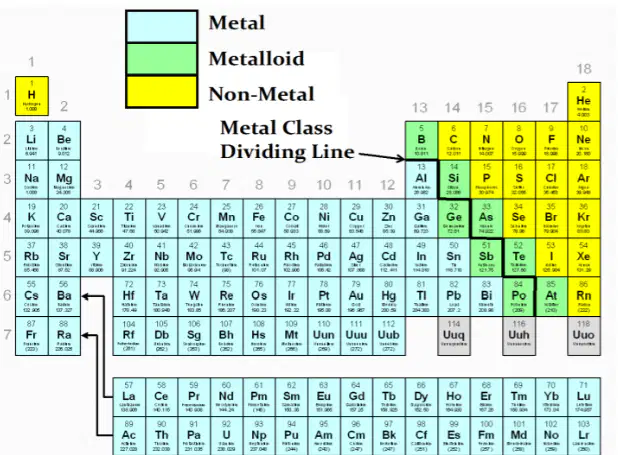
The element silicon (Si) is a _______________. What are its properties?
Metalloid. Properties: blend of properties between metals and nonmetals, can conduct electricity but not as well as metals, brittle, solid at room temperature, used in semiconductors.
Metal. Properties: good conductor of electricity, malleable, ductile, shiny, solid at room temperature (except mercury).
Nonmetal. Properties: poor conductor of electricity, not malleable or ductile, dull, can be solid, liquid, or gas at room temperature.
Noble gas. Properties: colorless, odorless, inert, gases at room temperature, very low chemical reactivity.
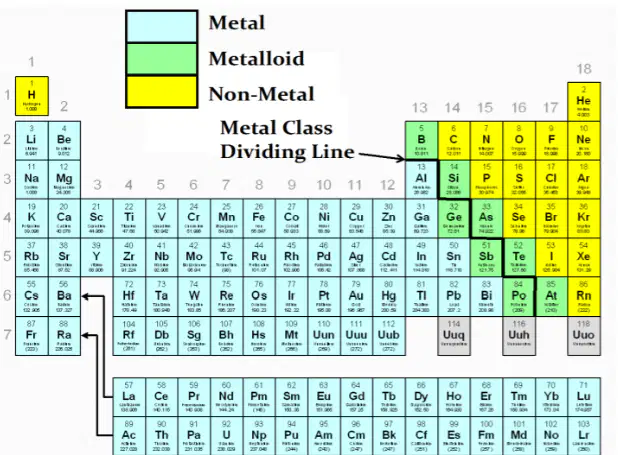
The element oxygen (O) is a _______________. What are its properties?
Non-metal. Properties: does not conduct heat or electricity well, usually brittle when solid, essential to life.
Metal. Properties: conducts heat and electricity well, malleable, ductile.
Metalloid. Properties: has properties of both metals and non-metals, semi-conductor.
Noble gas. Properties: colorless, odorless, inert under most conditions.
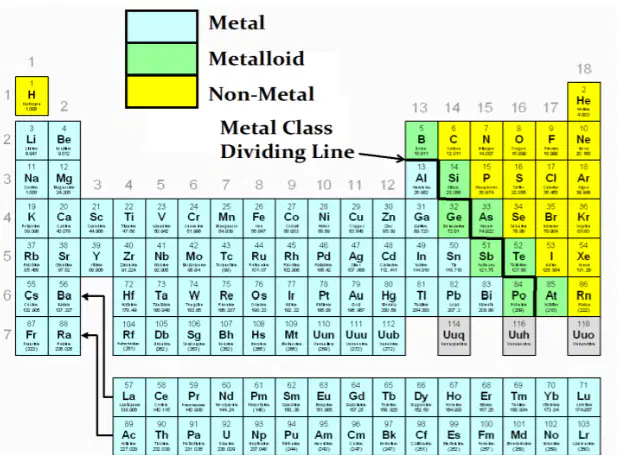
The element aluminum (Al) is a _______________.
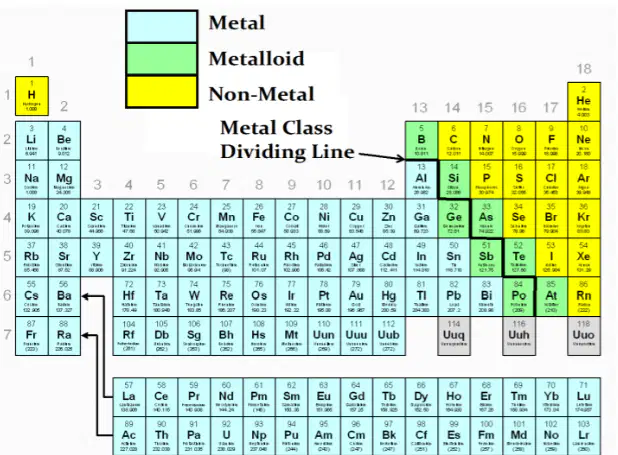
The element hydrogen (H) is a _______________. What are its properties?
Non-metal. Properties: does not conduct heat or electricity well, gas at room temperature, essential to life.
Metal. Properties: shiny, conducts electricity well, solid at room temperature.
Metalloid. Properties: has properties of both metals and non-metals, semi-conductor.
Noble gas. Properties: inert, does not react easily, gas at room temperature.
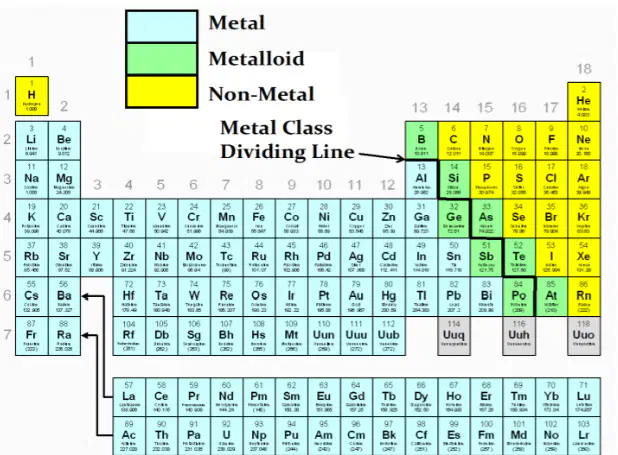
The element potassium (K) is a _______________. What are its properties?
Metal. Properties: metallic luster, conducts heat and electricity well, malleable, ductile, solid at room temperature.
Nonmetal. Properties: dull, poor conductor of heat and electricity, brittle, often gaseous at room temperature.
Metalloid. Properties: has properties of both metals and nonmetals, semi-conductive, often brittle.
Noble gas. Properties: colorless, odorless, inert, gaseous at room temperature.
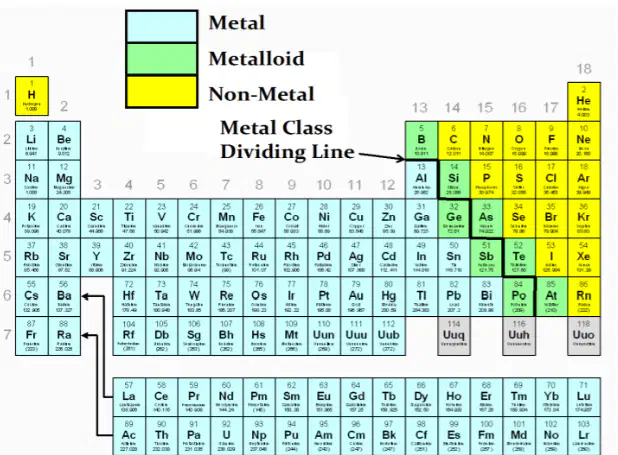
The element germanium (Ge) is a _______________.

