
Font size
 Worksheets
End of Semester Exam Revision
Total questions: 43
Worksheet time: 2hrs 25mins
Match each particle arrangement to its corresponding state of matter.

solid

liquid

gas
Which of the following statements best describe the movement of molecules in the liquid state?
The molecules are not moving from place to place.
The molecules are sliding over each other.
Molecules are fixed in position and only vibrate.
Molecules are in constant random motion.
Match each type of structure to its corresponding diagram.

giant ionic

metallic

simple molecular

giant molecular
Complete the following sentences:
Sodium chloride is an (a) compound. It does not conduct electricity when it is a (b) because the ions cannot move. When it is (c) , sodium chloride does conduct electricity because the ions are free to move.
Match the term to the correct change of state
solid → liquid
melting
liquid → gas
boiling
liquid → solid
freezing
gas → liquid
condensation
solid → gas
sublimation
Which changes of state involve energy being released?
solid → liquid
liquid → solid
liquid → gas
gas → liquid
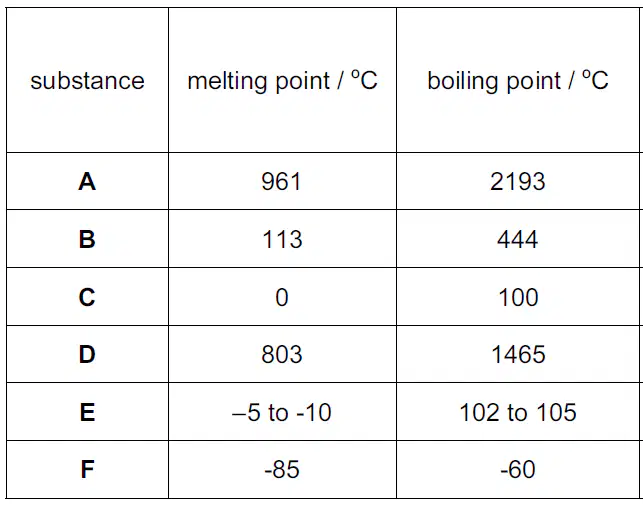
Which three substances are solids at room temperature?
(a)

Which one is a gas at room temperature?
(a)
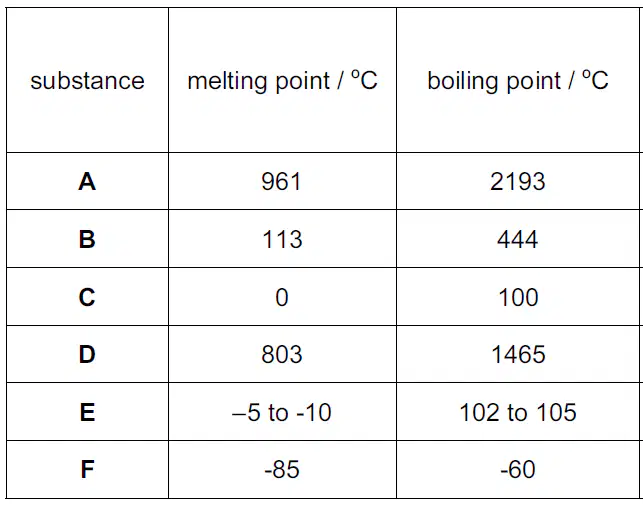
Which two substances are liquids at room temperature?
(a)
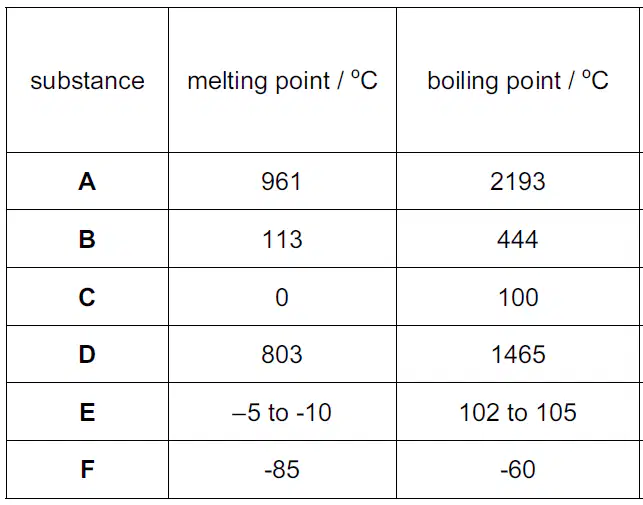
Which one is an impure substance?
(a)

Which one is an ionic compound?
(a)

Which substance is a metal?
(a)
Match each diagram with the correct term.

distillation

chromatography

filtration

evaporation

fractional distillation
Match each apparatus with its correct use
balance
measures mass
measuring cylinder
measures volume of liquids
thermometer
measures temperature
stopwatch
measures time
burette and pipette
measure accurate volume of liquids
Match each diagram with the name of the apparatus.

measuring cylinder

burette

pipette

stopwatch

thermometer
Rank the following gases according to their rate of diffusion (1 = fastest).
nitrogen gas, N2
oxygen gas, O2
fluorine gas, F2
carbon dioxide gas, CO2
chlorine gas, Cl2
Carbon monoxide (CO) and nitrogen gas (N₂) diffuse at nearly the same rate. Which of the following best explains why?
Both gases have the same number of protons.
Both gases have similar molar masses (Mr).
Both are diatomic gases.
Both have the same volume
Match the term to the correct description.
separates an insoluble substance from a liquid
filtration
a solid appears as the solution cools
crystallisation
the solvent is removed as a gas
evaporation
used to separate a mixture of two liquids
fractional distillation
a gas changes to a liquid, on cooling
condensation

A student uses paper chromatography to identify the food dyes in a coloured sweet, S. The student uses four known food dyes, W, X, Y, and Z, and ethanol as the solvent. The chromatogram obtained is shown. Which statements are correct?
S contains only two dyes.
X is insoluble in ethanol.
S contains Y and Z.
S contains W.

Four different food colourings are analysed using chromatography. The results are shown on the chromatogram. The diagram is not drawn to scale. Which food colouring contains a component with an Rf value of 0.3?
A
B
C
D
Match the two particles that have the same electronic structure.
O2-
Ne
K+
S2-
Sr2+
Kr
Ba2+
I-
An ion contains 10 electrons, 13 protons and 14 neutrons. State the nucleon number of the ion.
(a)
An ion contains 10 electrons, 13 protons and 14 neutrons. Give the symbol of the element that forms this ion.
(a)
Copper has two different naturally occurring atoms, 63Cu and 65Cu. State the term used for satoms of the same element with different nucleon numbers.
(a)
Match the name of the compound to its correct formula.
Al2O3
aluminium oxide
Al(OH)3
aluminium hydroxide
AlCl3
aluminium chloride
Al(NO3)3
aluminium nitrate
Al2(SO4)3
aluminium sulfate
Which of the following are properties of ionic compounds such as potassium sulfide, K2S?
High melting point
malleable and ductile
Conducts electricity when dissolved in water
soluble in water
Potassium is in Group 1 of the periodic table. Which of the following statements about potassium are correct?
It is a metal.
The type of bonding is metallic.
Its structure has potassium ions (K⁺) arranged in a lattice surrounded by free electrons.
There is a strong force of attraction between potassium ions and the free electrons.
Its structure shows sharing of electrons.
Barium sulfate (BaSO₄) is an insoluble salt that can be prepared by precipitation. It is formed by mixing aqueous solutions of barium nitrate and sulfuric acid:
Ba(NO3)2(aq) + H2SO4(aq)→BaSO4(s) + 2HNO3(aq)
Arrange the steps involved in preparing the insoluble salt in the correct order.
Mix solutions of barium nitrate and sulfuric acid.
Filter the mixture to separate the precipitate.
Wash the precipitate with distilled water.
Dry the precipitate by pressing it between filter papers.
Graphite, diamond, and silica (silicon dioxide) are all giant covalent substances. Which of the following statements correctly describe their structure and properties?
Diamond has a tetrahedral structure where each carbon atom is bonded to four others.
Graphite conducts electricity because it has free-moving delocalized electrons.
Silica has a layered structure with weak forces between the layers.
Diamond is very hard due to its strong covalent bonds.
Graphite is soft and slippery because layers can slide over each other.
Match each giant covalent substance to its common use.
Used in cutting tools
Diamond
Used in lubricants and pencil leads
Graphite
Used in making glass
Silica (SiO2)
Match each giant covalent substance with its structure.

diamond

graphite

silica (SiO2)
Which dot-and-cross diagram shows the arrangement of outer shell electrons in a molecule of
hydrogen chloride?


Magnesium reacts with fluorine to form the ionic compound magnesium fluoride. The electronic structures of an atom of magnesium and an atom of fluorine are shown.
Has two electrons in its outer shell
magnesium atom
Has seven electrons in its outer shell before bonding
fluorine atom
Loses two electrons and forms a positive ion
Mg2+
Gains one electron to achieve a full outer shell
F-
Electrostatic attraction between oppositely charged ions
ionic bond
Gypsum is hydrated calcium sulphate, CaSO4.xH2O. It contains 20.9% water by mass. Calculate x.
Mr: CaSO4, 136; H2O, 18.
79.1 g of CaSO4 = (a) moles
20.9 g of H2O = (b) moles
x = (c)
A compound X contains 82.76% of carbon by mass and 17.24% of hydrogen by mass. Calculate the empirical formula of compound X.
(a)
If the empirical formula of compound X is C2H5 and has a relative molecular mass of 58, what is its molecular formula?
(a)
Match each term with its correct description.
Has a relative charge of -1
electron
Has a relative mass of 1 and no charge
neutron
Found in the nucleus and has a positive charge
proton
Central part of the atom where protons and neutrons are located
nucleus
particles found in the nucleus
nucleon
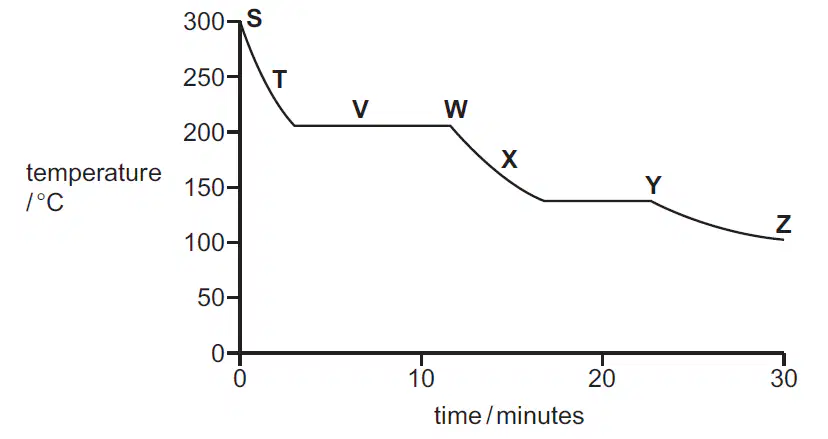
The graph shows how the temperature of a substance changes as it is cooled over a period of 30 minutes. The substance is a gas at the start. Which letter, shows when
(a) the particles in the substance have the most kinetic energy (a)
(b) the substance exists as both a gas and a liquid? (b)
The movement of particles from an area of high concentration to an area of low concentration, down a concentration gradient, is called (a) .
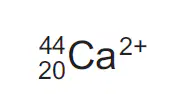
How many electrons, neutrons and protons are there in the ion shown?
number of electrons (a)
number of neutrons (b)
number of protons (c)
Match each diagram with its correct description.

gas containing diatomic molecules

gas containing single atoms

represents a compound

mixture of compounds

mixture of elements
Match each type of structure with its correct conductivity behavior in both solid and liquid states.
Conducts electricity only when molten or in solution, not as a solid
ionic
Conducts electricity in both solid and liquid states due to mobile electrons
metallic
Does not conduct electricity in both solid and liquid states due to lack of free-moving charged particles
giant covalent

Which substance has ionic bonding? (a)
Which substance is metal? (b)

