
 Worksheets
Types of timber
Total questions: 28
Worksheet time: 17mins
What are the two main types of timbers?
Hardwoods and Softwoods
Plywood and MDF
Oak and Pine
Teak and Bamboo
What type of tree loses its leaves annually?
Deciduous Trees
Coniferous Trees
Evergreen Trees
Palm Trees
What type of tree keeps its leaves all year round?
Coniferous Trees
Deciduous Trees
Fruit Trees
Palm Trees
What is the term for the different uses of timber in construction and manufacturing?
Timber Applications
Timber Growth
Timber Harvesting
Timber Seasoning
What is timber sourced from?
Timber is classified into which two types based on tree type?
Hardwoods and softwoods
Metals and plastics
Stones and bricks
Glass and ceramics
Name two applications where timber is widely used.
Construction and furniture.
Electronics and software.
Pharmaceuticals and banking.
Aerospace and telecommunications.
Timber is a renewable, sustainable, and highly versatile material.
True
False
Hardwoods come from ______ trees, which shed leaves annually. (Fill in the blank)
Deciduous
Coniferous
Evergreen
Tropical
Softwoods come from ______ trees, which are evergreen. (Fill in the blank)
Coniferous
Deciduous
Broadleaf
Palm
Which of the following statements is true?
Hardwoods are lighter and easier to work with than softwoods.
Softwoods are denser and stronger than hardwoods.
Hardwoods are typically denser and stronger, whereas softwoods are lighter and easier to work with.
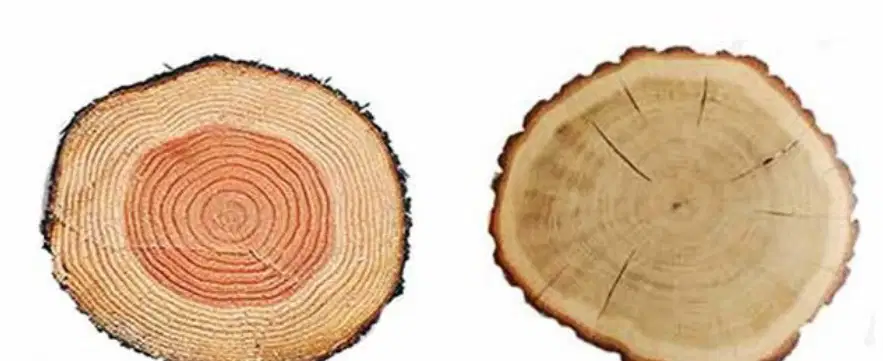
The image below shows a comparison between a softwood and a hardwood cross-section but which one is hardwood?
Left
Right
Which type of wood is typically denser and stronger?
Softwood
Hardwood
Plywood
Particle board
Match the following types of forests with their examples:
balsa, ebony, mahogany
Tropical hardwood forests
ash, birch, cherry
Temperate hardwood forests
cypress, fir, pine
Softwood (coniferous) forests
Softwood (coniferous) forests are mainly found in the northern parts of North America, Europe, and Asia.
True
False
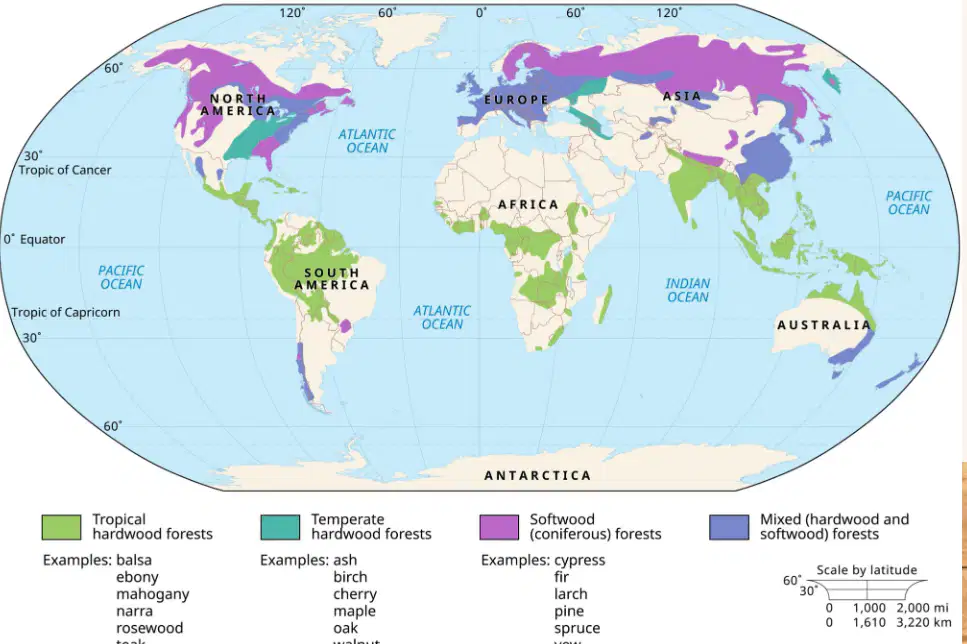
Which continent has significant areas of mixed (hardwood and softwood) forests according to the map?
Africa
Australia
Europe
South America
According to the passage, what are hardwoods mainly used for?
Framing and paper production
Furniture, flooring, and high-end construction
General construction
None of the above
According to the passage, what are softwoods mainly used for?
Furniture and flooring
High-end construction
Framing, paper production, and general construction
None of the above
Fill in the blank: Hardwoods are used in furniture, flooring, and high-end construction due to their _______ and durability.
strength
color
weight
softness
Hardwood trees often take ____ years to mature.
50-100
5-10
10-20
20-30
Softwoods mature faster than hardwoods.
True
False
According to the passage, timber is sawn into planks or boards using which of the following techniques?
Plain sawing
Quarter sawing
Rift sawing
All of the above
Fill in the blank: The methods of sawing timber affect the ______ pattern and stability of the wood.
grain
color
weight
length
Match the following sawing techniques with their corresponding wood grain pattern as shown in the diagram:
Plain-Sawn
Most wavy grain pattern
Quarter-Sawn
Straight grain pattern
Rift-Sawn
Most uniform grain pattern
What makes timber a sustainable material?
It is always cheap
It is sourced from responsibly managed forests
It is easy to cut
It is always available

What does FSC stand for?
Forest Stewardship Council
Forest Safety Committee
Forestry Standards Certification
Forest Sustainability Council

What does PEFC stand for?
Programme for the Endorsement of Forest Certification
Public Environmental Forestry Council
Protected Environment for Forest Conservation
Programme for Environmental Forest Care
It is important to understand the differences between hardwoods and softwoods when selecting timber for a project because:
They have different properties and uses.
They are the same in all aspects.
Only hardwoods can be used for construction.
Softwoods are always more expensive.

