
 Worksheets
Part 107 Operations Review
Total questions: 98
Worksheet time: 49mins
Which of the following is the primary purpose of a preflight inspection for a remote PIC operating a sUAS?
To ensure the sUAS is in a condition for safe operation.
To increase the speed of the sUAS.
To improve the appearance of the sUAS.
To reduce the weight of the sUAS.
According to the text, what should a preflight inspection checklist for a sUAS include at a minimum?
A visual or functional check of critical components.
A detailed weather report.
A list of previous flight locations.
A record of pilot training hours.
Why is it important to inspect propeller blades for nicks, cracks, or bends before a sUAS flight?
Such damage can degrade structural integrity and impact controllability and safety.
It makes the sUAS look more professional.
It increases the battery life of the sUAS.
It helps the sUAS fly faster.
What is a recommended practice if a battery appears “bloated” or abnormal during a preflight inspection?
Do not use or charge the battery.
Charge the battery immediately.
Use the battery for a short flight.
Store the battery in the sUAS.
Which of the following is NOT listed as a minimum item to check during a preflight inspection?
Weather conditions at the flight location.
Visual condition of sUAS components.
Registration markings for legibility.
Servo motor attachment points.
A remote PIC notices that the propeller installation does not follow manufacturer guidelines. What is a potential consequence of this oversight?
Separation of the blade in flight, loss of control, and possible injury or damage.
Increased battery efficiency.
Improved camera performance.
Reduced noise during flight.
Why is it important to verify that all systems have an adequate energy supply before a sUAS flight?
To ensure the intended operation can be completed safely.
To make the sUAS lighter.
To improve the color of the sUAS lights.
To reduce the need for future inspections.
If a manufacturer does not provide a preflight checklist, what should a remote PIC do?
Create their own guidelines to properly check all critical components.
Skip the preflight inspection.
Only check the propellers.
Rely on previous inspection records.
Which of the following should be calibrated prior to all sUAS flights?
Battery levels
sUAS compass
Display panel
Fuel type
What is the purpose of verifying communication with sUAS and ensuring GPS location is acquired?
To check battery levels
To ensure proper operation and/or aircraft location
To calibrate the compass
To attach equipment securely
According to FAA requirements, what is one of the main responsibilities of the remote PIC and other crewmembers before flight?
Scan the airspace for potential collision hazards
Calibrate the sUAS compass
Attach all equipment securely
Check fuel type and quantity
Which of the following is NOT a recommended action for the remote PIC to achieve effective communication?
Foster open communication among the crew
Establish communication procedures prior to flight
Select a distracting method of communication
Use hand-held radios or other effective means
Why is it important to verify all controller operations for accuracy and display of heading and altitude?
To ensure the sUAS is securely attached
To confirm correct type and quantity of fuel
To ensure accurate flight information is available
To calibrate the compass
If a flight path walk through is required, what should be verified?
Battery levels
Noted obstructions that may interfere with the sUAS
Display panel functionality
Onboard navigation data links
What should be done to maintain awareness of the sUAS position during operation?
Use only the display panel
Observe the sUAS directly with visual observation
Rely on GPS location only
Check the fuel type and quantity
Which of the following is a basic communication procedure in aviation?
Listen before you transmit.
Transmit without listening.
Ignore the microphone position.
Speak as loudly as possible at all times.
What is the main purpose of using the phonetic alphabet in aviation communications?
To make conversations longer
To spell out groups of letters or difficult words during adverse communication conditions
To confuse the listener
To replace normal language
Why is brevity important in aviation communications?
It makes conversations more interesting.
It ensures understanding between parties and keeps contacts as brief as possible.
It allows for more background noise.
It helps pilots avoid using the radio.
A remote PIC must decide how to communicate with the VO before flight. What should be considered in making this decision?
The method most appropriate for the operation and safety
The color of the aircraft
The weather forecast for the next week
The number of passengers on board
Suppose you are communicating in a busy and noisy environment as a pilot. Which strategy would best help ensure effective communication?
Speak quickly and use slang
Use the phonetic alphabet for clarity and keep messages brief
Ignore the microphone and use hand signals
Wait until the environment is quiet before speaking
What is the telephony word for the letter "B" in the NATO phonetic alphabet?
Bravo
Beta
Baker
Boston
Which of the following is the correct pronunciation for the telephony word "Delta"?
DELL-TAH
DEL-TA
DEE-EL-TAH
DELL-TEE
If you hear the word "Yankee" over a radio transmission, which letter is being referred to?
Y
W
X
Z
Which telephony word is used for the number "7"?
Seven
Seventy
Sierra
Sable
What is the correct telephony word and pronunciation for the letter "Q"?
Quebec (KEH-BECK)
Queen (KWEEN)
Quota (KWO-TAH)
Quasar (KAY-ZAR)
If a pilot spells out "Mike India Kilo Echo" over the radio, what word are they communicating?
MIKE
MAKE
MICE
MINE
Which of the following is NOT a correct telephony word for any letter or number in the NATO phonetic alphabet?
Baker
Zulu
Tango
Lima
How is the number "1" pronounced in the NATO phonetic alphabet?
WUN
ONE
WON
OON
A message is spelled out as "Golf Romeo Echo Echo November". What word is being communicated?
GREEN
GRAIN
GROAN
GROWN
How should the number 500 be spoken according to standard aviation phraseology?
Five zero zero
Five hundred
Fife hundred
Five oh oh
Why is the number nine spoken as "niner" in aviation communications?
To make it sound more professional
To avoid confusion with the German word for "no"
Because it is easier to say
To match international standards
When stating a heading of 360 in aviation, how should it be spoken?
Three sixty
Three six zero
Three hundred sixty
Three six
What word should follow the speed when communicating it in aviation?
Miles per hour
Kilometers per hour
Knots or mile per hour
Feet per second
How many degrees apart are the lines of longitude that define each time zone?
10°
12°
15°
20°
What does "Zulu time" refer to in aviation?
Local time at the airport
Time at the equator
Coordinated Universal Time (UTC)
Daylight savings time
Which of the following should be included in an initial transmission to ATC?
Aircraft’s complete call sign, location, and intention
Only the aircraft’s call sign
Only the location
Only what you want to do
Why should call signs be spoken in their entirety the first time during initial contact?
To save time
To avoid confusion with similar numbers or sounds
To follow international law
To impress the controller
If the time is 1500Z, how should it be spoken in aviation communications?
Fifteen hundred Zulu
One five zero zero Zulu
Three o’clock Zulu
Fifteen Zulu
What is the primary reason for using standard phraseology in aviation communications?
To sound professional
To ensure clarity and avoid confusion
To follow tradition
To save time
What does the aviation phrase "Acknowledge" mean?
Let me know that you have received my message.
Tell me what you plan to do.
Yes.
No or permission not granted.
Which phrase should a pilot use to indicate they have received a message, understand it, and will comply with it?
Roger
WILCO
Stand by
Final
If an air traffic controller says "Hold short," what should the pilot do?
Proceed to the runway immediately.
Stay in place where currently located.
Begin takeoff roll.
Read back the message.
What is the correct response if you are unable to comply with a specific instruction, request, or clearance?
Affirmative
Unable
Verify
Final
Which phrase is used to request confirmation of information, such as an assigned altitude?
Advise intentions
Verify
Read back
Stand by
A controller says, "Line up and wait." What should the pilot do?
Begin takeoff immediately.
Taxi onto the departure runway and wait for takeoff clearance.
Hold short of the runway.
Read back the message.
Why should "Roger" not be used to answer a question requiring a yes or no answer?
It means "no."
It only means the message was received, not agreement or disagreement.
It is used for emergencies only.
It is a request for confirmation.
What does the phrase "Without delay" instruct a pilot to do?
Wait for further instructions.
Proceed with approved instructions in a rapid manner.
Hold short of the runway.
Read back the message.
If a pilot hears "How do you hear me?" from ATC, what is being asked?
The pilot is being asked to confirm their altitude.
The pilot is being asked to report their intentions.
The pilot is being asked about the quality of the transmission.
The pilot is being asked to hold short.
A pilot is told "Stand by" by ATC. What should the pilot do?
Proceed immediately.
Wait for further instructions and reestablish contact if the delay is lengthy.
Begin takeoff roll.
Read back the message.
What is the primary purpose of the Automatic Terminal Information Service (ATIS)?
To provide continuous broadcast of non-control information in selected high-activity terminal areas.
To give weather updates to pilots only.
To control the movement of aircraft on the runway.
To provide food and lodging information to pilots.
When is ATC authorization required for sUAS operations?
When operating at or near an airport with a control tower and/or within controlled airspace.
When operating at any airport, regardless of control tower presence.
Only when flying above 10,000 feet.
Only during nighttime operations.
What should remote PICs do when ATC authorization is not required?
Monitor the CTAF to stay aware of manned aircraft communications and operations.
Ignore all radio communications.
Contact the ATIS for clearance.
Only communicate with ground control.
Why is it helpful to announce sUAS operations on the CTAF?
To increase local pilots’ situational awareness and potentially increase safe interaction among manned and unmanned aircraft.
To request fuel and lodging services.
To receive weather updates.
To get clearance for takeoff.
Which frequency should be used for self-announce procedures when no tower, FSS, or UNICOM is available?
MULTICOM frequency 122.9
ATIS frequency
Ground control frequency
UNICOM frequency 123.45
What is the function of ground control frequencies at airports with operating air traffic control towers (ATCT)?
To reduce congestion on the tower frequency and manage movement on the ground.
To provide weather updates to pilots.
To broadcast non-control information.
To announce food and lodging services.
What steps should a pilot take when arriving at an airport with a part-time ATCT and the tower is not in operation?
Select the correct CTAF, announce intentions, and monitor other pilots’ communications.
Contact ATIS for clearance.
Use ground control frequency for all communications.
Wait for the tower to become operational.
Why is it important to state the airport name and use the term “traffic” at the beginning and end of a transmission when more than one airport uses the same frequency?
To avoid confusion and ensure all pilots in the area understand which airport and aircraft are being referenced.
To request clearance from ATC.
To receive weather updates.
To announce food and lodging services.
Which frequency should be used to communicate at an airport with no tower, FSS, or UNICOM?
CTAF frequency
MULTICOM frequency 122.9
UNICOM frequency 122.8
FSS frequency
When should a pilot self-announce on CTAF before departure at an airport with no tower or FSS in operation?
After takeoff
Before taxiing and before taxiing on the runway for departure
After landing
Only when entering the downwind
At what distance from the airport should inbound pilots begin making position reports according to the recommended communications procedures?
5 miles out
10 miles out
15 miles out
20 miles out
What is the main difference between the direction of flight (track) and aircraft heading when receiving traffic advisories?
Track is always north, heading is always east
Track is the direction the aircraft is moving, heading is the direction the nose is pointing
Track is the direction the nose is pointing, heading is the direction the aircraft is moving
There is no difference
Why might there be a slight difference in the perceived location of observed aircraft and the actual location when receiving traffic advisories?
Because advisories are based on aircraft color
Because advisories are based on the direction of flight (track), not heading
Because advisories are based on altitude only
Because advisories are based on weather conditions
If an aircraft heading 090° is advised of traffic at the three o’clock position, where should the remote PIC look?
Directly ahead
To the left of the direction of flight
To the right of the direction of flight
Directly behind
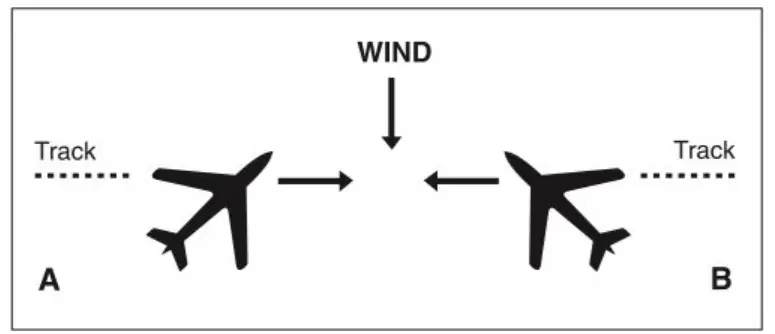
Select the statement that best describes the information shown in the diagram.
The diagram shows aircraft heading and altitude
The diagram shows aircraft color and speed
The diagram shows that traffic advisories are based on direction of flight (track), not aircraft heading
The diagram shows airport layout
Which of the following is a primary consideration for radio frequencies used in sUAS operations?
Frequency interference
Weather conditions
Battery life
Flight altitude
What are the most commonly used sUAS frequencies?
2.4 GHz and 5.8 GHz
1.2 GHz and 3.6 GHz
900 MHz and 4.9 GHz
7.2 GHz and 8.4 GHz
Why might frequency interference be a problem when operating an unmanned aircraft?
It can cause lost links and flyaways
It increases battery consumption
It reduces the aircraft's speed
It makes the aircraft heavier
Which organization regulates the radio frequency bands used by sUAS in the United States?
Federal Communications Commission (FCC)
National Aeronautics and Space Administration (NASA)
Federal Aviation Administration (FAA)
Department of Transportation (DOT)
What is recommended to ensure there are no potential interfering transmissions in the area before sUAS operation?
Use a frequency spectrum analyzer
Increase the aircraft's altitude
Change the aircraft's color
Reduce the payload weight
Why are both 2.4 GHz and 5.8 GHz radio frequency bands considered line-of-sight?
Barriers between the control station and sUAS can disrupt the command and control link
They are the only frequencies approved by the FAA
They are not affected by weather conditions
They can transmit through any material
What should the remote PIC do in case of an inflight emergency?
Deviate from any rule of Part 107 to the extent necessary to meet the emergency
Immediately land the sUAS regardless of location
Contact the FCC for permission to continue
Ignore the emergency and continue the mission
Which of the following is NOT a recommended action for the remote PIC before sUAS operations?
Review emergency actions during preflight planning
Inform crewmembers of their responsibilities
Ignore manufacturer’s guidance for emergencies
Prepare to respond to abnormal and emergency situations
What is a "lost link" in the context of sUAS operations?
A situation where the aircraft loses its GPS signal but continues to fly normally.
An interruption or loss of the control link between the control station and the unmanned aircraft.
A scenario where the aircraft runs out of battery during flight.
A situation where the aircraft is intentionally landed at an alternate site.
Which of the following is NOT considered an emergency situation for sUAS operations?
Flyaways
Loss of control
Lost link
Imminent danger of collision
According to the text, what should a lost link sUA do if it loses connection with the control station?
Immediately land wherever it is.
Continue flying in a random direction.
Remain airborne in a predictable or planned maneuver to allow time to re-establish the communication link.
Return to the original launch site without following any set procedures.
Why is it important for remote PICs to conduct a thorough preflight briefing with crewmembers regarding lost link procedures?
To ensure crewmembers know how to repair the aircraft.
To discuss responsibilities and contingency plans for abnormal and emergency situations.
To teach crewmembers how to fly the aircraft manually.
To avoid using communication equipment during flight.
Which of the following is a recommended contingency planning measure for sUAS operations?
Ignoring airspace constructs to save time.
Planning for alternate landing/recovery sites in case of abnormal conditions.
Only briefing the remote PIC and not the rest of the crew.
Relying solely on the aircraft’s automated systems without human intervention.
If a lost link sUA flies at an altitude set by the remote PIC prior to flight, what is the main purpose of this procedure?
To increase flight speed.
To avoid obstacles in the area or follow a predefined route.
To reduce battery consumption.
To test the aircraft’s maximum altitude.
What should be included in contingency planning for sUAS operations according to the text?
Only the flight path and altitude.
A precautionary landing away from the original launch location and means of communication with ATC.
The color and design of the aircraft.
The number of flights per day.
What is the primary purpose of flight termination in sUAS operations?
To intentionally and deliberately perform controlled flight to the ground
To increase the altitude of the aircraft
To extend the flight duration
To improve battery efficiency
Which of the following is NOT a requirement for Flight Termination Points (FTPs)?
Be located within power-off glide distance or low-power rapid descent
Be based on the assumption of an unrecoverable system failure
Take into consideration altitude, winds, and other factors
Ensure the aircraft lands at the original takeoff point
A flyaway in sUAS operations is best described as:
An interruption or loss of the control link that prevents control of the aircraft
A planned maneuver to test the aircraft's range
A routine battery replacement procedure
A method for increasing flight speed
What should remote PICs do to prepare for possible loss of GPS during sUAS operations?
Check NOTAMs for known GPS service disruptions and make a plan of action
Ignore GPS signals and rely solely on manual control
Increase the altitude to improve GPS reception
Turn off the GPS system before flight
Why are battery fires a significant hazard for sUAS?
sUAS utilize high energy density, rechargeable batteries that can malfunction or fail
Batteries are always exposed to water during flight
Battery fires are required for takeoff
Batteries are only used for emergency landings
Why is it important to inspect sUAS batteries for damage, bloating, or excessive heat before each flight?
To prevent potential battery fires and ensure safe operation
To increase the aircraft's speed
To improve camera quality
To reduce the weight of the aircraft
If a flyaway occurs while operating in an airspace that requires authorization, what is the recommended action?
Notify ATC as outlined in the authorization
Continue flying as normal
Attempt to regain control without informing anyone
Land the aircraft immediately without notification
Which of the following is NOT a characteristic of lithium batteries?
Highly flammable
Capable of self-ignition
Subject to thermal runaway
Completely safe under all conditions
What is thermal runaway in lithium batteries?
A process where the battery cools down rapidly
A rapid discharge event causing adjacent cells to overheat and possibly catch fire
A slow discharge of energy over time
A method to safely dispose of batteries
Why is it inadvisable to use water to extinguish a lithium battery fire?
Water can cause the battery to recharge
Lithium can react with water, making the fire worse
Water will cool the battery too quickly
Water is too expensive
Which of the following is a recommended way to prevent a battery fire during storage?
Store batteries in battery bags designed to contain failures
Store batteries in a metal box with coins
Leave batteries exposed to air
Store batteries in water
What should you do if you notice bubbling or warping during battery charging?
Continue charging as normal
Ignore it and use the battery anyway
Stop charging and check for damage or defects
Place the battery in water
When disposing of a used or damaged lithium battery, what is the correct procedure?
Throw it in regular trash
Follow manufacturer and local trash collection guidelines
Burn it to destroy hazardous materials
Bury it in the ground
Why is it important to prevent lithium batteries from coming into contact with metal objects?
It makes the battery heavier
It can cause short circuits and increase fire risk
It improves battery performance
It keeps the battery cool
What is the role of the remote PIC in sUAS operations?
To fly the aircraft only
To hold a current Remote Pilot Certificate and have final authority and responsibility for the operation and safety of the sUAS
To repair the aircraft
To monitor weather conditions only
If a battery fire occurs during an sUAS flight, what steps should be taken to ensure safety?
Land the aircraft safely and follow manufacturer guidance for response procedures
Continue flying until the battery is depleted
Pour water on the battery immediately
Ignore the fire and focus on the mission
Which of the following is NOT typically a member of the designated sUAS crew?
A person manipulating the controls under direct supervision of the remote PIC.
A VO acting as a flight crewmember to help see and avoid air traffic.
A person associated with the operation of the sUAS as part of the designated crew.
A passenger unrelated to the operation of the sUAS.
What does ADM stand for in the context of sUAS operations?
Aeronautical Decision Making
Aircraft Data Management
Aerial Deployment Mechanism
Automated Drone Monitoring
Which of the following is a primary focus of Crew Resource Management (CRM) in sUAS operations?
Effective use of all available resources
Increasing flight speed
Reducing battery consumption
Improving camera resolution

