
 Worksheets
Chapter 13 Ag Comm Media Relations
Total questions: 82
Worksheet time: 41mins
What is the primary goal of any media relations strategy?
To increase sales
To serve as a credible and trustworthy source of information
To entertain the audience
To reduce costs
Which of the following is NOT a component of a media relations plan?
Contacting members of the media directly
Writing news releases
Organizing internal meetings
Providing photo or video opportunities
What is one responsibility of communications team members in an organization?
Designing advertisements
Communicating activities and events to outside audiences
Managing financial accounts
Hiring new employees
Which of the following is an example of news media?
Social clubs
Radio and television
Book clubs
Local libraries
What is one benefit of developing an effective news media relations strategy for your organization?
It guarantees front-page news coverage.
It enhances the public's knowledge and understanding of your program.
It reduces the need for public engagement.
It eliminates the need for social media presence.
Why is it important to build credibility in your program, event, or activity through media relations?
Because it increases the cost of media campaigns.
Because people perceive that what they see in the news media is important.
Because it reduces the need for advertising.
Because it guarantees immediate success.
What should be considered when developing a media relations strategy?
The color scheme of the organization's logo.
The kind of work reporters do and their needs.
The number of employees in the organization.
The organization's internal communication methods.
What is a realistic goal when setting up a media relations plan?
Expecting every news release to result in a front-page story.
Setting a goal to get one story published in a news outlet.
Assuming all media calls will be answered immediately.
Planning to eliminate all media interactions.
What is a key aspect of developing your message strategically?
Ignoring feedback from colleagues
Sharing key points with everyone in the organization
Focusing only on personal opinions
Avoiding planning and practice
Which of the following is important when deciding on your approach to get your goals accomplished?
Using only one type of media for all audiences
Identifying specific audiences to reach
Avoiding social media completely
Focusing solely on television interviews
Who should be responsible for handling news media requests in an organization?
Only the organization's president
Any random employee
The person designated to handle calls
The organization's accountant
What is one component of an effective media relations strategy?
Becoming a reputable, expert source
Avoiding media contacts
Limiting news releases
Ignoring media representatives
How often should you update the list of media contacts?
Once a month
Once a year
Every two years
Every six months
What are media kits often composed of?
News releases, brochures, and photographs
Only news releases
Only brochures
Only photographs
Why is it important to explain your need to media representatives personally?
To ensure they ignore your request
To make the task as easy as possible for the media outlet
To demand immediate coverage
To avoid giving them any information
What is one benefit of using social media for organizations trying to reach news professionals?
It allows organizations to avoid creating news releases.
It helps organizations bypass news media gatekeepers.
It ensures all events are listed in newspapers.
It guarantees interviews on television.
Why might newspapers and stations be more likely to publicize an event?
If it is a private event.
If it impacts a large number of people.
If it is held in the evening.
If it is a small community gathering.
What should you be prepared for if invited to a television or radio interview?
To appear during late-night hours.
To discuss unrelated topics.
To appear during early morning hours.
To provide a written statement only.
What is the purpose of writing news releases?
To entertain the audience.
To provide basic information for covering a story.
To replace social media announcements.
To advertise products directly.
What role does a gatekeeper play in the news media?
Decides what is important and reported
Writes all the news articles
Conducts interviews with news subjects
Designs the layout of the newspaper
What is the primary function of a news director or editor?
To create advertisements
To determine newsworthiness
To manage social media accounts
To print newspapers
Which of the following best describes the concept of newsworthiness?
The ability to entertain the audience
The relevance and importance of a story
The length of a news article
The number of images in a news report
What does "Timeliness" refer to in the context of news reporting?
The location of the event
The prominence of the people involved
When the event happened or will happen
The economic impact of the event
Why is "Proximity or location" important for news coverage?
It ensures the event is significant
It helps in covering financial issues
It attracts local media interest
It highlights unusual events
Which factor increases the likelihood of an event being covered due to "Prominence"?
The event's location
Involvement of high-profile individuals
The economic impact
The timing of the event
What does "Human interest" focus on in a news story?
Financial issues
Interesting people doing unusual things
The timing of the event
The location of the event
How does "Conflict" contribute to a story's newsworthiness?
By highlighting financial issues
By showing struggles between opposing forces
By involving high-profile individuals
By being located in a prominent area
What is the typical length of soundbites used by radio reporters?
5 to 10 seconds
10 to 20 seconds
20 to 30 seconds
30 to 40 seconds
Why do newspaper reporters spend considerable time talking with sources?
To create visual stories
To gather detailed quotations and facts
To produce short soundbites
To focus on online content
How do television stories differ from newspaper stories in terms of detail?
Television stories are more detailed
Newspaper stories are less detailed
Television stories are less detailed
Both are equally detailed
What is a common feature of most news media today?
They only use printed stories
They have an online component
They focus solely on radio broadcasts
They avoid using video clips
What is one of the most helpful things a source can do when working with media?
Provide detailed background information
Respect deadlines
Offer exclusive interviews
Share personal opinions
What is a key strategy for establishing successful media relations?
Think like a news reporter
Focus on entertainment value
Limit communication
Avoid scheduling conflicts
Why is it important to schedule events to maximize news coverage?
To ensure exclusivity
To avoid conflicts with other major events
To attract more sponsors
To reduce costs
What should you do to ensure your news events are covered well in advance?
Arrange events at the last minute
Communicate clearly with media representatives
Focus only on digital media
Limit the number of interviews
How are journalists and reporters described in the document?
Specialists in specific fields
Generalists with broad knowledge
Experts in agriculture
Focused on entertainment
What is one characteristic of journalists and reporters according to the text?
They are poor observers.
They avoid personalizing stories.
They are good observers.
They never follow trends.
Why is it important to verify information before providing it to the media?
To ensure the information is entertaining.
To make the story more dramatic.
To ensure the facts are correct.
To confuse the audience.
What should journalists do to make their stories more engaging?
Avoid personalizing the story.
Emphasize people and personal interests.
Focus only on negative aspects.
Ignore trends and current events.
How can written materials help media professionals?
By making stories less clear.
By providing unnecessary details.
By helping them write the story.
By confusing the audience.
What is a key characteristic of a news release?
It should be lengthy and detailed.
It should be brief and well-written.
It should contain technical jargon.
It should be sent to the general public.
Why is it important to use understandable terms in a news release?
To impress the audience with complex language.
To ensure the message is clear to all readers.
To make the release appear more professional.
To fill up space in the document.
What should be included in the directions/travel section of a news release?
Detailed directions and assistance with camera gear.
A list of all attendees.
A summary of the event's history.
A personal opinion about the event.
What is the primary purpose of a news release?
To entertain the audience.
To announce something with news value.
To provide a detailed analysis of an event.
To advertise a product.
What is the purpose of the Dairy Council of Florida's news release mentioned in the example?
To announce a new dairy product
To inform about a program providing greater access to milk in schools
To advertise a dairy farm
To recruit new employees
What is a key element of the news writing style mentioned in the document?
Chronological order
Inverted pyramid structure
Narrative storytelling
Question and answer format

What is the purpose of the "Lead" in the inverted pyramid structure?
To provide background information
To include additional information
To grab the reader’s attention
To offer quotations
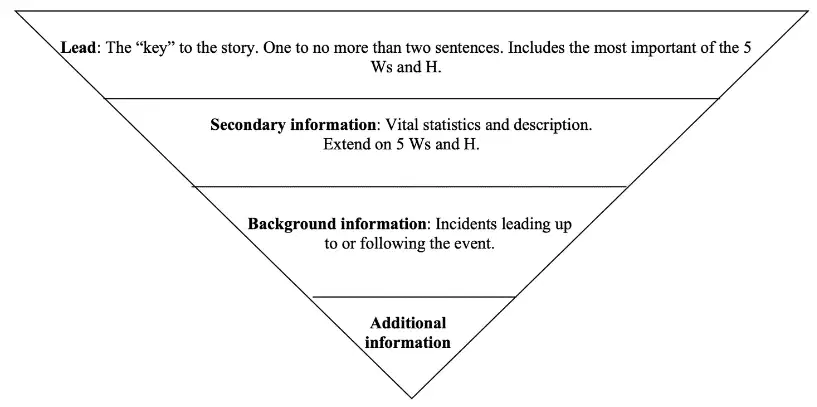
Which questions are most important to answer in the "Lead" of a news story?
Why and How
Who, What, When, Where, Why, and How
Where and When
What and Why
What is the typical length of paragraphs in a news story according to the inverted pyramid structure?
Three to four sentences
One to two sentences
Five to six sentences
Four to five sentences
Why is it important to use quotations in a news story?
To provide background information
To bring “life” to the story
To extend on the 5 Ws and H
To follow AP Style
What is the purpose of the "how" section in a news release?
To provide the location and time of the event
To explain the importance of the event
To give a brief history of the event
To list the number of members in an organization
Why is it important to include context in a news release?
To make the release longer
To provide useful detail and history
To confuse the reader
To avoid mentioning the organization
What should be included in the identification section of a news release?
The event's location
The name, phone number, and e-mail address of the writer
The date of the event
The number of pages in the release
How should the spacing and length of a news release be formatted?
Single-spaced and handwritten
Double-spaced and no more than two pages
Triple-spaced and handwritten
Single-spaced and more than three pages
What is a "boilerplate" in the context of a news release?
A detailed report of an event
A short paragraph with general information about an organization
A list of questions for an interview
A summary of a news article
What is the purpose of a pre-event news release?
To summarize the event after it happens
To generate coverage of the event before it occurs
To provide a detailed analysis of the event
To advertise products related to the event
What should you do when a media representative calls?
Ignore the call
Ask for their name, who they work for, and what they want
Immediately provide all the information they request
Direct them to your website
What is a key component of effective media relations strategy during an interview?
Being unprepared and spontaneous
Knowing what you want to say and being confident
Avoiding any questions from the media
Providing lengthy and detailed answers
What are "communication points" in the context of an interview?
The main issues or points you want to convey
The questions asked by the interviewer
The location of the interview
The time allotted for each response
Why is it important to make short, simple, and specific statements during an interview?
To confuse the interviewer
To ensure clarity and conciseness
To fill time during the interview
To avoid answering the questions
What should you do after completing a statement in an interview?
Continue talking without pause
Pause to allow for editing
Start a new topic immediately
Ask the interviewer a question
What is a recommended length for answers in recorded television or radio interviews?
5 minutes or more
1 minute or less
20 seconds or less
2 minutes or more
What should you avoid doing after answering a question in an interview?
Keep talking to fill the silence
Refer to previous answers
Stop talking if satisfied with your answer
Use the interviewer's name frequently
Why should you avoid using verbal fillers like "uh" and "ah" in interviews?
They make you sound more confident
They are difficult to edit out
They enhance the clarity of your message
They are encouraged in media interviews
What is a common problem with pitch in speaking?
Speaking too quickly
Inflecting up at the end of sentences
Speaking too softly
Using too many technical terms
What is the importance of maintaining eye contact during a television interview?
It distracts the interviewer
It shows you are committed to what you are saying
It makes you appear nervous
It is not important in interviews
What is the effect of lowering your pitch and inflecting downward when speaking?
It makes you sound more assertive.
It makes you sound more passive.
It makes you sound more aggressive.
It makes you sound more uncertain.
What is the term used to describe the speed at which you talk?
Tone
Volume
Rate
Pitch
Why is it important to practice varying your pitch, rate, and volume?
To confuse the audience
To add emphasis and expression to your message
To make your speech longer
To avoid using gestures
What is a mock news interview?
An interview with a real media representative
A practice interview with someone acting as a media representative
An interview conducted over the phone
An interview without any questions
What should you concentrate on during a mock news interview to avoid stage fright?
The audience's reactions
The questions you are being asked
Your appearance
The time limit
What is one recommended practice to help relax before an interview?
Take a deep breath
Drink coffee
Eat a heavy meal
Avoid all liquids
Why is it suggested to yawn before an interview?
It helps you focus
It prevents you from being tense
It improves your voice
It makes you more alert
What should you remind yourself of before an interview?
You are the expert
You need more practice
You should be nervous
You might not know the topic
Why is it important to review past interviews before a new one?
To memorize answers
To identify strengths and weaknesses
To copy previous responses
To impress the interviewer
What mindset should you have during an interview?
It is a test
It is a conversation
It is a performance
It is a debate
Which foods and beverages should be avoided before an interview?
Fruits and vegetables
Cola drinks and chocolates
Water and tea
Bread and pasta
What type of questions should be used to encourage detailed responses?
Yes or no questions
Open-ended questions
Compound questions
Rhetorical questions
Why should compound questions be avoided in interviews?
They are too simple
They can confuse the interviewee
They encourage detailed responses
They are too formal
What is a recommended clothing style for a television studio setting?
Bright-colored clothes
Tight stripes or plaids
Conservative, professional appearance
Casual attire
What effect can tight stripes or plaids have on camera?
They enhance the image
They cause a moire effect
They make colors more vibrant
They improve lighting
What should be ensured about clothing in both studio and on-location interviews?
It should be bright and colorful
It should have a place to clip a microphone
It should be casual
It should be loose-fitting

