
 Worksheets
Chemistry Final Part 2 Review
Total questions: 100
Worksheet time: 3hrs 30mins
The strongest intermolecular forces of attraction exist in a liquid whose heat of vaporization is
200 J/g
300 J/g
400 J/g
500 J/g
What is the normal boiling point of ethanoic acid?
52°C
55°C
101.3°C
117.9°C
Based on Table H, which compound has the weakest intermolecular forces at 75°C?
Answer Explanation:
Table H shows the vapor pressure curves of different substances. The substance with the weakest intermolecular forces will have the highest vapor pressure at a given temperature, because its molecules escape into the vapor phase more easily. At 75°C, propanone has the highest vapor pressure among the options, indicating it has the weakest intermolecular forces.
Option Explanations:
ethanoic acid: Ethanoic acid has strong hydrogen bonding, resulting in lower vapor pressure and stronger intermolecular forces than propanone.
ethanol: Ethanol also exhibits hydrogen bonding, making its intermolecular forces stronger than those of propanone.
propanone: Propanone has the highest vapor pressure at 75°C, indicating the weakest intermolecular forces among the choices.
water: Water has very strong hydrogen bonds, so its intermolecular forces are much stronger than those of propanone.
ethanoic acid
ethanol
propanone
water
According to Reference Table H, what is the boiling point of ethanoic acid at 80 kPa?
28°C
100°C
111°C
125°C
What is the vapor pressure of propanone at 45°C?
21 kPa
60. kPa
70. kPa
79 kPa
According to the kinetic molecular theory, the particles of an ideal gas
constantly move in circular paths
Explanation: According to the kinetic molecular theory, gas particles move in straight lines until they collide with something. They do not move in circular paths.
have no attractive forces between them
Explanation: The kinetic molecular theory assumes that there are no attractive or repulsive forces between gas particles. This is a key characteristic of an ideal gas.
do not transfer energy when the particles collide
Explanation: The theory states that collisions between gas particles are elastic, meaning energy can be transferred, but the total kinetic energy remains constant.
are separated by small distances relative to their sizes
Explanation: Gas particles are actually separated by large distances relative to their sizes, not small distances.
The kinetic molecular theory states that all particles of an ideal gas are
colliding without transferring energy
Explanation: This is incorrect. In the kinetic molecular theory, collisions between gas particles are elastic, meaning energy can be transferred between particles, but the total energy remains constant.
in random, constant, straight-line motion
Explanation: This is correct. According to the kinetic molecular theory, gas particles move in random, constant, straight-line motion until they collide with each other or the walls of the container.
arranged in a regular geometric pattern
Explanation: This is incorrect. Gas particles are not arranged in any pattern; they are far apart and move freely.
separated by small distances relative to their size
Explanation: This is incorrect. Gas particles are separated by large distances compared to their size, which is why gases are compressible.
Which statement describes the particles of an ideal gas, based on the kinetic molecular theory?
The volume of the particles is considered negligible.
Explanation: According to the kinetic molecular theory, the particles of an ideal gas are so small compared to the distances between them that their own volume can be ignored. This allows the gas to be compressed easily and explains why the gas fills its container.
The force of attraction between the particles is strong.
Explanation: This is incorrect. In an ideal gas, the force of attraction between particles is assumed to be negligible, not strong.
The particles are closely packed in a regular, repeating pattern.
Explanation: This describes a solid, not an ideal gas. In an ideal gas, particles are far apart and move freely.
The particles are separated by small distances, relative to their size.
Explanation: This is incorrect. In an ideal gas, the particles are separated by large distances compared to their size.
At which temperature and pressure will a sample of neon gas behave most like an ideal gas?
- A. 300. K and 2.0 atm
- B. 300. K and 4.0 atm
- C. 500. K and 2.0 atm
- D. 500. K and 4.0 atm
Answer Explanation:
Gases behave most ideally at high temperatures and low pressures because the particles have more kinetic energy and are farther apart, minimizing intermolecular forces. Among the options, 500. K and 2.0 atm (option C) provides the highest temperature and a lower pressure, making it the best conditions for neon gas to behave like an ideal gas.
300. K and 2.0 atm
300. K and 4.0 atm
500. K and 2.0 atm
500. K and 4.0 atm
Under which conditions of pressure and temperature is a real gas most like an ideal gas?
low pressure and low temperature
low pressure and high temperature
high pressure and low temperature
high pressure and high temperature
A sample of gas occupies a volume of 50.0 milliliters in a cylinder with a movable piston. The pressure of the sample is 0.90 atmosphere and the temperature is 298 K. What is the volume of the sample at STP?
- 41 mL: This is the correct answer. Using the combined gas law, \( \frac{P_1 V_1}{T_1} = \frac{P_2 V_2}{T_2} \), and plugging in the values (\( P_1 = 0.90 \) atm, \( V_1 = 50.0 \) mL, \( T_1 = 298 \) K, \( P_2 = 1.00 \) atm, \( T_2 = 273 \) K), we get \( V_2 = \frac{0.90 \times 50.0 \times 273}{298 \times 1.00} \approx 41 \) mL.
- 49 mL: This value is too high. It does not account for the decrease in temperature and increase in pressure when converting to STP, both of which would decrease the volume.
- 51 mL: This value is also too high. It ignores the effect of the lower temperature and higher pressure at STP, which would reduce the volume.
- 55 mL: This is much too high. At STP, the volume should decrease, not increase, compared to the original conditions.
41 mL
49 mL
51 mL
55 mL
A 3.00-liter sample of gas is at 288 K and 1.00 atm. If the pressure of the gas is increased to 2.00 atm and its volume is decreased to 1.50 liters, the Kelvin temperature of the sample will be
144 K
288 K
432 K
576 K
If 60. liters of hydrogen gas at 546 K is cooled to 273 K at constant pressure, the new volume of the gas will be
120 L
20. L
30. L
40. L

Which graph best shows the change in the volume of 1 mole of nitrogen gas as pressure increases and temperature remains constant?
[Graph A]
[Graph B]
[Graph C]
[Graph D]

Which graph shows the pressure-temperature relationship expected for an ideal gas?
Answer Explanations:
Option A: This graph shows a straight line passing through the origin, indicating a direct proportionality between pressure and temperature. This matches Gay-Lussac's Law (P ∝ T at constant volume), which is the expected relationship for an ideal gas.
Option B: This graph shows pressure remaining constant as temperature increases, which does not match the behavior of an ideal gas at constant volume.
Option C: This graph shows an undefined or vertical relationship, which does not represent any physical law for an ideal gas.
Option D: This graph shows a curve where pressure decreases as temperature increases, which is the opposite of the expected relationship for an ideal gas at constant volume.
[Graph A]
[Graph B]
[Graph C]
[Graph D]
Which compound is insoluble in water?
CaBr2
KBr
AgBr
NaBr
Based on Reference Table F, which of these saturated solutions has the highest concentration of dissolved ions?
NaCl(aq)
AgCl(aq)
PbCl2(aq)
Hg2Cl2(aq)
According to Reference Table F, which compound is most soluble in water?
BaCO3
BaSO4
ZnCO3
ZnSO4
Under which conditions of temperature and pressure is a gas most soluble in water?
high temperature and low pressure
high temperature and high pressure
low temperature and low pressure
low temperature and high pressure
According to Table G, Which compound becomes less soluble in water as the temperature of the solution is increased?
Answer Explanations:
NH3: This is the correct answer. According to Table G, the solubility of NH3 (ammonia) in water decreases as temperature increases, which is typical for gases.
KCl: The solubility of potassium chloride increases with temperature.
NaCl: The solubility of sodium chloride increases slightly with temperature.
NH4Cl: The solubility of ammonium chloride increases with temperature.
NH3
KCl
NaCl
NH4Cl
A solution contains 10 grams of KCl dissolved in 100 grams of water at 75°C. How much more KCl would have to be added to make it a saturated solution?
30 g
50 g
10 g
40 g
What is the total mass of KNO3 that must be dissolved in 50. grams of H2O at 60.°C to make a saturated solution?
32 g
53 g
64 g
106 g
Heat flows from an object at a temperature of 20.°C to an object at a temperature of
15°C
25°C
35°C
45°C
A saturated solution of NaNO3 is prepared at 60°C using 100. grams of water. As this solution is cooled to 10°C, NaNO3 precipitates (settles) out of the solution. The resulting solution is saturated. Approximately how many grams of NaNO3 settled out of the original solution?
Answer Explanation for Each Option:
Option 1: 46 g – Correct. At 60°C, 124 g of NaNO3 can dissolve in 100 g of water. At 10°C, only 78 g can dissolve. The difference, 124 g - 78 g = 46 g, is the amount that precipitates out as the solution cools.
Option 2: 61 g – Incorrect. This value does not correspond to the difference in solubility between 60°C and 10°C.
Option 3: 85 g – Incorrect. This is not the correct difference in solubility at the given temperatures.
Option 4: 126 g – Incorrect. This value is higher than the total amount that could dissolve at 60°C and is not possible in this context.
46 g
61 g
85 g
126 g
According to Reference Table G, how many grams of NH4Cl must be dissolved in 100 grams of H2O at 70°C to reach solution equilibrium?
52 g
56 g
62 g
86 g
Molarity is defined as the
moles of solute per kilogram of solvent
mass of a solution
moles of solute per liter of solution
volume of a solvent
What is the molarity of a solution that contains 16 moles of NaOH in 2 liters of solution?
2 M
0.5 M
8 M
80 M
What is the concentration of an aqueous solution that contains 1.5 moles of NaCl in 500 milliliters of this solution?
0.30 M
0.75 M
3.0 M
7.5 M
A 3.0 M HCl(aq) solution contains a total of
3.0 grams of HCl per liter of water
3.0 grams of HCl per mole of solution
3.0 moles of HCl per liter of solution
3.0 moles of HCl per mole of water
What is the concentration of O2, in parts per million, in a solution that contains 0.008 gram of O2 dissolved in 1000. grams of water?
0.8 ppm
8 ppm
80 ppm
800 ppm
Compared to the freezing point and boiling point of water at 1.0 atm, a 0.5 M aqueous solution of NaCl at 1.0 atm has
a lower freezing point and a lower boiling point
a lower freezing point and a higher boiling point
a higher freezing point and a lower boiling point
a higher freezing point and a higher boiling point
Compared to the freezing point and boiling point of water at 1 atmosphere, a solution of a salt and water at 1 atmosphere has a
lower freezing point and a lower boiling point
lower freezing point and a higher boiling point
higher freezing point and a lower boiling point
higher freezing point and a higher boiling point
Which sample, when dissolved in 1.0 liter of water, produces a solution with the highest boiling point?
0.1 mole KI
0.2 mole KI
0.1 mole CaCl2
0.2 mole CaCl2
A person with a body temperature of 37°C holds a cup of hot water in their hand. The temperature of the cup is 44°C. The air temperature is 22°C. Which phrase describes a heat transfer that occurs in this system?
- Option 1: from the air to the cup
Explanation: This is incorrect because the air (22°C) is cooler than the cup (44°C), so heat would not flow from the air to the cup. Heat flows from higher to lower temperature. - Option 2: from the hand to the cup
Explanation: This is incorrect because the hand (37°C) is cooler than the cup (44°C), so heat would not flow from the hand to the cup. Instead, heat flows from the cup to the hand. - Option 3: from the air to the hand
Explanation: This is incorrect because the air (22°C) is cooler than the hand (37°C), so heat would not flow from the air to the hand. - Option 4: from the cup to the hand
Explanation: This is correct. The cup (44°C) is hotter than the hand (37°C), so heat will transfer from the cup to the hand.
from the air to the cup
from the hand to the cup
from the air to the hand
from the cup to the hand
Which list includes three forms of energy?
temperature, chemical, thermal
temperature, thermal, alkalinity
electromagnetic, nuclear, chemical
electromagnetic, alkalinity, nuclear
Which form of energy is associated with the random motion of the particles in a sample of water?
chemical energy
electrical energy
nuclear energy
thermal energy

The heating curve below represents a sample of a substance starting as a solid below its melting point and being heated over a period of time. Which statement describes the energy of the particles in this sample during interval BC?
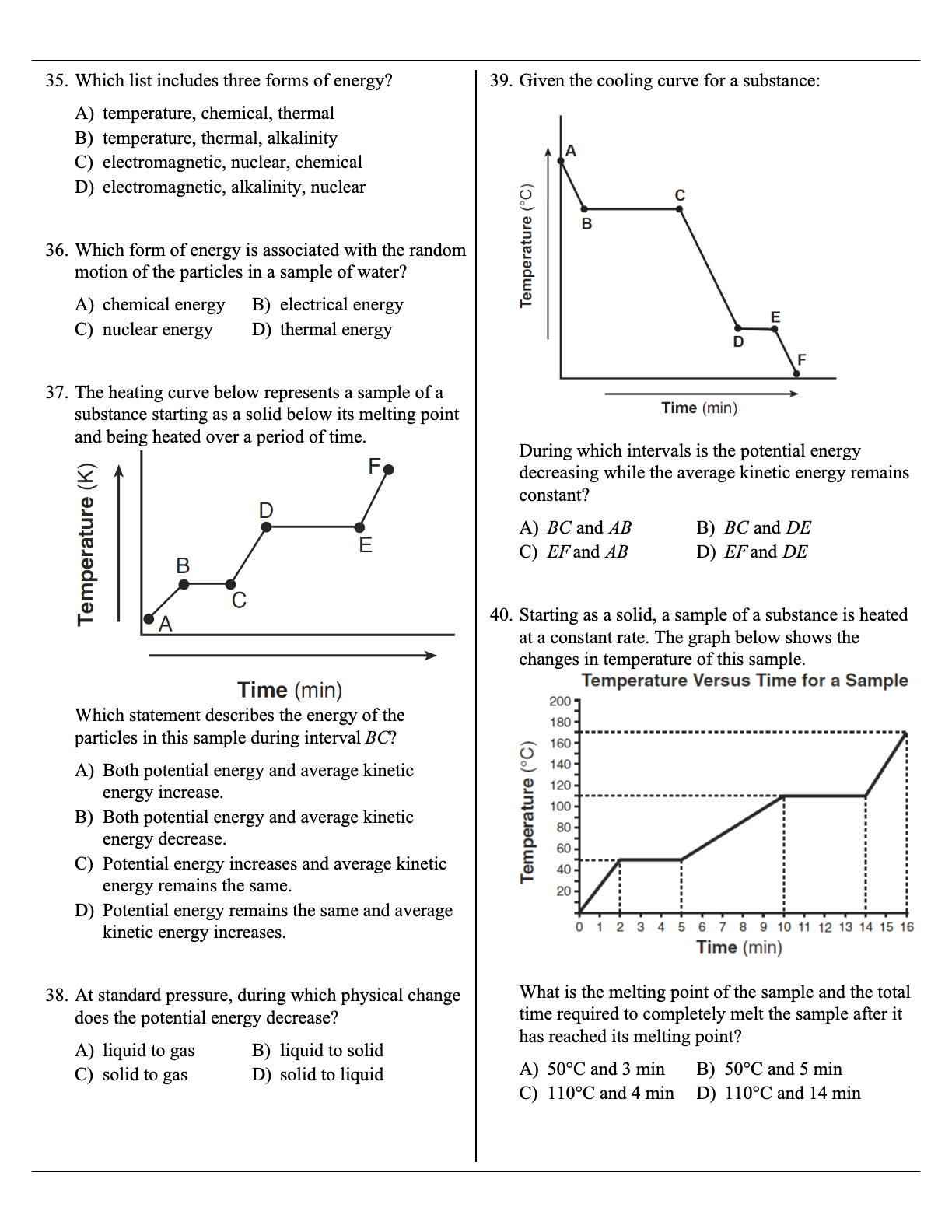
Answer Explanations:
A) Both potential energy and average kinetic energy increase.
This is incorrect. During interval BC, the temperature does not change, so the average kinetic energy remains the same. Only potential energy increases as the substance melts.
B) Both potential energy and average kinetic energy decrease.
This is incorrect. Energy is being absorbed, so potential energy increases, not decreases. The average kinetic energy also does not decrease because the temperature is constant.
C) Potential energy increases and average kinetic energy remains the same.
This is correct. During interval BC, the temperature (and thus the average kinetic energy) stays the same, but energy is absorbed to overcome the forces holding the solid together, increasing the potential energy.
D) Potential energy remains the same and average kinetic energy increases.
This is incorrect. The temperature does not increase, so the average kinetic energy does not increase. The potential energy increases as the substance melts.
A) Both potential energy and average kinetic energy increase.
B) Both potential energy and average kinetic energy decrease.
C) Potential energy increases and average kinetic energy remains the same.
D) Potential energy remains the same and average kinetic energy increases.
At standard pressure, during which physical change does the potential energy decrease?
Answer Explanations:
liquid to gas: During this change (boiling/evaporation), potential energy increases as particles move further apart.
liquid to solid: During this change (freezing), potential energy decreases because particles move closer together.
solid to gas: During this change (sublimation), potential energy increases as particles move much further apart.
solid to liquid: During this change (melting), potential energy increases as particles move further apart.
liquid to gas
liquid to solid
solid to gas
solid to liquid

Given the cooling curve for a substance: During which intervals is the potential energy decreasing while the average kinetic energy remains constant?
Answer Explanations:
A) BC and AB
AB is a sloped segment where temperature decreases, so both kinetic and potential energy change. BC is a flat segment (phase change), where temperature (kinetic energy) remains constant and potential energy decreases.
B) BC and DE
This is correct. Both BC and DE are flat segments on the cooling curve, representing phase changes. During these intervals, the temperature (and thus average kinetic energy) remains constant, while potential energy decreases as the substance changes phase.
C) EF and AB
Both EF and AB are sloped segments where temperature decreases, so both kinetic and potential energy change. These are not intervals where only potential energy decreases.
D) EF and DE
EF is a sloped segment (both energies change), but DE is a flat segment (only potential energy decreases). This option is only half correct.
Correct answer: B) BC and DE
A) BC and AB
B) BC and DE
C) EF and AB
D) EF and DE

Starting as a solid, a sample of a substance is heated at a constant rate. The graph below shows the changes in temperature of this sample. What is the melting point of the sample and the total time required to completely melt the sample after it has reached its melting point?
Answer Explanation for all options:
Option 1: 50°C and 3 min
This is the correct answer. The melting point is the temperature at which the substance changes from solid to liquid, shown by the plateau on the graph. The plateau occurs at 50°C, from 2 minutes to 5 minutes. The total time to completely melt is 5 min - 2 min = 3 min.
Option 2: 50°C and 5 min
This is incorrect. While the melting point is correctly identified as 50°C, the total time to melt is not 5 minutes. The plateau lasts from 2 min to 5 min, which is only 3 minutes.
Option 3: 110°C and 4 min
This is incorrect. 110°C is not the melting point; it is another plateau on the graph, likely representing the boiling point. The time interval at this temperature is also not related to melting.
Option 4: 110°C and 14 min
This is incorrect. 110°C is not the melting point, and 14 min is not the time required to melt the sample. These values do not correspond to the melting process on the graph.
50°C and 3 min
50°C and 5 min
110°C and 4 min
110°C and 14 min

The cooling curve below represents the uniform cooling of a substance, starting at a temperature above its boiling point. During which time interval does the substance exist as both a liquid and a gas?
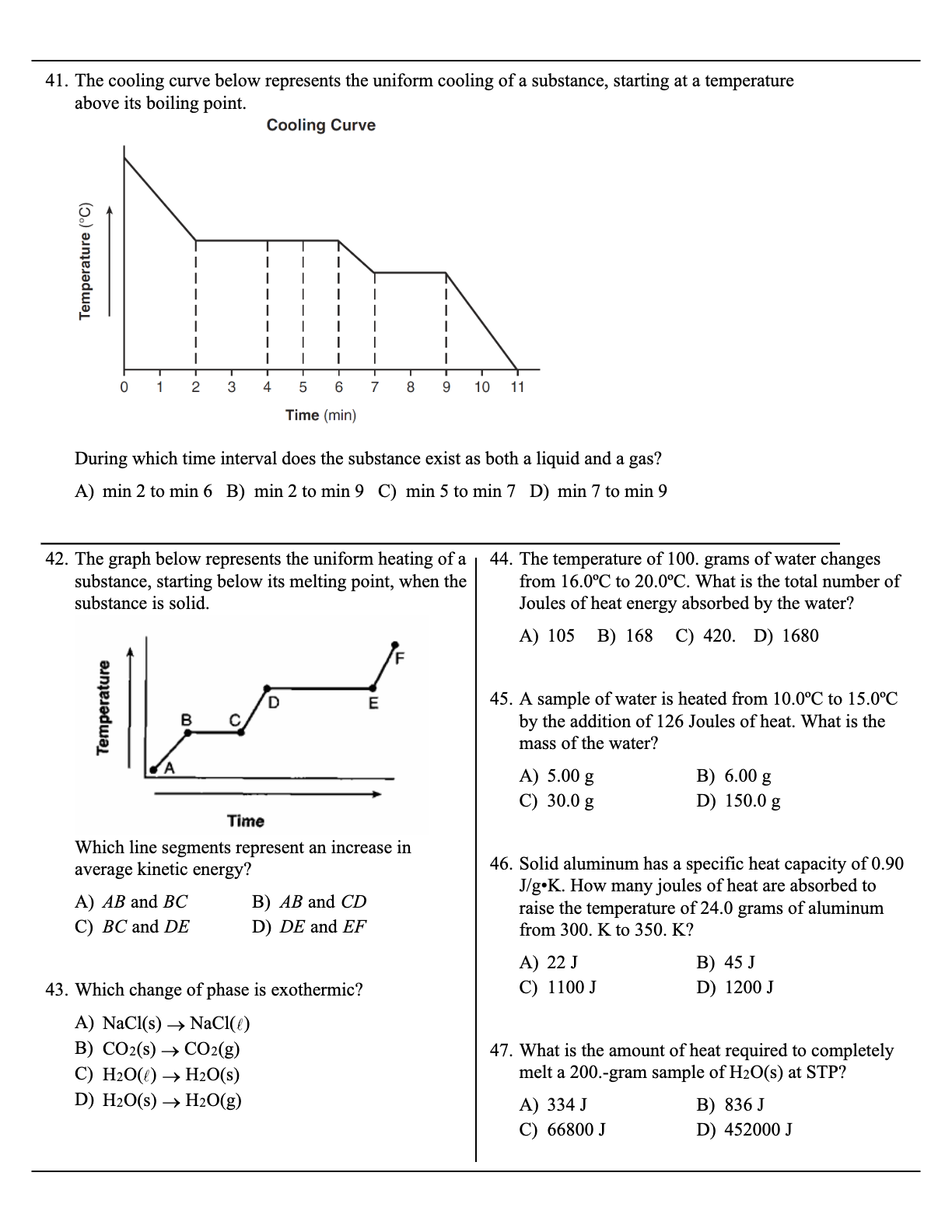
Answer Explanations:
Option 1: min 2 to min 6
This is the correct answer. On a cooling curve, a flat (horizontal) segment indicates a phase change, where the temperature remains constant as the substance changes state. For a substance cooling from above its boiling point, the first flat segment represents the condensation (gas to liquid) phase change. During this time, both liquid and gas are present. In the graph, this flat segment occurs from min 2 to min 6.
Option 2: min 2 to min 9
This interval is too long. While min 2 to min 6 is the correct phase change interval for liquid and gas, the segment from min 6 to min 9 represents a different phase change (liquid to solid), not liquid and gas.
Option 3: min 5 to min 7
This interval only partially overlaps with the correct phase change. The phase change from gas to liquid starts at min 2 and ends at min 6, so min 5 to min 7 is not entirely within the correct interval.
Option 4: min 7 to min 9
This interval represents the second flat segment, which is the phase change from liquid to solid (freezing), not the liquid and gas phase. Therefore, this is not the correct answer.
min 2 to min 6
min 2 to min 9
min 5 to min 7
min 7 to min 9

The graph below represents the uniform heating of a substance, starting below its melting point, when the substance is solid. Which line segments represent an increase in average kinetic energy?
Answer Explanations:
A) AB and BC: This is incorrect. While AB shows an increase in temperature (and thus average kinetic energy), BC is a flat segment where the temperature does not change, indicating a phase change. During phase changes, the average kinetic energy does not increase.
B) AB and CD: This is correct. Both AB and CD are segments where the temperature is rising, which means the average kinetic energy of the particles is increasing.
C) BC and DE: This is incorrect. Both BC and DE are flat segments, representing phase changes (melting and boiling), where the temperature and average kinetic energy remain constant.
D) DE and EF: This is incorrect. DE is a flat segment (phase change), but EF is a rising segment. Only EF shows an increase in average kinetic energy, not DE.
A) AB and BC
B) AB and CD
C) BC and DE
D) DE and EF
Which change of phase is exothermic?
NaCl(s) → NaCl(ℓ)
CO2(s) → CO2(g)
H2O(ℓ) → H2O(s)
H2O(s) → H2O(g)
The temperature of 100. grams of water changes from 16.0°C to 20.0°C. What is the total number of Joules of heat energy absorbed by the water?
105
168
420
1680
A sample of water is heated from 10.0°C to 15.0°C by the addition of 126 Joules of heat. What is the mass of the water?
5.00 g
6.00 g
30.0 g
150.0 g
Solid aluminum has a specific heat capacity of 0.90 J/g•K. How many joules of heat are absorbed to raise the temperature of 24.0 grams of aluminum from 300. K to 350. K?
Answer Explanation:
To find the amount of heat absorbed, use the formula:
q = m × c × ΔT
where:
m = mass = 24.0 g
c = specific heat capacity = 0.90 J/g•K
ΔT = change in temperature = 350 K - 300 K = 50 K
So,
q = 24.0 g × 0.90 J/g•K × 50 K = 1080 J
The closest answer is 1100 J.
Option Explanations:
22 J: This value is much too low and does not result from the correct calculation.
45 J: This value is also too low and does not match the calculation steps.
1100 J: This is the correct answer, as shown in the calculation above.
1200 J: This value is slightly higher than the calculated value and is not as close as 1100 J.
22 J
45 J
1100 J
1200 J
What is the amount of heat required to completely melt a 200.-gram sample of H2O(s) at STP?
Answer Explanations:
Option 1: 334 J
This value represents the heat of fusion per gram for water, not the total heat required to melt 200 grams. It is incorrect.
Option 2: 836 J
This value is not related to the calculation for melting 200 grams of ice. It is incorrect.
Option 3: 66800 J
This is the correct answer. The heat required to melt ice is calculated using the heat of fusion: Heat required = mass × heat of fusion = 200 g × 334 J/g = 66,800 J.
Option 4: 452000 J
This value is much higher than the correct calculation and is incorrect.
Therefore, the correct answer is 66,800 J.
334 J
836 J
66800 J
452000 J
How much energy is required to vaporize 10.00 grams of water at its boiling point?
Answer Explanation:
To vaporize water at its boiling point, we use the heat of vaporization of water, which is 2260 J/g. For 10.00 grams:
Energy = mass × heat of vaporization = 10.00 g × 2260 J/g = 22600 J.
So, the correct answer is 22600 J.
Option Explanations:
2260 J: This is the amount of energy needed to vaporize 1 gram of water, not 10 grams.
3340 J: This value is unrelated to the heat of vaporization of water.
4200 J: This is close to the specific heat capacity of water (per gram per °C), not the heat of vaporization.
22600 J: Correct. This is the energy required to vaporize 10 grams of water at its boiling point (10.00 g × 2260 J/g).
2260 J
3340 J
4200 J
22600 J
Chemical reactions are most likely to occur when reacting particles collide with the
proper energy and proper orientation
proper first ionization energy and proper molecular symmetry
same mass and the same number of electrons
same number of valence electrons and the same number of electron shells
According to which theory or law is a chemical reaction most likely to occur when two particles with the proper energy and orientation interact with each other?
atomic theory
collision theory
combined gas law
law of conservation of matter
As the temperature of a reaction increases, it is expected that the reacting particles collide
more often and with greater force
more often and with less force
less often and with greater force
less often and with less force
Which combination of reactants would result in the fastest reaction rate?
a 1.0 g strip of zinc with 10 mL of 0.20 M HCl(aq)
a 1.0 g strip of zinc with 10 mL of 2.0 M HCl(aq)
1.0 g of powdered zinc with 10 mL of 0.20 M HCl(aq)
1.0 g of powdered zinc with 10 mL of 2.0 M HCl(aq)
A 5.0-gram sample of Fe(s) is to be placed in 100 milliliters of HCl(aq). Which changes will result in the fastest rate of reaction?
increasing the surface area of Fe(s) and increasing the concentration of HCl(aq)
increasing the surface area of Fe(s) and decreasing the concentration of HCl(aq)
decreasing the surface area of Fe(s) and increasing the concentration of HCl(aq)
decreasing the surface area of Fe(s) and decreasing the concentration of HCl(aq)
What occurs when a catalyst is added to a chemical reaction?
an alternate reaction pathway with a lower activation energy
an alternate reaction pathway with a higher activation energy
the same reaction pathway with a lower activation energy
the same reaction pathway with a higher activation energy
A 1.0-gram piece of zinc reacts with 5 milliliters of HCl(aq). Which of these conditions of concentration and temperature would produce the greatest rate of reaction?
1.0 M HCl(aq) at 20°C
1.0 M HCl(aq) at 40°C
2.0 M HCl(aq) at 20°C
2.0 M HCl(aq) at 40°C
For which compound is the process of dissolving in water exothermic?
NaCl
NaOH
NH4Cl
NH4NO3
Which compound is formed from its elements by an exothermic reaction at 298 K and 101.3 kPa?
C2H4(g)
HI(g)
H2O(g)
NO2(g)

In each of the four beakers shown below, a 2.0-centimeter strip of magnesium ribbon reacts with 100 milliliters of HCl(aq) under the conditions shown. In which beaker will the reaction occur at the fastest rate?
A) A
B) B
C) C
D) D
Which equation represents an exothermic reaction at 298 K?
N2(g) + O2(g) → 2NO(g)
C(s) + O2(g) → CO2(g)
KNO3(s) → K+(aq) + NO3−(aq)
NH4Cl(s) → NH4+(aq) + Cl−(aq)
Given the balanced equation representing a reaction: CH4(g) + 2O2(g) → 2H2O(g) + CO2(g) + heat Which statement is true about energy in this reaction?
The reaction is exothermic because it releases heat.
The reaction is exothermic because it absorbs heat.
The reaction is endothermic because it releases heat.
The reaction is endothermic because it absorbs heat.
Which mathematical expression represents the heat of reaction for a chemical change?
(PE of the products) – (PE of the reactants)
(PE of the products) + (PE of the reactants)
(PE of the products) ÷ (PE of the reactants)
(PE of the products) × (PE of the reactants)
Based on Reference Table I, when 2.00 moles of NH4NO3(s) dissolves in water
25.7 kJ of energy is released and the temperature of the water increases
25.7 kJ of energy is absorbed and the temperature of the water increases
51.4 kJ of energy is released and the temperature of the water increases
51.4 kJ of energy is absorbed and the temperature of the water decreases
In chemical reactions, which term is defined as the difference between the potential energy of the products and the potential energy of the reactants?
heat of fusion
heat of reaction
thermal conductivity
electrical conductivity
Given the balanced equation representing a reaction at 101.3 kPa and 298 K: N2(g) + 3H2(g) → 2NH3(g) + 91.8 kJ Which statement is true about this reaction?
It is exothermic and ΔH equals –91.8 kJ.
It is exothermic and ΔH equals +91.8 kJ.
It is endothermic and ΔH equals –91.8 kJ.
It is endothermic and ΔH equals +91.8 kJ.
Given the balanced equation: KNO₃(s) + 34.89 kJ → K⁺(aq) + NO₃⁻(aq) Which statement best describes this process?
It is endothermic and entropy increases.
It is endothermic and entropy decreases.
It is exothermic and entropy increases.
It is exothermic and entropy decreases.
Given the reaction: 2 H₂(g) + O₂(g) → 2 H₂O(l) + 571.6 kJ What is the approximate ΔH for the formation of 1 mole of H₂O(l)?
–285.8 kJ
+285.8 kJ
–571.6 kJ
+571.6 kJ

Given the potential energy diagram of a chemical reaction: Which arrow represents the potential energy of the reactants?
A) A
B) B
C) C
D) D
Which statement best describes this reaction? 2 NH₃(g) + heat → N₂(g) + 3 H₂(g)
exothermic, with an increase in entropy
exothermic, with a decrease in entropy
endothermic, with an increase in entropy
endothermic, with a decrease in entropy

Which letters represent the activation energy of the forward and reverse reactions, respectively?
A) A and C
B) A and D
C) B and C
D) B and D

Given the potential energy diagram for a chemical reaction: Which numbered interval represents the heat of reaction?
1
2
3
4

Given the potential energy diagram for a reaction: Which interval on this diagram represents the difference between the potential energy of the products and the potential energy of the reactants?
1
2
3
4
Systems in nature tend to change toward
lower energy and less disorder
lower energy and greater disorder
higher energy and less disorder
higher energy and greater disorder
Which equation represents a change that results in an increase in disorder?
I2(s) → I2(g)
CO2(g) → CO2(s)
2Na(s) + Cl2(g) → 2NaCl(s)
2H2(g) + O2(g) → 2H2O(ℓ)
When ice, H2O(s), melts at 0°C, entropy increases because the
average kinetic energy of the particles increases
average kinetic energy of the particles decreases
particle arrangement is more random
particle arrangement is less random

Given the potential energy diagram for a chemical reaction: Which statement correctly describes the energy changes that occur in the forward reaction?
The activation energy is 10. kJ and the reaction is endothermic.
The activation energy is 10. kJ and the reaction is exothermic.
The activation energy is 50. kJ and the reaction is endothermic.
The activation energy is 50. kJ and the reaction is exothermic.
A reaction will be spontaneous if it results in products that have
lower potential energy and less randomness
lower potential energy and more randomness
greater potential energy and less randomness
greater potential energy and more randomness
All chemical systems at equilibrium have equal
masses of reactants and products
concentrations of reactants and products
rates of forward and reverse reactions
activation energies of forward and reverse reactions
As NaCl(s) dissolves according to the equation NaCl(s) → Na⁺(aq) + Cl⁻(aq), the entropy of the system
decreases
increases
remains the same
Which statement describes a chemical reaction that has reached equilibrium?
The reactants have been completely consumed.
The reverse reaction has stopped
The concentrations of the products and reactants remain constant.
The rate of the forward reaction is greater than the rate of the reverse reaction.
Which statement describes a reaction at equilibrium?
The mass of the products must equal the mass of the reactants.
The entropy of the reactants must equal the entropy of the products.
The rate of formation of the products must equal the rate of formation of the reactants.
The number of moles of the reactants must equal the number of moles of the products.
Given the reaction at equilibrium: 2 SO₂(g) + O₂(g) ↔ 2 SO₃(g) + heat Which change will shift the equilibrium to the right?
increasing the temperature
increasing the pressure
decreasing the amount of SO₂(g)
decreasing the amount of O₂(g)
When dissolved in water, an Arrhenius base yields
hydrogen ions
hydronium ions
hydroxide ions
oxide ions
Given the reaction at equilibrium: 4 HCl(g) + O₂(g) ↔ 2 Cl₂(g) + 2 H₂O(g) If the pressure on the system is increased, the concentration of Cl₂(g) will
decrease
increase
remain the same
Given the equation representing a reaction at equilibrium: N₂(g) + 3H₂(g) ↔ 2NH₃(g) What occurs when the concentration of H₂(g) is increased?
The equilibrium shifts to the left, and the concentration of N₂(g) decreases.
The equilibrium shifts to the left, and the concentration of N₂(g) increases.
The equilibrium shifts to the right, and the concentration of N₂(g) decreases.
The equilibrium shifts to the right, and the concentration of N₂(g) increases.
Given the system at equilibrium: 2POCl₃(g) + energy ⇌ 2PCl₃(g) + O₂(g) Which changes occur when O₂(g) is added to this system?
The equilibrium shifts to the right and the concentration of PCl₃(g) increases.
The equilibrium shifts to the right and the concentration of PCl₃(g) decreases.
The equilibrium shifts to the left and the concentration of PCl₃(g) increases.
The equilibrium shifts to the left and the concentration of PCl₃(g) decreases.
Given an equation representing a system at equilibrium: 2SO2(g) + O2(g) ⇌ 2SO3(g) + energy Which change occurs when the temperature is increased?
The equilibrium shifts to the left and the concentration of SO3(g) decreases.
The equilibrium shifts to the left and the concentration of SO3(g) increases.
The equilibrium shifts to the right and the concentration of SO3(g) decreases.
The equilibrium shifts to the right and the concentration of SO3(g) increases.
Given the reaction at equilibrium: A(g) + B(g) ⇌ C(g) + D(g) The addition of a catalyst will
shift the equilibrium to the right
shift the equilibrium to the left
increase the rate of forward and reverse reactions equally
have no effect on the forward or reverse reactions
Which is a characteristic of an aqueous solution of H2SO4?
It conducts electricity.
It forms OH- ions.
It turns litmus blue.
It turns phenolphthalein pink.
Which compounds are both classified as electrolytes?
NH4Cl and H2SO4
C6H12O6 and CH3OH
NH4Cl and C6H12O6
KCl and CH3OH
Which pair of compounds represents one Arrhenius acid and one Arrhenius base?
CH3OH and KOH
CH3OH and HCl
HNO3 and KOH
HNO3 and HCl
When one compound dissolves in water, the only positive ion produced in the solution is H3O+ (aq). This compound is classified as
a salt
a sugar
an Arrhenius acid
an Arrhenius base
Which substance yields H+(aq) as the only positive ion in an aqueous solution?
CH3CHO
CH3CH2OH
CH3COOH
CH3OCH3
Which statement describes one acid-base theory?
An acid is an H+ acceptor, and a base is an H+ donor.
An acid is an H+ donor, and a base is an H+ acceptor.
An acid is an H- acceptor, and a base is an H- donor.
An acid is an H- donor, and a base is an H- acceptor.
Given the equation representing a reversible reaction: NH3(aq) + H2O(ℓ) ⇌ NH4+(aq) + OH-(aq) The water molecule acts as an acid because it
accepts a hydrogen ion
accepts a hydroxide ion
donates a hydrogen ion
donates a hydroxide ion
Given the balanced equation representing a reaction: HCl + H2O → H3O+ + Cl− The water molecule acts as a base because it
A) donates an H+
B) accepts an H+
C) donates an OH−
D) accepts an OH−
Which statement represents neutralization?
An Arrhenius acid and an Arrhenius base react to produce water and a salt.
An Arrhenius acid and a salt react to produce water and an Arrhenius base
Water and an Arrhenius acid react to produce an Arrhenius base and a salt.
Water and a salt react to produce an Arrhenius base and an Arrhenius acid.
Which equation represents a neutralization reaction?
6HClO3 → 4HCl + 2HClO3
CH4 + 2O2 → CO2 + 2H2O
Ca(OH)2 + H2SO4 → CaSO4 + 2H2O
Ba(OH)2 + Cu(NO3)2 → Ba(NO3)2 + Cu(OH)2
Which statement explains why 10.0 mL of a 0.50 M H2SO4(aq) solution exactly neutralizes 5.0 mL of a 2.0 M NaOH(aq) solution?
The moles of H+(aq) equal the moles of OH−(aq).
The moles of H2SO4(aq) equal the moles of NaOH(aq).
The moles of H2SO4(aq) are greater than the moles of NaOH(aq).
The moles of H+(aq) are greater than the moles of OH−(aq).
Which process is used to determine the concentration of an acid?
chromatography
distillation
electrolysis
titration
In a titration, 10.0 mL of 0.0750 M HCl(aq) is exactly neutralized by 30.0 mL of KOH(aq) of unknown concentration. What is the concentration of the KOH(aq) solution?
0.0250 M
0.0750 M
0.225 M
0.333 M

