
 Worksheets
Physical Science Semester Exam Review
Total questions: 58
Worksheet time: 58mins
Water is a compound because it
Can be broken down into simpler substances
Always has two hydrogen atoms or each oxygen atom
Cannot be broken down into simpler substances
A substance that is malleable and conducts electricity is a
Metal
Nonmetal
Metalloid
Which of the following is a physical change?
Burning wood
Sawing wood
Rust forming
Which of the following is a chemical change?
Ice melting
Ice being carved
Cooking an egg
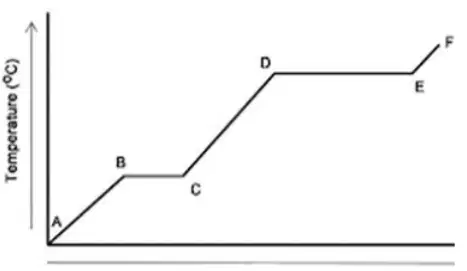
Which letters indicate the region for the melting of a substance?
B to C
D to E
E to F
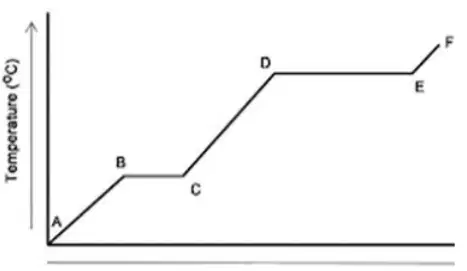
Which letters indicate the region for the vaporization of a substance?
B to C
C to D
D to E
Which letters indicate the region for the condensation of a substance?
C to B
D to C
E to D
Which letters indicate the region for the freezing of a substance?
C to B
D to C
E to D
Where is the solid state found?
A to B
C to D
E to F
Where is the liquid state found?
A to B
C to D
E to F
Where is the gas state found?
A to B
C to D
E to F
Which of the following changes is an example of an endothermic change?
Condensation
Vaporization
Freezing
Which of the following changes is an exothermic change?
Sublimation
Condensation
Melting
As the sample is heated and the temperature rises, the kinetic energy
Increases
Decreases
Stays the same
As the sample is cooled and the temperature lowers, the kinetic energy
Increases
Decreases
Stays the same
Which of the following is unique for any given element?
The number of neutrons
The number of protons
The number of electrons
The formation of an ionic bond involves the
Sharing of electrons
Transfer of electrons
Sea of electrons
According to the law of conservation of mass, how does the mass of the products in a chemical reaction compare to the mass of the reactants?
There is no relationship
The masses are equal
The masses of one side will be greater
Which general statement is not true for metals?
Most metals are brittle
Most metals are ductile
Most metals are malleable
Atoms will form chemical bonds to achieve
A stable eight valence electrons
An electron pair
An unstable eight valence electrons
The formation of a metallic bond involves
Sharing of electrons
Transfer of electrons
Sea of electrons
Lithium and fluorine react together to form LiF. What is the name of this compound?
Lithium fluorine
Lithium (I) fluoride
Lithium fluoride
What is the formula for magnesium chloride?
MgCl
MgCl₂
Mg₂Cl₂
Which of the following chemical reactions is balanced for the synthesis of NaBr?
Na + Br₂ → NaBr
Na + Br₂ → 2 NaBr
2 Na + Br₂ → 2 NaBr
When two or more substances are combined and can be separated by physical means, the result is
A compound
A mixture
An element
Which of the following chemical reactions is balanced for the combustion of methane?
CH₄ + O₂ → H₂O + CO₂
CH₄ + 2 O₂ → 2 H₂O + CO₂
CH₄ + O₂ → H₂O + CO₂
CH₄ + 3 O₂ → H₂O + CO₂
The vertical columns on the periodic table are called
Families
Periods
Columns
Each substance to the right of the arrow in a chemical equation is a(n)
Reactant
Product
Coefficient
The center of an atom is called the
Hub
Nucleus
Core
The state of matter that has a definite volume and definite shape is a
Solid
Liquid
Gas
The state of matter that has a definite volume but no definite shape is a
Solid
Liquid
Gas
The state of matter that has no definite volume but no definite shape is a
Solid
Liquid
Gas
The particles in this state of matter are limited to vibrational motion because the particles are packed so closely together
Solid
Liquid
Gas
The type of matter in which the particles are free to move in all directions until they have spread out evenly throughout the container is a
Solid
Liquid
Gas
The shape of an apple is a
Physical property
Physical change
Chemical property
As the volume of a gas decreases and the temperature remains constant, what will happen to the pressure of the gas?
Remain the same
Decrease
Increase
What are the horizontal rows of the periodic table called?
Families
Periods
Groups
What type of elements include gases, are brittle as solids and poor conductors of heat and electricity?
Metals
Nonmetals
Metalloids
A certain atom has 26 protons, 26 electrons, and 30 neutrons. What is its mass number?
26
52
56
What chemical bond occurs when atoms share electrons to become stable?
Ionic
Metallic
Covalent
Why do the noble gases NOT form compounds readily?
They need too many electrons to be stable
They have a full outer shell
They have an empty outer shell
According to the law of conservation of mass, if two atoms of oxygen are used as a reactant, how many atoms of oxygen must be a part of the product?
0
1
2
What family of elements contains the most active metals?
Alkali metals
Halogens
Noble gases
What subatomic particle has a +1 charge?
Proton
Neutron
Electron
What subatomic particle has a -1 charge?
Proton
Neutron
Electron
Which subatomic particle has no charge?
Proton
Neutron
Electron
What particles are in the nucleus of the atom?
Only protons
Protons and neutrons
Only neutrons
How many valence electrons do members of group 15 have?
2
5
7
How many valence electrons do members of group 13 have?
3
5
7
What type of element is referred to as a semiconductor?
Nonmetal
Metal
Metalloid
What is a mole?
A unit of measurement
An underground animal
A dozen of something
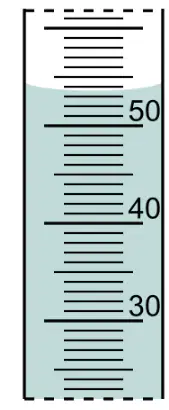
The correct reading of the graduated cylinder on the right is
53.6 mL
53.0 mL
53 mL

The correct reading of the thermometer is
54.2 °C
54.0 °C
54.5 °C
The statement “the rock is shiny” is an example of
Qualitative data
Quantitative data
What is the formula for iron (II) oxide?
FeO
FeO₂
FeO₃
Diamond and graphite are examples of ________________, more than one crystalline form of the same element.
Allotropes
Ions
Isotopes
The periodic table is arranged according to the…
Atomic number, which is the number of protons
Atomic number, which is the number of neutrons
Atomic mass, which is the number of protons
Atomic mass, which is the number of neutrons
What is the formula for the compound of carbon tetrafluoride?
C₂F
C₂F₄
CF₄
CF₅

