
 Worksheets
Waves Quiz Review 22 May Quiz
Total questions: 65
Worksheet time: 2hrs 42mins


The distance between 2 high points (or low points) in a wave.
frequency
wavelength
crest
trough
Mechanical waves that travel through a medium moving back and forth in the same direction the wave travels
Longitudinal wave
Transverse wave
Surface wave
Mechanical waves that travel through a medium moving perpendicular to the motion of the wave.
Transverse wave
Surface wave
Longitudinal wave
medium
The size of the displacement off of resting position
frequency
wavelength
compression
amplitude
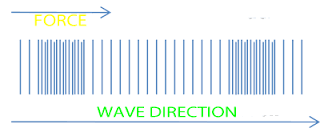
What type of waves have compressions?
A wave that can travel with or without a medium is called a(n)
electromagnetic wave
mechanical wave
surface wave
all waves can travel in any way
What is a general definition of wave interference?
When a wave bounces off an object
When more than on wave meet and interact in the same medium
When a wave bends around a corner
When a wave creates static
When 2 waves meet on the same medium, how do they interact?
They bounce off one another
They travel through one another
They refract off one another

What type of interference is being shown in the picture?
Constructive
Destructive

What type of interference is occurring in the picture?
Constructive
Destructive

What is the index of refraction of a refractive liquid if the angle of incidence in the AIR is 35 degrees and the angle of refraction is 14 degrees? What is the correct way to solve?
n (sin35) = (1)(sin14) ...n=0.42
n (sin35) = (1)(sin14) ...n=2.37
(1)(sin35) = n (sin14) ...n=2.37
(1)(sin35) = n (sin14) ...n=0.42
What is the index of refraction of a refractive liquid if the angle of incidence in the AIR is 35 degrees and the angle of refraction is 14 degrees? What is the correct way to solve?
n (sin35) = (1)(sin14) ...n=0.42
n (sin35) = (1)(sin14) ...n=2.37
(1)(sin35) = n (sin14) ...n=2.37
(1)(sin35) = n (sin14) ...n=0.42
What is the index of refraction of a refractive liquid if the angle of incidence in the AIR is 35 degrees and the angle of refraction is 14 degrees? What is the correct way to solve?
n (sin35) = (1)(sin14) ...n=0.42
n (sin35) = (1)(sin14) ...n=2.37
(1)(sin35) = n (sin14) ...n=2.37
(1)(sin35) = n (sin14) ...n=0.42

If light is traveling from air to water with an angle of INCIDENCE of 40 degrees, what is the angle of refraction? (n=1 air, n=1.33 water)
...How do you solve: (1)(sin40) = (1.33)(sinƟ)
48 degrees
2.07 degrees
11.9 degrees
28.9 degrees
If light is traveling from air to water with an angle of INCIDENCE of 40 degrees, what is the angle of refraction? (n=1 air, n=1.33 water)
...How do you solve: (1)(sin40) = (1.33)(sinƟ)
48 degrees
2.07 degrees
11.9 degrees
28.9 degrees
Light has the highest velocity in which medium?
flint glass n=1.70
barium glass n=1.60
crown glass n=1.523
water n=1.33
diamond n=2.45
diamond
water
flint glass
barium glass

Light travels through a liquid at 2.25 E 8 m/s. What is the index of refraction of the liquid? n=c/v.....v=c/n.....c=3E8 m/s
1.33
1.0
1.523
2.45
Light travels through a liquid at 2.25 E 8 m/s. What is the index of refraction of the liquid? n=c/v.....v=c/n.....c=3E8 m/s
1.33
1.0
1.523
2.45

Light traveling through air encounters a second medium which slows the light to makes the index of refraction 1.6. What is the velocity of light in the second medium? Which is the correct way to set up and solve this problem? n=c/v.....v=c/n.....c=3E8 m/s
n = 3E8 / 1.6
n = 1.6 / 3E8
v = 3E8 / 1.6
v = 1.6 / 3E8

Glass has a _____________ index of refraction (or "n") than air.
Equal
Greater
Less
Impossible to say
According to Willebord Snell, light passing from air to glass will cause the light to
maintain its original speed
accelerate while it is in glass
increase its speed
reduce its speed

If light is traveling from air to water and has an angle of REFRACTION of 30 degrees, what is the angle of INCIDENCE? (n=1 air, n=1.33 water) Which is set up correctly?
(1)(sin30) = (1.33)(sinƟ)....
.....sinƟ = (1)(sin30) / 1.33
(1)(sin30) = (1.33)(sinƟ).....
.....sinƟ = 1.33 / (1)(sin30)
(1)(sinƟ) = (1.33)(sin30)......
....sinƟ = (1.33)(sin30) / 1
(1)(sinƟ) = (1.33)(sin30).....
.....sinƟ = 1 / (1.33)(sin30)

A student placed a pencil in a cup of water. The pencil appears broken because light
always travels in a straight line.
bends when it passes through water.
makes the water in the glass evaporate.
reflects the pencil on the water's surface.

Based on the image, which medium has a larger index of refraction?
Medium 1 has a larger index of refraction.
Medium 2 has a larger index of refraction.
Both mediums have the same index of refraction.
Cannot be determined.

Based on the image, as light passes from medium 1 to medium 2
light speeds up and bends towards the normal
light speeds up and bends away from the normal
light slows down and bends towards the normal
light slows down and bends away from the normal
Based on the image, as light passes from medium 1 to medium 2
light speeds up and bends towards the normal
light speeds up and bends away from the normal
light slows down and bends towards the normal
light slows down and bends away from the normal
Which of the following is a correct representation of snell's law?
n1sinθ2=n2sinθ1
n1sinθ1=n2sinθ2
n2sinθ1=n1sinθ2
n1/sinθ1=n2/sinθ2

Standing waves are created by
Two identical waves reflecting off each other
Two identical waves being diffracted together
Two identical waves move through each other in opposite directions
Two identical waves are diffracted from two identical sources
In the diagram which letters represent the nodes
A B C
A C E
B D
B D E
A C D


The first harmonic has
1 antinode
1 node
2 antinodes
no nodes
The second harmonic on a string fixed at both ends shows
A wavelength
Half a wavelength
Two wavelengths
The third harmonic on a string fixed at both ends shows
A wavelength and a half
Half a wavelength
Two wavelengths
A wavelength

The figure represents a string of length L, fixed at both ends, vibrating in several harmonics. Which string shows the 4th harmonic?
A
B
C
D
E

The figure represents a string of length L, fixed at both ends, vibrating in several harmonics. Which string shows the 3rd harmonic?
A
B
C
D
E
The figure represents a string of length L, fixed at both ends, vibrating in several harmonics. Which string shows the 3rd harmonic?
A
B
C
D
E


Calculate the wavelength of light that has a frequency of 5.2 x 10¹² 1/s.
5.8 x 10 -5 m
5.8 x 10 -7 m
5.19 x 10 14 m
1.56 x 10 23 m
Calculate the wavelength of light that has a frequency of 5.2 x 10¹² 1/s.
5.8 x 10 -5 m
5.8 x 10 -7 m
5.19 x 10 14 m
1.56 x 10 23 m
A wave has a frequency of 10 hz and a wavelength of 4 m. What is the velocity of the wave?
24 m/s
40 m/s
2.5 m/s

