
 Worksheets
Topic 12: Stars, Galaxies, and the Universe Review
Total questions: 76
Worksheet time: 54mins
True or False: A light-year is a measurement of time.
False
True
Scientists classify stars based on _____ and _____.
temperature
color
size
brightness
We live in an ______ galaxy.
Spiral
Irregular
Quasars
Elliptical
Our solar system formed ______ years ago.
4.6 billion
150 million
1 billion
4.8 billion
True or False: Dark matter is the force that is causing the expansion of the universe to accelerate.
False. Dark energy
True. Dark matter
False. Gravity
False. Antimatter
Parallax is used to determine a star’s
Distance from Earth
Composition
Temperature
Brightness
Which of the following is a major difference between elliptical galaxies and spiral galaxies?
Elliptical galaxies have almost no gas or dust between stars.
Elliptical galaxies vary more in shape than spiral galaxies.
Spiral galaxies have almost no gas or dust between the stars.
Spiral galaxies contain only old stars.
A star is born when
A nebula expands
A protostar begins to cool
Helium and oxygen combine
Nuclear fusion starts
The theory astronomers have developed to describe the formation of the universe is known as what?
Big crunch theory
Collision-ring theory
Galactic expansion theory
Big bang theory
Which of the following is not a characteristic of stars?
size
temperature
texture
chemical composition (what it’s made of).
The brightness of a star as seen from Earth is called what?
parallax
absolute brightness
apparent brightness
light-year
A dying high-mass star can suddenly explode, becoming a what?
nebula
protostar
black hole
supernova
Many stars belong to larger groups called what?
star cluster
eclipsing binary
binary stars
galaxies
Gravity pulled most of the gas into the center of the disk, where the gas eventually became hot and dense enough to nuclear fusion to begin and what was born?
The Sun
Inner Planets
Outer Planets
The Universe
What uses powers of ten to write very large or small numbers in shorter form?
Scientific method
Scientific notation
Scientific notes
Exponents
The most massive stars collapse to form ____________ when they die.
black hole
nebula
red giant
supergiant
A dying high-mass star can suddenly explode to become a ____________.
supernova
nebula
white dwarf
red giant
Astronomers have discovered we can only see very little of the mass of galaxies where the remaining mass is known as ____________.
dark matter
supernova
nebula
red giant
Galaxies that appear to have a bulge in the middle and arms that move outward are called ____________.
spiral galaxies
elliptical galaxies
irregular galaxies
dwarf galaxies
Galaxies that are active young galaxies with giant black holes at their centers are known as ____________.
quasars
nebulae
pulsars
white dwarfs
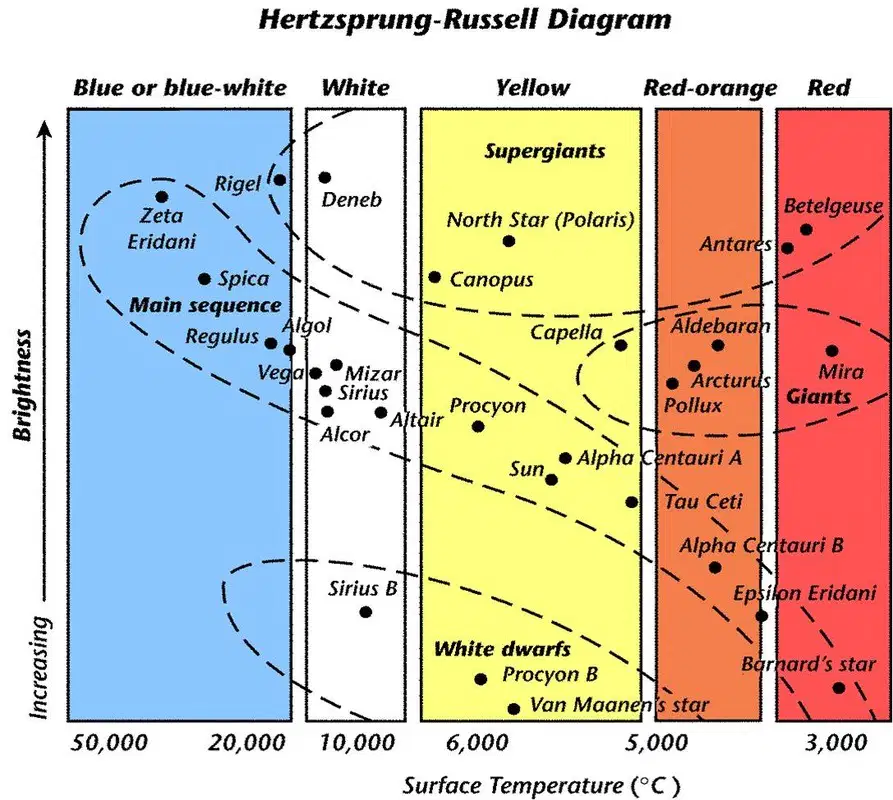
Alcor and Deneb are similar because they are both:
planets
stars
moons
asteroids
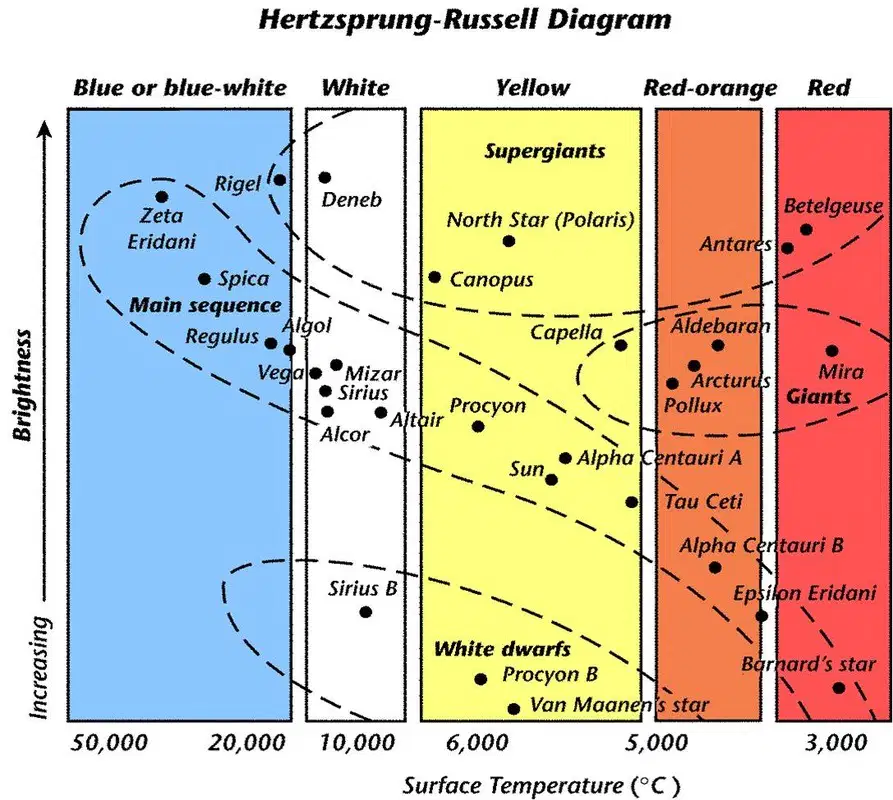
Using the Hertzsprung-Russell Diagram, name the star that is very bright and red in color.
Betelgeuse
Sirius
Sun
Rigel
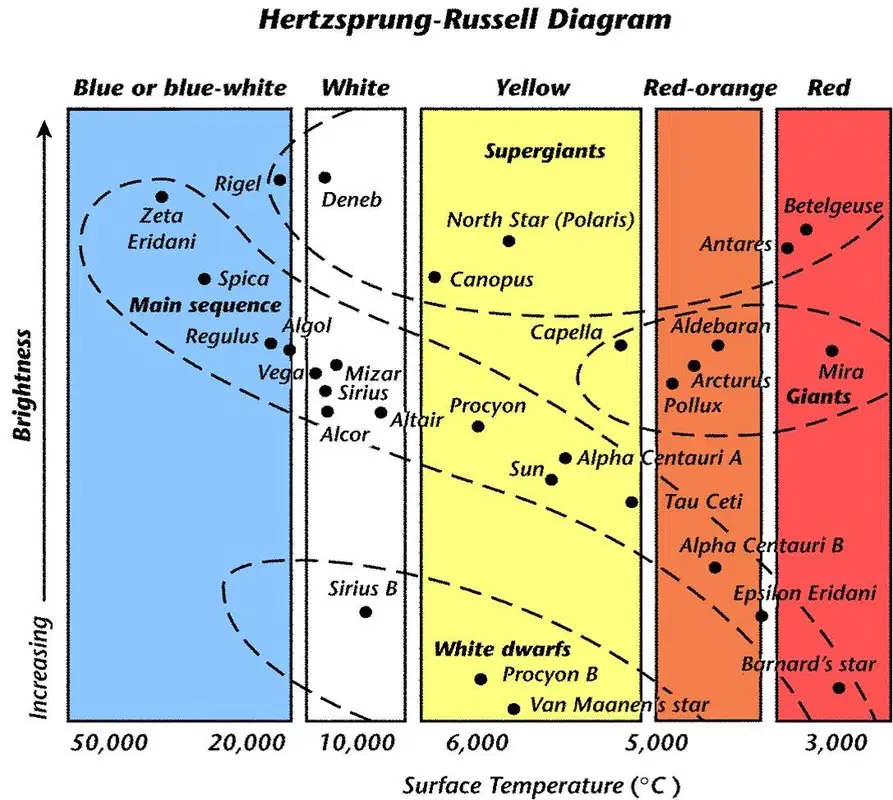
Using the Hertzsprung-Russell Diagram, name the stars on the diagram that are red.
Main Sequence stars
Red Giants and Supergiants
White Dwarfs
Blue Giants
Another word for absolute brightness: ____________
Luminosity
Opacity
Density
Magnitude
Name the scientist who supported his theory of the big bang: ____________
Edwin Hubble
Isaac Newton
Albert Einstein
Galileo Galilei
What is the force that allows the planets to orbit the sun?
Gravity
Magnetism
Friction
Electricity
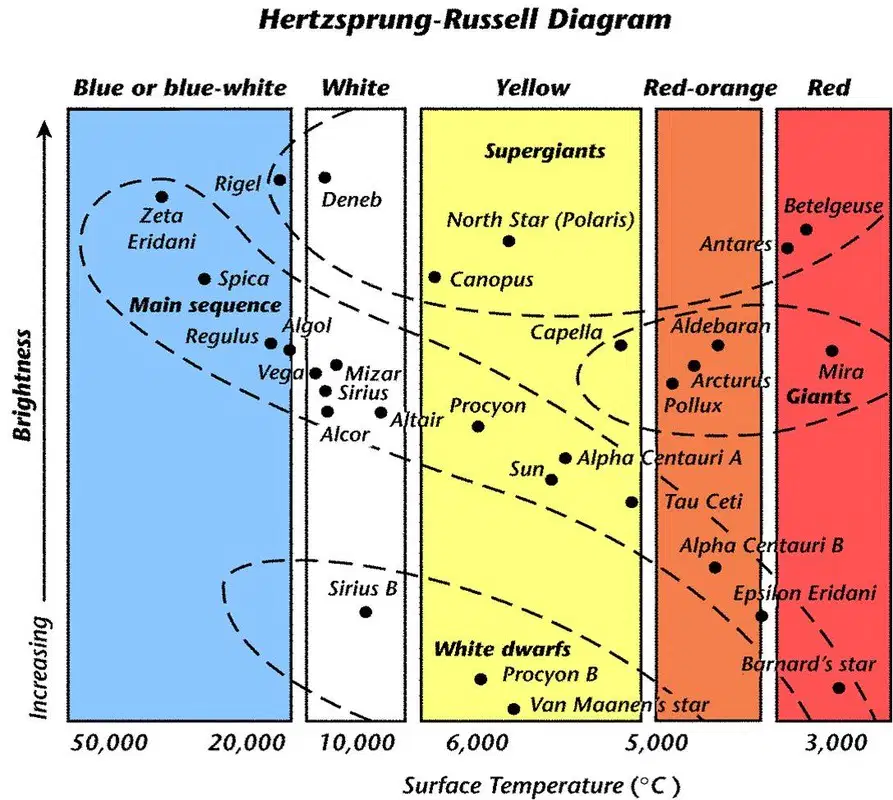
Refer to the Hertzsprung-Russell Diagram. Which type of star is characterized by high brightness and low surface temperature?
White dwarfs
Main sequence
Supergiants
Giants
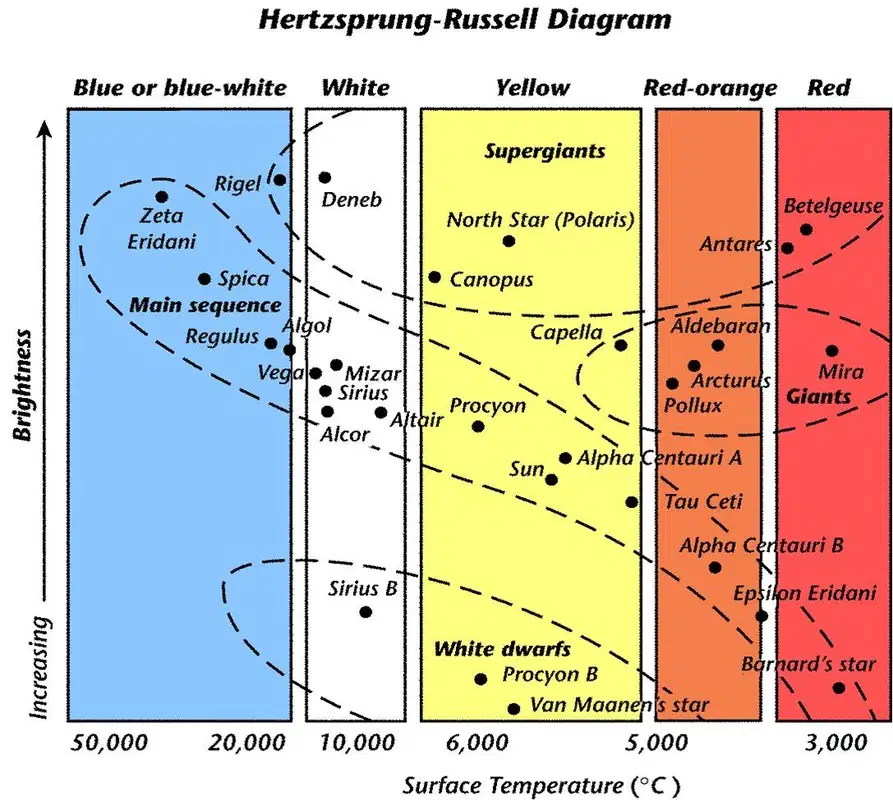
Refer to the Hertzsprung-Russell Diagram. What color are the hottest stars?
Red
Yellow
White
Blue or light blue
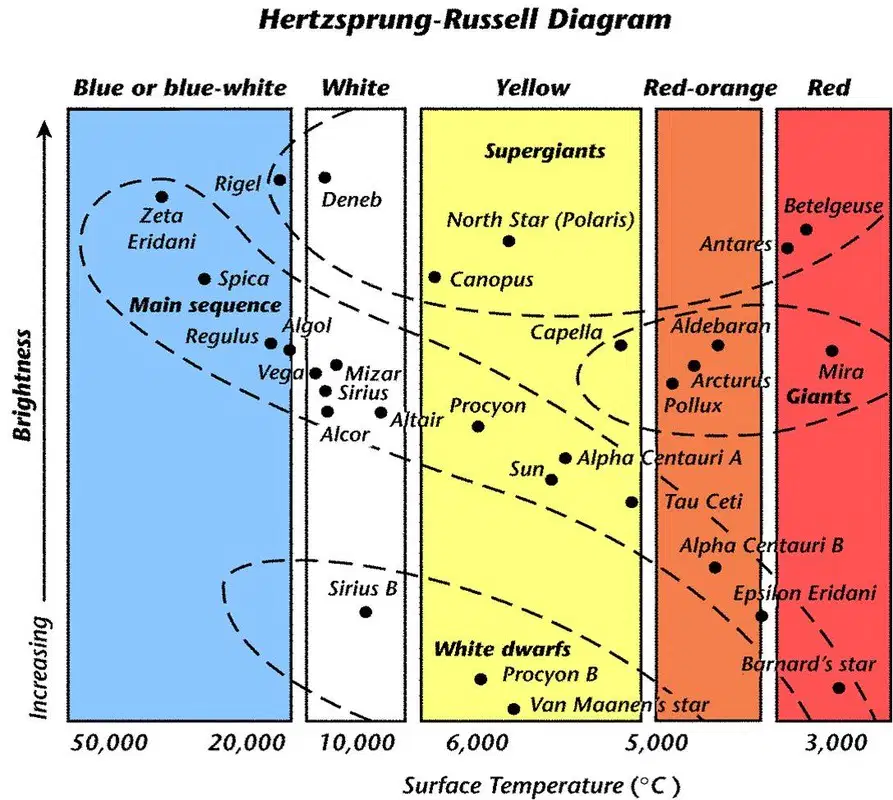
Refer to the Hertzsprung-Russell Diagram.
Fill in the blank: The Sun is classified as a ______ star in the main sequence.
yellow
red
blue
white
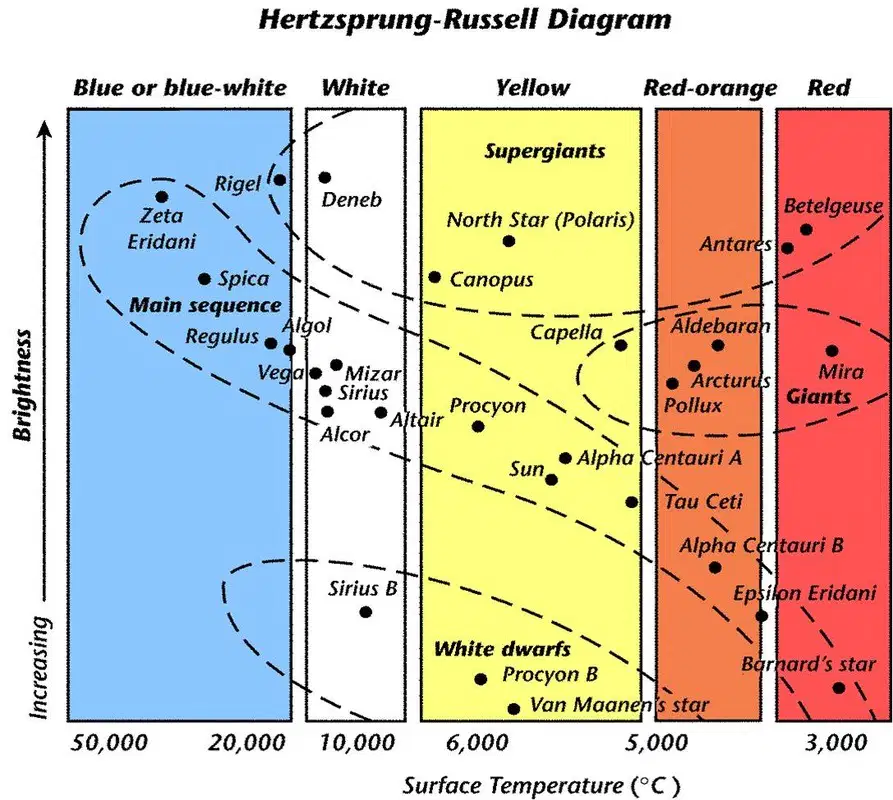
Refer to the Hertzsprung-Russell Diagram. Which of the following stars is a white dwarf?
Betelgeuse
Sirius B
Capella
Antares
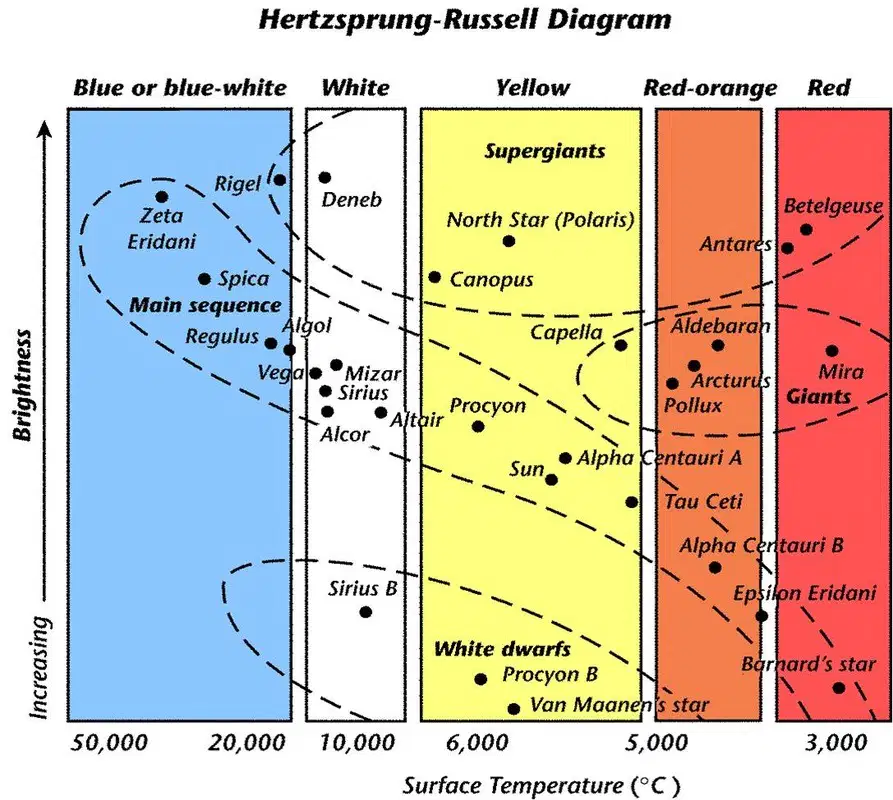
Refer to the Hertzsprung-Russell Diagram. True or False: As the surface temperature of a star increases, its color shifts from red to blue.
True
False
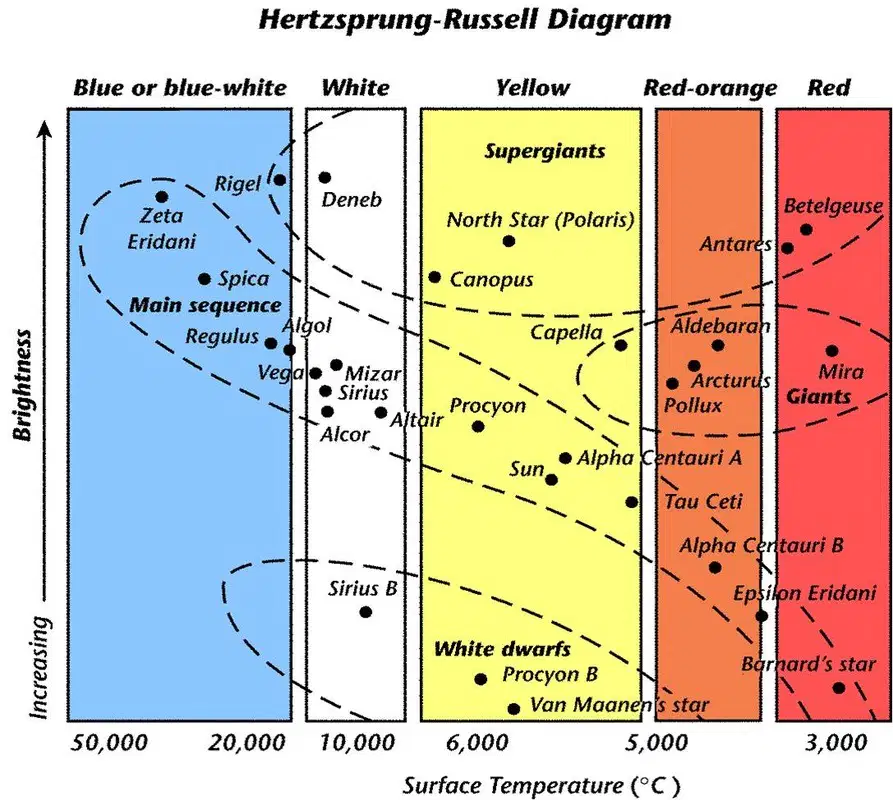
Refer to the Hertzsprung-Russell Diagram. Which type of star is the Sun classified as?
Supergiant
Main Sequence
White Dwarf
Giant
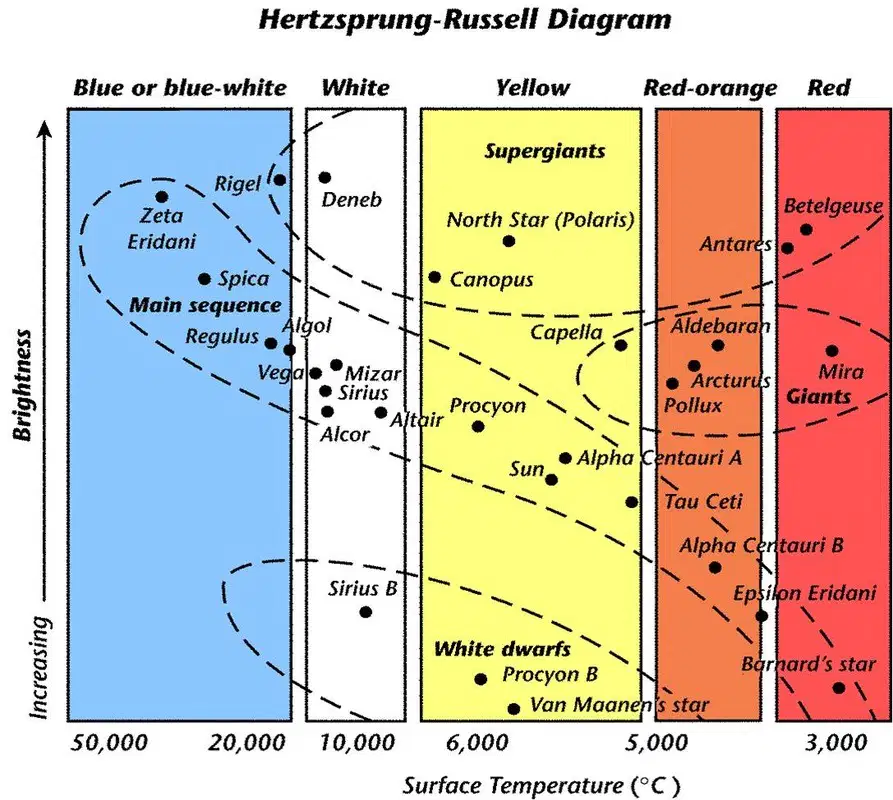
Refer to the Hertzsprung-Russell Diagram. What is the color of stars with the highest surface temperature?
Red
Yellow
Blue or Blue-white
White

Refer to the Hertzsprung-Russell Diagram.
Fill in the blank: Stars with a surface temperature of about 3,000 K are typically ______ in color.
Red
Blue
White
Yellow
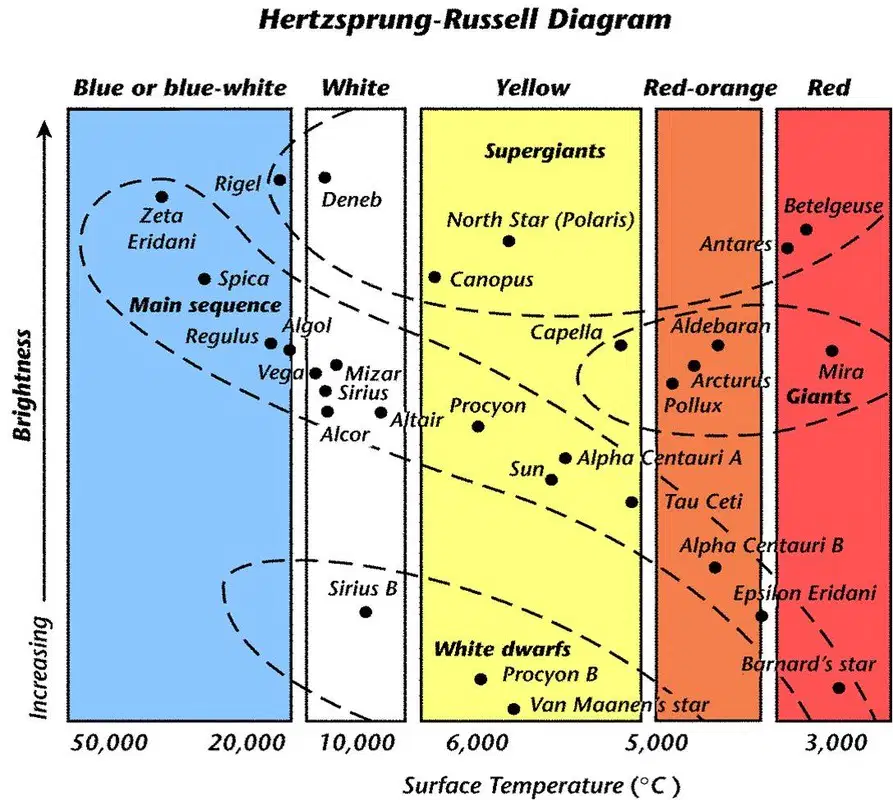
Refer to the Hertzsprung-Russell Diagram.
True or False: As the surface temperature of a star increases, its color shifts from red to blue.
True
False
Luminosity is defined as:
The amount of light emitted by a star or other celestial object.
The distance between two stars.
The temperature of a star.
The size of a planet.
Edwin Hubble was:
an astronomer
a painter
a mathematician
a musician
Gravity is:
A force that attracts objects toward each other
A type of energy
A form of light
A chemical reaction
A spectrograph is used for what purpose in astronomy?
Measuring the brightness of stars
Analyzing the spectrum of light from celestial objects
Calculating the distance to galaxies
Tracking the movement of asteroids
Astronomical Unit (AU)
distance from Earth to Sun-used to measure distances within our solar system (ex. distance between Mars and Jupiter)
distance light travels in one year-used to measure distances outside our solar system (ex. measuring distances between stars/galaxies)
Theory of early astronomers. Earth is at the center of the universe. The sun and planets would revolve around the Earth.
Sun is at the center of the solar system.

Apparent Magnitude/Brightness


Most galaxies are moving away from each other which means the universe is contracting.
True
False
A star that has no fuel but glows faintly is a black dwarf.
True
False
Stars with less mass will last longer than stars with more mass.
True
False
The type of light that humans can see is _______________ light.
visible
ultraviolet
infrared
microwave
The length of a star’s life is determined by its _______________.
mass
luminosity
radius
temperature
What does the Hertzsprung-Russell Diagram graph?
A star's absolute brightness and temperature
A star's apparent and true brightness
A star's distance and temperature
A star's distance and apparent brightness
Astronomers think that in the future the universe will continue to
Shrink
Expand
Explode
Collapse
What does a light year measure?
Temperature
Distance
Brightness
A(n) ___________ galaxy looks like a round or flattened ball.
Elliptical
Irregular
Spiral
Which one is an irregular galaxy?


Which is a spiral galaxy?


Helium and Carbon
Hydrogen and Lithium
Hydrogen and Sodium
Hydrogen and Helium
According to the big bang theory, the universe is about how old?
1 million years
500 billion years
4.7 billion years
14 billion years
What are patterns of stars in the sky called?
Galaxies
Constellations
Star Systems
Comets
The life cycle of a MASSIVE star will be :
short
long
medium
Which objects are not in the correct order ?
Sun, Mercury, Venus, Earth, Asteroid Belt, Mars, Jupiter, Saturn, Uranus, Neptune, Pluto, Kuiper Belt
Mercury and Venus
Neptune and Pluto
Asteroid Belt and Mars
Saturn and Uranus
Gas giants have:
large size
many moons
few moons
rocky interiors
Our Sun is considered a ___________ sized star.
Small
Medium
Large

What type of galaxy is this?
Spiral
Elliptical
Irregular
a huge ball of very hot gases in space
constellation
asteroid
star
galaxy

