
Font size
 Worksheets
Section 11.1 Learning Outcomes
Total questions: 93
Worksheet time: 47mins
Marketing research is:
The process of gathering, analyzing, and interpreting information about a market.
The act of selling products to customers.
A method of advertising products.
A way to manufacture goods.
Two types of data gathered through marketing research are:
Primary and secondary data
Qualitative and quantitative data
Internal and external data
Descriptive and inferential data
Trend research is the process of:
Identifying and analyzing patterns or shifts in consumer behavior, industry, or market.
Creating new products without market analysis.
Ignoring market changes.
Focusing only on past data.
The purpose of a marketing-information system is to:
Collect, analyze, and distribute marketing data for decision making.
Increase product prices in the market.
Develop new products only.
Reduce the number of employees in the marketing department.
Define the term 'marketing research'.
Marketing research is the process of gathering, analyzing, and interpreting information about a market, including information about the target market, consumers, competitors, and the industry as a whole.
Marketing research is the process of creating advertisements for a product or service.
Marketing research is the process of selling products directly to consumers through various channels.
Marketing research is the process of manufacturing goods based on consumer demand.
Define the term 'data'.
Data are facts and statistics collected together for reference or analysis.
Data is a type of computer virus.
Data refers to a programming language.
Data is a type of hardware device.
Define the term 'database'.
A database is an organized collection of data, generally stored and accessed electronically from a computer system.
A database is a type of computer virus that deletes files.
A database is a programming language used to create websites.
A database is a device used to increase internet speed.
Define the term 'primary data'.
Primary data is data collected firsthand for a specific research purpose.
Primary data is data obtained from secondary sources such as books and articles.
Primary data is data that has been processed and analyzed by others.
Primary data is data collected from the internet without verification.
Define the term 'representative sampling'.
Representative sampling is a subset of a population that accurately reflects the members of the entire population.
Representative sampling is a method of collecting data only from volunteers.
Representative sampling is when data is collected from the largest group available, regardless of characteristics.
Representative sampling is a process of selecting only those individuals who are easiest to reach.
Define the term 'qualitative data'.
Qualitative data is non-numerical information that describes qualities or characteristics.
Qualitative data is numerical information that can be measured and counted.
Qualitative data refers to data that is always represented in percentages.
Qualitative data is information that only includes numbers and statistics.
Define the term 'quantitative data'.
Quantitative data is numerical information that can be measured or counted.
Quantitative data is descriptive information that cannot be measured.
Quantitative data refers to opinions and feelings.
Quantitative data is information represented by colors or shapes.
Define the term 'focus group'.
A focus group is a small, diverse group of people whose reactions are studied to gauge the response to a product, service, or concept.
A focus group is a statistical method used to analyze large datasets for market trends.
A focus group is a written survey distributed to a large population to collect quantitative data.
A focus group is a marketing strategy that involves only online feedback from customers.
Define the term 'survey'.
A survey is a method of gathering information from individuals, usually by asking questions.
A survey is a type of weather phenomenon.
A survey is a mathematical equation.
A survey is a form of physical exercise.
Define the term 'variable'.
A variable is any factor, trait, or condition that can exist in differing amounts or types.
A variable is a fixed value that never changes.
A variable is a mathematical operation.
A variable is a type of scientific instrument.
Define the term 'secondary data'.
Secondary data is information that has already been collected for another purpose but is being utilized for a new research project.
Secondary data is information collected firsthand by the researcher for the specific purpose of the study.
Secondary data refers to data that is always qualitative in nature.
Secondary data is information that is never published or made available to the public.
Define the term 'customer buzz'.
Customer buzz refers to the excitement or interest generated among customers about a product, service, or brand.
Customer buzz is the process of collecting customer feedback through surveys.
Customer buzz is a type of customer loyalty program.
Customer buzz refers to the complaints made by customers about a product.
Define the term 'marketing trend'.
A marketing trend is a general direction in which marketing strategies and tactics are moving.
A marketing trend is a fixed rule that all companies must follow.
A marketing trend is a type of product packaging.
A marketing trend is a government regulation on advertising.
Define the term 'social trend'.
A social trend is a pattern of change in society that influences consumer behavior and preferences.
A social trend is a government policy that regulates business operations.
A social trend is a type of weather pattern affecting agriculture.
A social trend is a financial strategy used by corporations.
Define the term 'marketing-information system (MkIS)'
A marketing-information system (MkIS) is a system for gathering, analyzing, and distributing marketing information to support decision making.
A marketing-information system (MkIS) is a system for managing financial transactions within an organization.
A marketing-information system (MkIS) is a tool for automating production processes in manufacturing.
A marketing-information system (MkIS) is a platform for recruiting and training new employees.
Define the term 'database marketing'.
Database marketing is a form of direct marketing that uses databases of customers to generate personalized communications and offers.
Database marketing is a method of storing physical products in a warehouse for distribution.
Database marketing refers to the process of creating databases for software development purposes.
Database marketing is a technique used to manage employee records in an organization.
The role of data in marketing research is to:
Provide insights for decision making
Increase product prices
Reduce advertising costs
Eliminate competition
Fill in the blank: ________ is the process of gathering and analyzing information to help make sound marketing decisions.
Marketing research
Advertising
Sales promotion
Public relations
Fill in the blank: ________ is information provided by marketing research.
Market intelligence
Product pricing
Sales commission
Employee benefits
Fill in the blank: ________ involves gathering and analyzing information about markets, customers, industry trends, new technology, and competing businesses.
Marketing-information management (MIM)
Product placement
Sales forecasting
Brand licensing
Fill in the blank: The ________ focuses on satisfying customers as the means of achieving profit goals.
marketing concept
production concept
selling concept
product concept
Fill in the blank: ______ are pieces of information gained through research.
Data
Opinions
Stories
Guesses
What is an organized collection of data in digital form called?
Data
Database
Customer
Research
Fill in the blank: Many businesses collect data and contact information about their current customers and store the information in a ______.
customer database
filing cabinet
marketing brochure
employee handbook
A ______ contains the results of marketing research.
customer database
marketing research database
data
contact list
Fill in the blank: ________ are pieces of information collected directly by an individual or organization.
Primary data
Secondary data
Estimated data
Derived data
Fill in the blank: ________ is conducted firsthand by a researcher.
Primary research
Secondary research
Desk research
Meta-analysis
Fill in the blank: A ________ is a group that includes a cross section of the entire population that is targeted.
representative sampling
random variable
control group
independent variable
Fill in the blank: ________ is the number of people who live within a defined area.
Population
Climate
Altitude
Economy
Fill in the blank: A ________ is the number of people in a research sample.
sample size
variable
hypothesis
control group
Being community-minded is important because:
It helps build stronger relationships and support systems.
It makes people more competitive.
It encourages isolation.
It reduces cooperation.
Showing school spirit can be done in which of the following ways?
Wearing school colors
Participating in school events
Cheering at games
All of the above
The next step for you after graduation is:
Pursue higher education
Start a job
Take a gap year
Start a business
Do you participate in community activities?
Yes
No
You attend school events and functions.
Yes
No
After graduation, are you:
heading to college?
entering the workforce?
enlisting in the military?
Fill in the blank: ________ are bits of information that provide insight into what people think about a topic.
Qualitative data
Quantitative data
Numerical data
Statistical averages
Fill in the blank: ________ are facts and figures from which conclusions can be drawn.
Quantitative data
Opinions
Assumptions
Predictions
Which of the following is a common way to collect primary data?
Observations
Textbooks
Internet memes
Fictional stories
Which of the following is a common way to collect primary data?
Interviews
Novels
Cartoons
Advertisements
Which of the following is a common way to collect primary data?
Surveys
Recipes
Poems
Paintings
Which of the following is a common way to collect primary data?
Diaries
Movies
Songs
Comics
Which of the following is a common way to collect primary data?
Experiments
Jokes
Advertisements
Posters
What does a researcher do in the observation method of collecting primary data?
Conducts surveys
Watches people or situations and records facts
Analyzes data from reports
Interviews consumers
What is the central research issue in observation for marketing research data?
Product pricing
Consumer behavior
Advertising effectiveness
Market segmentation
A ________ is a person hired by a company to visit its place of business and observe the quality of service.
secret shopper
cashier
security guard
manager
Observers must have objectivity, which means to be ________, or free of personal feelings, prejudices, or interpretations.
unbiased
emotional
subjective
partial
In observation, observers are allowed to let their personal feelings influence their findings.
True
False
What is an interview in the context of marketing research data?
A casual conversation between friends
A formal meeting between two or more people to obtain certain information
A written survey
An online poll
What is the central research issue addressed by interviews in marketing research?
A) Insight into thoughts and opinions of people about a product or business
B) Collecting sales data
C) Analyzing financial statements
D) Designing advertisements
Fill in the blank: A ________ is a group of people brought together to discuss a specific topic.
Focus group
Lecture
Interview
Survey
Which of the following is NOT a way to conduct interviews in marketing research?
Focus group
One-on-one interviews
Sending mass emails
Both A and B
What is a survey? Fill in the blank: A ______ is a set of questions posed to a group of people to determine how that group thinks, feels, or acts.
survey
experiment
theory
hypothesis
Surveys are often used to obtain what type of data?
Quantitative data
Anecdotal stories
Historical artifacts
Chemical formulas
What is the central research issue when using surveys in marketing research?
Gathering facts and figures about a group of consumers.
Designing new products for the market.
Setting prices for different market segments.
Choosing advertising channels for a campaign.
Before deciding to use a written survey, what is one important consideration?
What is the best method for getting information?
How many people like surveys?
What color should the survey be?
How long will it take to print the survey?
Before deciding to use a written survey, what is one important consideration?
Who is the target audience?
What is the weather like?
How many pages does the survey have?
What color is the survey paper?
Before deciding to use a written survey, what is one important consideration?
How many people should receive the survey to get an adequate number of responses?
What color should the survey paper be?
Should the survey be handwritten or typed?
What font size should be used for the survey?
Before deciding to use a written survey, what is one important consideration?
How will a representative sampling be selected?
What color should the survey paper be?
How many questions can be skipped?
Should the survey be handwritten or typed?
According to the guidelines for creating a survey, what type of questions should be included to make it easy for respondents to answer?
Open-ended questions
Closed-ended questions
Subjective questions
None of the above
According to the guidelines for creating a survey, why is it important to write objective questions?
Because questions should not lead respondents to a particular answer, as biased questions produce biased data.
Because objective questions are always easier to answer than subjective ones.
Because objective questions guarantee higher response rates.
Because objective questions are more entertaining for respondents.
According to the guidelines for creating a survey, questions should be put in a ______ sequence.
logical
random
alphabetical
reverse
According to the guidelines for creating a survey, why should a survey be kept short?
To save paper
To reduce costs
Respondents may not take the time to complete a long survey
To make it more interesting
According to the guidelines for creating a survey, what is the benefit of including space for comments?
The best information may come from unstructured responses.
It reduces the length of the survey.
It ensures all responses are identical.
It eliminates the need for data analysis.
What is a diary in the context of marketing research data?
A written record of the thoughts, activities, or plans of the writer during a given period of time.
A list of products sold in a store.
A type of advertisement.
A financial report.
What is the central research issue when using a diary in marketing research?
A) Learning about the activities of consumers.
B) Calculating profits.
C) Designing advertisements.
D) Managing employees.
An open-response format allows respondents to write whatever they want about their experiences.
True
False
A forced-choice format uses ________, where only one answer can be chosen from several options, such as a multiple-choice test.
closed-ended questions
open-ended questions
subjective questions
essay questions
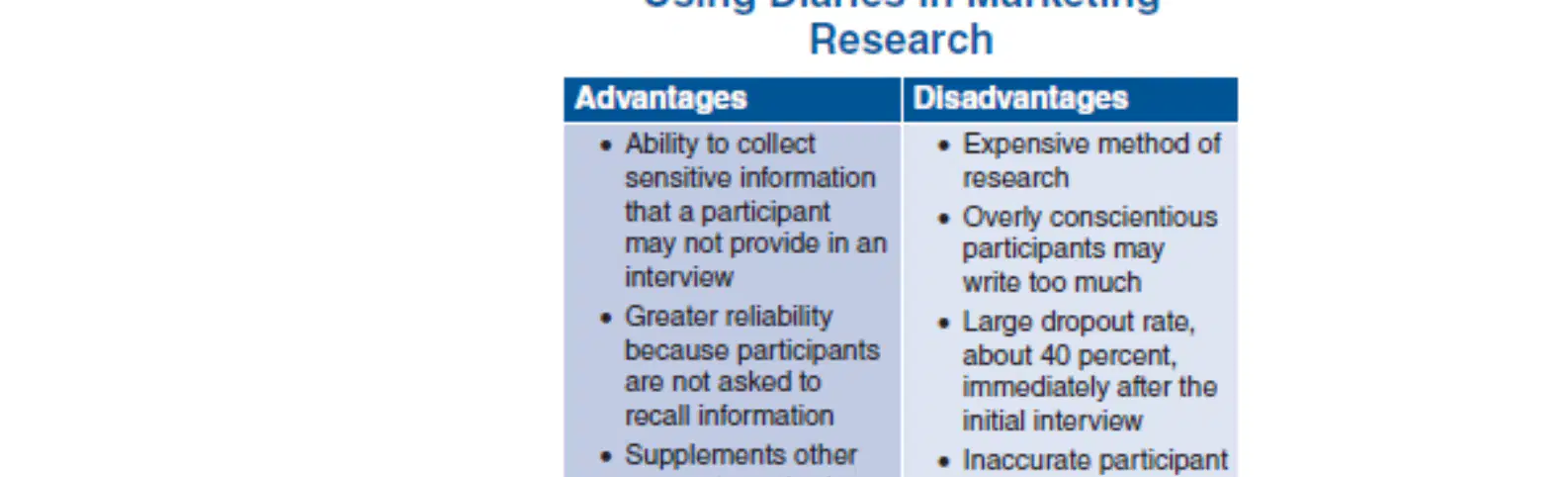
One advantage of using diaries in marketing research is the ability to collect ______ information that a participant may not provide in an interview.
sensitive
irrelevant
public
general
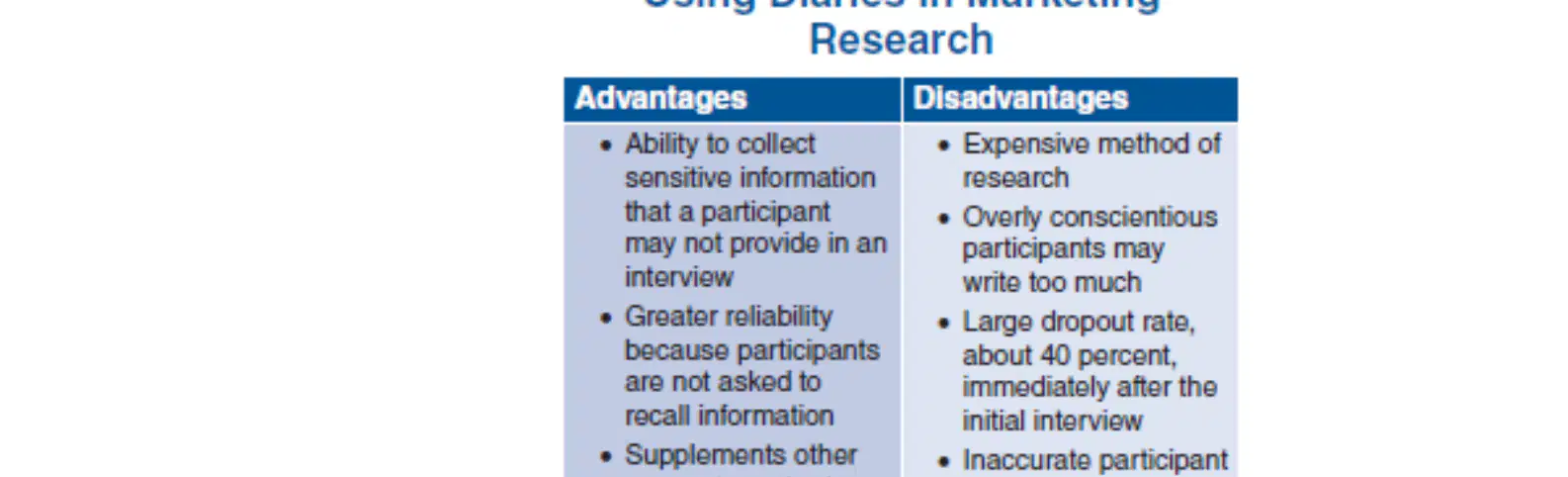
Using Diaries in Marketing Research: Fill in the blank. Greater ______ is an advantage of using diaries in marketing research because participants are not asked to recall information.
reliability
cost
complexity
bias
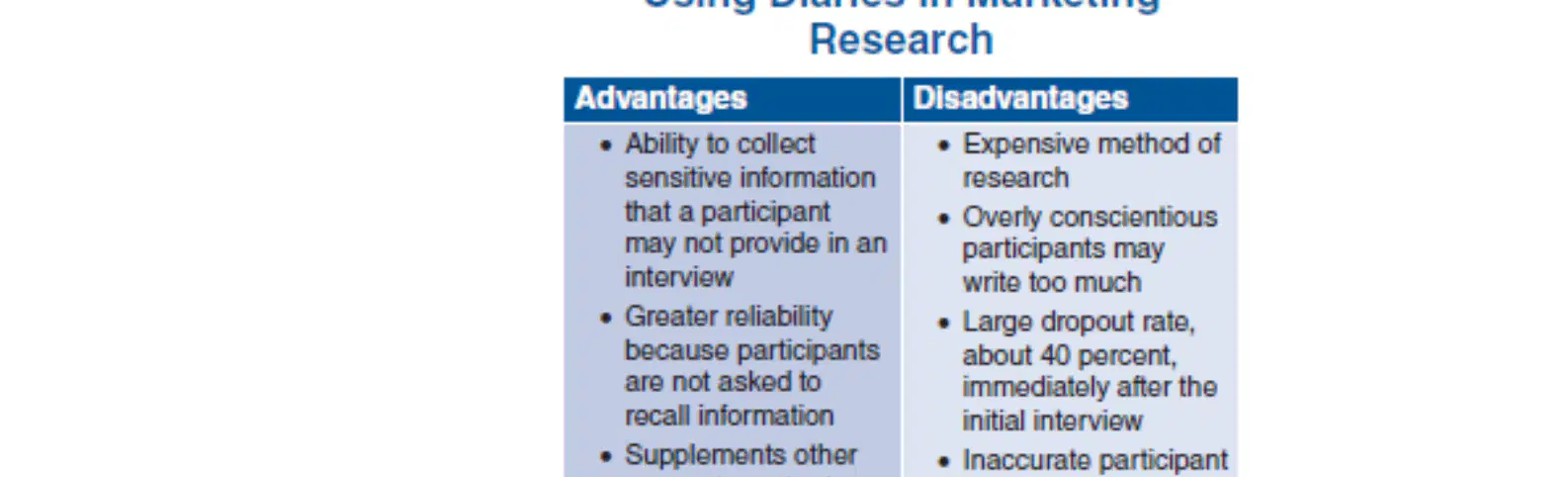
Using diaries in marketing research can supplement other ______ methods.
research
cooking
driving
painting
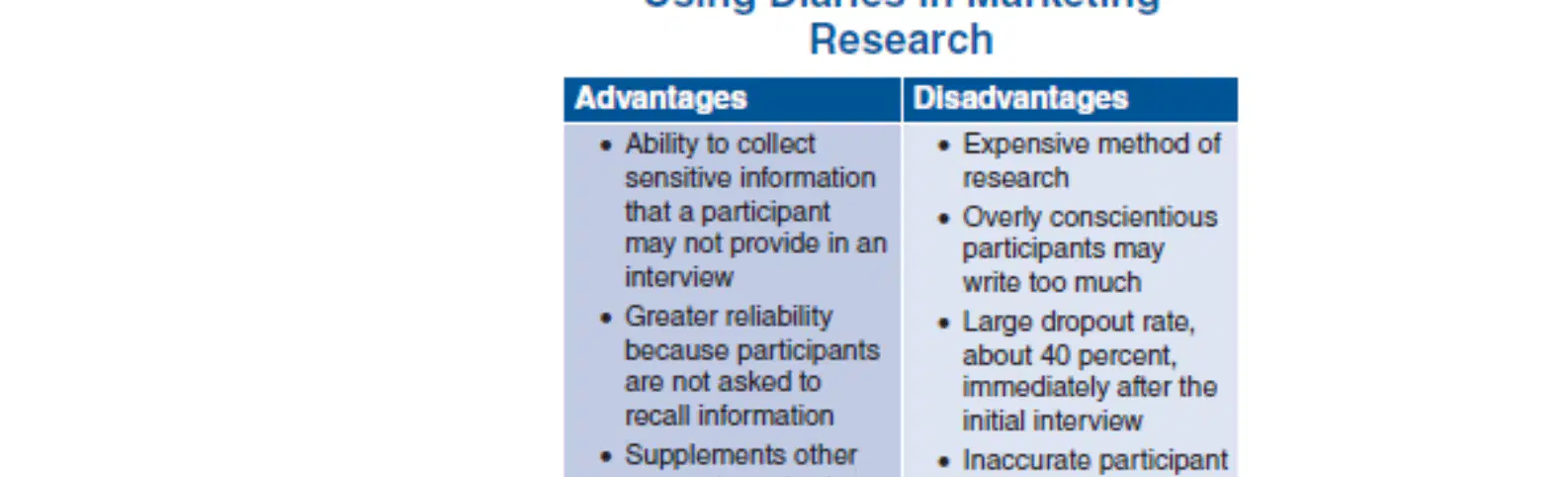
Using Diaries in Marketing Research: Which of the following is a disadvantage of using diaries in marketing research?
Ability to collect sensitive information
Expensive method of research
Greater reliability
Supplements other research methods
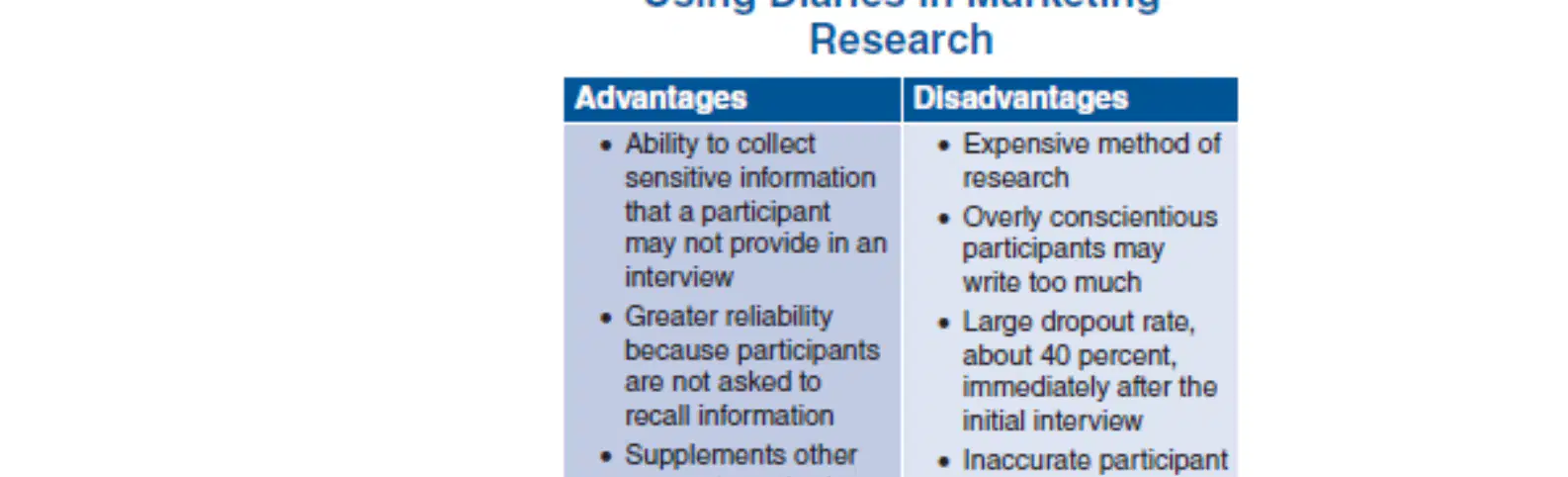
Overly conscientious participants may write too much is a disadvantage of using diaries in marketing research.
True
False
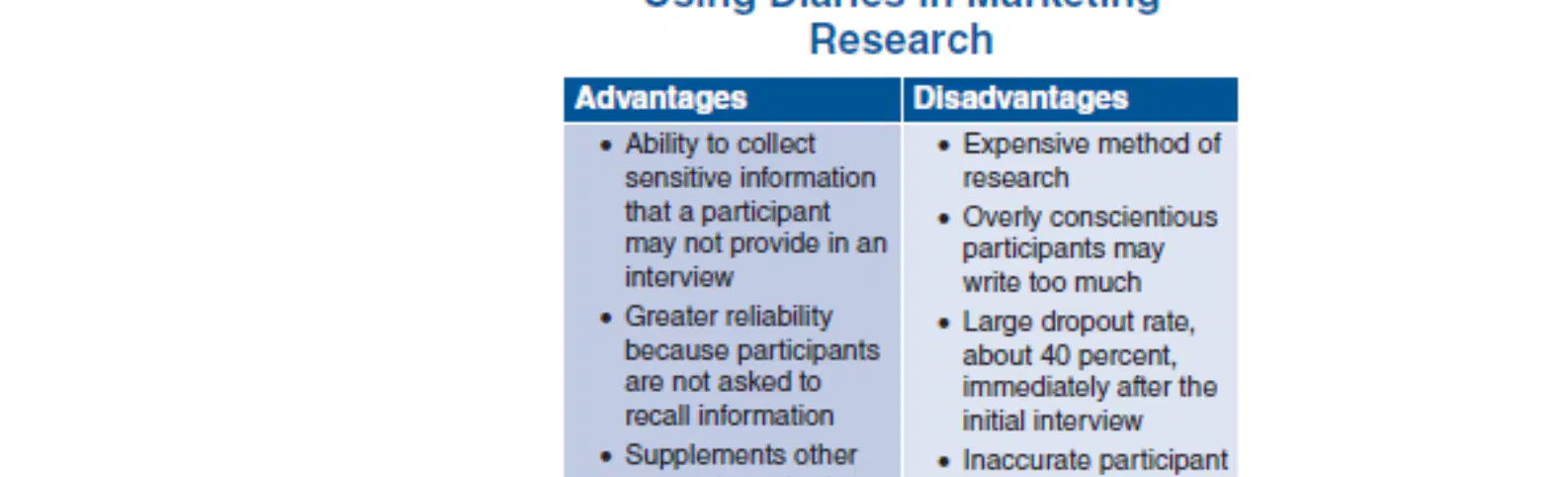
Using Diaries in Marketing Research: Fill in the blank. A large ______ rate, about 40 percent, immediately after the initial interview is a disadvantage of using diaries in marketing research.
dropout
response
growth
success

Inaccurate participant ______ is a disadvantage of using diaries in marketing research.
responses
locations
products
budgets
Fill in the blank: An ________ is a procedure performed in a controlled environment to test or discover something.
experiment
observation
lecture
prediction
What is the central research issue in an experiment?
Testing a variable
Collecting opinions
Observing natural behavior
Analyzing sales data
Fill in the blank: A ________ is something that changes or can be changed in an experiment.
variable
constant
result
hypothesis
Research sets up two situations that differ in only one variable.
True
False
Results from two experiment situations are compared for results.
True
False
What are secondary data in marketing research?
Information, statistics, or other types of data that already exist.
Data collected firsthand for a specific research purpose.
Data generated through experimental research only.
Information obtained exclusively from focus group discussions.
Secondary research is searching data already assembled and recorded by whom?
Someone else.
Yourself.
A computer program.
A research assistant.
Which of the following is NOT an external source of secondary data?
Governmental sources
Market research sources
Internal data collected by the company
The Internet
Internal sources of secondary data include ________ collected by the company.
internal data
external data
government reports
industry publications
Which of the following is an example of an external source of secondary data?
Internal data collected by the company
Trade associations
Employee records
Company memos
List any two external sources of secondary data mentioned in the slide.
Governmental sources, Market research sources, Academic sources, Trade associations, The Internet (any two)
Personal interviews, Focus groups, Direct observation, Experiments, Case studies (any two)
Internal memos, Employee records, Company newsletters, Staff meetings, Internal reports (any two)
Family discussions, Personal diaries, Home videos, Private letters, Family photo albums (any two)
Governmental sources: Federal, state, and local governments collect an enormous amount of ________.
data
furniture
paintings
vehicles
Governmental sources: Information can easily be found about the economy, industries, and the ________.
population
weather
transportation
architecture
Which of the following is NOT mentioned as a type of information that can be found from governmental sources?
A) Economy
B) Industries
C) Population
D) Weather

