
 Worksheets
Food Chain, Food Web, and Energy Pyramid Assessment
Total questions: 19
Worksheet time: 10mins
Name
Class
Date
1.
1. Approximately how much energy is transferred from one trophic level to the next?
a)
10 %
b)
15 %
c)
50 %
d)
5 %
2.
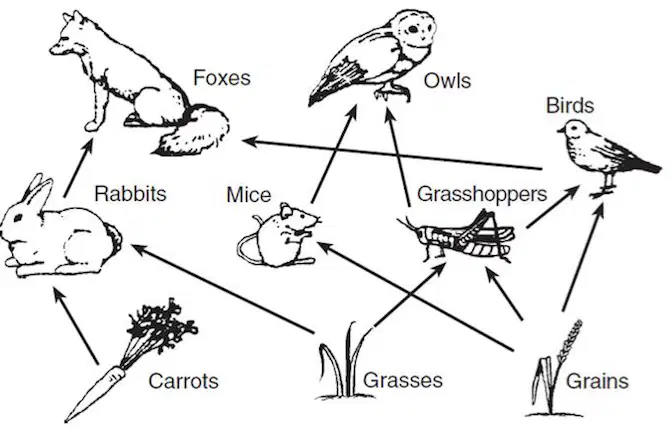
2. This is an example of a simple food web. Which of these organisms are producers?
a)
Foxes, Owls, Birds
b)
Rabbits, Mice, and Grasshoppers
c)
Carrots, Grasses, and Grains
d)
Grasses, Rabbits, Foxes
3.
3. Humans consume a diet that consists of both meats and plants. Humans are an example of _______.
a)
Omnivore
b)
Carnivore
c)
Herbivore
d)
Producer
4.
4. Worms, mushrooms, and bacteria serve an important role in our ecosystem. They are ______ which are responsible for consuming dead organisms and recycle nutrients back into the ecosystem.
a)
Producers
b)
Primary Consumers
c)
Decomposers
d)
Tertiary Consumers
5.
5. What is the correct sequence (order) of organisms starting at the base of the energy pyramid and working up?
a)
Tertiary Consumers->Secondary Consumers-> Primary Consumers->Producers
b)
Producers->Primary Consumers->Secondary Consumers-> Tertiary Consumers
c)
Secondary Consumers-> Primary Consumers->Producers->Tertiary Consumers
d)
Primary Consumers->Tertiary Consumers->Secondary Consumers->Producers
6.
6. The arrows in a food chain represents__________.
a)
The flow of energy from consumer to producer.
b)
The flow of energy from one source(producer or consumer) to another consumer.
c)
The flow of dead matter from one organism to the next.
d)
The flow of matter from predator to prey.
7.
7. What are the three energy roles that organisms fill in an ecosystem?
a)
scavenger, decomposer and consumer
b)
omnivore, carnivore and herbivore
c)
producer, consumer and scavenger
d)
producer, consumer and decomposer
8.
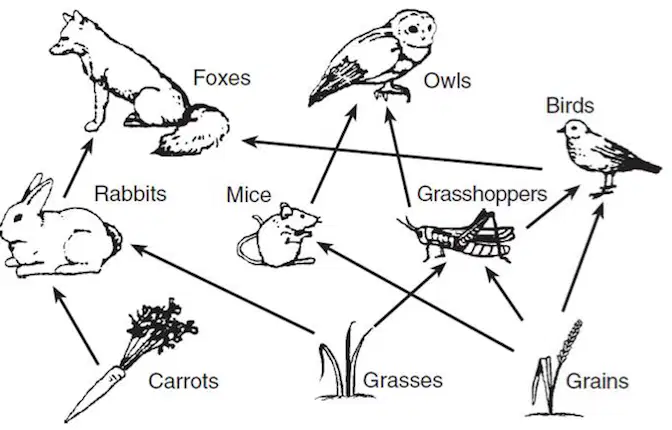
8. If the following food web was represented in an energy pyramid, which organism(s) would have the least energy?
a)
Rabbits, mice, grasshoppers
b)
Carrots, grasses, and grasshoppers
c)
Carrots, grains, and grasses
d)
Foxes, owls, and birds
9.
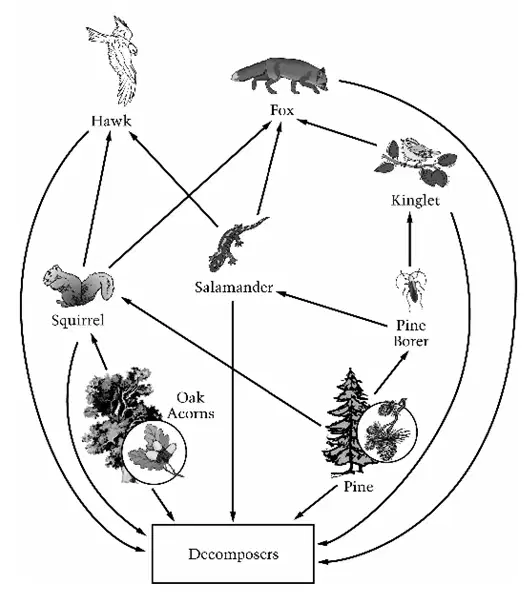
9. The following is a food web. Which represents a food chain in this food web?
a)
Oak-> Decomposer->Squirrel->Hawk
b)
Decomposer-> Salamander->Fox
c)
Decomposer->Pine->Pine borer
d)
Oak->Squirrel->Fox->Decomposer
10.
10. A(n) _______________ is an organism that will only eat consumers.
a)
Omnivore
b)
Herbivore
c)
Carnivore
d)
Producer
11.
11. What level of the energy pyramid is the largest?
a)
The top, tertiary consumer
b)
The bottom, producer
c)
The second to bottom, primary consumer
d)
None of the above
12.
12. Which type of organism is vital (important) in recycling nutrients back into the ecosystem?
a)
Producer
b)
Sun
c)
Decomposers
d)
Consumers
13.
13. Phytoplankton convert the sun’s energy into consumable energy for some marine life. The organisms that eat phytoplankton are ________.
a)
Producers
b)
Primary Consumers
c)
Secondary Consumers
d)
Tertiary Consumers
14.
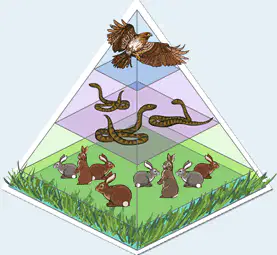
14. If a disease strikes the snake population in the food chain shown, what will be the initial effect on the populations of hawks and rabbits?
a)
The populations of hawks and rabbits will decrease.
b)
The populations of hawks and rabbits will increase.
c)
The population of hawks will increase. The population of rabbits will decrease.
d)
The population of hawks will decrease. The population of rabbits will increase.
15.
15. What is the BEST way to show the interaction between organisms in an ecosystem?
a)
A food chain because you can see what an organism eats and what eats it,
b)
A picture because you can see all of the organisms
c)
A food web because you can see all the interactions that could occur in the ecosystem
d)
All of the above
16.
16. An organism feeds on the dead bodies of other organisms. This organism is a
a)
decomposer
b)
scavenger
c)
predator
d)
carnivore
17.
17. Why are there usually few organisms at the top of an energy pyramid?
a)
They need less food to survive
b)
Energy is lost as you move up, so there is less energy available
c)
Energy is gained as you move up, so there is less energy available
d)
They is neither lost or gained, they just eat less
18.
18. A giraffe eats trees, it is a(n)
a)
producer
b)
carnivore
c)
scavenger
d)
herbivore
19.
BONUS: Algae is a(n)
a)
heterotroph
b)
autotroph
c)
consumer
d)
decomposer
100 %

