Wayground logo

Free Printable Worksheets

Font size

S
M
L
XL
Worksheets

Crit A

Total questions: 143

Worksheet time: 4hrs 42mins

Name
Class
Date
1.

Doesn't cause the object to become radioactive

a)

Contamination

b)

Irradiation

2.

Occurs if the radioactive source is on or in the object

a)

Contamination

b)

Irradiation

3.

In radiotherapy, the radiactive source stays inside the machine. The person is

a)

Irradiated

b)

Contaminated

4.

Eating Radioactive material _____ the stomach.

a)

Irradiates

b)

Contaminates

5.

Surgical instruments are put near a radioactive source to kill bacteria. This is called...

a)

Irradiation

b)

Contamination

6.

Alexander Litvinenko was poisoned when he drank tea containing Polonium-210. His tea was

a)

Irradiated

b)

Contaminated

7.

A person breathes in Radon gas. Radon is an alpha emitter.

a)

The person is contaminated.

b)

The person is irradiated.

8.

Clouds contain radioactive materials. When the clouds are high in the sky we are being

a)

irradiated

b)

contaminated

9.

Rocks contain radioactive uranium. There are rocks under the ground. We are being

a)

irradiated

b)

contaminated

10.

Rocks contain radioactive uranium. If I swallowed a tiny bit of rock I would be

a)

irradiated

b)

contaminated

11.

The banana you had as a snack contains radioactive potassium. You have been

a)

irradiated

b)

contaminated

12.

The banana you had as a snack contains radioactive potassium. Your clothes have been

a)

irradiated

b)

contaminated

13.

If a person is injected with a radioactive source they are...

a)

contaminated

b)

irradiated

14.

Select the correct option.

a)

Everything that is irradiated is also contaminted.

b)

Everything that is contaminated is also irradiated.

c)

Both of these statements are true.

15.
What is emitted during Beta Radiation?
a)
A high-energy Electron.
b)
Protons.
c)
Neutrons.
d)
Nuclei
16.
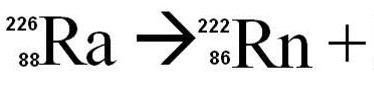
Complete the nuclear equation and determine the type of decay that is occurring in this reaction. 
a)
alpha
b)
beta
c)
gamma
d)
none
17.
A helium nucleus with two protons and two neutrons is called a(n) ____.  
a)
alpha particle
b)
electroscope
c)
beta particle
d)
gamma ray
18.
Negatively charged particles emitted from a nucleus at a high speed are ____.  
a)
alpha particle
b)
gamma rays
c)
beta particles
d)
X rays
19.
What type of decay?
a)
alpha
b)
beta
c)
gamma
20.
A material that can stop gamma radiation is
a)
lead
b)
jello
c)
sunscreen
d)
wood
21.
A material that can stop alpha radiation is
a)
lead
b)
paper
c)
sunscreen
d)
wood
22.
An isotope is an atom of an element with a different number of
a)
protons
b)
electrons
c)
neutrons
d)
pencils
23.
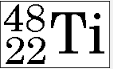
How many protons does this isotope of titanium have?
a)
48
b)
22
c)
26
d)
70
24.
What happens to the atomic number during alpha decay?
a)
The atomic number decreases by 4
b)
The atomic number increases by 1
c)
The atomic number decreases by 2.
d)
The atomic number stays the same.
25.
Arrange in order of increasing ability to penetrate matter.
a)
Beta, gamma, alpha
b)
Alpha, gamma, beta
c)
Gamma, beta, alpha
d)
Alpha, beta, gamma
26.
Balance the following equation:
146C --> 0-1e + ________
a)
145B
b)
146C
c)
147N
d)
42He
27.
Which type of nuclear radiation is being emitted here?
a)
Alpha
b)
beta
c)
gamma 
d)
none
28.
What particle completes this reaction?
a)
alpha particle
b)
beta particle
c)
gamma particle
d)
neutron
29.
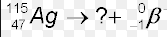
What element is the ?
a)
Ag-115
b)
Cd-115
c)
Pd-115
d)
Not Listed
30.

If we start off with element 5024X after an gamma decay we get an element(product) that looks like...

a)

5124X

b)

5023X

c)

5024X

d)

5025X

31.
If Gadolinium-150 goes through alpha decay, the resulting element has a new atomic mass of _____.
a)
150
b)
148
c)
146
32.
What element is the ?
a)
Ag-115
b)
Cd-115
c)
Pd-115
d)
Not Listed
33.
Balance the following equation:
146C --> 0-1e + ________
a)
145B
b)
146C
c)
147N
d)
42He
34.
a)
42He
b)
0-1 e
c)
00Y
d)
178O
35.
a)
42He
b)
0-1 e
c)
00Y
d)
178O
36.
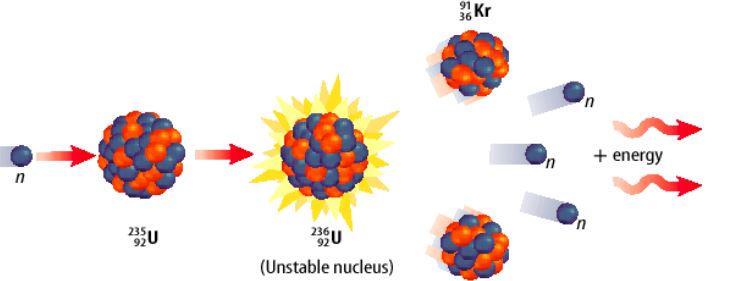
The splitting of a nucleus into smaller nuclei is
a)
fusion
b)
fission
c)
decay
d)
gamma radiation
37.
Two or more nuclei combine to form one larger nucleus in the process of nuclear _____.
a)
Fusion
b)
Fission
c)
Tracing
d)
Decay
38.
Solve this equation for alpha decay.
88226Ra = ___ + 24He
a)
86222Rn
b)
89226Ac
c)
84224Po
d)
88225Ra
39.
Solve this equation for alpha decay.
85209At = ___ + 24He
a)
83205Bi
b)
86209Rn
c)
81207Tl
d)
85208At
40.
Solve this equation for beta decay.
614C = ___ + -10e
a)
410Be
b)
714N
c)
210He
d)
613C
41.
Solve this equation for beta decay.
2760Co = ___ + -10e
a)
2556Mn
b)
2860Ni
c)
2358V
d)
2759Co
42.

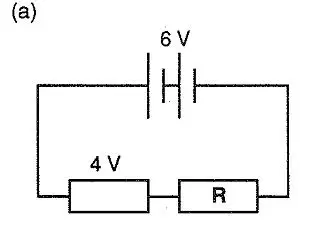
What is the current at P?

a)

3A

b)

0A

c)

6A

43.

What is the current at Q?

a)

3A

b)

0A

c)

6A

44.

What is the current at P?

a)

3A

b)

2A

c)

1A

d)

0A

45.

What is the current at Q?

a)

3A

b)

2A

c)

1A

d)

0A

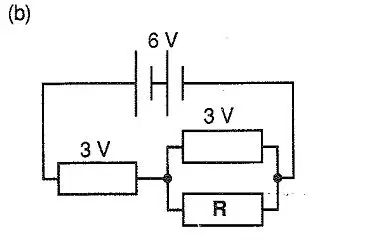
46.

What is the voltage across component R?

a)

6V

b)

4V

c)

2V

d)

0V

47.

What is the Voltage across component R?

a)

6V

b)

3V

c)

0V

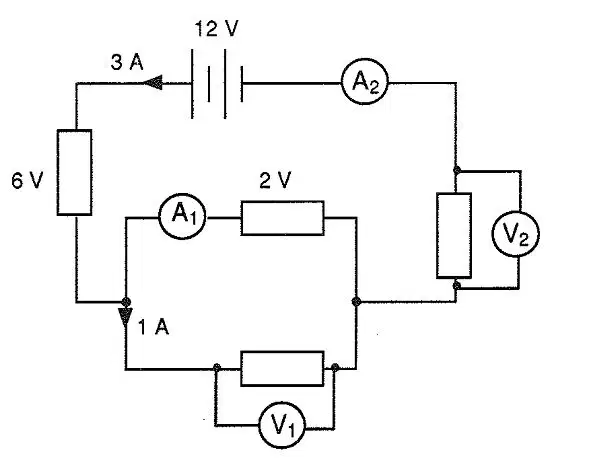
48.

What is the current at A1?

a)

3A

b)

2A

c)

1A

d)

0A

49.

What is the current at A2?

a)

3A

b)

2A

c)

1A

d)

0A

50.

What is the Voltage at V1?

a)

12V

b)

6V

c)

4V

d)

2V

51.

What is the Voltage at V2?

a)

12V

b)

6V

c)

4V

d)

2V

52.

What is the current at A1?

a)

0.6A

b)

0.4A

c)

0.3A

d)

0.2A

53.

What is the current at A2?

a)

0.6A

b)

0.4A

c)

0.3A

d)

0.2A

54.

What is the current at A3?

a)

0.6A

b)

0.4A

c)

0.3A

d)

0.2A

55.

What is the voltage at V1?

a)

9V

b)

3V

c)

2V

d)

1V

56.

What is the current at V2?

a)

9V

b)

3V

c)

2V

d)

1V

57.

What is the current at V3?

a)

9V

b)

3V

c)

2V

d)

1V

58.

About 90 percent of the stars in the universe, including the sun, are main sequence stars. What do all main sequence stars have in common?

a)

All main sequence stars are yellow like our sun.

b)

All main sequence stars are as bright as our sun.

c)

They are all undergoing fusion of helium into carbon within their cores

d)

They are undergoing fusion of hydrogen into helium within their cores

59.

Which of the following correctly ranks astronomical objects by size, starting with the smallest?

a)

earth, sun, solar system, galaxy, universe

b)

sun, solar system, earth, universe, galaxy

c)

universe, galaxy, solar system, earth, sun

d)

solar system, earth, sun, universe, galaxy

60.
Which of the following is NOT a characteristic used to classify stars?
a)
Color
b)
Temperature
c)
Size
d)
Shape
61.
A light year is a measurement of:
a)
Time
b)
Distance
c)
Gravity
d)
None of the Above
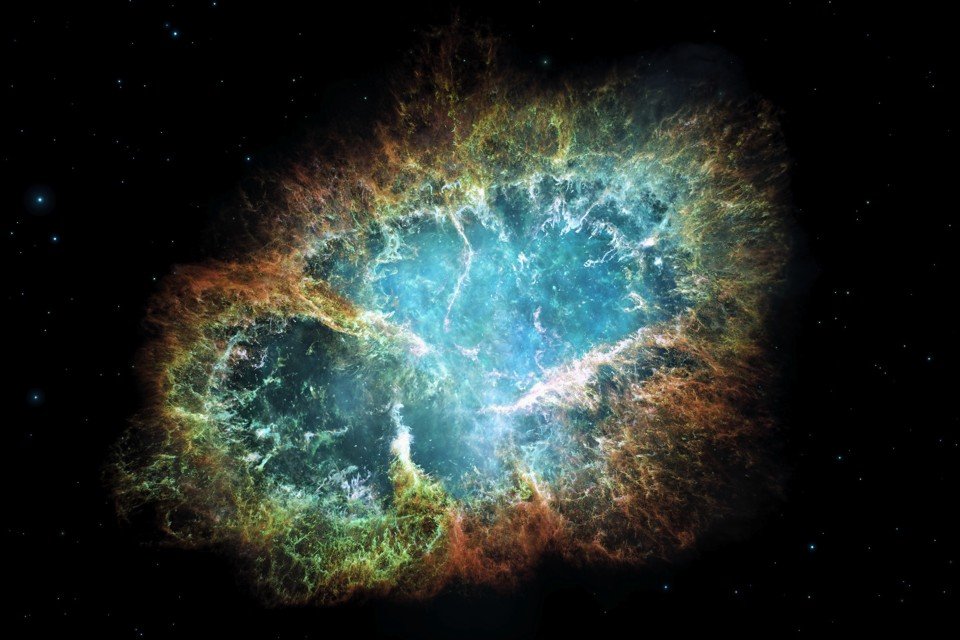
62.
Explosion of a high-mass star.
a)
White Dwarf
b)
Planetary Nebula
c)
Supernova
d)
Neutron Star
63.
An object whose gravity is so strong that nothing can escape.
a)
Planetary Nebula
b)
Supernova
c)
Neutron Star
d)
Black Hole
64.
Which of the following is a name used for stars:
a)
Neutron
b)
Supergiant
c)
White dwarf
d)
All of the above
65.

Stars are made of mostly which two gases?

a)

Hydrogen and Helium

b)

Hydrogen and Oxygen

c)

Hydrogen and Nitrogen

d)

Hydrogen and Carbon

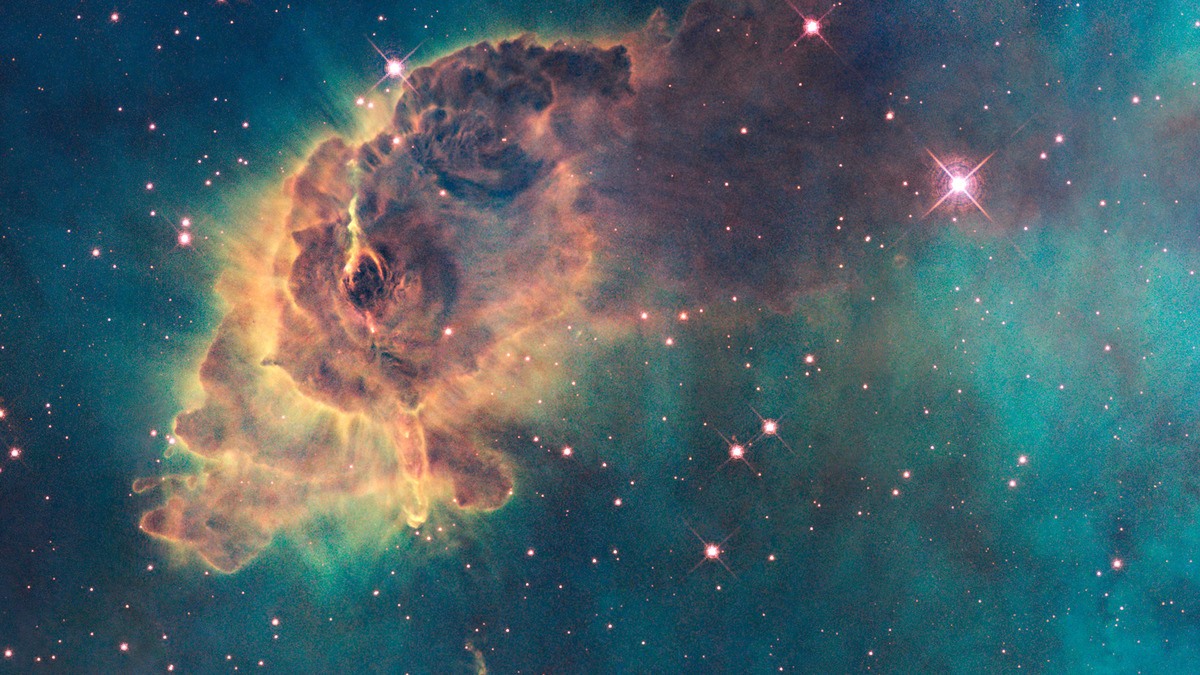
66.

A star is born in a cloud of gas and dust called a __________.

a)

nebula

b)

galaxy

c)

asteroid

d)

black hole

67.

Stars give off heat and light in a process called ___________.

a)

nuclear fusion

b)

supernova

c)

luminosity

d)

spectroscopy

68.
What color of star is the hottest?
a)
Blue
b)
Red
c)
Yellow
d)
Orange
69.
What color of star is the coolest?
a)
Red
b)
Yellow
c)
Blue
d)
White
70.
What is the name of the largest stars?
a)
Protostars
b)
Supergiants
c)
Red Giants
d)
Dwarf Stars
71.
What is the name of the gas/dust clouds that form stars?
a)
Nebulas
b)
Protostars 
c)
Supernova
d)
Neutron Star
72.
What is the name of the explosion at the death of a massive star?
a)
Supergiant
b)
Supernova
c)
Black Hole
d)
Nebula
73.
What word best describes our sun?
a)
Average
b)
Supergiant
c)
Dwarf
d)
Red Giant
74.
What is the name of the star in our solar system?
a)
Venus
b)
Sun
c)
Jupiter
d)
Mars
75.
The H-R diagram is a graph that shows the relationship between ______________ for stars. 
a)
temperature and color
b)
temperature and brightness
c)
brightness and color
d)
distance and brightness
76.
All stars begin their life in a
a)
Main Sequence
b)
Nebula
c)
Protostar
d)
Black Dwarf
77.
______ is a force that causes dust particles to stick together in a nebula.
a)
nuclear fusion
b)
gravity
c)
hydrogen
d)
friction
78.
Most stars are made of which elements?
a)
Hydrogen only
b)
Hydrogen and Lithium
c)
Hydrogen and Sodium
d)
Hydrogen and Helium
79.
A ________ is an object so dense with so much gravity that even light cannot escape.
a)
neutron star
b)
white dwarf
c)
blackhole
d)
black dwarf
80.
What is a Star?  (pg. 284)
a)
a large celestial body that is composed of gas and emits light
b)
a large ball of fire
81.
A supergiant might explode and become a_____.
a)
main sequence stars
b)
white dwarf
c)
supernova
d)
nebula
82.

The professional who studies the stars is...

a)

an astronaut.

b)

an astrologer.

c)

an astronomer.

83.
Why do stars in the night sky look so small?
a)
stars are small
b)
stars are close
c)
stars are far away
84.
Our galaxy is called the
a)
Earth Nebula
b)
The Hubble Galaxy
c)
The Milky Way
d)
The Snickers
85.

What will be the next stage in our star the sun's life cycle?

a)

supernova

b)

white dwarf

c)

blackhole

d)

red giant

86.
A small, hot star near the end of its life is a star called a
a)
white dwarf
b)
red dwarf
c)
supergiant
d)
protostar
87.
A black hole is an object so dense with so much gravity that even ________ cannot escape.
a)
gravity
b)
galaxies
c)
spaceships
d)
light
88.
Takes two small nuclei and combines them into a larger nucleus
a)
fission
b)
fusion
89.
The splitting of a nucleus into smaller nuclei is
a)
fusion
b)
fission
c)
half-life
d)
gamma radiation
90.
How do nuclear power-plants work?
a)
Fusion
b)
Half-life
c)
Fission
d)
Fusion or fission
91.
This is an example of...
a)
Fission  reaction
b)
Fusion reaction
c)
Decomposition reaction
d)
Decay
92.
Where does fusion occur naturally?
a)
Underwater
b)
All around us
c)
In the radioactive waste
d)
On the sun
93.
Which atoms combine together during fusion reaction on the sun?
a)
Helium and Hydrogen atoms
b)
Hydrogen atoms
c)
Hydrogen and Lithium atoms
d)
Hydrogen and Carbon atoms
94.
An example of an uncontrolled fission reaction is _______________
a)
Nuclear power plants
b)
Radio active decay
c)
Atomic Bomb
d)
On the surface of the sun
95.
What does it mean that fusion is a "chain reaction?"
a)
many steps or mini-reactions in the process
b)
long chains of elements form in a row
96.
Do all stars make energy through fusion?
a)
Yes
b)
No
c)
Just our sun
d)
Only large stars
97.
Why do scientists most want to learn more about fusion?
a)
To win the Nobel prize
b)
To make energy for people to use
c)
To destroy the world
d)
To know more about stars
98.
_________ happens naturally due to an unstable nucleus.
a)
fission
b)
fusion
c)
radioactive decay
d)
K-capture
99.
Which of these statements correctly describes how the chain reaction occurs in nuclear fission.
a)
Uranium releases electrons to create   electricity
b)
When a nuclear fission reaction occurs, the electrons emitted can strike other nuclei in the sample, and cause them to split
c)
When a nuclear fission reaction occurs, the neutrons emitted can strike other nuclei in the sample, and cause them to split
d)
 Protons and neutrons change to electrons because the nuclei are so big
100.
What is a benefit of nuclear fission?
a)
The ability to absorb energy
b)
The ability to release tremendous amounts of energy
c)
The ability to produce more energy than nuclear fusion
d)
There are no beneficial aspects of nuclear fission
101.
The major drawback to nuclear fission reactors is the difficulty of achieving safe disposal of radioactive waste products.
a)
true
b)
false
102.
Very high temperature and pressure is required for:
a)
Fission
b)
 Fusion
c)
Radioactive Decay
103.
One disadvantage of nuclear energy is ___.
a)
it is a fossil fuel
b)
it leaves behind radioactive waste
c)
it emits large amounts of pollution into the atmosphere
d)
there are no disadvantages
104.
Requires temperatures of millions of degrees?
a)
Fission
b)
Fusion
105.
Which of the following is true about nuclear fusion?
a)
It is easy to implement.
b)
It produces less energy than nuclear fission.
c)
It produces more energy than nuclear fission.
d)
It has the ability to occur easily in everyday life.
106.
Nuclear fusion releases energy when:
a)
heavy ions fuse together
b)
very light nuclei fuse together
c)
uranium splits into two fragments
d)
uranium emits a neutron
107.
The splitting of a nucleus into smaller nuclei is
a)
fusion
b)
fission
c)
decay
d)
gamma radiation
108.
The momentum of an object depends upon the object's ___________&_____________.  
a)
size and shape
b)
mass and speed
c)
mass and veloctiy
d)
mass and energy
109.
The equation to calculate momentum is
a)
p=mv
b)
p=1/2mv2
c)
p=mgh
d)
p=mg
110.
Which has more momentum: a car stopped at a red light or a bike moving at 15 mph?
a)
car
b)
bike
c)
they are equal
d)
cannot determine using the info provided
111.
Momentum is a ____________________ quantity
a)
science
b)
scalar
c)
vector
d)
energy
112.
In any collision (crash) the ______ is ALWAYS constant
a)
Total Momentum
b)
total speed
c)
total Velocity
d)
Energy
113.
When two objects collide, the Pbefore is ____________ the Pafter.
a)
more than 
b)
less than 
c)
equal to
d)
unrelated to
114.
When the speed of an object is doubled, its momentum
a)
remains unchanged in accord with the conservation of momentum.
b)
doubles
c)
quadruples
d)
decreases
115.
What is the unit for momentum?
a)
m/sec
b)
kg/sec
c)
kg/m
d)
kg m/sec
116.
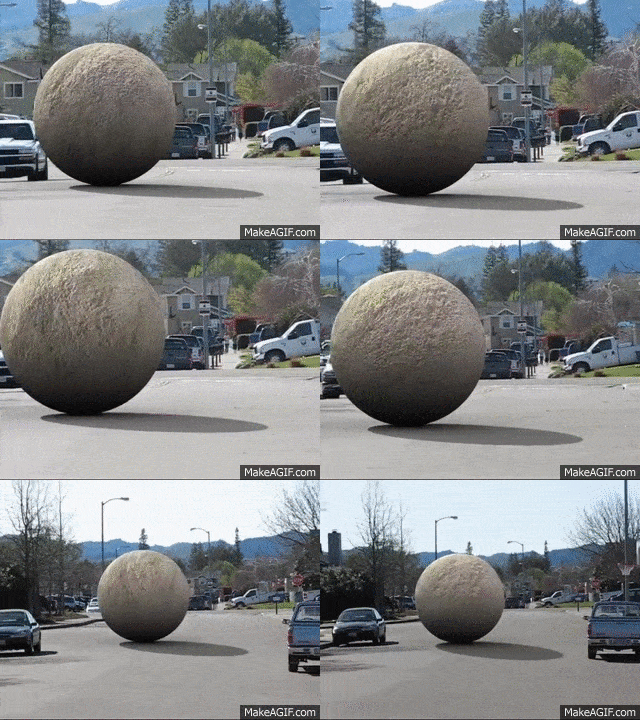
A 50 kg ball rolls down the street at 5 m/s. Calculate the momentum of the ball. 
a)
55 kg*m/s
b)
100 kg*m/s
c)
250 kg*m/s
d)
500 kg*m/s
117.
A 2.5 kg ball moving at 5 m/s collides with a 2.5 kg stationary ball in a perfectly elastic collision.  What is the velocity of the second ball after the collision? 
a)
5 m/s
b)
2.5 m/s
c)
10 m/s
d)
7.5 m/s
118.
A 9300 kg railroad car traveling at a velocity of 5 m/s strikes a second boxcar that weighs 5000 kg at rest. At what speed will the second boxcar move?
a)
18.6 m/s
b)
9.3 m/s
c)
7.5 m/s
d)
1.86 m/s
119.
Which object listed below has the greatest momentum?
a)
A 0.05 kg object rolling at 0.2 m/s.
b)
A 0.15 kg object rolling at 2 m/s.
c)
A 0.15 kg object rolling at 1 m/s
d)
A 0.4 kg object rolling at 2 m/s.
120.
Determine the momentum of 1000-kg car moving northward at 20 m/s......... 
a)
20000 N
b)
20000 Joules
c)
20000 Kg * m/s
d)
20000 kg * m/s north
121.
A 0.250 kg cart moving at 0.400 m/s has how much momentum?
a)
0.1 kg-m/s
b)
1 kg-m/s
c)
10 kg-m/s
d)
100 kg-m/s
122.
A person on a stationary skateboard throws a bowling ball with a velocity of 5.0 m/s. What is a possible speed of the person after the throw? 
a)
0 m/s
b)
1.5 m/s
c)
5.0  m/s
d)
7.5 m/s
123.
Two football players with mass 75 kg and 100 kg run directly toward each other with speeds of 6 m/s and 8 m/s respectively. If they grab each other as they collide, the combined speed of the two players just after the collision would be:
a)
2 m/s 
b)
3.4 m/s 
c)
4.6 m/s 
d)
7.1 m/s
124.
A biker with a mass of 75 kg moves along the path with a constant velocity of 5 m/s. What is the biker's momentum?
a)
25 m/s
b)
375 m/s
c)
25 kg m/s
d)
375 kg m/s
125.
The purpose of crumble zones on a car is to
a)
decrease time of impact.
b)
increase force of impact.
c)
increase the time of impact.
d)
decrease the impulse during impact.
126.

A constant force of 4.5 N acts on a 7.2-kg object for 10.0 s. What is the change in the object's momentum?

a)

45 kg m/s

b)

72 kg m/s

c)

32.4 kg m/s

d)

0.45 kg m/s

127.
In a physics experiment, two carts of mass 1.5 kg each are rolled towards each other.  The orange cart has a velocity of 2 m/s and the blue cart has a velocity of -1m/s.  The carts stick together when they collide.  Calculate their final speed.
a)
0.5 m/s
b)
1.0 m/s
c)
0.33 m/s
d)
0.67 m/s
128.
While playing pool, the white cue ball strikes the 8 ball. Before the collision, the cue ball's velocity was 10 m/s and the 8 ball was at rest. If both ball's have a mass of 0.15 kg and the cue ball's velocity after the collision is 2 m/s, what is the 8 ball's velocity?
a)
2 m/s
b)
8 m/s
c)
-2 m/s
d)
1.5 m/s
129.

The turning effect of a force is called a

a)

moment

b)

momentum

c)

rotation

d)

pivot

130.

The point at which a lever or see-saw

balances or rotates.

a)

Pivot

b)

Moment

c)

Momentum

d)

Centre

131.

Where is the pivot on a crowbar?

a)

Point A

b)

Point B

132.

Where is the pivot on the wheelbarrow shown?

a)

Point A

b)

Point B

133.

The turning effect of force can make an object to turn in a ________________ and ___________ direction

a)

Clockwise and Anti-clockwise

b)

Up and Down

c)

Right and Left

134.

What TWO things does the

size of a moment depend on?

a)

the force applied

b)

the distance from the pivot

c)

the length of the object

135.

Moment (Nm) =


_______ (N) x __________(m)

a)

Force and perpendicular distance

b)

Energy and perpendicular distance

c)

Momentum and perpendicular distance

d)

Speed and time

136.

What is moment measured in?

a)

Newton metres (Nm)

b)

Newtons (N)

c)

Kilograms (kg)

137.

How could you increase the turning effect of a spanner?

Select TWO answers.

a)

hold the spanner closer to the pivot

b)

hold the spanner further away from the pivot

c)

use less force to turn the spanner

d)

use more force to turn the spanner

138.

A force of 5 N acts on a lever 2 m from the pivot. What is the size of the moment?

a)

10 Nm

b)

7 Nm

c)

3 Nm

d)

2.5 Nm

139.

A force of 12 N acts on a lever 3 m from the pivot. What is the size of the moment?

a)

36 Nm

b)

15 Nm

c)

9 Nm

d)

4 Nm

140.

What is the moment acting on the seesaw?


IF YOU ARE CONFUSED, LOOK BACK IN YOUR BOOK!

a)

1.6 Nm anticlockwise

b)

15 Nm anticlockwise

c)

4 Nm clockwise

d)

16 N clockwise

141.

What is the moment produced by the 15 N?

CONVERT cm into m

a)

1.5 Nm (anti-clockwise)

b)

15 Nm (clockwise)

c)

150 Nm (anti-clockwise)

d)

0.15 Nm (clockwise)

142.

When an object is in equilibrium, the sum of clockwise moments is equal to the sum of the anticlockwise moments. Which law states this?

a)

Law of moments

b)

Newton' law of motion

c)

Law of conservation of energy

d)

Law of conservation of momentum

143.

Calculate the weight of the father!


IF YOU ARE CONFUSED, LOOK BACK IN YOUR BOOK!

a)

600 N

b)

800 N

c)

700 N

d)

500 N