
 Worksheets
Biology Semester 2
Total questions: 87
Worksheet time: 44mins
As cells grow in size, which of the following does not change?
The surface area
The volume
The surface area to volume ratio
The distance solutes diffuse into the cell
Choose the following statement that is most correct:
As a cell grows, cell surface area increases at a faster rate than cell volume
As a cell grows, cell volume increases at a faster rate than cell surface area
As a cell grows, cell surface area and cell volume increase at the same rate
As a cell grows, cell volume and cell surface area decrease at the same rate.
Which of the following is not a reason cells divide?
To Maintain a surface area to volume ratio that allows for efficient diffusion
To Replace dead cells
To increase the chromosome number
To allow the organism to grow
During what phase of the cell cycle is DNA duplicated?
M
G1
G2
S
During what phase does the cell spend most of its life?
Cytokinesis phase
M phase
Interphase
Prophase
A duplicated chromosome consists of two identical strands of coiled up DNA. What are these strands called?
Sister chromatids
Alleles
Centrioles
Centromeres
What is the proper order of phases in mitosis?
Metaphase, Prophase, Anaphase, Telophase
Prophase, Metaphase, Telophase, Anaphase
Prophase, Metaphase, Anaphase, Telophase
Prophase, Telophase, Metaphase, Prophase
During mitosis, chromosomes line up along the equator of the cell. During what phase does this occur?
Telophase
Prophase
Anaphase
Metaphase
During mitosis, the nuclear membrane reforms and the DNA unwinds. During what phase does this occur?
Prophase
Interphase
Telophase
Anaphase
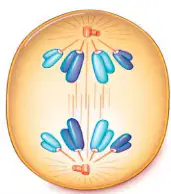
The Picture above best represents a cell in which phase of mitosis?
Telophase
Metaphase
Anaphase
Prophase
Which of the following best describes the results of mitosis?
4 daughter cells with half of the original cells chromosomes
2 daughter cells, each identical to the original cell
24 daughter cells, 12 identical to the original, and 12 different form the original
2 daughter cells with twice the chromosomes of the original
What’s cancer?
An inability to clot blood
Loss of nerve function over time
3 copies of chromosome number 15
Uncontrolled cell reproduction
What are proteins that regulate the cell cycle called?
Cell Captains
Factor VIII
Lysine, Leucine and Theorine
Cyclins
What does a tumor suppressor gene do?
Slows down cell reproduction
Causes cancer
Causes a biopsy
Triggers chemotherapy
What happens when a cancerous tumor metastasizes?
It stops growing
It grows faster
Part of the tumor breaks off and moves to another part of the body spreading the cancer
Its replicated by a PCR machine
Cancer can be treated by using chemicals to kill off cancerous cells. What is this called?
Radiotherapy
Stem Cell Therapy
Chemotherapy
Immunotherapy
What kind of cells does meiosis produce?
Body cells
Diploid cells
Haploid cells
Exact duplicate cells
Humans have a diploid number of 46. What is a human’s haploid number?
92
46
23
4
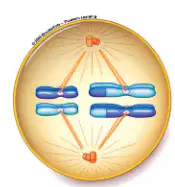
Which phase of meiosis does the picture above most accurately represent?
Metaphase II
Anaphase I
Metaphase I
Anaphase II
During which phase of meiosis are sister chromatids separated?
Prophase II
Anaphase II
Prophase I
Anaphase I
During what phase of meiosis does crossing over occur?
Prophase II
Prophase I
Telophase I
Telophase II
Cells containing two alleles for each trait are best described as:
Gametes
Haploid
Diploid
Gonads
When two haploid cells come together in fertilization, what is formed?
Sperm
Egg
Zygote
Ovary
Normal human genetic males have a chromosome combination of XY. Normal human genetic females have a chromosome combination of XX. What is the probability of a male and a female human having an offspring that is male?
¼ or 25%
½ or 50%
1/8 or 12.5%
What is the probability of a man and a woman having 3 male offspring in a row?
¼ or 25%
1/8 or 12.5%
½ or 50%
1 or 100%
If the couple from the problem above were to have a 4th child, what is the probability that the 4th child would be male?
1/8 or 12.5%
½ or 50%
¼ or 25%
1/16 or 6.2%
Why does Gregor Mendel have his picture in almost every high school Biology textbook?
He discovered that genetic traits were passed from one generation to another by “factors.”
He discovered natural selection
He took an x ray photograph of a DNA molecule
He invented chemotherapy.
If your grandma is the P generation, who are you?
F1
F2
P
P1
What is the law of segregation?
One gene is independent of another gene as long as they are on different chromosomes
One allele may be dominant over another
Alleles separate during meiosis to different gametes
The more pea plants you grow, the less your deviation will be.
TT is best described as a:
Archetype
Phenotype
Genotype
Prototype
Which of the following is heterozygous?
Yy
YY
TT
rr
Which of the following would have a short wrinkled green phenotype?
TtRrYy
TTRRYy
ttrryy
Ttrryy
Cross a heterozygous tall pea plant with another heterozygous tall pea plant. What would the expected percentage of tall pea plant offspring be?
100%
50%
25%
75%
A yellow pea plant and a green pea plant (P generation) are crossed and 100 offspring (F1) are observed. Here is what they looked like: Yellow Peas: 55 plants Green Peas: 45 plants. What are the most likely genotypes of the P generation?
Yy x Yy
YY x Yy
yy x Yy
yy x YY
A yellow pea plant and a green pea plant (P generation) are crossed and 100 offspring (F1) are observed. Here is what they looked like: Yellow Peas: 55 plants Green Peas: 45 plants. What is the deviation in the problem above?
50
.2
.1
5
A heterozygous tall, heterozygous round pea is crossed with a heterozygous tall wrinkled pea. What are the correct genotypes for this cross?
TtRr x TtRr
TtRr x Ttrr
TTRR x TtRr
TtRR x Ttrr
A heterozygous tall, heterozygous round pea is crossed with a heterozygous tall wrinkled pea. What is the chance of a tall wrinkled offspring?
9/16
6/16 or 3/8
3/16
1/16
A woman has type B blood, her mother was type O. If this woman has a child with a man who has type O blood, what are the possible genotypes of the child?
100% oo
100% Bo
½ Bo, ½ oo
¾ Bo, ¼ oo
A man has type A blood and he has a child with a woman with type AB blood. Which of the following blood types is not a possible type for their child?
B
A
AB
O
What term best describes human blood types?
Polygenetic
Incomplete dominant
Multiple alleles
100% dominant
Color blindness is a X linked recessive trait. If a normal sighted woman whose father was color blind has a child with a normal sighted man, what is the probability that they will have a color blind child?
100%
1/2
3/4
1/4
Huntington Disease is an autosomal dominant disease in humans. If a Heterozygous male has a child with a woman who does not have the disease, which of the following statements would be true?
The male parent has the disease and there is a 50% chance his child will inherit it.
The female parent has the disease and there is a 50% chance her child will inherit it.
There is a 25% chance the child will have the disease
There is a 100% chance the child will have the disease.
A RR red flower is crossed with a R’R’ (or WW) white flower. The F1 generation of flowers are RR’ (or RW) pink. What type of inheritance is this an example of?
Multiple alleles
Incomplete dominance
Polygenic
X linked
People with blue eyes have a genotype of Aabbcc. What kind of inheritance is this an example of?
Multiple alleles
X linked
Incomplete dominance
Polygenic
Some people inherit a X linked recessive trait and their blood lacks the ability to clot and stop bleeding. What is this condition called?
Hemophilia
Polydactyly
Huntington Disease
Marfan syndrome
A female human is diagnosed with a rare genetic disease. Neither of her parents have the disease. How might the child have inherited the disease?
The disease is dominant and carried by at least one parent.
The disease is sex linked and inherited only from the father
It’s impossible, one of her “parents” cannot be her biological parent.
The disease is recessive and carried by both parents.
Which of the following genetic disorders can be detected by analyzing the person’s chromosome number?
Tay Sachs
Hemophilia
Down syndrome
Sickle cell anemia
What’s a Karyotype?
A diagram showing a human and all of his or her relatives that have or carry a genetic disease
A picture of a human’s chromosomes in metaphase
A perfect example of a person carrying a genetic disease
When a person sings along with prerecorded music.
The failure of chromosomes to separate during meiosis is called:
X chromosome inactivation
Sticky centromere syndrome
Tetrad disconnect failure
Nondisjunction
A person with Klinefelter syndrome would have which of the following genotypes?
YY
XY
XXX
XXY
Because the gene for red green color blindness is located on the X chromosome, which of the following is not possible?
A carrier mother to pass the gene on to her daughter
A color blind father to pass the gene on to his son
A carrier mother to pass the gene on to her son
A color blind father to pass the gene on to his daughter.
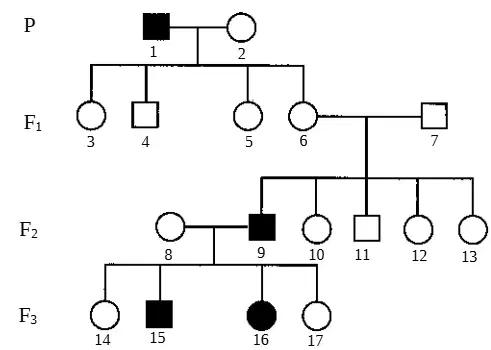
What will individual 9 look like?
They will not have any melanin in their skin and have pink eyes
They will have 6 toes and fingers
They will not be able to digest phenylalanine.
Their blood will not be able to clot and stop bleeding.
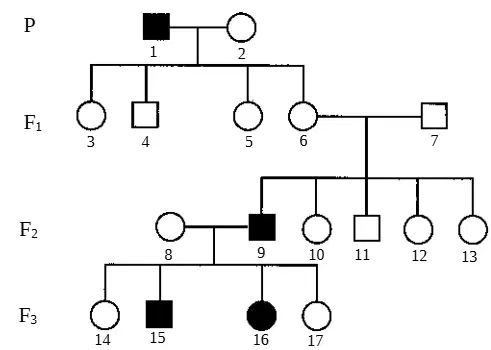
What is the relationship between individual 17 and 6?
6 is 17’s grandparent
6 is 17’s great uncle
17 is 6’s second cousin
17 and 6 are not genetically related.
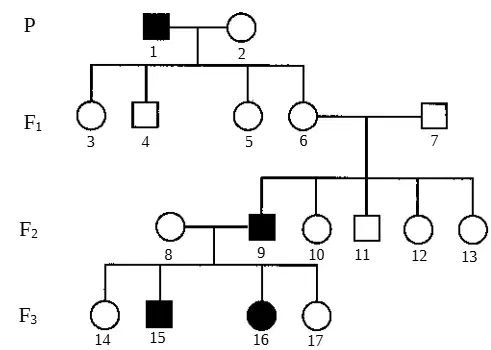
How many of individual 6 and 7’s offspring are female?
3
5
2
0

What is the genotype of individual 6?
AA
Aa
aa
Aa or AA
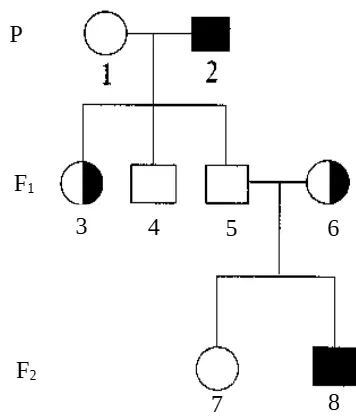
What is the genotype of individual 6?
XHXH
XHXh
XhY
XHY
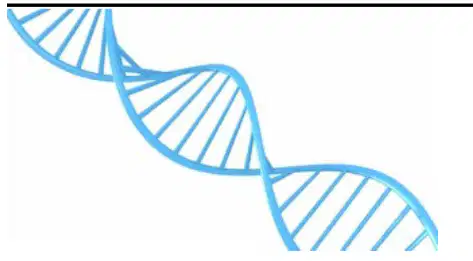
Which statement best describes the picture above?
It’s a double helix and its DNA
It’s a single helix and its RNA
It’s a double helix and its RNA
It’s a single helix and its DNA
In what way is DNA the "instructions for life?"
DNA is the molecule that the cell uses to attack other cells
The cell uses DNA to make proteins, and then uses the proteins to do many important things.
The cell uses DNA to digest food and build cell walls
The cell reads DNA like a computer reads a program. This "program" is made up of more and more DNA strands.
How many nucleotides are there in a codon?
1
2
3
4
1 codon codes for how many amino acids?
1
2
3
4
Where does translation happen?
The nucleus
The ribosome
The Golgi Apparatus
The DNA factory
What is the process of producing a mRNA molecule from a sequence of DNA called?
Transcription
Translation
Replication
Reproduction
What are cytosine, thymine, uracil, adenine and guanine called?
Phosphates
5 carbon sugars
Nitrogen bases
Amino acids
Which of the following is not a part of a nucleotide?
Phosphates
5 carbon sugars
Nitrogen bases
Amino acids
Which of the following correctly describes a protein?
A. A string of connected amino acids
B. A long chain of nucleotides
C. 5 carbon atoms in a ring
D. A double helix
What is the correct complimentary DNA sequence from the following Nucleotides?
TAG ACT CGA
ATC TGA GCT
ATC TGC GAG
AUC UGA GCU
What is the correct complimentary mRNA sequence form the following DNA sequence?
CUG UAU GAA
CTG TAT GAA
GAC ATA CTT
CUG UUU GUU
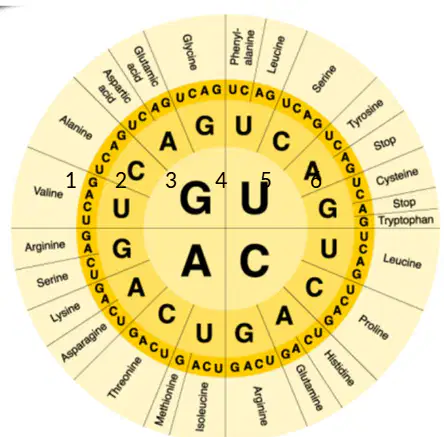
Which codons code for the amino acid Aspartic Acid?
CAG, UAG
GAG, GAA
AAA, GGG
GAC, GAU
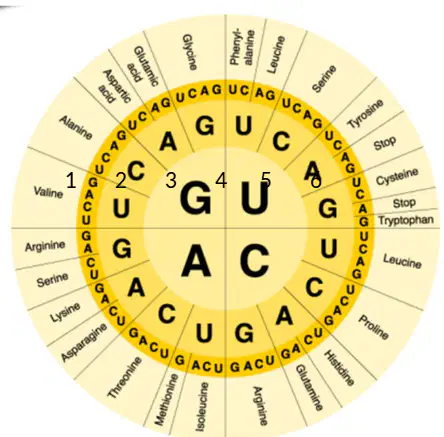
Why is there no T in the diagram?
DNA does not have T
Because it would confuse Threonine with Thiamine
RNA does not have T
Because T = G/A
What does a restriction enzyme do?
Manufactures DNA
Synthesizes proteins
Cuts DNA
“Unzips” DNA
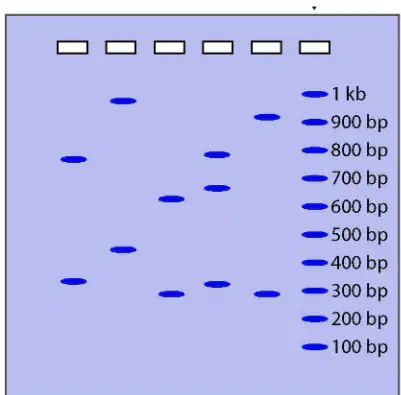
What does a PCR machine do?
Makes copies of DNA
Destroys DNA
Brings in amino acids to match with the codons
Separates DNA from RNA
Which of the following is DNA fingerprinting not used for?
Identify a suspect in a criminal case
Identify the shape of a DNA molecule
Identify a parent in a paternity case
Identify human remains
How old is the earth?
4.6 million years
46 million years
4.6 billion years
46 billion years
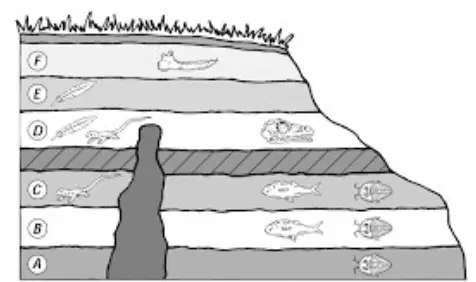
In the above diagram, which rock layer would contain the oldest fossils?
A
B
C
D
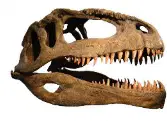
The Fossil above is found 1000 miles away in rock layer X. Chose the following statement that is most correct:
Rock Layer X is younger than rock layer D.
Rock Layer X is older than rock layer A.
Rock layer X is the same age as rock layer F.
Rock layer X is younger than rock layer B.
When Darwin published the Origin of Species, he included all of the following ideas except:
The idea that there are variations of traits within a population
The idea that organisms produce a greater number of offspring than can survive
Species change over time by natural selection
The idea that only the physically strongest individuals survive
What’s natural selection?
A method for determining the age of a fossil
The traits an organism acquires during its lifetime are passed on to offspring
Features that are observed on earth like the Grand Canyon are the product of processes that can be continually observed on earth.
Organisms with traits that are well suited to their environment will have more offspring than organisms with traits that are not well suited to their environment.
Charles Darwin collected many species during his voyage on the Beagle. Which species would he eventually use as a key example of natural selection?
Finches from the Galapagos Islands
Elephants from India
Polar bears from Alaska
Giraffes from Africa
Why do Peacocks have such big colorful tails?
It enables them to have more offspring
It allows them hide from predators
It enables them to run faster
It enables them to fly higher
A scientist collects 8 different looking salamanders. What would be the best way to tell if they were the same species or not?
Record which salamanders look the most similar
Weigh them to find the salamanders that are most similar in mass
Mate them with each other to see if they can have healthy offspring.
Feed them food to see which salamanders eat the same type of food.
Which of the following is an example of a vestigial structure?
The pelvis of the whale
The Beak of the Galapagos finch
The wings of the Peppered Moth
The beard of Charles Darwin
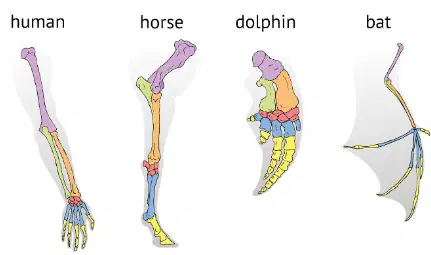
The diagram shows the arrangement of bones on 4 different modern mammals. What is this an example of?
Artificial selection
Homologous structures
Vestigial structures
Fossil evidence of evolution
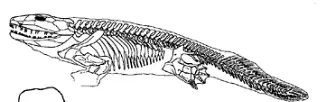
Here are 4 fossils. Which one is most likely the most recent common ancestor of all 4 organisms in the diagram?
A.
B.
C.
D.
Which of the following is true about a salamander embryo and a human embryo at a certain time in each’s development?
They both have opposable thumbs
They both have stripes like a zebra
They have nothing in common
They both have a tail
Polar Bears and Grizzly bears share a common ancestor. Polar Bears have smaller ears than Grizzly bears so they will not freeze in cold temperatures. What is this an example of?
Vestigial structure
Homologous structure
Adaptation
Fossilization
What is the best explanation of how Polar Bears have genes for small ears and Grizzly bears don’t?
Recessive genes
Dominant genes
Mutations
Artificial selection

Use this diagram to answer the next 2 questions: Choose the statement that is most correct:
A. Humans and chimps share a common ancestor
B. Humans evolved from chimps
C. Humans and chimps are not genetically related
D. Humans evolved from Bonobos

