
 Worksheets
Unit 8 Waves Study Guide - Part Two
Total questions: 55
Worksheet time: 28mins
__________________ relates to the brightness of light.
Frequency decreases as wavelength _____________ so wavelength and frequency are ______________ proportional.
When Maya looks at a rainbow, she notices that the ___________ of light depends on the wavelength of the light wave.
color
energy
The direction in which light travels can be represented using arrows called ____________.
While studying for her physics exam, Anika noticed that electromagnetic waves are composed of changing _________ and __________ fields that are perpendicular to one another. What are these fields?
electric
light
magnetic
sound
The intensity of a light wave depends on its wavelength/amplitude (select one).
wavelength
amplitude
If Grace is adjusting the brightness of a flashlight (which changes the amplitude of the light waves it emits), will/will not (pick one) this change the wavelength of the light?
will
will not
Emma is looking at herself in a mirror. The bouncing of light off the mirror's surface is called ______
refraction
reflection
The passing of light waves through matter is called _________
Aaron is doing a science experiment to see how light passes through different materials. He observes that light transmits through transparent materials. Some examples he notes are: clean air, ________ water, and ______________ glass.
tinted
clean
salt
smooth
Oliver is decorating his room and notices that the light coming through his frosted glass window is scattered in many different directions, making it hard to see clearly through it. Materials like frosted glass, tissue paper, and waxed paper are examples of ___________ materials.
Opaque
translucent
Nora tries to shine a flashlight through different materials. She notices that some materials do not let any light pass through them. Instead, they reflect light, absorb light, or both. These are called _________ materials.
Opaque
translucent
Differences in _________cause the different wavelengths of light to separate.
When Kiley places a straw in a glass of water, the straw appears to bend at the surface. This effect is called _________.
reflection
Refraction
Bending

Conor is observing a straw in a glass of water, and he notices that the straw looks bent at the surface of the water. He wonders which interactions between light and matter can change the direction that light travels. Select all that apply.
absorption
reflection
refraction
transmission
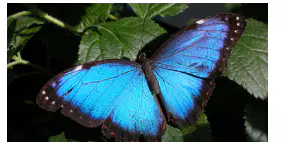
The butterfly and leaves are in white light from the sun. Which of the following would be true if only blue light was shining on them? Select all that apply.
Some golfers use a blue filter to help see where their ball is in tall grass. The white golf ball will appear ____________ ( white/ blue/green) when viewed through the filter
Green grass around the ball will appear mostly ___________ (green/black/blue) when viewed through the filter, which makes seeing the ball easier.
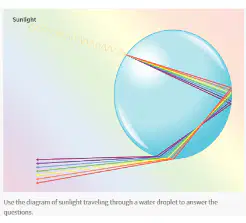
Which statements describe the waves of light that exit the droplet? Select all that apply.
Rainbows form because of the behaviors of visible sunlight in water droplets. Sunlight is (refracted/ reflected/absorbed) when it enters a droplet.
When your eyes detect all wavelengths of visible light at once in equal proportions, you perceive ________ light.
______, _______, ________ are referred to as the primary colors of light.
The____________ of light that are reflected and reach your eyes determine what color you perceive an object to be.
Avery is using a red filter in her science experiment. The red filter transmits the wavelengths corresponding to red light but _________ other visible light wavelengths.
blocks
reflects
refracts

If you put a red filter over the light source, the red item still appears mostly red, but the other colors appear mostly __________ because all colors except red were filtered out.
Emma and Lily are exchanging ideas during a group project. This act is called _________.
communication
signal
______________ anything that can transmit information.
While visiting a science museum, Aria learns about the invention of the electric telegraph in 1837. Who invented it?
Isaac Newton
Albert Einstein
Samuel Morse
Grace receives a warning message from the fire alarm system in her building. The message is only helpful if she understands how to interpret, or _______________ the message.
decode
encode
When Hudson and Oliver agree on what a signal means, they can __________ information into a signal.
decode
encode
Morse code uses combinations of ________ of different lengths to represent numbers and letters.
A combination of dashes and dots can be used to represent each letter in the __________ for Morse code.
While watching the ocean, Keghan noticed that the water moves up and down, carrying energy across the surface. These ______________ are disturbances that transfer energy from one place to another.
waves
amplitudes
frequencies
Scientists and inventors applied scientific knowledge about electric current and magnetism to develop technologies such as ________________ and ________ the telegraph, and the telephone .
Communication devices use ________________ and ________________ waves to carry information over long distances.
Modern computers may send and receive information through electric signals in wires, _________________ cables, and using WiFi.
While setting up a new wireless network at home, James wonders what kind of waves Wifi uses to transmit data through the air. Wifi uses ____________ waves sent through the air.
fiber optic
digital
analog
radio
Jackson is downloading a large file on his laptop using WiFi at home. Over short distances, information transfer appears almost_______________ such as when a cell phone transfers data over WiFi.
backwards
over a along time
instantaneous
Abigail is learning about how information is transmitted in her technology class. Her teacher explains that information and signals can be ____ or ________.
light
digital
analog
sound
____________ information and signals are continuous.
_______________ information and signals are not continuous.

Every piece of information that you see on a computer can be represented as a series of _____’s and _____’s.
Ali is learning about how computers store photos. She discovers that digital images are encoded as ________ signals.
binary
analog
radio
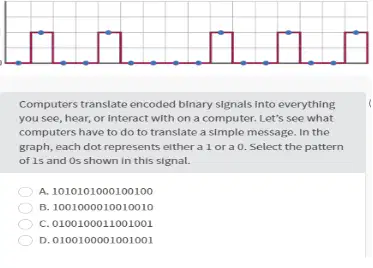
The pattern that matches the graph is _____
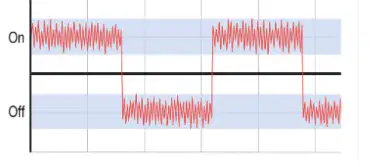
The signal represented in the illustration is digital/ analog.
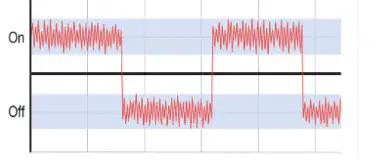
This signal is very noisy. Why is the signal still able to transmit information reliably?
The concept of noise does not only apply to ________
Noise can occur any time a signal is transmitted, __________________, or recorded.
Once noise has been added to an analog signal, there is ______ way to completely remove it, when the signal is decoded, the noise is observed, and you might hear static in an audio transmission or see blurriness in an image.
When a signal is changed due to noise, information is lost. The process of noise addition to signals is also known as ____________________.
A digital signal has defined levels, and therefore noise (does/ does not) have as large an effect when the signal is decoded.
_________________ the digital signal filters out the noise, so a transmitted sound or image will be clear and more reliable.
Advances in technology now allow scientists to make high-quality recordings of ___________ in the wild.
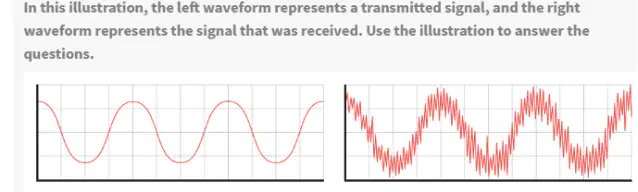
Why are these two signals different from one another?
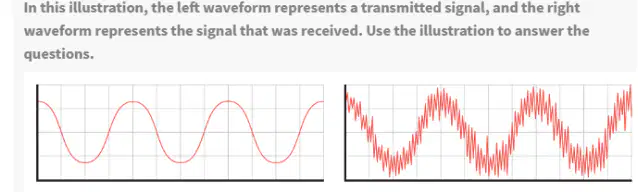
Assume that the received signal is transmitted back to the original transmitter. What is likely to happen to the waveform as it is sent back?

