
 Worksheets
IYH Term 2 Quiz all topics
Total questions: 42
Worksheet time: 21mins

The part of the brain responsible for connecting the left and right hemispheres.
Corpus collosum
Cerebellum
Medulla oblongata
Thalamus

The part of the brain responsible for higher cognitive functions such as thinking and decision making.
Cerebral cortex
Cerebellum
Medulla oblongata
Hypothalamus
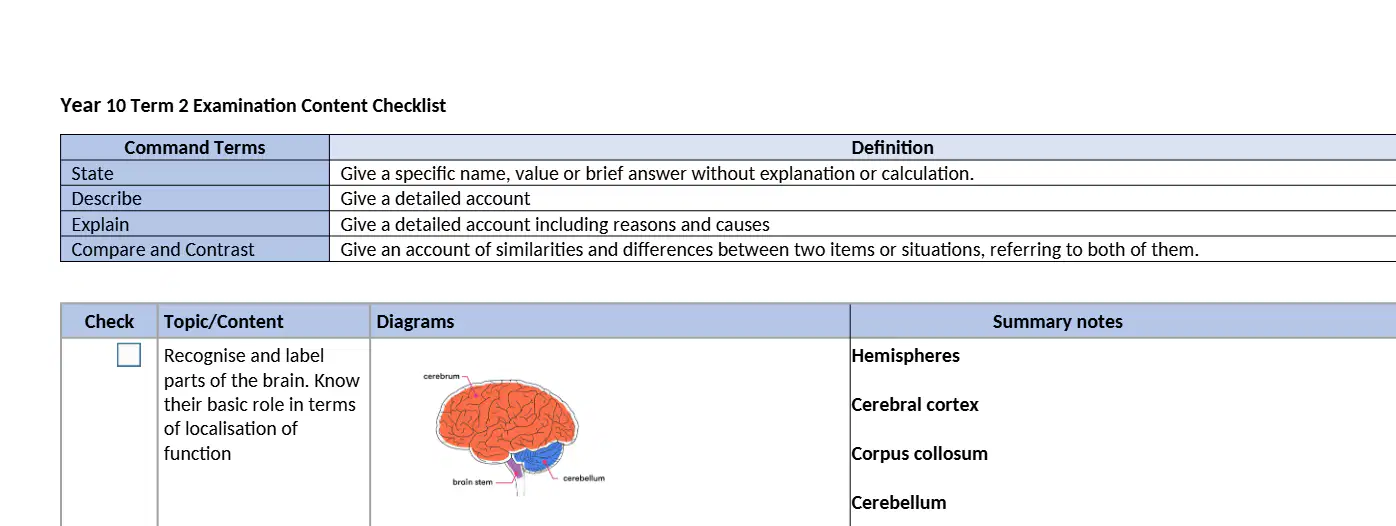
The part of the brain responsible for balance and coordination.
Cerebellum
Medulla Oblongata
Frontal Lobe
Hypothalamus
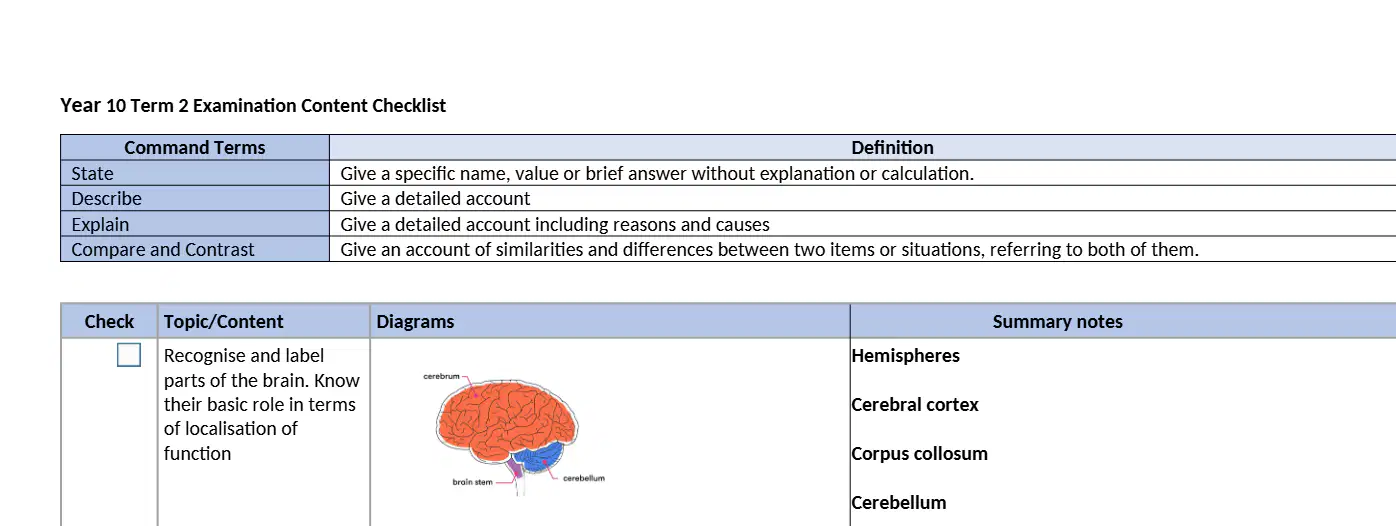
The part of the brain responsible for basic life functions such as breathing and heartbeat.
Brain stem
Cerebellum
Cerebrum
Hypothalamus
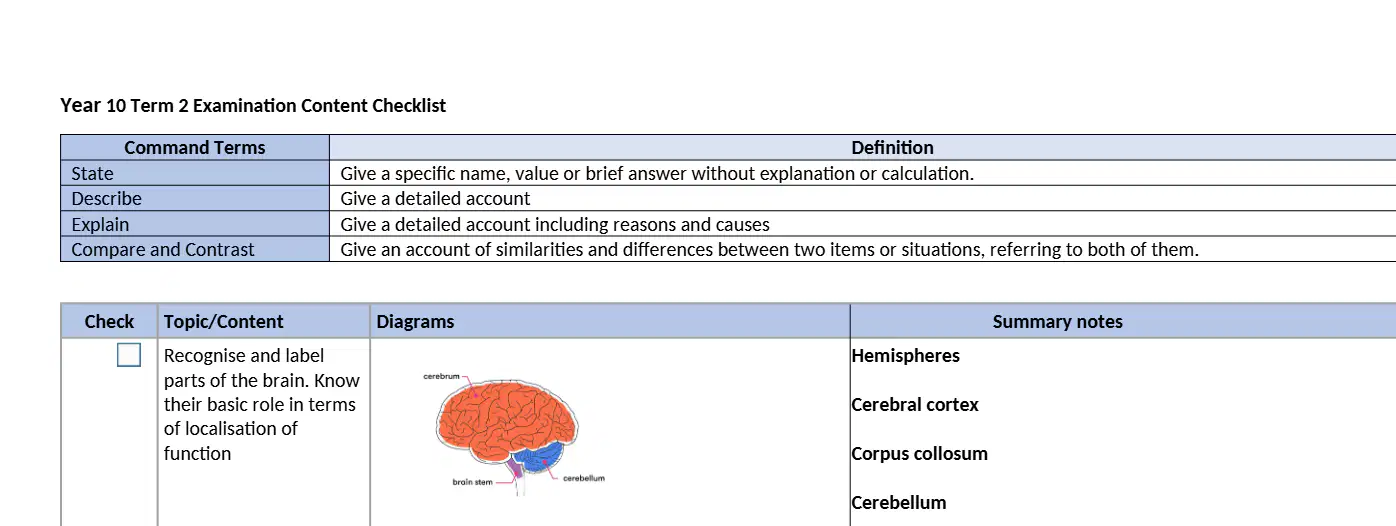
The two main divisions of the brain that are responsible for different functions on the left and right sides.
Hemispheres
Lobes
Cerebellum
Cortex

The lobe of the brain responsible for visual processing.
Occipital lobe
Frontal lobe
Parietal lobe
Temporal lobe

The lobe of the brain responsible for auditory processing and memory.
Temporal lobe
Frontal lobe
Occipital lobe
Parietal lobe

The lobe of the brain responsible for processing sensory information such as touch.
Parietal lobe
Frontal lobe
Occipital lobe
Temporal lobe

The lobe of the brain responsible for reasoning, planning, and voluntary movement.
Frontal lobe
Parietal lobe
Occipital lobe
Temporal lobe

Brain damage helps researchers to understand localisation of function in the brain by:
allowing observation of changes in behavior after specific areas are damaged
increasing overall brain activity
improving memory and learning abilities
making the brain more resistant to injury
The basic role of the Limbic system in terms of localization of function is:
Regulation of emotions and memory
Control of voluntary movements
Processing visual information
Regulation of heart rate
The basic role of the Hippocampus in terms of localization of function is:
Regulation of emotions
Formation of new memories
Control of voluntary movements
Processing of visual information
The basic role of the Amygdala in terms of localization of function is:
Regulation of emotions, especially fear and aggression
Control of voluntary movements
Processing of visual information
Regulation of heart rate
What did the case study of HM teach us in terms of localization of function?
demonstrating the importance of the hippocampus in memory formation
showing the role of the cerebellum in movement
proving the function of the occipital lobe in vision
illustrating the function of the frontal lobe in decision making
Neuroplasticity is defined as:
The brain's ability to change and adapt as a result of experience.
A disease affecting the nervous system.
A type of brain surgery.
A fixed structure of the brain that cannot change.
Neuroplasticity is the brain's ability to reorganize itself by forming new neural connections. Which of the following is a real-life example of neuroplasticity?
Learning to play a musical instrument and improving over time
Digesting food in the stomach
The heart pumping blood throughout the body
Bones healing after a fracture
Which of the following brain imaging techniques is best known for measuring brain activity by detecting changes associated with blood flow, and what is one limitation of this technique?
CT scan; limited spatial resolution
MRI; cannot measure brain activity
fMRI; expensive and sensitive to movement
EEG; poor temporal resolution
Which brain scan is best to measure electrical activity in the brain in real time?
EEG (Electroencephalogram)
MRI (Magnetic Resonance Imaging)
CT (Computed Tomography) scan
PET (Positron Emission Tomography) scan
Which scan gives a fast and detailed picture of the brain's structure, especially in emergencies?
CT (Computed Tomography)
EEG (Electroencephalogram)
PET (Positron Emission Tomography)
Ultrasound
Which scan shows brain activity by measuring blood flow while someone does a task?
fMRI (Functional Magnetic Resonance Imaging)
CT (Computed Tomography) scan
EEG (Electroencephalogram)
X-ray
Which scan is best for detecting tumours and structural abnormalities in the brain?
MRI (Magnetic Resonance Imaging)
X-ray
Ultrasound
ECG (Electrocardiogram)
"Contralateral" is defined as:
On the same side of the body
On the opposite side of the body
In the middle of the body
Above the body
Hemispheric lateralisation and contralateral brain organisation can be compared or contrasted in terms of:
Their roles in language and motor control
Their locations in the spinal cord
Their involvement in digestion
Their function in the endocrine system
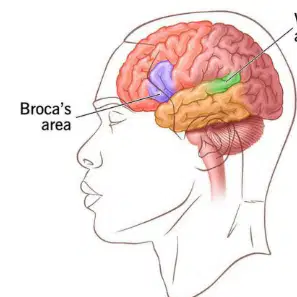
Which of the following best compares and/or contrasts these Broca's and Wernicke's areas?
Broca's area is for speech production; Wernicke's area is for language comprehension.
Both areas are responsible for motor control of speech.
Wernicke's area is for speech production; Broca's area is for language comprehension.
Both areas are unrelated to language.
Localisation refers to:
The idea that specific brain areas have specific functions.
The process by which the brain adapts to new experiences.
The ability of the brain to repair itself after injury.
The communication between neurons in different brain regions.
The amygdala in the human brain is primarily involved in which of the following functions?
Regulating emotions such as fear and aggression
Controlling voluntary muscle movements
Processing visual information
Regulating heart rate
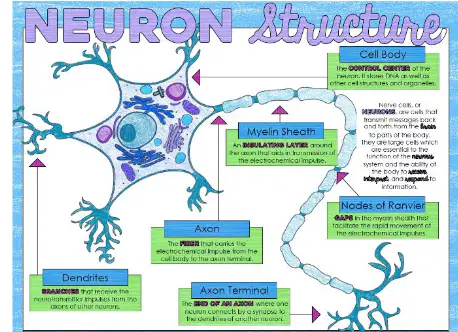
Which of the following lists the different parts of a neuron and their function?
Dendrites receive signals, axon transmits signals, cell body processes information, axon terminals send signals to other cells.
Axon receives signals, dendrites transmit signals, cell body stores energy, axon terminals absorb nutrients.
Cell body sends signals, dendrites store information, axon digests waste, axon terminals produce hormones.
Dendrites transmit signals, axon receives signals, cell body creates myelin, axon terminals store DNA.
The percentage of grey matter versus white matter present in the brain is:
40% grey matter, 60% white matter
60% grey matter, 40% white matter
50% grey matter, 50% white matter
30% grey matter, 70% white matter
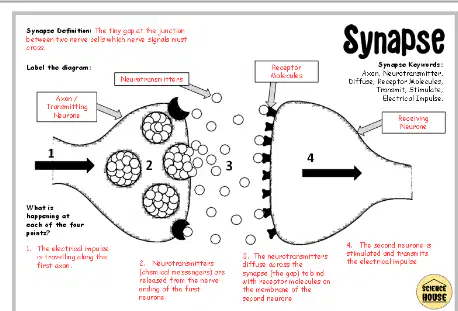
A synapse transmits messages across the synaptic cleft by:
releasing neurotransmitters that cross the cleft and bind to receptors on the next neuron
sending electrical impulses directly through the cleft
allowing ions to flow freely between neurons
using hormones to carry messages across the cleft
Mirror neurons are hypothesised to be evolutionary because:
they enable imitation and social learning, which are advantageous for survival.
they are only found in humans.
they have no known function.
they are responsible for all brain activity.
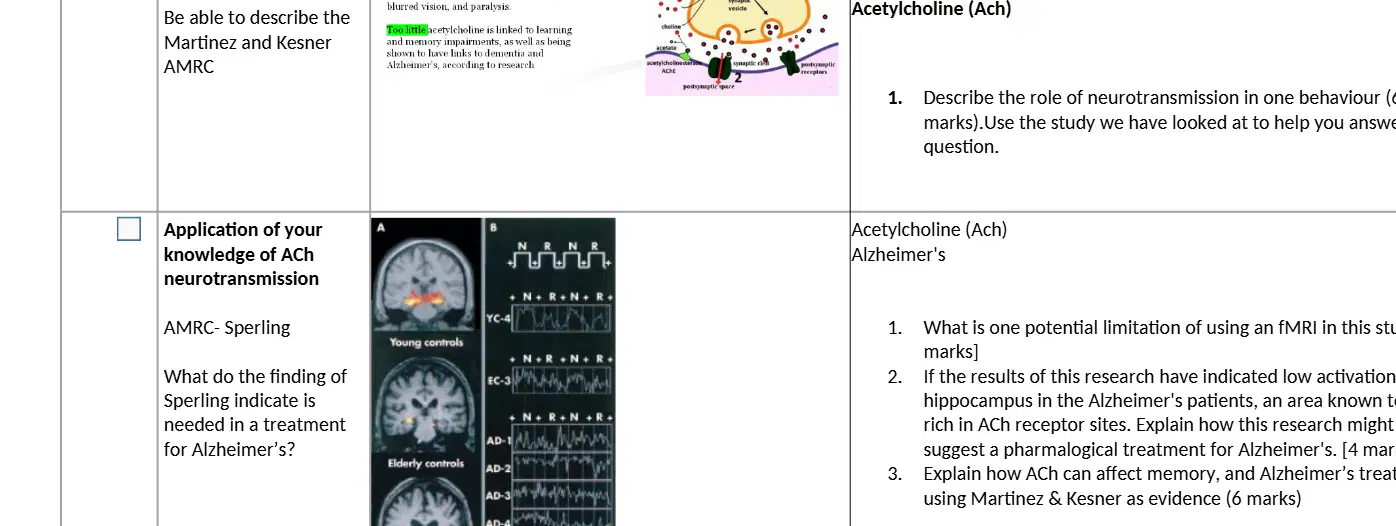
If the results of this research have indicated low activation in the hippocampus in the Alzheimer's patients, an area known to be rich in ACh receptor sites, what pharmacological treatment might this research suggest for Alzheimer's?
A drug that increases acetylcholine activity
A drug that decreases acetylcholine activity
A drug that blocks dopamine receptors
A drug that increases serotonin levels
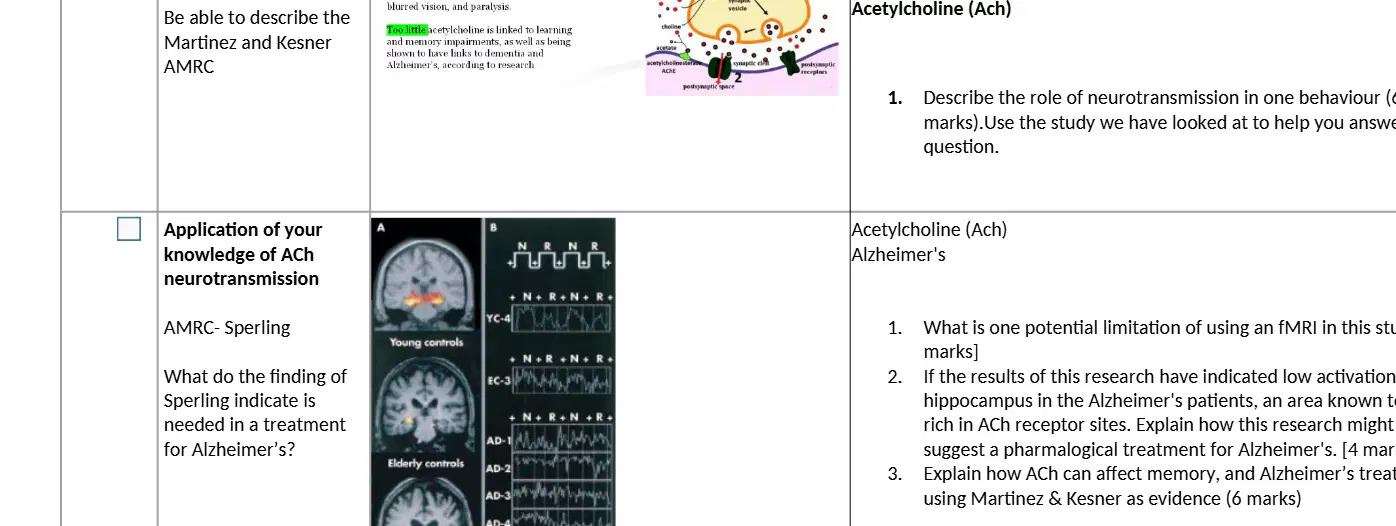
Acetylcholine (ACh) can affect memory, and Alzheimer's treatment can be explained using Martínez & Kesner's study as evidence. Which of the following best summarizes this relationship?
ACh is involved in memory formation, and Martínez & Kesner showed that manipulating ACh levels in rats affected their memory, supporting treatments for Alzheimer's that increase ACh.
ACh is unrelated to memory, and Martínez & Kesner found no effect of ACh manipulation on memory, suggesting Alzheimer's treatments should not target ACh.
Martínez & Kesner's study showed that decreasing ACh improved memory, so Alzheimer's treatments aim to reduce ACh.
ACh only affects motor function, and Martínez & Kesner's study was unrelated to memory or Alzheimer's.
Which of the following best compares and contrasts treatments for mental illness in historical versus modern times?
Historical treatments often involved inhumane practices like asylums and exorcisms, while modern treatments focus on therapy and medication.
Both historical and modern treatments rely solely on spiritual healing.
Modern treatments are less effective than historical treatments.
Historical treatments used advanced medications similar to those used today.
Diagnosing mental illness involves which of the following?
Using standardized diagnostic criteria such as the DDM.
Relying solely on patient self-report without any research context.
Using a Standardized diagnostic criteria such as the DSM.
Diagnosing based on cultural stereotypes.
The purpose of classification systems is to:
organize and group things based on similarities
create random groups
make things more complicated
ignore differences between objects
The findings of the Rosenhan study suggested:
Psychiatrists may be poorly trained to recognise mental illness.
Diagnostic criteria for mental illness is not always accurately applied.
It was difficulty to be admitted to mental institutions.
Mental institutions are inhumane.
Match the causes of schizophrenia with their descriptions:
Genetic factors
Higher likelihood of schizophrenia in individuals with a family history.
Neurotransmitter imbalances
The dopamine hypothesis suggests excess dopamine activity in specific brain regions.
Brain structure abnormalities
Structural changes such as enlarged ventricles and reduced grey matter.
Prenatal factors
Maternal infections, malnutrition, or birth complications increasing risk.
Neurodevelopmental disruptions
Early disruptions in brain development that may contribute to schizophrenia.
Which of the following lists includes both positive and negative symptoms of schizophrenia?
Hallucinations and delusions; apathy and social withdrawal
Euphoria and insomnia; paranoia and mania
Obsessions and compulsions; memory loss and confusion
Anxiety and phobias; irritability and aggression
One 'modern day' therapy used in the treatment of schizophrenia is:
Cognitive Behavioral Therapy
Insulin Therapy
Heat/Cold Therapy
Physical Therapy
What are the symptoms and one theory/etiology for Dissociative Identity Disorder (DID)?
Symptoms include memory gaps and identity disruption; one theory is childhood trauma.
Symptoms include hallucinations and delusions; one theory is genetic inheritance.
Symptoms include compulsive behaviors; one theory is neurotransmitter imbalance.
Symptoms include mood swings; one theory is seasonal affective disorder.
A split brain patient can name an object in their right hand?
Yes
No
A split brain patient can say a word from left visual field.
Yes
No

