
 Worksheets
Final Exam - American Studies 1: 24/25
Total questions: 34
Worksheet time: 3hrs 50mins
Name
Class
Date
1.
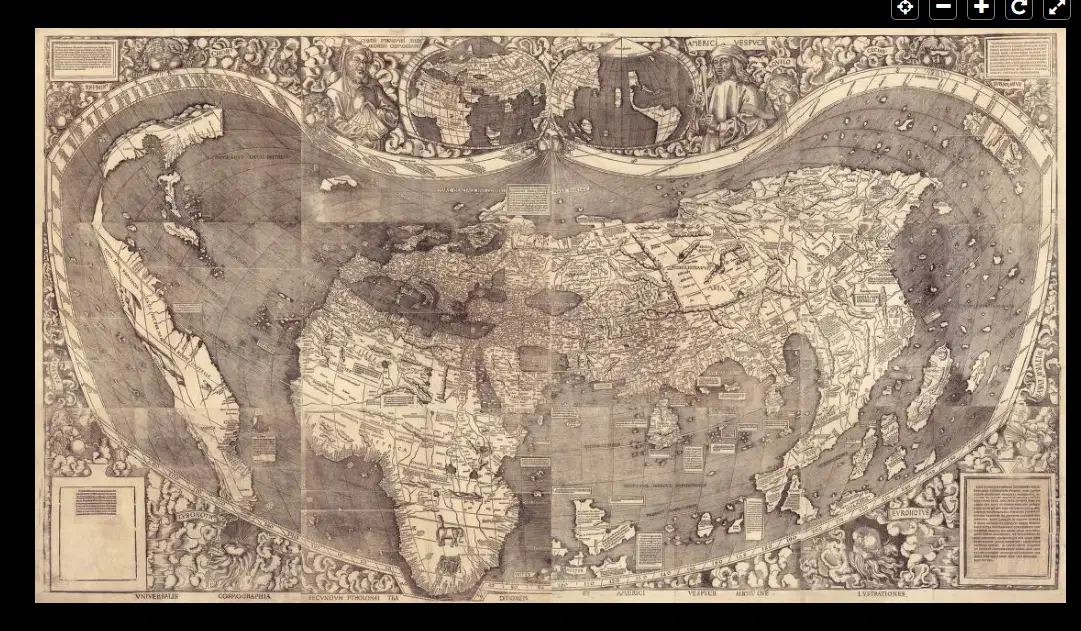
What do you think this map indicates about European knowledge of the geography and people of North / South America in 1507?
a)
They had accurate and detailed knowledge
b)
Their knowledge was limited and incomplete
c)
They exaggerated the size of the continents
d)
They ignored these continents completely
2.
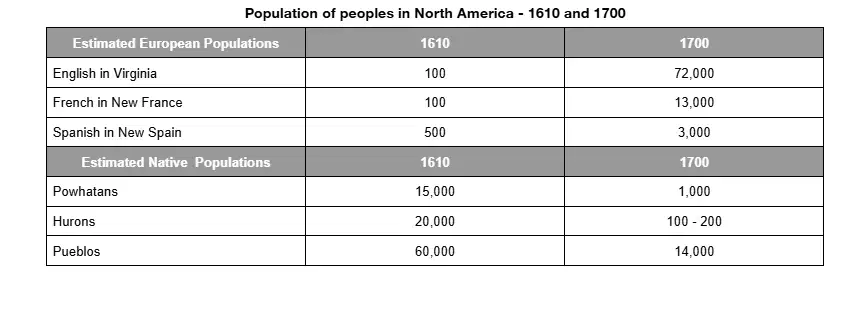
What is your hypothesis on why this trend happened?
4 lines
3.
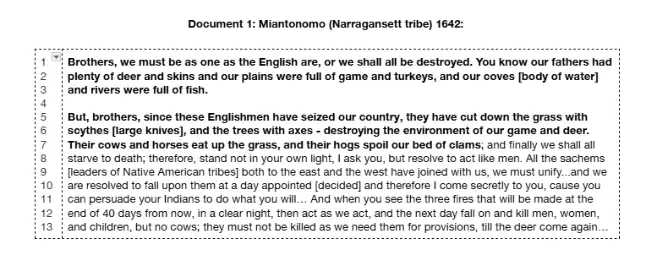
According to lines 5–8, what has been the impact of European colonization on the environment?
a)
It has improved soil and water quality
b)
It has destroyed the environment needed for game and food
c)
It has had no impact on the environment
d)
Europeans have planted more trees and grass
4.
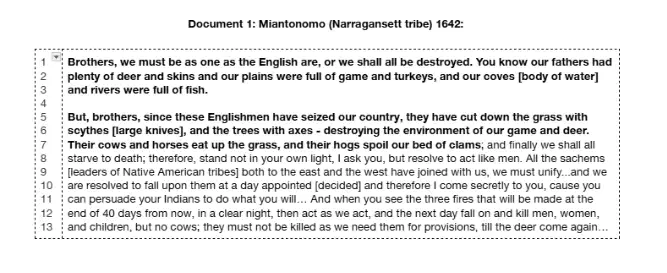
According to Miantonomo, what should his audience do in retaliation against the colonists?
a)
Negotiate peace treaties
b)
Unite and attack the colonists at an appointed time
c)
Abandon their lands
d)
Join the English colonists
5.
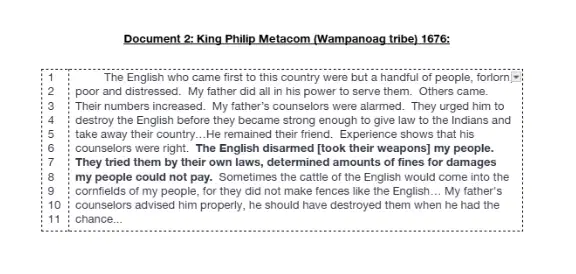
According to lines 6–8, how did English colonists’ laws affect the Wampanoag tribe?
a)
They protected Wampanoag land and rights
b)
They disarmed the Wampanoag and imposed fines they could not pay
c)
They allowed equal legal treatment
d)
They gave the Wampanoag special privileges
6.
What life was like for Native Americans before and after European colonization? How was it similar? How was it different? What specifically changed?
4 lines
7.
In order to grow cash crops such as tobacco and rice, you need year long growing seasons, including plenty of sunshine and humid, rain filled springs and summers. Which colonial region had the highest percentage of exports of cash crops? Choose the best answer
a)
Southern Colonies
b)
Middle Colonies
c)
New England Colonies
8.
Which colonial region do you think was known as the “breadbasket” of the 13 colonies (hint: bread is made from grains so think about which colonial region exported the most grains)?
a)
Southern Colonies
b)
Middle Colonies
c)
New England Colonies
9.
Which colonial region do you think had the most access to rivers, lakes, bays, waterways, and oceans? Choose the best answer on the left and complete the sentence on the right using evidence from one graph.
a)
Southern Colonies
b)
Middle Colonies
c)
New England Colonies
10.
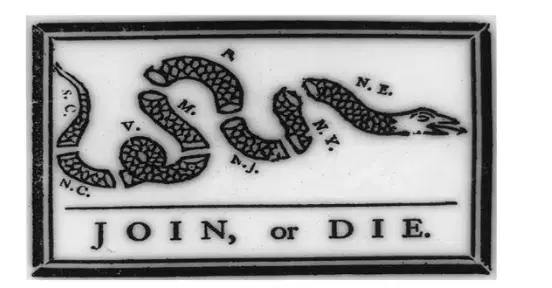
Considering the caption "Join or Die," what might this phrase mean in the context of the colonies?
a)
The colonies should join together or face destruction
b)
The colonies should ignore each other
c)
The colonies should prepare for hunting
d)
The colonies should trade with the French
11.
What caused American colonists in different states to unify as one nation leading up to the French and Indian War?
a)
The threat of French military power and shared dangers on the frontier
b)
Economic competition among colonies
c)
The desire to remain separate
d)
British government demands
12.
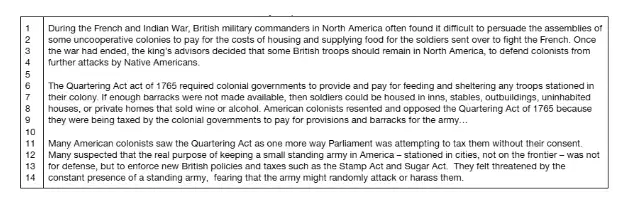
What did the Quartering Act of 1765 require?
a)
Pay no taxes for soldiers
b)
Provide housing and supplies for British troops stationed in the colonies
c)
Join the British army
d)
Build forts for Native Americans
13.
What did some colonists suspect the real purpose of keeping a small standing army in America?
a)
Defend against the French
b)
Enforce British policies and taxes such as the Stamp Act and Sugar Act
c)
Protect Native Americans
d)
Train colonial militias
14.
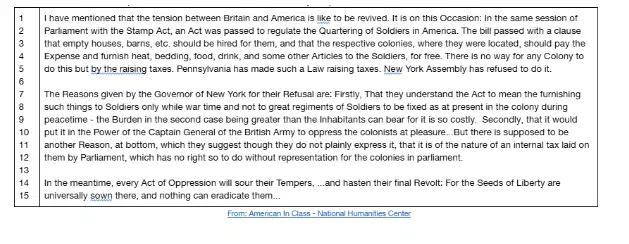
Did all of the colonies agree to pay for the quartering of soldiers?
a)
Yes, all agreed
b)
No, Pennsylvania paid but New York refused
c)
No colonies paid
d)
Only southern colonies paid
15.
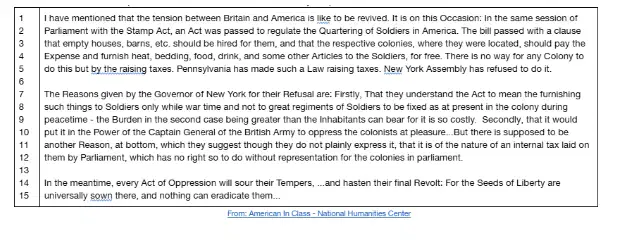
What is the Benjamin Franklin warning will happen at the end of this excerpt?
4 lines
16.
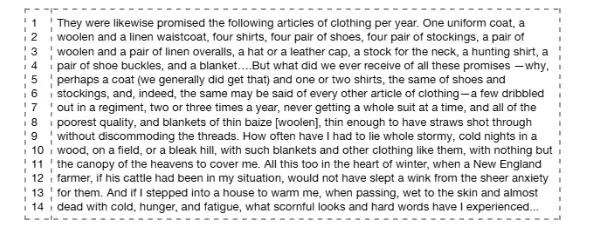
To what extent did the American soldiers receive the clothing that they were promised?
a)
They received all clothing in full and on time
b)
They received a few pieces, mostly poor quality, and never a full suit at once
c)
They received no clothing at all
d)
They received better clothing than promised
17.
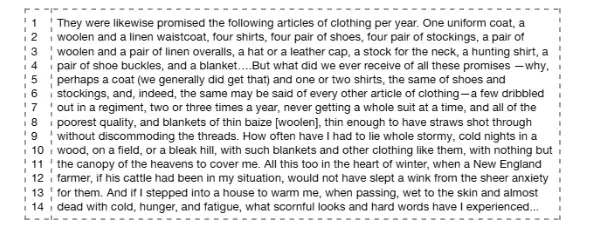
Did the US Congress and US Army keep their promises to the young men who joined the Revolutionary Army? What does this suggest to you about the financial state of America during and after the war?
4 lines
18.
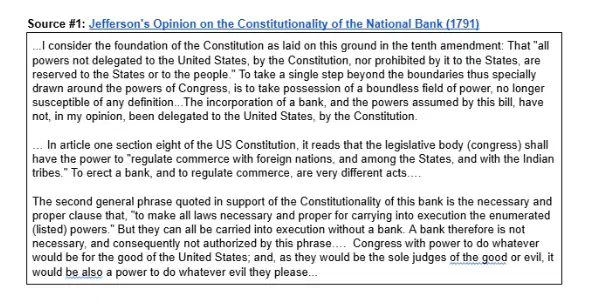
In source #1, what are the three claims Jefferson makes about why the National Bank would be unconstitutional?
a)
It is not delegated to Congress, regulating commerce is different from erecting a bank, and the bank is not necessary under the necessary and proper clause
b)
The Bank would strengthen state governments, it would protect farmers, and it would be fair
c)
The Bank would reduce federal power, increase state taxes, and violate treaties
d)
The Bank is supported by the Constitution, necessary for defense, and benefits all states
19.
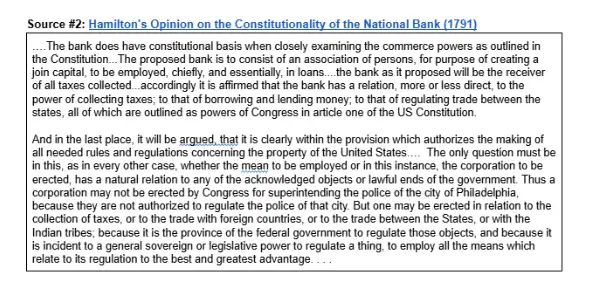
In source #2, what are the two claims Hamilton makes about why the National Bank is constitutional?
a)
It relates to Congress’s power to collect taxes and regulate commerce, and it is necessary to carry out those powers
b)
It violates the Constitution and is unnecessary
c)
It should only regulate state governments
d)
It is unconstitutional but needed anyway
20.
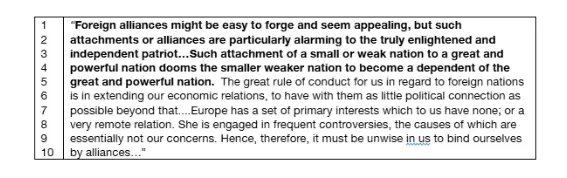
According to lines 1 – 4, does Washington support or argue against forming alliances with other nations? Cite evidence from the text to support your claims.
4 lines
21.
If you had to capture the main idea of the Farewell Address as a whole, what would that main idea be in one or two sentences?
4 lines
22.
Overall, did the United States of America follow George Washington’s suggested pathway?
a)
Yes, fully followed all his advice
b)
Partially followed, but with significant differences in political parties and alliances
c)
No, completely ignored his advice
d)
Not sure
23.
Why do you think Americans might have wanted the lands in the Louisiana Purchase in 1803? What advantages would it give the young nation?
4 lines
24.
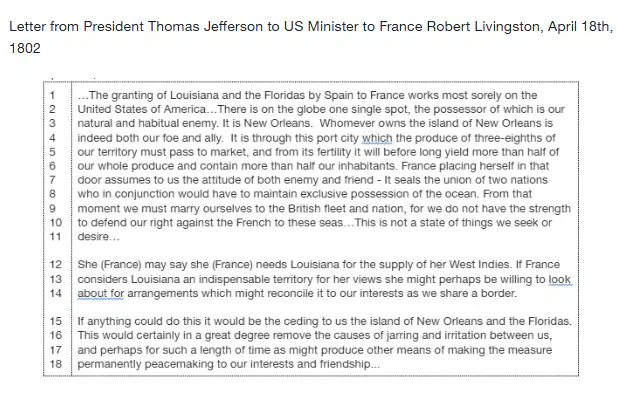
Why is New Orleans and the possession of New Orleans important to the United States according to this document?
a)
It controls trade as the port for much of the US territory’s produce
b)
It is a cultural center
c)
It has many factories
d)
It is a military base
25.
According to this document, which two pieces of land is President Jefferson hoping to acquire from France?
a)
Florida and Texas
b)
New Orleans and Florida
c)
California and Oregon
d)
Louisiana and Canada
26.
What motivated President Jefferson to negotiate the Louisiana Purchase? What was President Jefferson’s vision for the American economy?
4 lines
27.
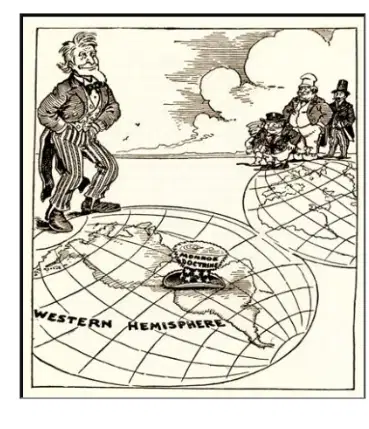
What is the Monroe Doctrine meant to represent according to this cartoon?
a)
European powers could colonize freely
b)
The American continents are no longer open to future colonization by any European power
c)
The US supports European colonization
d)
Colonization is encouraged for mutual benefit
28.
What does the Monroe Doctrine say about American involvement in European affairs?
a)
As friendly and cooperative actions
b)
As neutral events that do not concern the US
c)
As manifestations of unfriendly dispositions toward the United States
d)
As opportunities for trade
29.
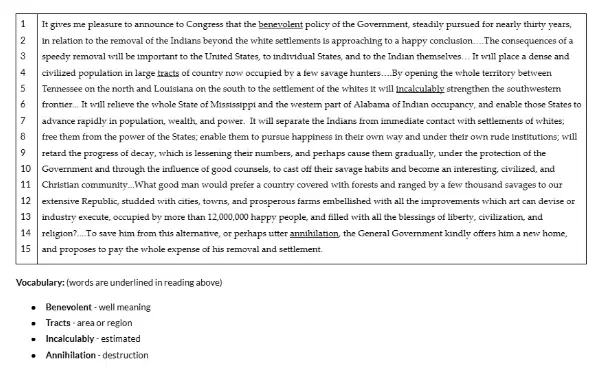
How does Jackson describe Native Americans in his message?
a)
As civilized and fully integrated citizens
b)
As “savage hunters” needing to be civilized
c)
As equal partners in government
d)
As wealthy landowners
30.
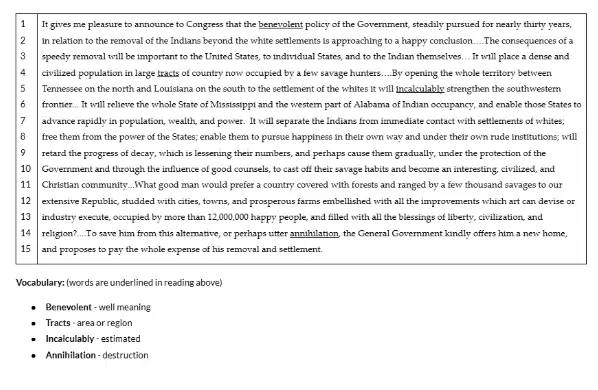
What were the arguments for Indian Removal according to Jackson?
4 lines
31.
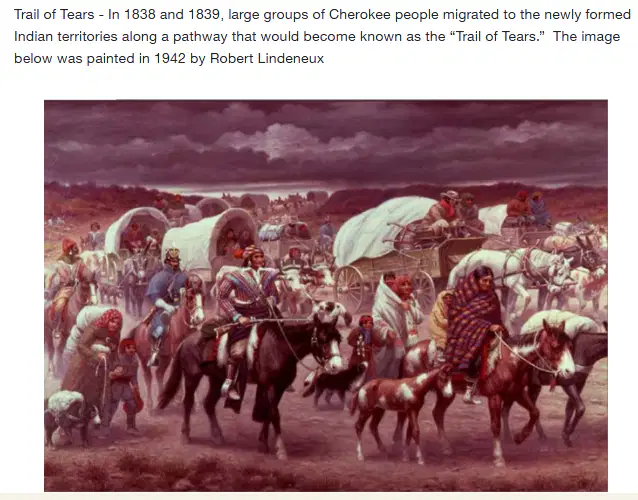
What does the painting of the Trail of Tears depict?
a)
A joyous migration of Native Americans
b)
The hardship and suffering endured by the Cherokee during removal
c)
A battle between Native Americans and settlers
d)
The signing of the Indian Removal Act
32.
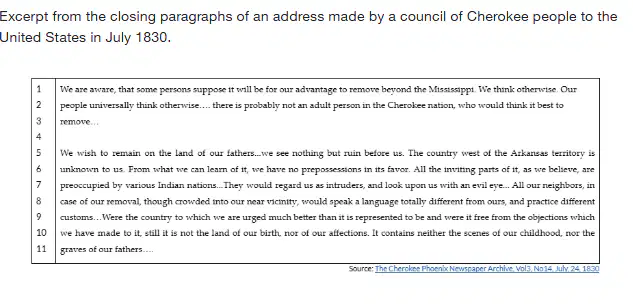
How do the Cherokee people feel about removal according to their council address?
a)
A) They agree it will be beneficial
b)
B) They oppose removal and want to stay on their ancestral lands
c)
C) They are indifferent to removal
d)
D) They want to move voluntarily for better land
33.
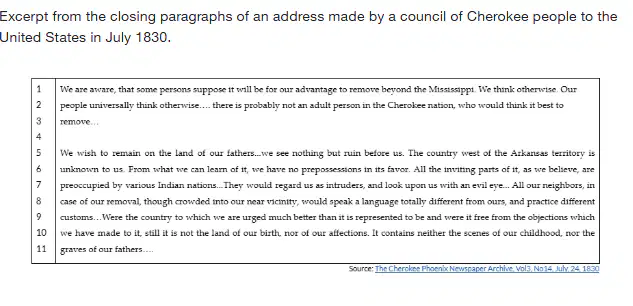
What are two reasons why the Cherokee were fearful of moving to the new lands? Provide evidence from the document to support your claims.
4 lines
34.
The Declaration of Independence boldly proclaimed that "all men are created equal" and guaranteed the rights to "life, liberty, and the pursuit of happiness."
Using the documents provided in this assessment—including Native American perspectives on colonization and land, colonial responses to British policies, experiences of soldiers during the Revolutionary War, debates over early American policies like the National Bank, westward expansion under Jefferson, George Washington’s Farewell Address, the Monroe Doctrine, and the Trail of Tears—write a well-organized response evaluating to what extent the United States lived up to the promises made in the Declaration of Independence during its early years.
4 lines
100 %

